rifanmuazin
Google officially launched its annual developer conference, Google I/O, on May 19, 2026, marking the occasion with a slate of significant announcements that promise to redefine the digital commerce landscape. At the forefront of these innovations is the much-anticipated Universal Cart, a sophisticated agentic commerce and checkout tool designed to streamline the online shopping experience through the power of artificial intelligence. This groundbreaking development builds upon Google’s foundational Universal Commerce Protocol (UCP), a collaborative effort with Shopify aimed at enabling seamless communication between AI agents and e-commerce payment infrastructures.
The introduction of Universal Cart represents a pivotal moment in Google’s strategy to integrate AI more deeply into consumer-facing applications. By leveraging its extensive ecosystem, which includes Google Search, its advanced AI model Gemini, YouTube, and Gmail, Google aims to create a unified and intelligent shopping experience that transcends individual merchant platforms. This initiative signals a strategic shift towards agentic commerce, where AI agents proactively assist users in their purchasing journeys, from discovery and comparison to checkout and post-purchase support.
The Genesis of Universal Cart and the Universal Commerce Protocol
The genesis of Universal Cart lies in the development of the Universal Commerce Protocol (UCP), a technical standard co-created by Google and Shopify. The UCP is engineered to facilitate direct communication between AI agents and the complex web of payment systems that underpin e-commerce transactions. This interoperability is crucial for enabling AI to not only understand product information and user preferences but also to execute transactions securely and efficiently across diverse retail environments.
Vidhya Srinivasan, Vice President and General Manager for Ads and Commerce at Google, articulated the vision behind Universal Cart in a detailed blog post accompanying the announcement. “Universal Cart is an intelligent shopping cart and your new hub for shopping on Google,” Srinivasan stated. “It works across merchants and across services, so you can add things to your cart while you’re browsing Search, chatting with Gemini, watching YouTube or even reading your Gmail.” This statement underscores the ambition to create a persistent, cross-platform shopping companion that adapts to user behavior and context.
The development of UCP and Universal Cart is not an isolated endeavor but rather a strategic move to establish Google as a central orchestrator of the future of e-commerce. By providing the underlying infrastructure and the user-facing application, Google aims to capture a significant share of the growing agentic commerce market. The partnership with Shopify, a leading e-commerce platform provider, further solidifies this ambition, granting access to a vast network of merchants and their customer bases.
Revolutionizing the Shopping Journey: Features and Functionality

Universal Cart is designed to be more than just a digital shopping basket; it’s envisioned as an intelligent assistant that actively enhances the shopping process. One of its most significant capabilities is the ability to aggregate items from multiple retailers into a single, unified cart. This means a shopper could, for instance, add a pair of sneakers from Nike, a skincare product from Ulta Beauty, and a piece of furniture from Wayfair, all without leaving their current Google service.
The AI powering Universal Cart goes beyond simple aggregation. Srinivasan detailed the proactive functionalities: “The moment you add a product to your cart, it gets to work in the background – finding deals and price drops, giving you insights on price history and alerting you when an item is back in stock. It all runs on our Gemini models, so your cart gets even smarter as the models improve.” This implies a dynamic and continuously learning system that aims to optimize for cost savings, availability, and user satisfaction.
Examples of proactive recommendations provided by Universal Cart include identifying potential incompatibilities between computer components added to the cart or suggesting alternative products based on user history and preferences. Crucially, Universal Cart integrates with Google Wallet, leveraging existing user data such as payment method perks, loyalty program memberships, and available merchant offers to inform its recommendations and optimize the checkout process. This integration ensures that users benefit from their established relationships with brands and payment providers.
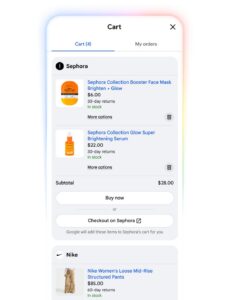
The visual representations of Universal Cart showcased during the Google I/O keynote featured seamless integration with prominent retailers, including Nike, Target, Ulta Beauty, and Wayfair. These examples provided tangible proof of the system’s ability to interface with diverse merchant inventories and checkout flows. The inclusion of these established players, many of whom rank high in e-commerce sales, signals a strong initial adoption and validates the potential of Universal Cart. Nike, for instance, holds a significant position at No. 15 in the Digital Commerce 360 Top 2000 Database, a testament to its substantial online retail presence. Similarly, Target ranks No. 5, Ulta Beauty No. 37, and Wayfair No. 11, highlighting the caliber of partners involved in the initial rollout.
Seamless Payments and Merchant Integration
The efficiency of the checkout process is a critical component of any successful e-commerce tool, and Universal Cart aims to excel in this area. The UCP plays a vital role in facilitating “super smooth” checkouts. Users will have the option to complete purchases directly through Google Pay with participating brands, requiring only a few taps. Alternatively, for merchants that prefer or require it, items can be transferred to the merchant’s own website for final checkout.
This flexibility is designed to accommodate the varied technical capabilities and business models of different retailers. The announcement highlighted an initial list of merchants whose products will soon be available through Universal Cart, including major players like Nike, Sephora, Target, Ulta Beauty, Walmart, and Wayfair. Additionally, Shopify merchants such as Fenty and Steve Madden are part of this early cohort, demonstrating the broad reach of the UCP and its ability to connect with a wide spectrum of online businesses.
The phased rollout strategy indicates a careful approach to scaling the technology. Universal Cart is slated to begin appearing across Google Search and the Gemini app in the United States during the summer of 2026. Following this initial deployment, its integration is expected to expand to YouTube and Gmail, further embedding the AI-powered shopping assistant into users’ daily digital lives. This staggered approach allows Google to gather user feedback, refine the AI models, and address any technical challenges before a wider global release.
Broader Implications for the E-commerce Ecosystem
The introduction of Universal Cart has profound implications for consumers, retailers, and the broader e-commerce industry. For consumers, it promises a more convenient, personalized, and potentially cost-effective shopping experience. The ability to manage purchases across multiple platforms from a single intelligent hub reduces friction and enhances discoverability. The AI-driven insights and proactive assistance can empower shoppers to make more informed decisions and secure better deals.
For retailers, Universal Cart presents both opportunities and challenges. On one hand, it offers a new channel to reach consumers, potentially increasing sales volume and customer engagement. By integrating with Universal Cart, merchants can tap into Google’s vast user base and leverage AI to understand customer behavior more deeply. The UCP’s ability to streamline checkout processes can also lead to reduced cart abandonment rates.
However, the rise of a centralized shopping cart managed by a third party like Google also raises questions about data ownership, merchant autonomy, and competition. Retailers will need to adapt to new integration standards and potentially share customer data with Google, albeit in anonymized or aggregated forms. The long-term impact on brand-customer relationships and the potential for Google to exert greater influence over pricing and promotions will be closely watched by industry analysts.
The Future of Agentic Commerce
Google’s foray into agentic commerce with Universal Cart is a significant step towards realizing the full potential of AI in everyday transactions. The underlying UCP, developed in collaboration with Shopify, sets a precedent for industry-wide standardization, which could accelerate the adoption of AI-driven commerce solutions. As AI models like Gemini continue to evolve, the capabilities of tools like Universal Cart will undoubtedly expand, offering increasingly sophisticated assistance and personalization.
The success of Universal Cart will depend not only on its technological prowess but also on its ability to build trust with both consumers and merchants. Transparency in data usage, robust security measures, and clear value propositions for all stakeholders will be critical. As Google continues to weave AI into the fabric of its services, Universal Cart stands as a testament to its ambition to shape the future of how we shop, interact with brands, and manage our digital lives. The coming months will reveal the true impact of this ambitious initiative as it rolls out across the U.S. and beyond.