rifanmuazin
In a significant development for e-commerce merchants navigating the increasingly complex landscape of artificial intelligence, Yoast SEO for Shopify has unveiled its innovative llms.txt feature. This new tool is designed to bridge the critical gap between vast product catalogs and the often-imprecise information relayed by generative AI platforms like ChatGPT and Google Gemini. The primary objective is to empower businesses to proactively guide AI tools, ensuring accurate, up-to-date, and brand-consistent descriptions of their products and services reach potential customers.
The rapid proliferation of large language models (LLMs) has fundamentally altered how consumers discover and interact with brands online. What was once primarily a search engine-driven journey is now often augmented or even initiated by AI assistants that synthesize information from across the web. While these AI tools offer unprecedented convenience, their ability to accurately represent specific product details or brand narratives has been a growing concern for online retailers. Unlike traditional search engine crawlers that systematically index entire websites, AI models often “grab what they can find, quickly, and fill in the gaps,” leading to a host of problems. For stores with extensive inventories, this can manifest as incomplete product descriptions, outdated pricing or availability information, or, perhaps most detrimentally, misdirection of potential customers to competitor sites when the AI struggles to find definitive answers.
The introduction of llms.txt by Yoast SEO for Shopify directly addresses these challenges. Conceived as a digital “store guide” for AI, this feature creates a dedicated file that explicitly informs AI tools which parts of an online store are most crucial. This includes top-selling products, key collections, essential policy pages (such as shipping, returns, and privacy), and other critical informational pages. Rather than allowing AI to indiscriminately wander through a website and potentially misinterpret or omit vital details, llms.txt provides a structured, prioritized roadmap.
The Evolution of AI in E-commerce and the Need for Precision
The past few years have witnessed an unprecedented surge in the adoption of generative AI, with platforms like ChatGPT quickly becoming household names. According to various industry reports, consumer interaction with AI chatbots for product research, recommendations, and customer service is projected to grow exponentially. A 2023 study by Salesforce indicated that 67% of consumers believe AI will improve their online shopping experience, yet a significant portion also expressed concerns about the accuracy of AI-generated information. This dual reality underscores the urgent need for mechanisms that ensure AI tools are fed reliable, authoritative data directly from the source.
Historically, websites have used robots.txt to instruct search engine crawlers about which parts of a site not to index. While conceptually similar in its role as a directive, llms.txt operates with a different intent: to explicitly highlight and prioritize specific content for AI understanding, rather than restricting access. This distinction is crucial in an era where AI doesn’t just index, but actively interprets, summarizes, and generates new content based on its ingested data. Without a clear guide, the risk of “AI hallucinations”—where AI fabricates or misrepresents information—becomes a tangible threat to brand integrity and customer trust.
Yoast, a long-standing leader in search engine optimization, has consistently adapted its tools to meet the evolving demands of the digital landscape. From optimizing for traditional keyword searches to embracing structured data and mobile-first indexing, the company’s trajectory reflects a commitment to helping websites achieve maximum visibility and accuracy. The development of llms.txt is a natural extension of this mission, recognizing that AI-driven discovery is now an inseparable component of a comprehensive SEO strategy.
Functionality and Implementation: A Tailored Approach for Merchants
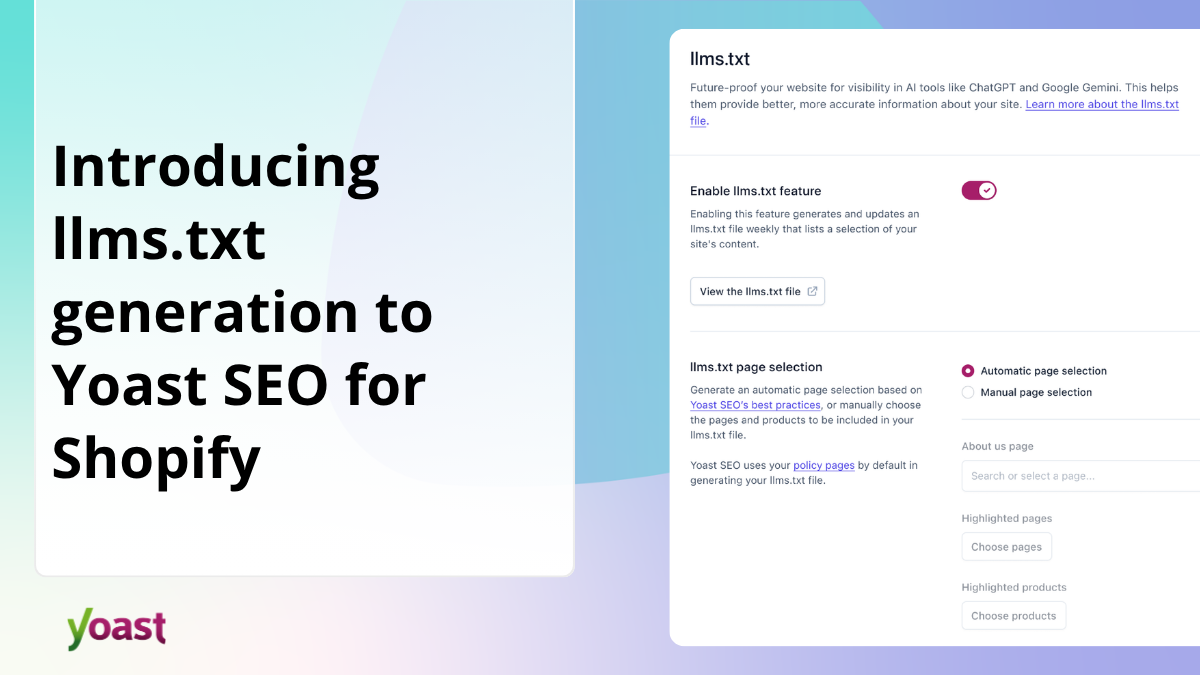
The core functionality of llms.txt is deceptively simple, yet profoundly impactful. Once activated within the Yoast SEO for Shopify settings, the feature automatically generates and maintains a file that communicates directly with AI models. This file acts as a curated sitemap, directing AI to the most relevant and authoritative content on an e-commerce store.
Merchants are offered two distinct modes of operation, providing flexibility based on their specific needs and desired level of control:
-
Automatic Handling by Yoast: For businesses seeking a hands-off approach, Yoast SEO can automatically build and update the
llms.txtfile on a weekly basis, leveraging existing Shopify data. In this mode, the system intelligently identifies and prioritizes:- Best-selling products: Ensuring that popular items with proven appeal are accurately represented.
- Newest products: Promptly informing AI about recent additions to the catalog.
- Highest-rated products: Highlighting items that have garnered positive customer feedback, building trust.
- Featured collections: Directing AI to curated product groupings that are strategically important.
- Key store policies: Such as shipping information, return policies, and privacy statements, which are crucial for customer confidence and compliance.
This automatic approach is ideal for merchants with dynamic inventories or those who prefer to focus their efforts elsewhere, confident that their most important content is consistently prioritized for AI.
-
Manual Selection for Granular Control: For merchants who require precise control over what AI tools prioritize, Yoast SEO offers a manual selection option. This mode allows users to hand-pick specific products, collections, and pages they wish to feature prominently in the
llms.txtfile. A dedicated section also allows for the explicit inclusion of the “About Us” page, ensuring that the brand’s unique story, mission, and values are accurately conveyed to AI, fostering a deeper connection with potential customers. This level of customization is particularly valuable for businesses running specific promotions, launching hero products, or wanting to emphasize particular brand narratives.
Regardless of the chosen mode, the llms.txt file is updated weekly to reflect any changes in the store’s catalog, including the automatic removal of deleted products. This ensures that the information provided to AI tools remains current and prevents the dissemination of outdated product details.
Technical Simplicity and Strategic Imperative
One of the most compelling aspects of the llms.txt feature is its accessibility. Yoast has engineered the solution to be entirely non-technical, eliminating the need for complex code editing or specialized development knowledge. Any member of a merchant’s team can activate the feature in seconds through the intuitive Yoast SEO for Shopify settings. This ease of implementation democratizes control over AI content representation, making it available to small businesses and large enterprises alike. Furthermore, Yoast has incorporated safeguards; if a merchant already has a redirect set up for /llms.txt, the system will respect it and provide a notification, preventing any disruption to existing configurations.
The decision to make llms.txt an opt-in feature reflects Yoast’s philosophy of empowering merchants. In an era where AI increasingly mediates how consumers discover and interact with products, Yoast believes that every merchant should have a direct say in how their content is perceived and utilized by these powerful new tools. This opt-in approach aligns with a broader industry discussion around content ownership, fair use, and the ethical implications of AI training data. By actively choosing to implement llms.txt, merchants are making a conscious decision to assert control over their brand narrative in the AI ecosystem.
Broader Implications for E-commerce and SEO
The introduction of llms.txt carries significant implications for the future of e-commerce and the evolving discipline of SEO.
For e-commerce merchants, the direct benefits are substantial:
- Enhanced Brand Accuracy: Minimizing the risk of AI misrepresenting products, pricing, or brand messaging.
- Improved Customer Experience: Shoppers receive accurate and consistent information, leading to higher satisfaction and reduced friction in the buying journey.
- Increased Conversion Rates: Accurate product descriptions and policy details build trust, which is a critical factor in purchase decisions.
- Competitive Advantage: Early adopters can ensure their brand stands out in AI-driven discovery, potentially gaining an edge over competitors whose information may be less precisely conveyed.
- Streamlined Operations: Reduced instances of customer service queries stemming from AI-generated misinformation.
For the SEO industry, llms.txt signifies a new frontier. Just as robots.txt and sitemaps became standard tools for search engine optimization, llms.txt could emerge as a foundational element for “AI optimization.” SEO professionals will need to incorporate strategies for guiding AI models, adding a new dimension to their expertise. It also highlights the ongoing shift from optimizing for search engines to optimizing for user intent, regardless of the interface (be it a traditional search bar or an AI chatbot).
From a consumer perspective, this development promises a more reliable and trustworthy online shopping experience. As AI becomes more integrated into daily life, the assurance that product information is directly sanctioned and prioritized by the brand itself will be invaluable.
Expert and Stakeholder Perspectives
Beth Parker, Product Marketing Manager at Yoast, whose insights were foundational to the feature’s announcement, emphasized the strategic importance: “We’ve seen the incredible potential of AI, but also the challenges it poses for maintaining brand integrity. llms.txt is about giving control back to the merchants. It’s about ensuring their hard-earned product catalogs are accurately represented, not just for search engines, but for the next generation of discovery tools.”
Industry analysts and e-commerce consultants have also weighed in on the significance. “The ability to directly influence how AI perceives and presents your products is no longer a luxury; it’s rapidly becoming a necessity,” states Dr. Evelyn Reed, a prominent e-commerce strategist. “As more consumers rely on AI for product discovery, businesses that proactively guide these models will build stronger brand recognition and trust. This move by Yoast positions Shopify merchants at the forefront of AI readiness.” Small business owners, often stretched thin, are particularly receptive. “Dealing with inaccurate descriptions from AI tools has been a headache,” remarked Sarah Chen, owner of a boutique artisan shop on Shopify. “Knowing that Yoast is handling this automatically for me, or letting me choose what’s most important, is a huge relief. It means my products are seen accurately, which is critical for my small business.”
A Look Ahead: Shaping the Future of Online Commerce
The llms.txt feature from Yoast SEO for Shopify represents more than just a new tool; it signifies a proactive step towards shaping a more accurate and controlled future for online commerce in the age of AI. As AI continues to evolve and integrate further into every aspect of digital life, the ability for businesses to communicate directly and authoritatively with these systems will become paramount.
By empowering merchants to define their narrative for AI, Yoast is not only solving an immediate pain point but also laying groundwork for future interactions between businesses and intelligent systems. It underscores the belief that while AI offers immense possibilities, human oversight and brand control remain indispensable. Merchants are encouraged to explore this new capability by logging into their Shopify stores and activating the llms.txt toggle within their Yoast SEO settings, taking a decisive step towards mastering their brand’s presence in the AI-driven digital realm.