The burgeoning landscape of artificial intelligence advertising is rapidly evolving, and a recent test conducted by PPC Hero offers a granular look into the nascent advertising capabilities within ChatGPT. With ChatGPT boasting over 800 million monthly active users – a figure representing nearly 10% of the global population – and processing approximately two billion prompts daily, the platform has become a significant nexus for user research and product discovery. This surge in AI assistant usage, with roughly 70% of all AI assistant traffic originating from ChatGPT, signifies a pivotal shift in consumer behavior. A substantial 63% of users turn to AI for research and discovery, while 53% leverage it for product and price comparisons. This migration of the "consideration" phase into a domain previously inaccessible to brands underscores the critical question for advertisers: not if they should be present, but how the advertising format functions once implemented.
The implications of this shift are profound. Historically, advertising channels have been meticulously segmented, allowing for precise targeting and measurable outcomes. However, AI interfaces like ChatGPT present a fundamentally different paradigm. Users are engaging with AI in a conversational, often exploratory, manner, seeking information and solutions rather than actively browsing for products. This necessitates a re-evaluation of how brands can insert themselves into these interactions without disrupting the user experience or appearing intrusive. The data from PPC Hero’s testing suggests that early adopters are grappling with these nuances, seeking to understand the efficacy and potential of this new advertising frontier.
Understanding the ChatGPT Ad Unit and Targeting Mechanism
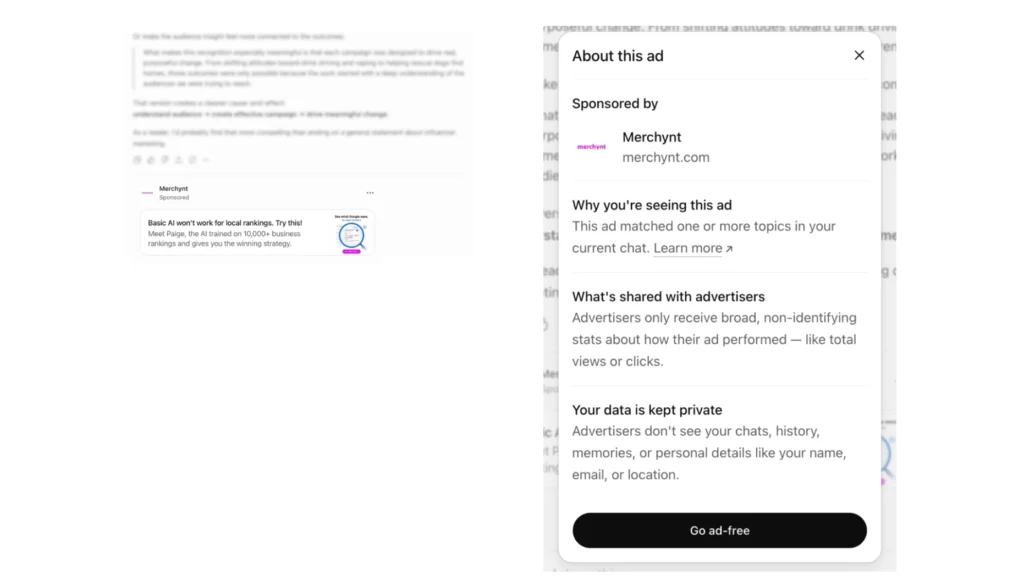
The advertising unit within ChatGPT is positioned directly beneath the AI’s generated response, clearly demarcated by a "Sponsored" label. This ad format is characterized by a single 1:1 image, a concise headline, a brief descriptive text, and a direct click-through link to the advertiser’s website. While this presentation appears straightforward, the underlying targeting mechanism is a key area where advertiser expectations may diverge from reality.
PPC Hero’s analysis reveals that the targeting employed is considerably more rudimentary than what many buyers might anticipate. The system operates on a purely contextual basis, directly correlating ad display with the user’s prompt rather than the AI’s generated response. Crucially, there is no inherent audience segmentation, demographic overlay, or granular geographic control. The sole determinant for an ad’s appearance is its relevance to the user’s query. This contextual alignment is the cornerstone of the ad delivery system, meaning that advertisers must ensure their messaging resonates with the specific keywords and intent embedded within the user’s prompt.
This approach to targeting, while seemingly limited, is a significant factor in managing advertising costs. The reliance on prompt relevance as the primary driver for ad visibility suggests a system designed to connect users with relevant sponsored content precisely when they are expressing a need or interest. For advertisers, this means a heightened emphasis on crafting highly specific and contextually appropriate ad creatives. A generic approach is unlikely to yield optimal results, as the AI’s algorithm is designed to prioritize relevance above all else. The lack of demographic or behavioral targeting, while a departure from traditional digital advertising, may also be seen as a privacy-conscious approach, aligning with broader trends towards user data protection.
The Role of Precision in Cost Efficiency
The pricing structure within ChatGPT advertising is a critical element that warrants detailed examination, as PPC Hero’s testing has significantly shaped their understanding of this emerging channel. OpenAI utilizes an opaque relevancy model that operates atop a proto-auction system. In practice, this dual mechanism results in two distinct pricing tiers. For niche prompts with minimal competitive bidding, the cost per mille (CPM) can be as low as $15. However, for highly contested prompts where multiple advertisers vie for visibility, the CPM can escalate to approximately $60.
Across various brands and campaigns, PPC Hero observed CPMs generally falling within the $25 to $35 range, with their own testing yielding figures closer to $40. This data consistently points to a clear pattern: the more precisely an advertiser’s creative content aligns with the user’s prompt, the greater the cost efficiency. This inverse relationship between creative relevance and CPM underscores the importance of strategic campaign development. Advertisers who invest time in understanding user prompt patterns and tailoring their ad copy and imagery accordingly are likely to achieve more favorable cost-per-click (CPC) and CPM rates.

The recommendation from PPC Hero is to steer clear of bidding on a cost-per-click (CPC) basis within this environment. The underlying methodology for CPC calculation is deemed too opaque to warrant confidence. Instead, the testing suggests that bidding on a CPM basis and allowing clicks to naturally accrue has resulted in a more effective CPC. This strategy leverages the platform’s contextual targeting to ensure that impressions are delivered to relevant audiences, with the assumption that genuine interest will translate into clicks. By focusing on impression quality and contextual relevance, advertisers can potentially drive higher-quality traffic at a more predictable cost.
The observed pricing model also hints at the platform’s developmental stage. As the ad platform matures and competition intensifies, it is reasonable to anticipate shifts in pricing dynamics. However, the current structure rewards strategic precision, making it an opportune time for advertisers to experiment and refine their approach to maximize value. The insight that tighter creative-prompt mapping leads to better efficiency is a crucial takeaway for any advertiser considering this channel.
Navigating the Measurement Challenge
A significant hurdle advertisers currently face in the ChatGPT advertising ecosystem is the limited measurement capabilities. At present, the platform primarily provides data on impressions and clicks, with minimal additional performance metrics. A notable absence is conversion optimization, meaning advertisers cannot directly instruct the platform to prioritize specific desired outcomes or chase conversions.
This limitation necessitates a strategic approach to measurement. Advertisers must focus on measuring the "knock-on effects" of clicks originating from ChatGPT. This involves a critical evaluation: do users who arrive on a website from ChatGPT exhibit a higher intent compared to those arriving from other channels such as native ads, display, video, social media, or search? This intent can be gauged by their subsequent on-site behavior.
Sharing pixel and conversion data with advertising partners is instrumental in this process. Early indicators from PPC Hero’s testing are encouraging, with click-through rates (CTRs) comparable to those of native ads. This is a strong signal, especially considering the nascent stage of the ChatGPT advertising format. The practical implication for advertisers is the imperative to establish a robust evaluation framework before deploying campaigns. This framework should clearly define how user intent from ChatGPT will be compared against website behavior generated from all other advertising channels.
Developing this framework involves defining key performance indicators (KPIs) beyond simple clicks. This could include metrics like time on site, pages per session, bounce rate, and, most importantly, downstream conversion events (e.g., form submissions, purchases) that occur after the initial click. By setting clear benchmarks and measurement methodologies upfront, advertisers can objectively assess the true value and ROI of their ChatGPT advertising efforts. The absence of direct conversion optimization places a greater onus on the advertiser to attribute and analyze performance using their own analytics and attribution models.
Pathways to Advertising on ChatGPT and Associated Costs
Advertisers have three primary avenues to access the advertising inventory within ChatGPT, with the optimal choice contingent upon their specific campaign objectives.
-
Criteo: This platform is particularly well-suited for commerce-focused campaigns. Criteo possesses the capability to ingest product feeds, making it an ideal solution for Consumer Packaged Goods (CPG) and retail brands. This integration allows for the simultaneous activation of thousands of ads, catering to large product catalogs. The estimated monthly investment for utilizing Criteo’s services for ChatGPT advertising ranges from $50,000 to $100,000. This tier is designed for businesses with significant product offerings and a need for broad reach within e-commerce contexts.

-
StackAdapt: For advertisers seeking a balance of features and flexibility, StackAdapt emerges as a viable option. Their offering for ChatGPT advertising is priced at approximately $50,000 per month. StackAdapt distinguishes itself by incorporating certain incentives and geo-targeting capabilities, providing a slightly more nuanced approach to campaign deployment than purely contextual targeting. This option may appeal to brands looking for more refined control over their ad placements without the highest investment thresholds.
-
Direct to OpenAI: For enterprises with substantial advertising budgets and a strategic imperative to be at the forefront of AI advertising, direct engagement with OpenAI is a possibility. However, this route comes with a significant minimum investment, sitting at around $250,000 per month. This direct channel likely offers greater access to platform insights and potentially more bespoke campaign management, but it is reserved for organizations with a high-stakes commitment to this emerging advertising space.
The current understanding of the ChatGPT advertising format’s optimal use cases is still evolving. Beyond its capacity to reach users in a heightened state of consideration, the precise applications are being explored. Therefore, it is crucial for advertisers to first clarify two fundamental aspects: how they intend to guide users to their website upon clicking an ad, and how they will measure the subsequent impact of these visits on their business objectives. These answers should dictate the budget allocation, rather than the other way around. A strategic approach that prioritizes clear goals and measurable outcomes will be more effective than simply allocating a budget based on available options.
Synthesizing the Findings: The Future of AI Advertising
The advertising format within ChatGPT is undeniably young, characterized by crude targeting mechanisms and nascent measurement capabilities. Despite these limitations, PPC Hero’s testing demonstrates that the channel is functional and capable of delivering results. The inexorable shift of user consideration into AI interfaces means that brands must engage, whether they feel fully prepared or not.
Observing the evolution of programmatic advertising provides a predictable roadmap for what lies ahead. Audience targeting is an almost certain development, given OpenAI’s extensive user data and inherent incentives to leverage it. Conversion optimization will inevitably follow, empowering advertisers to drive specific actions. As more brands enter the space, competition will intensify, leading to increased CPMs. The auction system is expected to become more transparent, gradually resembling the established channels advertisers are already familiar with.
Brands that actively test and engage with this channel now will gain a significant advantage as it matures. This head start becomes particularly valuable as costs inevitably rise and competition intensifies, narrowing the performance gap between early adopters and latecomers. The current environment, while imperfect, offers a unique opportunity to experiment, learn, and establish a foundational presence before the landscape becomes more saturated and standardized. The ability to gather early insights into user behavior and creative effectiveness within this novel context will be a critical differentiator in the long term. The journey from rudimentary contextual targeting to sophisticated AI-driven advertising campaigns is already underway, and those who adapt quickly will be best positioned to capitalize on the future of digital marketing.