Muslim
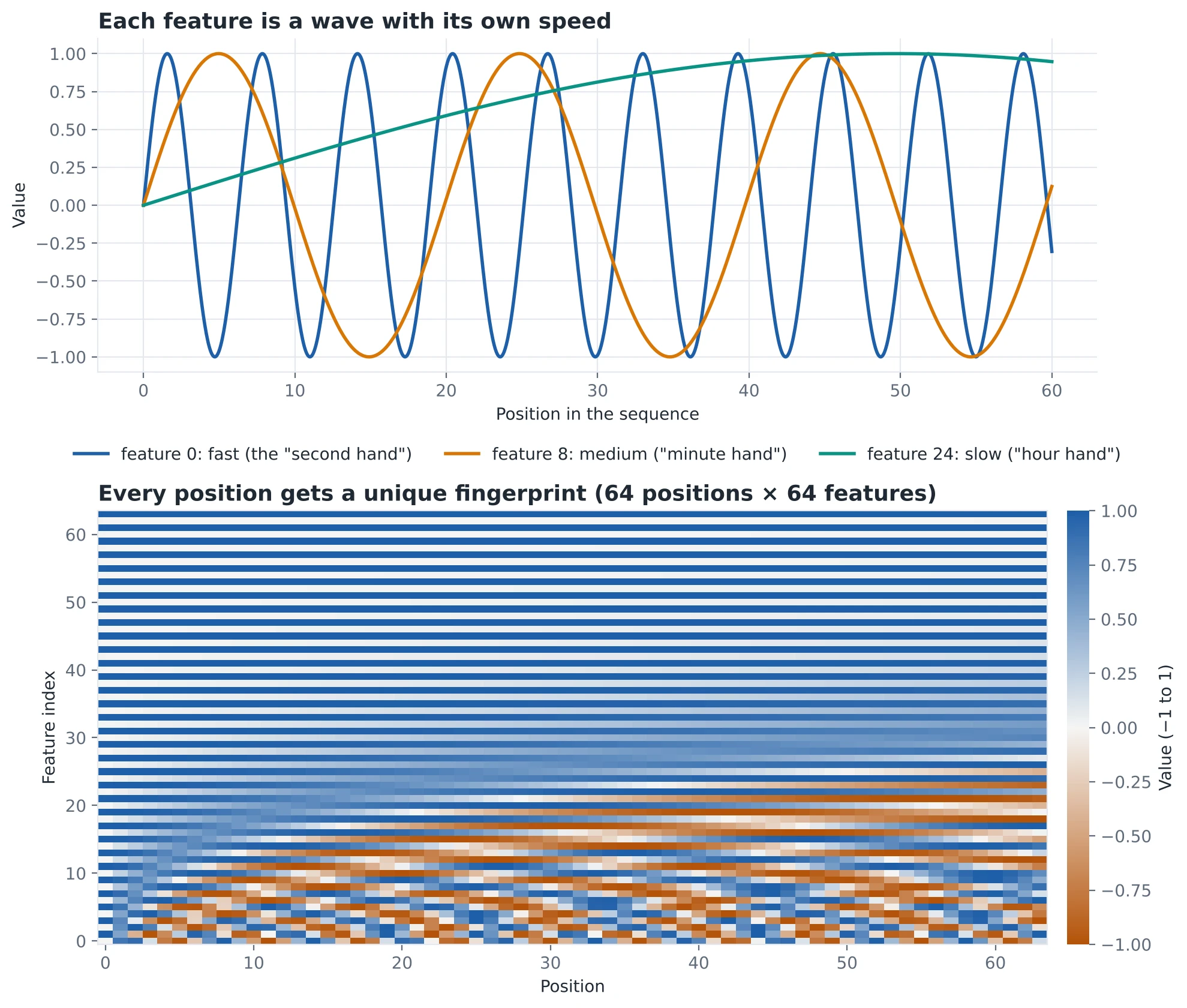
The architecture of the modern transformer, the engine behind virtually every leading large language model (LLM) from GPT-4 to LLaMA, possesses a fundamental structural quirk: it is naturally "position-blind." In the realm of natural language processing, the difference between the sentences "The dog hunted the fox" and "The fox hunted the dog" is categorical, yet a raw transformer treats both as an identical collection of tokens. To bridge this gap, researchers developed positional embeddings—a critical component that informs models of the specific order and proximity of words within a sequence. Without these mathematical markers, a language model perceives a prompt not as a coherent narrative or instruction, but merely as an unordered "bag of words."
As the industry pushes toward longer context windows and more sophisticated reasoning capabilities, the methods used to encode position have undergone a rapid evolution. From the learned absolute embeddings of the early GPT era to the complex rotary mathematics currently dominating the field, the history of positional encoding reflects the broader trajectory of artificial intelligence research: a shift from static, rigid structures to fluid, relative, and computationally efficient systems.
The Mathematical Necessity of Positional Data
The central innovation of the transformer, as introduced in the seminal 2017 paper "Attention is All You Need," is the self-attention mechanism. This mechanism allows every token in a sequence to look at every other token to determine relevance. However, the operation that powers this—the dot product of vectors—is permutation-invariant. Mathematically, the dot product of two vectors remains the same regardless of where those vectors appear in a sequence.
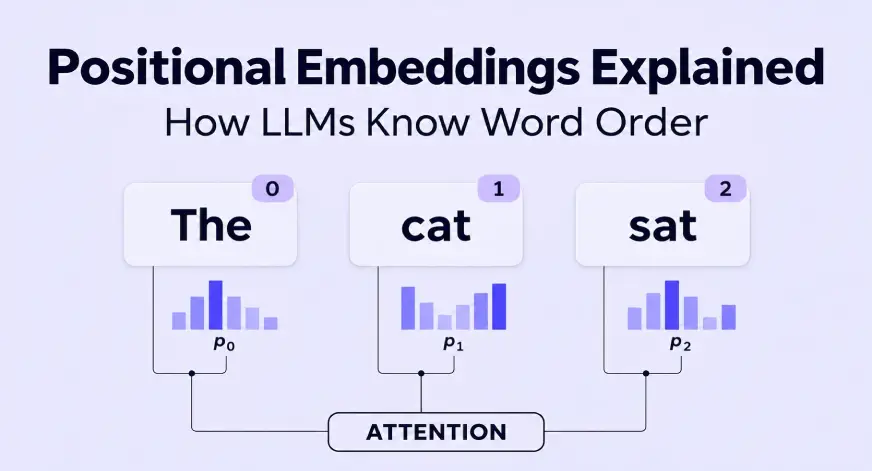
Consider a digital group chat without timestamps. A user can read every message sent, but without the chronological metadata of when each message arrived, the context of the conversation is lost. In a transformer, the self-attention mechanism functions similarly. When a model processes a sentence, it calculates attention scores between tokens based on their semantic values. If the word "fox" appears at the beginning of a sentence as the subject and "dog" appears at the end as the object, the attention mechanism, in its raw form, cannot distinguish their roles based on position alone.
Technical testing demonstrates this limitation clearly. In experiments where word embeddings are processed through a standard attention head without positional data, the resulting representation for a specific word remains identical even if its position in the sentence is swapped. This failure to distinguish word order necessitates an external signal—a positional embedding—that is added to or integrated with the token embeddings before they enter the attention layers.
The Chronology of Positional Encoding Methods
The development of positional encoding can be categorized into three distinct eras, each addressing the limitations of its predecessor while introducing new capabilities for handling longer and more complex sequences.
Phase 1: Learned Absolute Positional Embeddings (The GPT-2 Era)
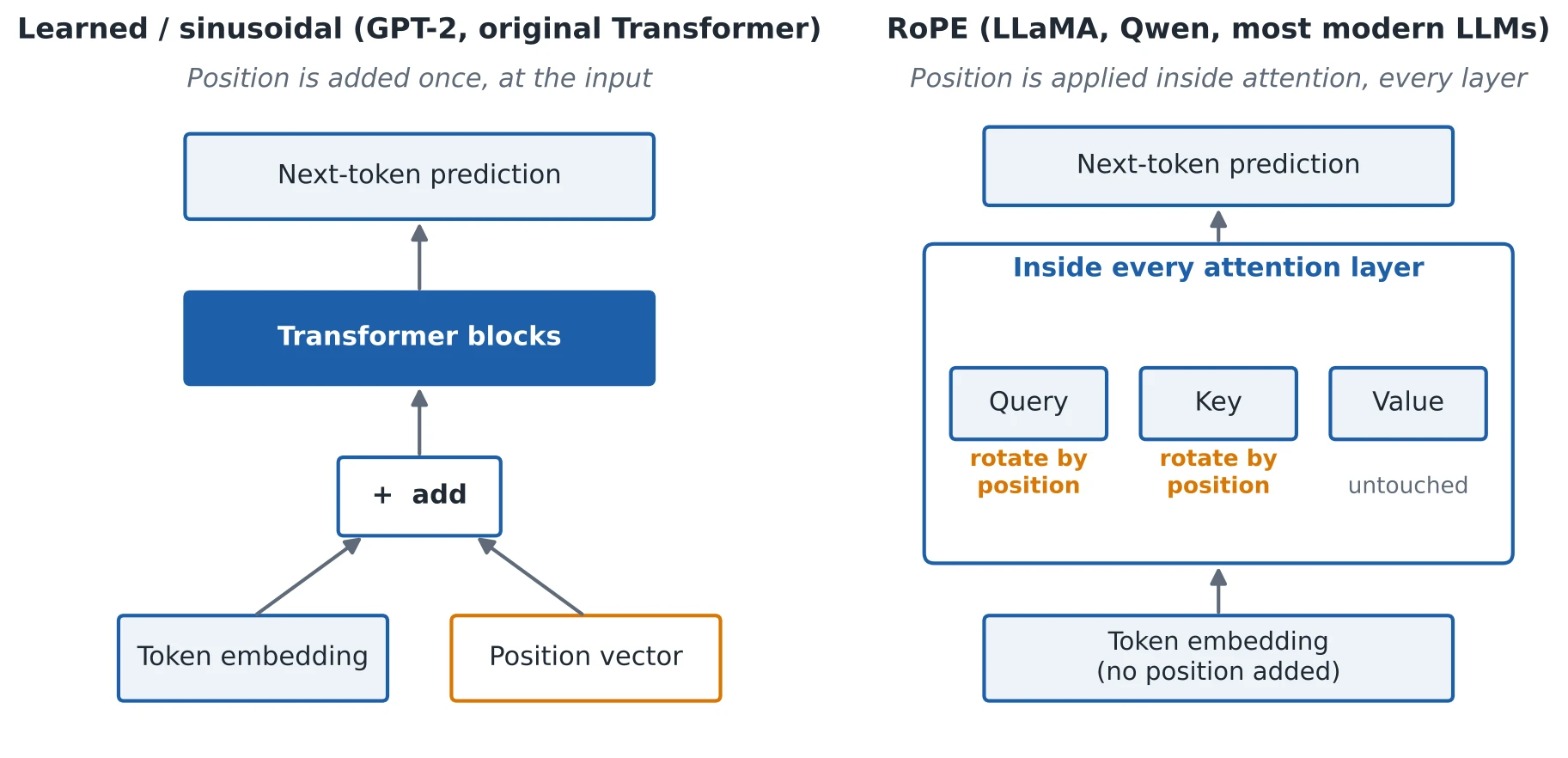
The earliest widespread solution, utilized by models like GPT-2 and BERT, involved learned absolute positional embeddings. In this approach, every specific position in a sequence (e.g., position 1, position 2, position 3) is assigned a unique, trainable vector. These vectors are learned during the training phase, much like the word embeddings themselves.
To process a sequence, the model simply adds the vector for "Position 1" to the first word’s embedding, the "Position 2" vector to the second, and so on. This provides the model with a clear "map" of where each word sits. However, this method suffers from significant scalability issues. Because the vectors are learned for specific slots, the model is physically limited by its training data. If a model is trained with a context window of 1,024 tokens, it has no mathematical concept of what "Position 1,025" looks like.
Furthermore, the cost of storing these embeddings scales poorly. In a GPT-2 Medium model with a 1,024-token context, positional weights account for roughly 0.3% of the model’s parameters. However, as context windows expand toward 100,000 tokens or more, these static tables could grow to occupy more than 20% of the model’s total parameter count, creating a massive memory overhead for data that is essentially just a coordinate system.
Phase 2: Sinusoidal Positional Encoding (The Original Transformer)
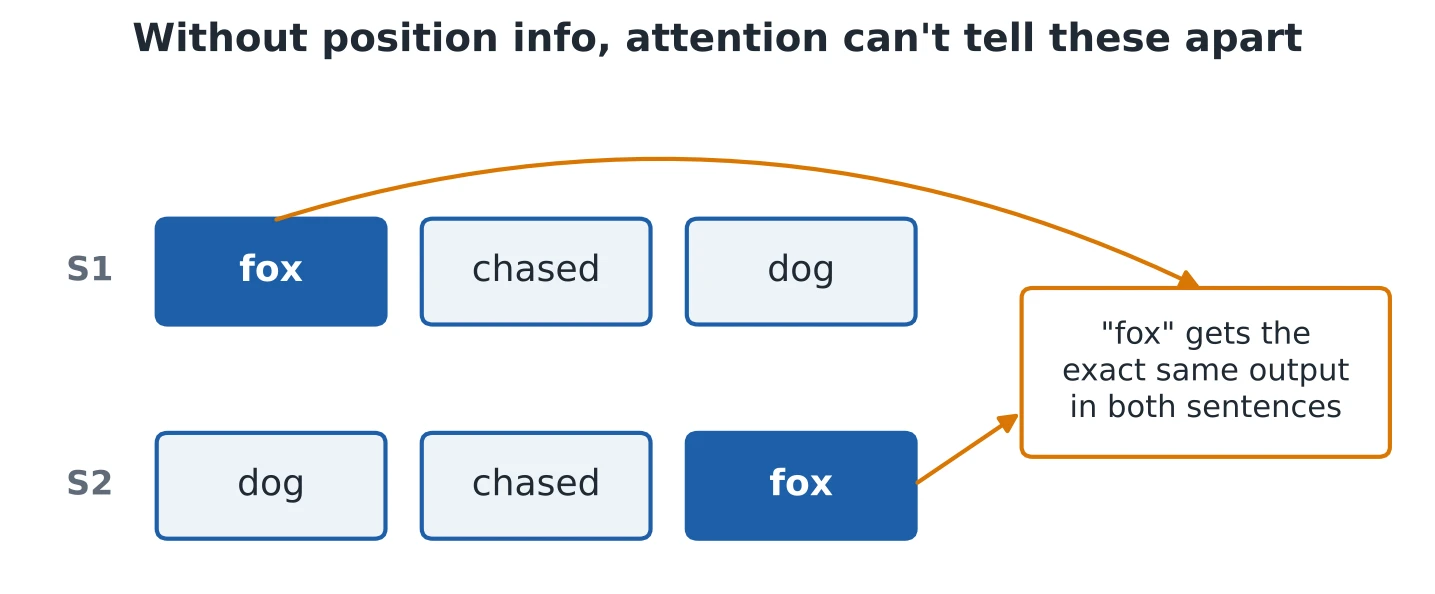
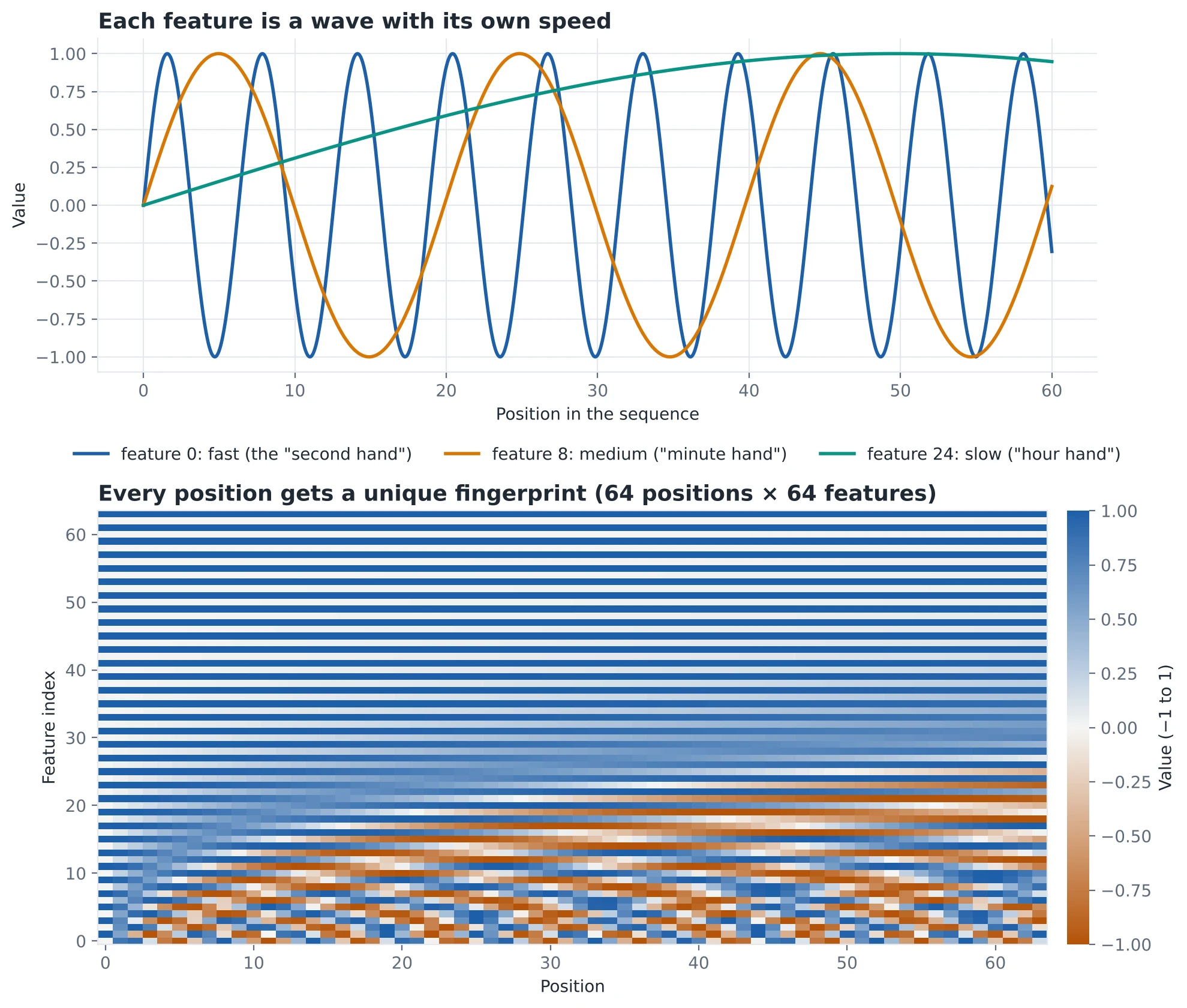
Seeking a more elegant solution, the authors of the original Transformer paper proposed Sinusoidal Positional Encoding. Rather than learning a table of vectors, this method uses fixed mathematical functions—specifically sine and cosine waves of different frequencies—to generate positional signatures.
This approach uses a "clock hand" analogy. Imagine a watch with three hands: one for seconds, one for minutes, and one for hours. The seconds hand moves rapidly, the minutes hand moves moderately, and the hours hand moves slowly. By looking at the positions of all three hands simultaneously, one can determine the exact time. Sinusoidal encoding applies this to vectors; some dimensions of the positional vector fluctuate rapidly across positions, while others change very slowly.
The primary advantage of this method is that it requires zero learned parameters and is, in theory, extensible to sequences longer than those seen during training. However, while it provided a better sense of relative distance than absolute embeddings, it still struggled to maintain high performance when models were pushed far beyond their original training lengths.
Phase 3: Rotary Position Embeddings (The Modern Standard)
The current state-of-the-art method, known as Rotary Position Embeddings (RoPE), was introduced in 2021 through the RoFormer paper. It has since been adopted by nearly all major modern LLMs, including LLaMA, Mistral, and Qwen.
Unlike previous methods that add a vector to the input embedding at the start of the model, RoPE operates within the attention mechanism itself. It works by rotating the "Query" and "Key" vectors in a high-dimensional space. The amount of rotation is determined by the token’s position. For example, a token at position 1 might be rotated by a small angle, while a token at position 10 is rotated ten times as much.
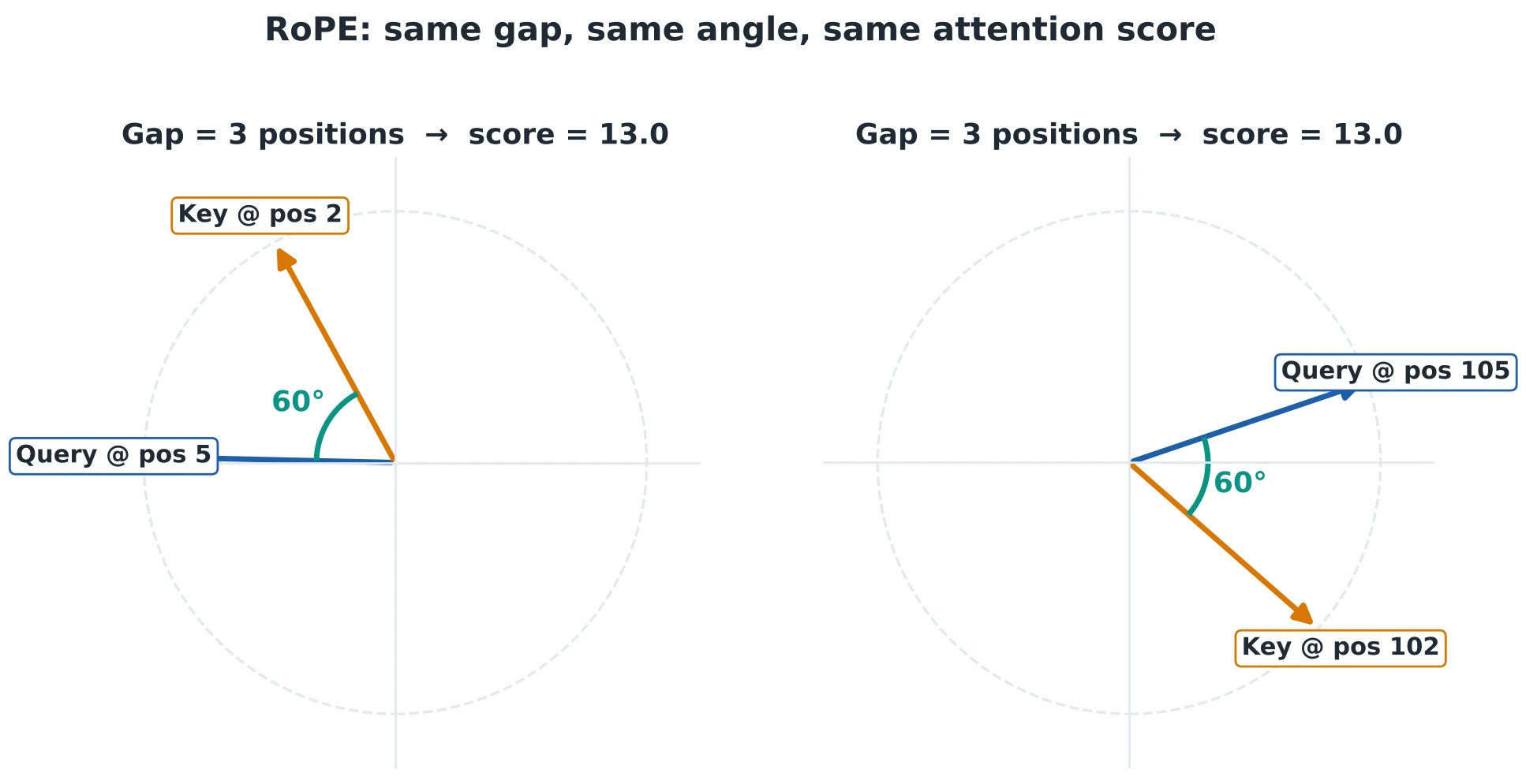
The breakthrough of RoPE lies in how it handles relative distance. Because it uses rotation, the "angle" between two tokens remains the same regardless of where they appear in the sequence, provided the distance between them is constant. If "Word A" is at position 5 and "Word B" is at position 2, the distance is 3. If they are moved to positions 105 and 102, the distance is still 3, and the mathematical relationship (the dot product) between their rotated vectors remains identical. This allows the model to "sense" relative distance directly and consistently, which is vital for maintaining coherence in long documents.
Comparative Industry Data and Technical Implications
The shift toward RoPE and its derivatives is driven by the industry’s demand for "Long Context" performance. Modern models are now expected to process entire books or massive codebases in a single prompt.
| Encoding Method | Parameter Requirement | Primary Strength | Key Limitation |
|---|---|---|---|
| Learned Absolute | High (O(N)) | Simple implementation | Fixed context length |
| Sinusoidal | Zero | Theoretically infinite | Poor extrapolation quality |
| RoPE | Zero | Excellent relative distance | Complexity in implementation |
Data from recent model releases suggests a diversification of these techniques. For instance, the SmolLM3 model utilizes a hybrid approach known as "NoPE" (No Positional Encoding) layers. In this configuration, RoPE is skipped in every fourth layer. Developers found that the causal mask (the mechanism that prevents a model from "looking ahead" at future words) already provides a subtle positional signal. By combining explicit RoPE layers with NoPE layers, researchers have achieved better performance in long-context scenarios while reducing computational overhead.
Broader Impact and Future Outlook
The evolution of positional embeddings is more than a technical footnote; it is a prerequisite for Artificial General Intelligence (AGI). For an AI to perform complex reasoning, follow multi-step instructions, or write functional software, it must possess a flawless understanding of sequence and structure.
The implications of RoPE, in particular, have enabled the "context window wars" of 2024, where models like Google’s Gemini and Anthropic’s Claude now boast context capacities ranging from 200,000 to over 1 million tokens. These advancements are only possible because the mathematical representation of "position" has moved away from rigid tables and toward fluid, relative rotations.
However, challenges remain. Even with RoPE, "lost in the middle" phenomena persist, where models struggle to recall information placed in the center of a very long prompt compared to the beginning or end. Future research is likely to focus on "Linear Attention" and "State Space Models" (like Mamba), which attempt to handle sequence data without the quadratic cost of standard attention, potentially reinventing the concept of positional awareness once again.
As the field moves forward, the consensus among AI researchers is clear: the ability of a machine to understand the difference between a dog hunting a fox and a fox hunting a dog was the first step. The next step is ensuring the machine can maintain that level of precision across a document the size of a library. Through the refinement of rotary embeddings and the exploration of hybrid layers, the industry is closer than ever to achieving that goal.


 Asep Darmawan

 Basiran