


The landscape of email marketing is undergoing a significant transformation, marked by a widening chasm between organizations that strategically invest in robust measurement, deliverability, and optimization, and those that continue to operate on mere assumptions. This critical divergence is a central theme in Sinch Mailgun’s recently released 2026 Email Impact Report, a comprehensive analysis published on April 17, 2026, that underscores email’s enduring importance while highlighting the escalating demands for sophistication and data literacy.
The 2026 Email Impact Report, drawing insights from a global survey of over 1,200 email senders and an unprecedented analysis of more than 400 billion real emails transmitted through Sinch Mailgun infrastructure in 2025, offers a stark, fact-based snapshot of the industry. Spanning five crucial chapters—covering ROI, industry benchmarks, deliverability, AI adoption, and investment trends—the report serves as an essential guide for email professionals navigating the complexities of the second half of 2026. It articulates a clear message: email is not merely surviving; it is evolving into a highly specialized discipline where precision and evidence-based strategies are paramount for achieving competitive advantage.
The Unyielding Importance of Email and the ROI Measurement Gap
Email remains a cornerstone of digital communication and marketing, a testament to its unparalleled reach and directness. The report confirms this foundational truth, revealing that a substantial 78% of senders consider email to be “very” or “extremely” important to their organization’s success. This high level of organizational buy-in is a rare commodity for any marketing channel, often surpassing the perceived value of newer, flashier platforms. However, the report also uncovers a troubling disconnect between this widespread belief in email’s value and the actual practices of measuring its impact.
Fewer than half of email senders actively measure the Return on Investment (ROI) of their email programs. Specifically, only 46% track ROI for promotional emails, and a slightly lower 43% do so for transactional emails. This means that the majority of email teams are operating on conviction rather than concrete evidence, a precarious position in an increasingly data-centric business environment. The implications of this measurement gap are profound. Without tangible data to demonstrate ROI, email programs struggle to secure increased budget allocations, perpetuate inefficiencies, and ultimately fall behind more analytically mature competitors.
For those organizations that do measure ROI, the results are compelling. A significant 60% of senders measuring promotional email ROI report returns greater than $10 for every $1 spent, indicating email’s exceptional efficiency when managed effectively. This impressive performance is mirrored in transactional email programs, where 62% of senders measuring ROI also report exceeding the $10:1 threshold. A smaller, yet notable, 13% of senders across both categories claim returns exceeding $40 for every dollar spent. While such high figures might seem ideal, Sinch Mailgun’s research suggests that returns this elevated could, counterintuitively, signal an underinvestment in the channel rather than peak efficiency. It implies that these programs might be leaving significant potential on the table by not scaling their successful strategies.
The primary obstacle to increasing email investment, cited by 43% of senders, is budget constraints. This highlights a self-perpetuating cycle: without data to prove email’s value, it’s difficult to secure budget, and without budget, it’s harder to invest in the tools and expertise needed for data collection and analysis. The report strongly advocates for an intermediate step: tracking revenue per campaign. Even with an imperfect attribution model initially, this approach can provide crucial early data points to build a case for further investment and gradually move towards more sophisticated ROI tracking.
Industry analysts often reiterate the principle that “what gets measured gets managed.” The report’s findings resonate with this sentiment, suggesting that organizations failing to quantify their email marketing efforts are essentially flying blind, unable to identify successes, pinpoint areas for improvement, or justify strategic resource allocation. As digital marketing budgets face increasing scrutiny, the ability to unequivocally demonstrate financial impact is no longer optional but a fundamental requirement for growth and sustainability.
Unveiling True Benchmarks: Insights from 400 Billion Emails
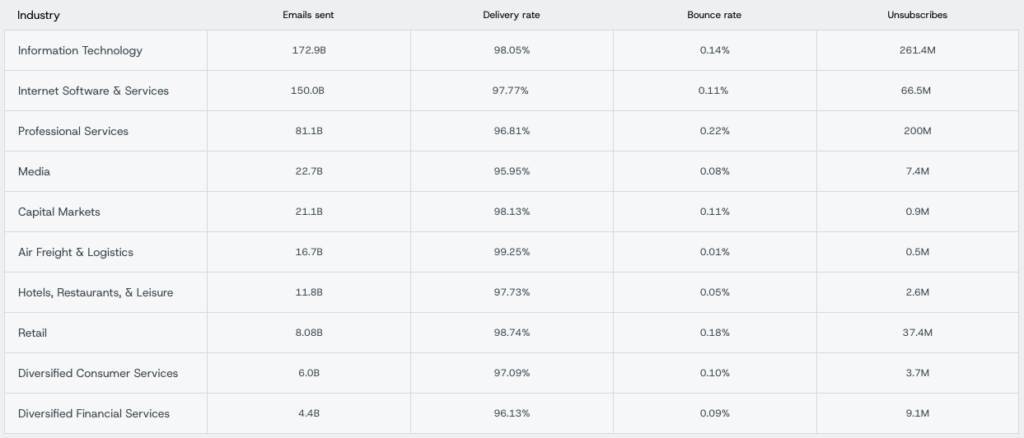
One of the most valuable contributions of Sinch Mailgun’s report lies in its unique approach to industry benchmarks. Unlike many industry reports that rely on self-reported estimates and surveys, Chapter 2 of this report leverages real sending data. By analyzing over 400 billion emails sent through Sinch Mailgun’s infrastructure in 2025, across the top 10 industries by volume, the report provides an unprecedented, fact-based view of email performance. This methodology offers a more accurate and reliable set of benchmarks, free from the biases inherent in self-reported data.

The granular data reveals significant variations in performance across sectors. The Air Freight & Logistics industry, predominantly characterized by transactional sends like shipping confirmations and tracking updates, demonstrates exemplary performance with a 99.25% delivery rate and an astonishingly low 0.01% bounce rate. These emails are highly anticipated and desired by recipients, naturally leading to superior engagement metrics. In stark contrast, the Media industry sits at the lower end of the spectrum within the top 10, with a 95.95% delivery rate. This is attributable to high email volumes and broad promotional audiences, which inherently create downward pressure on deliverability metrics due to varied engagement levels and higher spam complaint rates.
However, the report critically cautions against relying solely on delivery rate as a performance indicator. An email “delivered” to a spam folder still technically counts as delivered by many metrics, despite failing to reach its intended audience in the inbox. The report makes a compelling case for senders to pair delivery rate tracking with inbox placement testing. This crucial additional step provides a true understanding of where emails are actually landing—whether in the primary inbox, promotional tabs, or, more detrimentally, the spam folder. Without inbox placement testing, organizations risk misinterpreting their deliverability performance and failing to address critical issues that impact reach and engagement.
The analysis of unsubscribe rates further underscores the importance of context. While Information Technology recorded the highest raw number of unsubscribes at 261 million, this figure must be contextualized against its colossal send volume of 172.9 billion emails. This translates to a relatively low unsubscribe rate of approximately 0.15%. Conversely, the Retail sector generated 37.4 million unsubscribes on a much smaller volume of 8.08 billion sends, indicating a significantly higher unsubscribe rate per email. This comparison highlights that raw volume alone is meaningless; understanding unsubscribe rates in relation to send volume is essential for accurate performance assessment and audience health monitoring. Deliverability experts consistently emphasize that high unsubscribe rates can be a red flag, indicating poor audience targeting, irrelevant content, or excessive sending frequency, all of which can negatively impact sender reputation and future deliverability.
Deliverability Progress Amidst Persistent Knowledge Gaps
Deliverability remains a paramount concern for email senders, with 89% acknowledging its importance to their organization. The good news is that the industry is seeing tangible improvements: 43% of senders reported improved inbox placement over the last 12 months. This progress is largely attributed to significant advancements in email infrastructure and the widespread adoption of authentication protocols.
A key driver of this improvement is the growing adoption of DMARC (Domain-based Message Authentication, Reporting, and Conformance). This vital email authentication protocol has seen substantial growth, spurred by increasingly stringent requirements from major mailbox providers like Gmail, Yahoo, and Microsoft. The report illustrates this trend with clear data: DMARC adoption grew from 43% in 2023 to 54% in 2024, reaching 61% in 2025. For the first time in Sinch Mailgun’s research, DMARC enforcement—through quarantine or reject policies—is outpacing passive monitoring, with over half of DMARC adopters now actively using these stricter policies. This shift signifies a maturation in email security, where organizations are moving beyond mere observation to actively prevent unauthorized use of their domains for email.
However, despite these infrastructure improvements, a critical knowledge gap persists. The report reveals that 36% of senders claim to monitor their “email deliverability rate,” a metric that, in essence, does not exist in a standardized, meaningful way. This confusion highlights a fundamental misunderstanding of core email metrics. As previously noted, the delivery rate measures emails accepted by the receiving server, including those shunted into spam folders. True inbox placement, which measures what actually reaches the user’s primary inbox, is a distinct and far more crucial metric. Disturbingly, only 25% of senders routinely conduct inbox placement tests to ascertain their actual reach. Furthermore, a significant 27% of DMARC users are unaware of the specific policy (none, quarantine, or reject) they have implemented, underscoring a concerning lack of understanding regarding their own security configurations.
The implications of this knowledge gap are substantial. While tools and protocols like DMARC are improving, their full potential cannot be realized if senders lack the literacy to understand and effectively utilize them. Mailbox providers, increasingly sophisticated in their filtering algorithms, prioritize authenticated and well-managed sending domains. Organizations that fail to grasp the nuances of deliverability, including proper authentication, list hygiene, and active inbox placement monitoring, risk severe penalties, including reduced inbox placement, blacklisting, and damaged sender reputation. Email security advocates frequently stress that DMARC, when properly implemented and monitored, not only protects a brand’s domain from phishing and spoofing but also significantly contributes to overall email deliverability. The ongoing evolution of email security, driven by major providers’ mandates, means that fundamental understanding and proactive management are non-negotiable for sustained success.
AI Adoption: Widespread Interest, Uneven Impact
Artificial intelligence (AI) has rapidly permeated various aspects of business, and email marketing is no exception. The report indicates a wide embrace of AI, with 79% of senders either currently using or planning to integrate AI into their email programs. However, the depth of this adoption varies significantly. Regular, systematic use of AI sits at a modest 27%, suggesting that a substantial portion of adopters are still in the experimental phase rather than fully embedding AI into their routine workflows.
The most common applications of AI in email marketing include copy generation (41%), content personalization (36%), dynamic content creation (29%), send time optimization (27%), and data analysis (27%). A clear pattern emerges from these use cases: AI delivers the most substantial value when it is integrated into decision-making processes rather than being confined to superficial content production. Teams that leverage AI for strategic functions such as personalization, optimizing send times, and A/B testing report compounding returns, enhancing their overall program efficiency and effectiveness. In contrast, teams that primarily use AI for basic tasks like drafting subject lines or simple content generation see a more limited impact, highlighting that the tool itself is less important than how it is strategically deployed.
The differential impact of AI is starkly illustrated by performance metrics: 54% of senders who have implemented AI report that their email programs improved moderately or significantly year-over-year. This contrasts sharply with only 37% of senders who are not using AI reporting similar improvements during the same period. This 17-point performance gap is a compelling indicator that AI is beginning to stratify email programs into distinct performance tiers. While the report carefully notes that this does not definitively prove causation, the consistency of the direction strongly suggests that strategic AI integration is becoming a critical differentiator in email marketing performance.
Interestingly, 23% of AI users report that AI has not helped them at all. This finding further reinforces the notion that the efficacy of AI is not inherent in the technology itself but in the depth and thoughtfulness of its integration. Simply adopting an AI tool without a clear strategy for how it will enhance decision-making, personalization, or optimization is unlikely to yield significant benefits. Marketing tech leaders often emphasize that successful AI implementation requires a clear understanding of business objectives, access to quality data, and a willingness to iterate and learn from the AI’s outputs. The future of email marketing, therefore, will not merely be about if an organization uses AI, but how effectively and strategically it integrates it into its core operations.
Future Investment: AI, Engagement, and Strategic Prioritization
Looking ahead to 2026, the report identifies “taking advantage of AI” and “increasing email engagement” as the top priorities for email senders, each cited by 40% of respondents. These priorities reflect a clear understanding that leveraging advanced technology and fostering deeper audience connections are vital for future success.
In terms of investment, 31% of senders plan to increase their email marketing budgets, while a substantial 48% intend to maintain their current spending levels. Only a small fraction, 7%, anticipate decreasing their investment. This outlook suggests a general stability and cautious optimism within the email marketing sector, with a significant portion of organizations recognizing the need to either expand or sustain their efforts. The planned increase in investment, while not a majority, aligns with the report’s findings on the proven ROI of email and the growing impact of AI, indicating a strategic shift among a proactive segment of the industry.
The report’s overarching conclusion is unequivocal: email continues to be a highly effective marketing channel. The wealth of data, from compelling ROI figures to real-world performance benchmarks and deliverability trends, consistently supports this assertion. However, the report also issues a critical caveat: future success will increasingly belong to those programs that commit to simultaneous investment in three interconnected areas.
First, measurement is paramount. Proving ROI with real data, rather than relying on intuition, is essential for securing resources, demonstrating value, and optimizing performance. Second, deliverability must be a continuous focus. Consistently reaching the inbox requires vigilant attention to authentication protocols (like DMARC), meticulous list hygiene, and proactive monitoring of inbox placement. Third, optimization through AI and rigorous testing is crucial for improving performance at scale. This includes leveraging AI for personalization, dynamic content, and send-time optimization, coupled with systematic A/B testing to refine strategies.
Crucially, none of these vital areas necessitate an immediate, massive budget outlay to begin. The report emphasizes that even incremental steps in measurement, deliverability, and optimization can yield significant, compounding returns over time. The widening gap observed in the 2026 Email Impact Report is not just a snapshot of current performance; it is a forecast for the competitive landscape of email marketing in the years to come. Organizations that embrace a data-driven, technologically informed, and strategically optimized approach will not only survive but thrive, solidifying email’s position as an indispensable engine of business growth and customer engagement.








