The digital marketing landscape is undergoing a profound transformation, driven by the rapid ascent of generative artificial intelligence, fundamentally altering how users seek and consume information. Traditional search engine optimization (SEO), long the bedrock of online visibility, is now complemented by a critical new discipline: Answer Engine Optimization (AEO). At its core, AEO addresses the burgeoning challenge of brand visibility in an era where AI models like ChatGPT, Perplexity, and Gemini, alongside Google’s own AI Overviews, increasingly provide direct, synthesized answers to user queries, often bypassing the need for a click-through to a website. This shift means that visibility once measured by search rankings can now vanish into an AI-generated response that marketers never directly see or track, creating an urgent need for specialized tools known as AEO checkers.
The Paradigm Shift: From Links to Answers
For decades, the internet operated on a link-based model, with search engines serving as directories to relevant web pages. SEO professionals meticulously optimized content to rank prominently in these lists, driving organic traffic through clicks. However, the advent of sophisticated large language models (LLMs) has introduced a "zero-click" phenomenon, where users receive comprehensive answers directly within the AI interface. Recent data indicates a growing trend: a significant percentage of search queries now result in no clicks to external websites, with users satisfied by the AI’s direct response. While specific figures vary, some industry reports suggest that over 60% of Google searches, for instance, are now "zero-click," a number likely to surge with the broader integration of AI. This evolution is not merely a change in interface; it represents a fundamental re-architecture of information discovery, demanding a new approach to brand presence.
A Brief Chronology of AI in Search
The journey towards answer-centric search accelerated dramatically in late 2022 with the public release of OpenAI’s ChatGPT. Its unprecedented ability to generate human-like text and answer complex questions rapidly captivated a global audience, demonstrating the immense potential of generative AI. Competitors quickly followed suit: Google launched Bard (later rebranded as Gemini) in early 2023, while Perplexity AI emerged as a distinct search-answer engine, notable for its robust citation practices.
![AEO checker tools that measure answer engine visibility [2026]](https://53.fs1.hubspotusercontent-na1.net/hubfs/53/aeo-checker-1-20260903-3858273.webp)
The most significant development for traditional search was Google’s integration of AI Overviews (formerly known as Search Generative Experience or SGE) into its main search results in May 2024. This move brought the summary-first, answer-engine behavior directly into the world’s most dominant search platform. Google stated that AI Overviews would appear "when our systems determine that it is additive to classic Search," indicating a strategic intent to provide instant, comprehensive answers without necessarily requiring users to navigate external links. This chronological progression underscores a clear industry trend: AI-powered summarization and direct answers are becoming the default, not the exception.
Defining Answer Engine Optimization (AEO)
Answer Engine Optimization (AEO) is the strategic discipline of enhancing how frequently and accurately a brand, its products, and its content appear within the AI-generated answers provided by these new "answer engines." While SEO aims to rank pages in a list of links, AEO strives to get a brand mentioned, its expertise acknowledged, and its content cited directly within the synthesized answer itself. The two disciplines are complementary, not conflicting. Strong SEO practices – ensuring crawlability, establishing authority, and producing high-quality, relevant content – remain foundational, as answer engines still rely on these signals to identify trustworthy and authoritative sources for their answers.
For content to be favored by AI, it must be easily parsed and highly trustworthy. This means clearly structured pages, direct and unambiguous answers to common questions, and claims rigorously backed by verifiable primary sources. Semantic optimization, ensuring that content aligns with user intent and the nuances of natural language, becomes paramount.
The Indispensable Role of an AEO Checker
In this dynamic environment, a dedicated AEO checker becomes an indispensable tool for marketers. Its primary function is to continuously monitor and measure a brand’s visibility across various answer engines, then translate that data into actionable recommendations for improvement. Specifically, an AEO checker performs several critical functions:
![AEO checker tools that measure answer engine visibility [2026]](https://no-cache.hubspot.com/cta/default/53/9dd5e54b-fbef-4dd0-bc44-1689feb1ea18.png)
- Visibility Measurement: It identifies which questions trigger AI answers that mention or cite your brand, and equally important, which questions surface competitor content or where the AI misrepresents your brand.
- Citation and Mention Tracking: Distinguishes between direct citations (where the AI links back to your domain) and brand mentions (where your brand is named in the answer text without a direct link). Both are valuable, but citations offer direct attribution and potential referral traffic.
- Content Gap Analysis: Highlights topics or queries where competitors are being cited or mentioned, but your brand is not, signaling opportunities for content creation or optimization.
- Accuracy Assessment: Verifies the accuracy of information presented by AI about your brand, products, or services, allowing for rapid correction of misinformation.
- Performance Prioritization: Ranks potential fixes – be it content updates, schema markup corrections, or entity optimization – based on their likelihood of improving citations and mentions.
- Continuous Monitoring and Reporting: Provides ongoing insights into visibility trends, allowing marketers to adapt strategies in real-time.
Without such a tool, managing brand presence in the AI-first search environment becomes an arduous, unscalable, and largely blind endeavor.
The Limitations of Manual AEO Checks
While manual checks can offer initial insights, they quickly become impractical and unreliable as a long-term strategy. For Google AI Overviews, the process involves running priority queries in incognito or signed-out sessions, recording whether an AIO appears, if your domain is cited, and the exact claims made. However, AI Overviews don’t trigger for every query, and their content can vary significantly between sessions, locations, and even minor rephrasing of a query. This inherent volatility makes single lookups unreliable, necessitating multiple checks per query, which is prohibitively time-consuming for any substantial list of keywords.
Similarly, checking ChatGPT and Perplexity requires individually prompting the AI and meticulously sifting through responses for brand mentions or citations. While Perplexity consistently provides citations, ChatGPT only searches the web when a query demands current information or explicitly instructed. This requires careful prompt engineering to ensure web retrieval is triggered.
Furthermore, traditional analytics tools like Google Search Console offer limited visibility into AI Overviews. As of the original article’s context, AI Overview activity was rolled into general "Web" search performance, making it difficult to isolate. While Google announced a dedicated generative AI performance report in June 2026, it initially focused on impressions, not necessarily click-throughs or specific citation data, and was rolled out to a subset of sites. This highlights the gap that specialized AEO checkers are designed to fill.
Key Metrics for AEO Success
![AEO checker tools that measure answer engine visibility [2026]](https://53.fs1.hubspotusercontent-na1.net/hubfs/53/aeo-checker-2-20260903-852936.webp)
To effectively measure the impact of AEO efforts, marketers must track a specific set of metrics:
- AI Visibility Score: A composite metric reflecting how often and how prominently a brand appears in AI-generated answers. This is often tracked week-over-week to identify trends.
- Citation Coverage: The percentage of relevant queries for which an AI answer includes a direct citation to your domain. This indicates the AI’s trust in your content as a primary source.
- Brand Mentions: The number of times your brand name is explicitly mentioned in AI answers, even without a direct link. This signifies brand recognition and authority within the AI’s knowledge base.
- AI-Referred Sessions: Direct traffic attributed to clicks from AI Overviews or other answer engines that provide clickable sources. While "zero-click" is common, any direct traffic indicates success in drawing users deeper.
- Branded Search Lift: An increase in direct branded searches following AI visibility, suggesting that AI answers are raising brand awareness even when direct clicks aren’t recorded.
It is crucial to interpret these metrics as trends over time rather than isolated snapshots. The volatile nature of AI outputs means that consistent improvement across weeks or months is far more indicative of success than a single positive data point.
Choosing the Right AEO Checker: Buyer Criteria
Selecting the appropriate AEO checking software is paramount for organizations looking to scale their efforts beyond manual spot-checks. Key criteria for evaluation include:
- Multi-Engine Support: The checker should monitor visibility across all major answer engines, including Google AI Overviews, ChatGPT, Perplexity, and Gemini, as each has distinct behaviors and user bases.
- Citation and Mention Tracking: The tool must accurately identify both direct citations (links back to your site) and explicit brand mentions within AI answers.
- Content Gap Analysis: It should highlight where competitors are being cited or mentioned for relevant queries, providing actionable insights for content strategy.
- Technical AEO Readiness: Features that assess how well your site’s schema, entity relationships, and overall crawlability support AI parsing are crucial.
- Prioritized Recommendations: The software should not just identify problems but also offer prioritized, actionable recommendations for content updates, schema improvements, or entity optimization.
- Reporting and Analytics: Robust dashboards and reporting capabilities are essential for tracking trends, demonstrating ROI, and communicating performance to stakeholders.
- Integration Capabilities: Seamless integration with existing marketing stacks, particularly CRM and CMS platforms, enhances workflow efficiency and data attribution.
Leading AEO Checker Tools in the Market
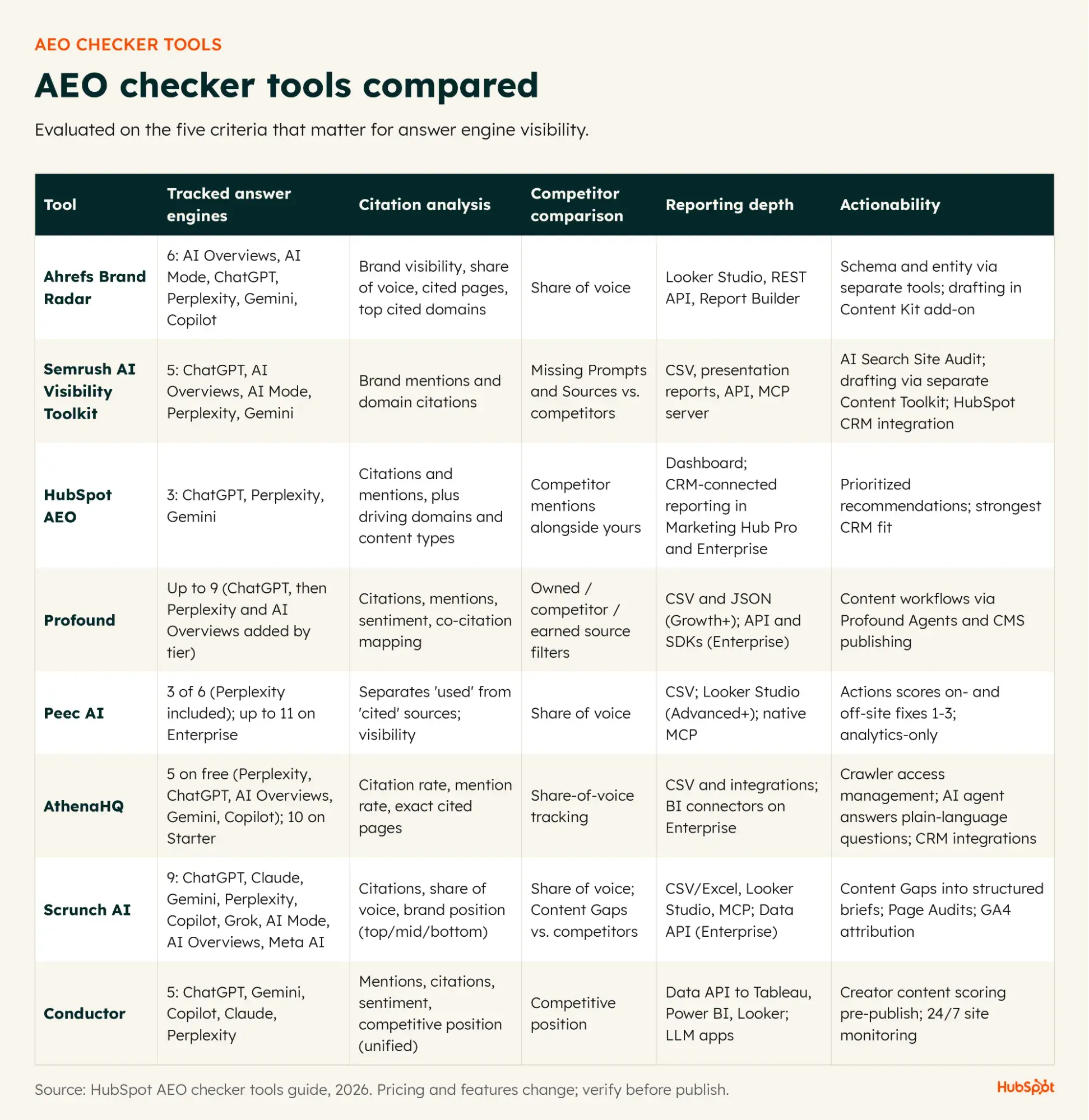
The market for AEO tools is rapidly evolving, with several platforms offering distinct capabilities:
![AEO checker tools that measure answer engine visibility [2026]](https://53.fs1.hubspotusercontent-na1.net/hubfs/53/aeo-checker-3-20260903-8904553.webp)
-
Tools with AI Overviews Tracking:
- Ahrefs Brand Radar: Leverages real search queries and boasts a substantial index of AI Overviews. It provides insights into brand mentions and sentiment within these summaries.
- Semrush AI Visibility Toolkit: Identifies existing ranking keywords that trigger AI Overviews, allowing marketers to prioritize content optimization for near-inclusion pages. It focuses on integrating AEO insights into traditional SEO workflows.
-
Tools with ChatGPT Citation Detection:
- HubSpot AEO: Tracks both citations and mentions across ChatGPT, Perplexity, and Gemini. It provides prioritized recommendations and, within HubSpot’s Marketing Hub, connects visibility data to CRM for comprehensive attribution.
- Profound: Goes beyond simple citation detection, offering sentiment scoring, flagging uncited prompts, and breaking down citations by source type (owned, competitor, earned), providing a nuanced view of brand perception.
-
Tools with Perplexity Monitoring:
- Peec AI: A specialized analytics tool focusing solely on Perplexity data, offering clean and precise reporting on citations and mentions within this increasingly popular answer engine.
- AthenaHQ: Offers Perplexity tracking across all its plans, including a free tier, and integrates a conversational assistant for interactive analysis.
-
Tools for Schema and Entity Readiness:
- Scrunch AI: Focuses on the technical foundation, checking whether AI crawlers can effectively reach and render a brand’s web pages, ensuring content is accessible for AI processing.
- Conductor: Combines 24/7 technical monitoring with a content scorer, helping optimize content for both human users and AI parsers, emphasizing relevance and authority.
HubSpot’s Integrated Approach: From Measurement to Action
HubSpot stands out by offering an integrated solution that bridges the gap between AEO diagnosis and content execution. While many AEO checkers provide valuable insights, they often leave marketers to export data and implement changes in separate systems. HubSpot AEO, available as a standalone product and integrated into Marketing Hub Professional and Enterprise, streamlines this process.
![AEO checker tools that measure answer engine visibility [2026]](https://53.fs1.hubspotusercontent-na1.net/hubfs/53/aeo-checker-4-20260903-6212698.webp)
It not only tracks visibility and provides prioritized recommendations (what to create, update, or outreach, and why) but also offers unique features like "Content Agent." This AI-powered tool can transform a blog recommendation into a research-backed first draft, tailored to the brand’s voice, with a single click. This draft lands directly in HubSpot’s content editor, where teams can review, refine, and publish through Content Hub and Marketing Hub, effectively closing the loop from insight to creation.
Crucially, HubSpot’s integration with its Smart CRM allows AI-referred traffic to be tracked as a distinct source, linking it to contacts and deals. While acknowledging the "zero-click" challenge where visibility doesn’t always translate to direct sessions, HubSpot aims to provide the most comprehensive attribution possible, allowing businesses to understand the true impact of their AEO efforts on the sales funnel. This holistic view is vital for demonstrating the return on investment in an evolving digital landscape.
The Broader Implications and Future Outlook
The rise of AEO checkers and the shift to answer-centric search have profound implications for businesses and content creators alike. It mandates a strategic pivot from keyword stuffing and link-building to semantic optimization, authority building, and clear, direct content that satisfies immediate user intent. Brands must become authoritative "entities" in the eyes of AI, not just collections of web pages.
Industry analysts widely agree that this shift will continue to accelerate. We can expect further innovations in how AI models source and present information, potentially leading to more dynamic and personalized answers. This will necessitate continuous adaptation from marketers, emphasizing the need for flexible, data-driven strategies. Furthermore, discussions around content attribution, intellectual property, and potential revenue sharing for cited sources are likely to intensify, shaping the economic model of the internet itself. For now, investing in robust AEO strategies and tools is not merely an advantage; it is a fundamental requirement for maintaining relevance and visibility in the AI-driven future of information.
Frequently Asked Questions About AEO Checkers
![AEO checker tools that measure answer engine visibility [2026]](https://53.fs1.hubspotusercontent-na1.net/hubfs/53/aeo-checker-5-20260903-8938354.webp)
How often should you run an AEO check?
The frequency depends on the method. Manual spot-checks require sampling several sessions per query due to output volatility. Automated checkers are superior, with daily or weekly refreshes catching fluctuations and providing a more accurate, continuous picture of brand visibility.
Is AEO the same as AI search optimization?
While often used interchangeably, AEO (Answer Engine Optimization) is the more precise term. It specifically refers to improving how often and accurately a brand appears in AI-generated answers from tools like ChatGPT, Perplexity, and Gemini. It’s recommended to standardize on AEO for clarity.
Can you reliably track citations in ChatGPT and Perplexity?
Yes, within certain limits. Both platforms can surface their sources, making individual responses readable. However, results can vary from one run to the next. Reliability is achieved through repetition: running prompts multiple times across fresh sessions to identify patterns rather than relying on a single snapshot.
Do AEO checkers replace traditional SEO tools?
No, AEO checkers do not replace traditional SEO tools; they complement them. AEO checkers focus on brand mentions and citations within AI answers, while SEO tools track rankings, keywords, and backlinks. Since strong SEO underpins the crawlability and authority signals that answer engines rely on, both types of tools are essential and should be run side-by-side for a comprehensive digital strategy.