rifanmuazin
In the dynamic landscape of Business-to-Business (B2B) marketing and sales, many organizations find themselves grappling with inconsistent pipeline generation and engagement metrics, despite employing a seemingly comprehensive suite of digital and human outreach tactics. The prevailing assumption often points to a deficiency in channel mix – a perceived need to add more platforms or strategies. However, a deeper analysis, spearheaded by marketing consultants and industry experts, suggests a fundamental misunderstanding of the core issue: the problem isn’t the channels themselves, but rather the timing and orchestration of their deployment. This shift in perspective highlights a critical need for B2B teams to re-evaluate their engagement strategies, moving beyond mere tactic execution to a more nuanced understanding of buyer behavior and readiness.
Sarah Threet, a Marketing Consultant at Heinz Marketing, articulates this pivotal point: “If your team is doing ‘all the right things’ but pipeline still feels inconsistent, the issue may not be your channels—it’s your timing.” This assertion challenges the conventional wisdom that inundates marketing departments with the pressure to adopt every new digital tool or campaign format. While paid campaigns, email nurturing sequences, Sales Development Representative (SDR) outreach, and retargeting efforts are standard components of modern B2B engagement, their efficacy is severely hampered when deployed at moments that do not align with the buyer’s journey. This misalignment not only fails to drive desired outcomes but can actively detract from the buyer experience, creating friction and potentially alienating prospects.
The common response to declining engagement, as observed by industry analysts, is often to “add more.” This typically manifests as an influx of new digital tools, a greater volume of content, and an expansion of marketing automation features. The underlying theory, however, is frequently misdirected. The belief that digital fatigue is solely a technology problem overlooks the critical element of how these technologies are orchestrated. Teams often find themselves executing a multitude of disconnected actions, leading to a chaotic and ineffective buyer journey. This can involve bombarding prospects with generic, untargeted messages, overwhelming them with irrelevant content, or initiating human outreach before a prospect has even expressed a modicum of interest. The result is a dilutive effect on even the most well-crafted messages and personalized approaches.
The current operational paradigm for many B2B teams can be characterized by several key missteps:
- Over-reliance on Automation without Context: Implementing automated sequences without a clear understanding of the buyer’s current stage in their decision-making process. This can lead to generic messages being sent at inappropriate times, diminishing their impact.
- Generic Nurturing Tracks: Employing broad nurturing campaigns that fail to account for individual buyer signals or account-specific needs, leading to disengagement.
- Lack of Integration Between Marketing and Sales: Siloed efforts where marketing generates leads that sales is not equipped to handle effectively due to a lack of context or misaligned timing.
- Focus on Volume over Velocity: Prioritizing the sheer number of touchpoints rather than the strategic timing and quality of each interaction.
This pervasive issue of mis-timed engagement can be understood through the lens of marketing orchestration, a concept that emphasizes the strategic coordination of all marketing activities to create a seamless and effective buyer experience. As detailed in Heinz Marketing’s perspective on marketing orchestration strategies, true effectiveness lies not in the number of channels used, but in how they are synchronized and timed in relation to buyer intent and behavior.
Why Personalization Alone Isn’t Enough
In an effort to combat declining engagement, many organizations turn to personalization as a panacea. While personalization is undoubtedly a crucial element of effective B2B marketing, it is not a substitute for correct timing. A highly personalized message, if delivered too early in the buyer’s journey, can still feel intrusive and unwelcome. Conversely, an automated follow-up that arrives too late can signal a lack of attentiveness and disconnect from the buyer’s evolving needs. Buyers are not just looking for relevance; they are seeking context and opportune engagement. They respond best when communications acknowledge their current situation, their stage in the decision-making process, and their specific needs at that particular moment. This requires a more sophisticated approach than simply inserting a prospect’s name or company into a template.
A Simpler Framework for Strategic Outreach
To navigate this complexity, B2B teams are encouraged to shift their focus from the tactical question, “What should we send next?” to a more strategic inquiry: “What do we actually know about this account?” This fundamental reorientation requires a deeper understanding of buyer intent and engagement signals. At a high level, this involves:
- Understanding Account Engagement: Tracking how an account interacts with your brand across various touchpoints, including website visits, content downloads, webinar attendance, and social media engagement.
- Identifying Buying Signals: Recognizing specific actions or indicators that suggest a prospect is moving through their buying journey, such as visiting pricing pages, downloading comparison guides, or engaging with competitor research.
- Assessing Buyer Readiness: Evaluating whether a prospect is in a state of active consideration or problem identification, indicating they are receptive to further engagement.
By consistently answering these questions, B2B teams can align their outreach efforts with actual buyer behavior, moving away from assumptions and toward data-driven decision-making. This approach ensures that every touchpoint, whether digital or human, is delivered at a moment when it is most likely to resonate and drive progress.
Where Common Pitfalls Lie
Several common missteps characterize the approach of many B2B teams, leading to suboptimal results:
- Human Outreach Too Early: Initiating direct human contact, such as a sales call or personalized email from an SDR, before a prospect has demonstrated any level of awareness or interest can be counterproductive. This premature outreach often results in low response rates, creates a poor initial impression, and represents a significant expenditure of valuable sales and marketing resources with minimal return. It signals a lack of understanding of the buyer’s journey and can lead to the perception of being overly aggressive or intrusive.
- Automation Too Late: Conversely, allowing high-intent accounts to languish in generic nurturing tracks while competitors actively engage them represents a missed opportunity. Automation, when deployed strategically, can be highly effective for initial engagement and qualification, especially for lower-priority accounts. However, for accounts showing strong buying signals, the transition to more personalized, human-led engagement needs to be timely. Delaying this transition can allow competitors to capture the attention and ultimately the business of promising prospects.
- No Prioritization of Effort: Treating all engaged accounts identically, regardless of their potential value or stage in the buying cycle, is an inefficient use of resources. High-performing teams recognize that not all engagement is equal. They prioritize their efforts based on account size, strategic importance, and demonstrated buying intent, ensuring that the most valuable opportunities receive the most focused and timely attention. This principle is a cornerstone of Account-Based Marketing (ABM) strategies, which aim to tailor marketing and sales efforts to specific high-value accounts.
The Mark of High-Performing Engagement Strategies
In contrast to these pitfalls, high-performing B2B teams align their outreach efforts with clear buyer signals. This strategic alignment typically involves:
- Digital Engagement for Early-Stage Awareness: Utilizing digital channels, such as targeted advertising, content marketing, and social media, to build awareness and educate prospects who are in the initial stages of their research.
- Personalized Digital Nurturing for Consideration: Employing personalized email campaigns, relevant content offers, and retargeting to guide prospects through the consideration phase, providing them with the information they need to evaluate solutions.
- Human Outreach for High-Intent Opportunities: Deploying SDRs and account executives for direct, personalized outreach to accounts that have demonstrated significant buying signals or reached specific engagement thresholds. This human touch is reserved for moments when it is most likely to be well-received and impactful.
- Strategic Account-Based Marketing (ABM): Focusing dedicated resources and personalized outreach on a select group of high-value target accounts, ensuring that every interaction is highly relevant and strategically timed.
Crucially, these high-performing teams understand the importance of not initiating these more resource-intensive efforts too early. They recognize that the buyer’s journey is a process, and that different stages require different types of engagement. This is particularly relevant in the current era, where Artificial Intelligence (AI) is increasingly scaling execution capabilities across marketing and sales functions. The ability of AI to automate tasks and personalize at scale makes the strategic timing of human intervention even more critical, ensuring that AI-powered efforts complement, rather than replace, the nuanced understanding and relationship-building that human interaction provides.
A Practical Framework for Timing Engagement
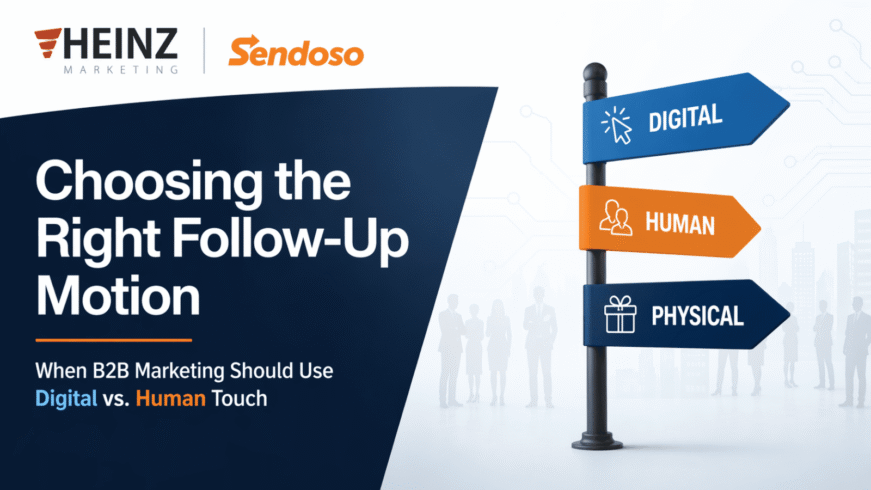
To provide a more actionable approach, a partnership between Heinz Marketing and Sendoso has yielded a practical framework designed to help B2B teams determine the optimal moment for digital versus human engagement. This framework aims to answer the critical question: “When should you stay digital, and when should you go human?” The guide provides a structured methodology for analyzing buyer signals, engagement levels, and account value to make informed decisions about the next best action.
The “Choosing the Right Follow-Up Motion: When B2B Marketing Should Use Digital vs. Human Touch” guide helps teams to:
- Identify Key Buyer Signals: Distinguish between passive engagement and active buying intent.
- Map Engagement Stages: Understand the typical progression of a buyer through their journey.
- Determine the Optimal Channel: Decide whether digital tools or human interaction are most appropriate for each stage and signal.
- Develop a Coordinated Outreach Strategy: Ensure seamless transitions between digital and human touchpoints for a cohesive buyer experience.
- Measure and Optimize Performance: Track the effectiveness of different engagement strategies and refine them for continuous improvement.
Conclusion: The Imperative of Strategic Timing
In conclusion, the persistent challenge of inconsistent outreach effectiveness in B2B environments is less a symptom of channel deficiency and more a consequence of poorly timed execution. The path forward for B2B teams is not to simply adopt more tactics, but to cultivate a deeper strategic understanding of when to deploy them. The core of successful engagement lies not in doing more, but in making more informed and timely decisions about what to do next. By embracing a framework that prioritizes the strategic orchestration of digital and human touchpoints, B2B organizations can significantly enhance buyer engagement, build stronger relationships, and ultimately drive more consistent and predictable pipeline growth.
For those seeking to delve deeper into this crucial aspect of B2B strategy, the comprehensive guide, “Choosing the Right Follow-Up Motion: When B2B Marketing Should Use Digital vs. Human Touch,” offers a detailed framework and practical applications for optimizing engagement across campaigns. This resource is available for download, providing actionable insights to transform outreach strategies. For further inquiries or to discuss specific challenges, direct communication with [email protected] is encouraged.