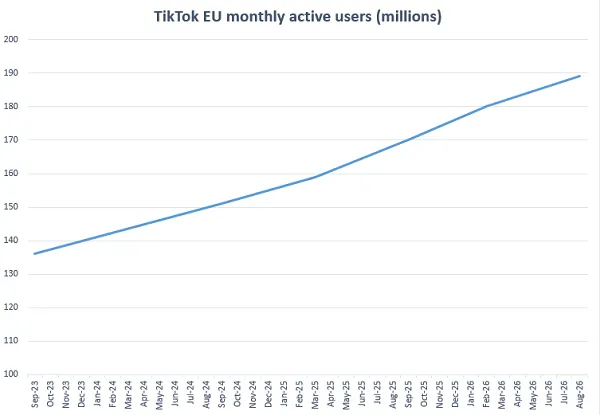
TikTok’s latest Digital Services Act (DSA) disclosure report reveals the platform’s sustained momentum within the European Union, with its monthly active user base in the region now reaching 189 million. This significant figure underscores TikTok’s continued expansion as a dominant force in the digital landscape, even as the report highlights a notable reduction in its human content moderation workforce since late 2024. The data, published as part of TikTok’s biannual transparency obligations under the EU’s landmark DSA, provides critical insights into the platform’s operational strategies, user engagement, and content governance mechanisms. Despite adding 9 million new EU users in the first half of 2026, the company’s moderation capabilities are increasingly reliant on automated systems, with 94.1% of policy violations addressed without human review, a trend that raises questions about the nuances of content enforcement.
The Digital Services Act: A New Era of Platform Accountability
The European Union’s Digital Services Act (DSA), which came into full effect for Very Large Online Platforms (VLOPs) and Very Large Online Search Engines (VLOSEs) in August 2023, represents a pioneering legislative effort to regulate the digital space. Enacted to create a safer, more predictable, and transparent online environment, the DSA imposes stringent obligations on platforms reaching over 45 million monthly active users in the EU. Its primary objectives include combating illegal content, protecting fundamental rights, ensuring user safety, and fostering greater accountability from digital service providers.
Under the DSA, VLOPs like TikTok are required to undertake comprehensive risk assessments, implement robust content moderation systems, provide clear complaint and redress mechanisms, offer enhanced transparency around advertising and content recommendation algorithms, and cooperate with national authorities and the European Commission. These obligations are designed to mitigate systemic risks such as the spread of disinformation, hate speech, and illegal goods, while empowering users with more control over their online experience. Non-compliance with the DSA can result in substantial penalties, including fines of up to 6% of a company’s annual global turnover, underscoring the gravity of these regulatory demands. TikTok was officially designated as a VLOP by the European Commission in April 2023, initiating its compliance journey under this stringent framework.
TikTok’s Ascendant Trajectory in the European Market
The latest DSA report confirms TikTok’s robust growth in the EU, cementing its status as a pivotal social media platform across the continent. With 189 million monthly active users, TikTok has seen a substantial increase of 9 million users in the first half of 2026 alone. This consistent upward trend highlights the platform’s enduring appeal, particularly among younger demographics, who are drawn to its short-form video format, algorithmic content discovery, and vibrant creator ecosystem. This growth trajectory positions TikTok as a formidable competitor to established social media giants like Meta’s Facebook and Instagram, and Google’s YouTube, which also command significant user bases in Europe but face different growth challenges. For context, while Meta platforms collectively boast hundreds of millions of users across Europe, TikTok’s rapid ascent demonstrates a shift in user engagement patterns and content consumption habits.
Interestingly, the reported 189 million monthly active users present a slight discrepancy with a previous announcement from TikTok. In September 2025, the company had published a blog post claiming to have surpassed 200 million EU users. This variance, while potentially attributable to different reporting methodologies, specific snapshot dates, or distinctions between marketing statements and official regulatory disclosures, highlights the importance of standardized reporting under the DSA. Regulatory bodies are likely to scrutinize such differences to ensure consistency and accuracy in transparency reporting, a cornerstone of the DSA’s objectives. Despite this, the current figures unequivocally demonstrate TikTok’s near-term trajectory towards and likely surpassing the 200-million-user milestone in the EU, reinforcing its significant market penetration.
Global Footprint and Regulatory Headwinds

TikTok’s European success is part of a broader global narrative of explosive growth, albeit one shadowed by significant geopolitical and regulatory challenges. Globally, TikTok boasts over a billion monthly active users, making it one of the most widely adopted applications in the world. Its audience is diverse, spanning across various regions, with significant user bases in North America, Latin America, and parts of Asia-Pacific. However, the platform faces varying degrees of restriction and outright bans in several key markets.
In India, for instance, TikTok was banned in 2020 amid national security concerns, representing a loss of hundreds of millions of potential users. Similarly, in Russia, the app’s operations are severely restricted due to local content laws, particularly those pertaining to the dissemination of information about the ongoing conflict in Ukraine. In its home country of China, TikTok operates under a distinct, localized version known as Douyin, which adheres to specific Chinese internet regulations and content guidelines. Beyond these outright restrictions, TikTok is currently navigating intense scrutiny in the United States, where legislative efforts to either ban the app or force a divestiture by its Chinese parent company, ByteDance, are ongoing, citing national security and data privacy concerns. These global pressures underscore the complex interplay between technological innovation, geopolitical dynamics, and evolving digital governance frameworks that TikTok must contend with in its quest for sustained global expansion.
Content Moderation: The Shifting Balance Towards Automation
A critical aspect of TikTok’s DSA disclosure pertains to its content moderation efforts, particularly the balance between human oversight and automated systems. In the first half of 2026, TikTok reported removing approximately 104 million uploads that violated its policies across the EU. A striking 94.1% of these removals were executed via automated means, without human review. This high reliance on artificial intelligence and machine learning for content detection and removal highlights the industry’s increasing push towards scalability and efficiency in addressing vast volumes of user-generated content.
While automated systems can process content at an unparalleled speed and volume, their efficacy in nuanced moderation decisions remains a subject of ongoing debate. AI is highly effective at identifying clear violations, such as nudity, graphic violence, or copyrighted material, based on predefined patterns. However, its capacity to accurately interpret context, sarcasm, satire, or subtle forms of hate speech and misinformation across diverse languages and cultural contexts can be limited. This reliance on automation raises concerns among digital rights advocates and policymakers about the potential for false positives, the suppression of legitimate expression, and the challenges in adequately addressing complex or evolving forms of harmful content.
The Shrinking Human Moderation Workforce
The report also brings into focus a significant strategic shift in TikTok’s human moderation staffing within the EU. While the platform reported adding an extra 64 human moderators in the EU compared to the second half of 2025, this minor increase is overshadowed by a substantial long-term reduction. In October 2024, TikTok’s DSA report indicated a workforce of 6,354 human moderators covering the EU region. The latest update reveals this number has plummeted to 3,738 members on its moderation staff. This represents a reduction of over 40% in human moderation capacity within a span of less than two years.
This dramatic decrease suggests a deliberate move by TikTok to centralize and optimize its moderation processes, heavily leveraging AI and machine learning technologies. The implications of this shift are profound. While AI can handle the sheer volume, human moderators are crucial for handling complex cases, reviewing appeals, understanding local cultural nuances, and providing the critical feedback loop necessary to train and improve AI systems. The reduction in human staff could potentially strain the platform’s ability to conduct thorough reviews, especially for content that falls into grey areas or requires subjective judgment, such as identifying nuanced forms of harassment, targeted abuse, or subtle incitement to violence. It also raises questions about the psychological toll on the remaining human moderators, who may be tasked with increasingly difficult and emotionally challenging content.
Chronology of Key Events

- Early 2023: The EU’s Digital Services Act officially comes into force, establishing a new regulatory framework for online platforms.
- April 2023: TikTok is officially designated as a Very Large Online Platform (VLOP) by the European Commission, obligating it to comply with the strictest DSA rules.
- October 2024: TikTok publishes its DSA transparency report covering the period up to June 2024, reporting 6,354 human content moderators for the EU region.
- September 2025: TikTok releases a public statement via its newsroom, announcing that its community in Europe has surpassed 200 million monthly active users.
- H1 2026 (January-June): The period covered by the latest DSA report, during which TikTok added 9 million new EU users and removed 104 million policy-violating uploads.
- August [Current Year]: TikTok publishes its latest EU DSA disclosure statement, reporting 189 million monthly active users and 3,738 human content moderators for the EU.
Statements and Reactions
While specific real-time statements are not available, the implications of TikTok’s report can elicit inferred reactions from various stakeholders.
TikTok’s Perspective (Inferred): A spokesperson for TikTok might emphasize the company’s unwavering commitment to DSA compliance and user safety. They would likely highlight the significant investment in advanced AI and machine learning technologies as a key strategy to scale content moderation effectively against the ever-increasing volume of user-generated content. "TikTok is dedicated to fostering a safe and compliant environment for our rapidly growing community in Europe," a representative might state. "Our latest DSA disclosure reflects our ongoing commitment to transparency and our strategic efforts to leverage cutting-edge AI technology to ensure the swift and accurate enforcement of our community guidelines. While our approach evolves, the core mission of protecting our users remains paramount." Regarding the user number discrepancy, they might suggest: "Minor variations in reporting methodologies or specific timeframes can occur between public announcements and official regulatory disclosures, but our consistent growth in the EU underscores our strong user engagement."
European Commission and DSA Regulators (Inferred): EU officials would likely underscore the importance of robust content moderation, transparency, and accountability, irrespective of the technological means employed. "The Digital Services Act mandates rigorous oversight to ensure that Very Large Online Platforms uphold their responsibilities in combating illegal and harmful content," a Commission representative might comment. "While we acknowledge the role of technological innovation in content moderation, our focus remains on the effectiveness and fairness of these systems, and platforms must demonstrate their capacity to protect users and adhere to fundamental rights. The reduction in human oversight will be closely examined to ensure it does not compromise the quality or accuracy of moderation decisions, particularly for complex and nuanced content."
Digital Rights Advocates and NGOs (Inferred): Advocacy groups would likely express concern over the significant reduction in human moderation staff. "While AI can be a powerful tool, human oversight remains absolutely critical for nuanced moderation decisions, especially concerning issues like hate speech, misinformation, and the protection of vulnerable communities," a representative from a digital rights organization might argue. "Over-reliance on automated systems risks increasing false positives, stifling legitimate expression, and making platforms less responsive to user complaints. The DSA aims to enhance user protection, and a drastic cut in human moderators could undermine that goal by prioritizing efficiency over efficacy and human rights."
Broader Impact and Implications
TikTok’s latest DSA report carries significant implications for the platform itself, the broader landscape of content moderation, and the future of digital regulation. For TikTok, the sustained user growth in the EU solidifies its position as a major player in the global social media arena. This expansion, however, comes hand-in-hand with heightened regulatory scrutiny, particularly under the DSA. Successfully navigating these complex regulatory environments, which demand unprecedented levels of transparency and accountability, will be crucial for TikTok’s long-term sustainability and reputation. The company must strike a delicate balance between fostering rapid growth and ensuring robust safety measures and strict compliance.
The trend towards increased automation in content moderation, exemplified by TikTok’s strategy, signals a broader industry shift. While AI offers unparalleled scalability in processing vast quantities of content, the ethical and practical implications of this reliance are still being debated. The effectiveness of AI in identifying subtle forms of harmful content, understanding context, and safeguarding freedom of expression remains a critical challenge. Regulators and civil society groups will continue to push for platforms to demonstrate that their automated systems are not only efficient but also accurate, fair, and transparent, with adequate human oversight and robust appeal mechanisms.
Finally, the DSA continues to serve as a global benchmark for platform regulation. Its comprehensive framework is inspiring similar legislative efforts in other jurisdictions worldwide, highlighting an evolving international consensus on the need for greater accountability from digital platforms. TikTok’s journey under the DSA provides a real-world case study into the challenges and opportunities inherent in implementing such expansive regulations. The ongoing dialogue between platforms, regulators, and civil society will shape the future of the digital space, continually redefining the boundaries of a "safe online environment" and the responsibilities of those who govern it. The latest disclosure from TikTok is not merely a statistical update; it is a testament to the dynamic and often contentious intersection of technological advancement, commercial ambition, and the imperative for public safety in the digital age.