

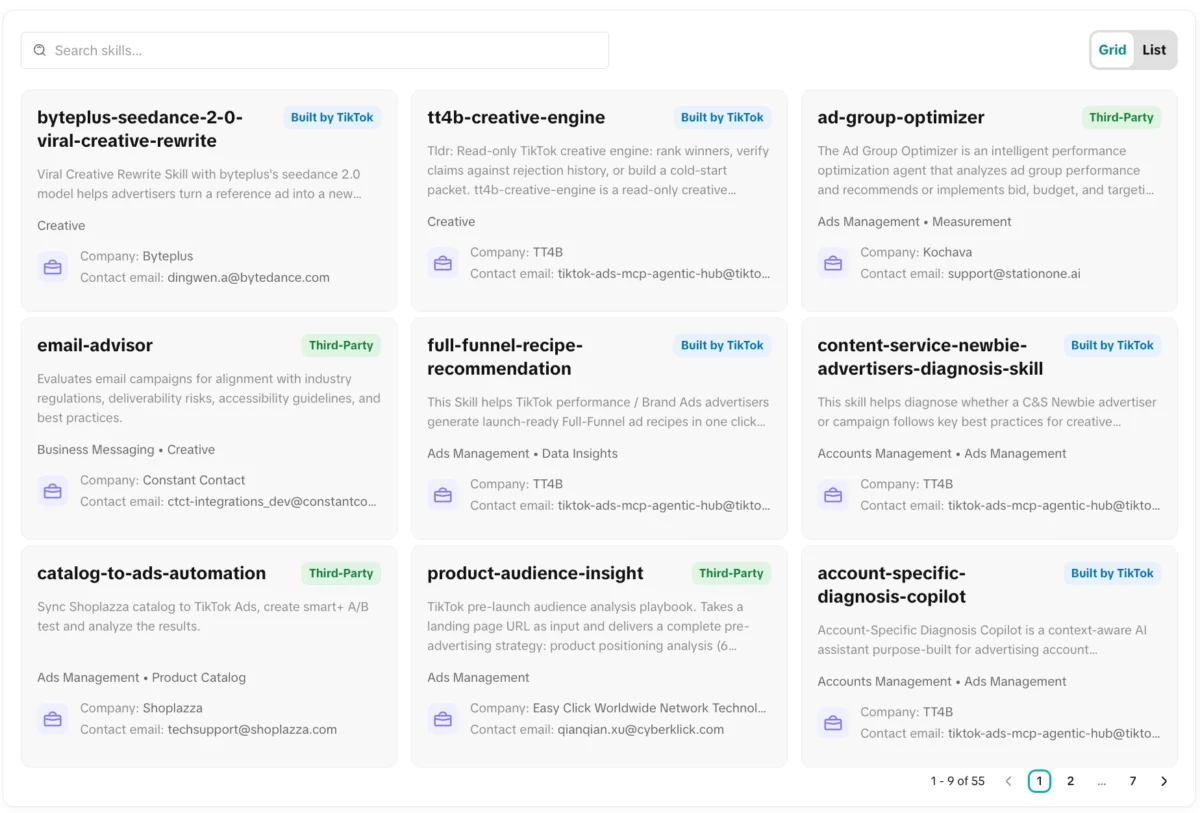
TikTok has boldly stepped into the evolving landscape of AI-driven advertising with the recent unveiling of its TikTok Ads MCP (Multi-Channel Partner) and Agentic Hub. This significant development marks a pivotal moment, integrating agentic AI directly into the core of advertising workflows and promising to redefine how marketers manage and execute campaigns on the popular platform. While the MCP connector itself represents a substantial technological leap, enabling AI tools to interface directly with TikTok Ads, it is the strategic architecture built atop this foundation—the Agentic Hub and its accompanying "Skills"—that signals a more profound shift in the industry. This innovation allows for the packaging, reuse, and sharing of specific paid social advertising methodologies, moving beyond mere efficiency gains to the codification of expert marketing practices.
The implications of TikTok’s move are far-reaching, suggesting a future where the nuanced expertise of seasoned paid social practitioners can be systematically embedded into AI systems. This contrasts with previous AI integrations that often required marketers to navigate between disparate AI environments and native ad platforms. Meta, for instance, recently introduced its Ads AI Connectors, a similar concept that allows AI tools to connect with Meta’s advertising ecosystem. However, TikTok’s Agentic Hub and Skills introduce a more sophisticated layer of abstraction, aiming to democratize advanced advertising strategies by making them accessible and repeatable.
Understanding TikTok’s Strategic AI Architecture
At its core, the TikTok Ads MCP serves as the foundational infrastructure layer. It grants AI agents direct access to the TikTok Ads platform, enabling them to interpret and execute commands through natural language processing. This direct interface eliminates many of the traditional barriers to AI integration, allowing for more seamless and intuitive interaction.
The true innovation, however, lies within the Agentic Hub. This component transforms raw access into actionable intelligence by introducing "TikTok Skills." These Skills are essentially pre-packaged instructions, methodologies, and established processes designed for specific advertising tasks. Instead of requiring individual marketers to painstakingly craft complex prompts and workflows from scratch for every campaign or objective, TikTok Skills offer a library of proven approaches that can be readily deployed within supported AI environments.
Consider the persistent challenge of creative fatigue, a common hurdle in paid social advertising. Traditionally, a paid social specialist would manually sift through performance data, analyze creative assets, identify declining engagement or conversion rates, pinpoint underperforming visuals, and then recommend necessary refreshes. This is a time-intensive and analytical process. With TikTok Skills, much of this diagnostic and prescriptive methodology can be encapsulated into a repeatable workflow. TikTok has already introduced Skills designed to identify creative fatigue, categorizing ads for scaling, monitoring, or retirement. This same principle can be extended across a vast spectrum of advertising functions, including budget optimization, audience discovery and segmentation, comprehensive reporting, campaign quality assurance (QA), and a multitude of other intricate workflows.
This development naturally raises critical questions about the degree of autonomy granted to these AI-driven workflows. Differentiating between identifying a problem, such as creative fatigue, and automatically enacting a solution, like pausing a creative asset, is paramount. Similarly, flagging inefficient ad spend is distinct from autonomously reallocating budget. As organizations increasingly encode their strategic methodologies into AI systems, they will face the crucial task of defining clear boundaries: what AI can act upon independently, what actions require human oversight and approval, and which decisions remain exclusively within the human domain. This nuanced approach to AI governance is fundamental to maximizing the benefits of agentic advertising while mitigating potential risks.
Navigating the Landscape of Human Judgment in AI Advertising
While the allure of full automation is strong, not every advertising workflow is a suitable candidate for complete delegation to an AI agent. The key distinction lies in recognizing where repeatable logic concludes and where essential business judgment begins. For marketing teams embarking on their journey with agentic paid social, a strategic approach is vital. This involves a thoughtful consideration of four core principles:
- Data-Driven Insights vs. Strategic Interpretation: AI excels at processing vast datasets and identifying patterns. However, interpreting the broader business implications of these patterns, understanding market nuances, and aligning insights with overarching business goals still requires human strategic acumen. For example, an AI might identify a dip in conversion rates for a specific audience segment. A human strategist would then contextualize this data, considering external factors like competitor activity, seasonal trends, or shifts in consumer sentiment, before devising a response.
- Efficiency Optimization vs. Brand Building: AI can efficiently optimize campaign parameters for immediate performance metrics like cost-per-acquisition (CPA) or return on ad spend (ROAS). However, building a strong brand narrative, fostering long-term customer loyalty, and creating resonant emotional connections with an audience often transcend purely algorithmic optimization. Human creativity and an understanding of brand ethos are indispensable in these areas.
- Repetitive Tasks vs. Complex Problem-Solving: Automating routine tasks like bid adjustments or ad scheduling frees up human resources. However, tackling complex, novel challenges that require creative problem-solving, innovative thinking, and adaptability in the face of unforeseen circumstances remains a human forte. This includes navigating unforeseen market disruptions or developing entirely new campaign strategies.
- Execution Automation vs. Ethical Governance: While AI can automate the execution of campaigns based on predefined rules, the ethical considerations surrounding advertising—such as data privacy, transparency, and responsible targeting—necessitate human oversight. Establishing and enforcing ethical guidelines for AI-driven advertising is a critical human responsibility.
The Broader Transformation for Paid Social Teams
The implications of platforms like TikTok exposing more of their advertising infrastructure to AI agents extend beyond individual campaign management. As AI gains deeper access, the execution of advertising strategies becomes increasingly replicable across different platforms and agencies. While proficiency in operating individual ad managers like TikTok Ads Manager will continue to hold value, the competitive advantage will increasingly shift towards a different set of skills.
This new paradigm places a premium on strategic judgment and systems thinking. Performance marketing leaders must cultivate the ability to discern what an AI agent should do, when it should perform specific actions, what data inputs are critical, what guardrails are necessary to ensure compliance and ethical conduct, and, crucially, how to identify when an AI’s recommendation or execution is flawed. This elevates the role of the human marketer from an executor of tasks to a strategic architect of AI-driven advertising systems.
For brands, this represents a significant opportunity to leverage years of accumulated expertise. By identifying the frameworks, decision-making processes, and insights that have historically driven performance, organizations can begin to codify this knowledge directly into their operational infrastructure. This transforms tacit knowledge into explicit, actionable systems that enhance consistency and scalability. The ultimate competitive advantage will not simply stem from access to AI agents, as this will become ubiquitous. Instead, it will arise from the sophistication and effectiveness of what these agents are taught to do.
The Bottom Line: A New Operating Model for Paid Social
TikTok Ads MCP provides AI with direct access to advertising workflows, but the Agentic Hub introduces a more consequential innovation: the ability to make the underlying methodologies of these workflows reusable and shareable. This points towards a fundamental reimagining of the operating model for paid social teams. As a greater proportion of campaign execution becomes agentic, marketing teams will need to adopt a more deliberate and structured approach to defining their analytical processes, decision-making frameworks, and governance protocols for AI actions.
The organizations poised to lead in this new era will be those capable of identifying their most potent strategic thinking, transforming it into robust, repeatable systems, and then utilizing the freed-up capacity to focus on higher-level strategic decision-making. In essence, paid social expertise is evolving from a set of individual skills to something that can be systematically built into the very fabric of the advertising system itself, creating a more intelligent, efficient, and strategically empowered future for digital advertising.









