

The Evolving Search Landscape: From Links to Answers
For decades, search engine optimization (SEO) revolved around securing top positions in a list of organic links. Users would pose a query, and search engines like Google would return a curated list of webpages, each potentially holding the answer. The onus was on the user to click through and synthesize information from multiple sources. However, the advent of large language models (LLMs) and advanced AI capabilities has ushered in a new era. Today, platforms such as Google’s AI Overviews, OpenAI’s ChatGPT, and Perplexity AI are designed to provide synthesized, direct answers to complex queries, often citing original sources within their responses.
This chronological progression of search technology marks a significant inflection point. Initially, keyword matching was paramount. Over time, semantic search, which understands the meaning behind queries, gained prominence. Now, answer engines are taking this a step further by generating comprehensive, human-like responses, effectively bypassing the traditional click-through model for many informational queries. This evolution necessitates a strategic pivot for content creators and marketers who rely on search for audience engagement and business growth.
The Rise of Answer Engine Optimization (AEO)
The urgency of this transition is palpable across the marketing industry. According to HubSpot’s authoritative 2026 State of AEO Report, a striking 58% of marketers report that their businesses are already actively optimizing content for answer engines. This data unequivocally demonstrates that Answer Engine Optimization (AEO) is no longer an experimental niche but a mainstream strategic priority. AEO is defined as the practice of structuring content in a way that allows answer engines to efficiently extract, comprehend, and confidently cite it as a source for their AI-generated responses.
Industry analysts and marketing professionals widely concur that this shift fundamentally redefines what it means to be "visible" online. Visibility is no longer solely about appearing in the top ten search results; it is increasingly about whether an AI can identify, extract, and attribute a clean, self-contained passage from a webpage to a specific brand or author. This paradigm shift places content structure at the absolute core of AEO, making it the primary mechanism for enabling such intelligent extraction and attribution.
Key Pillars of AEO: Structuring Content for AI Citation
Earning citations from answer engines is not a matter of chance; it’s a systematic process that hinges on distinct structural attributes. The content most frequently cited consistently exhibits a handful of recognizable traits, primarily centered around its organization and presentation.
I. Question-Led Headings and Direct-Answer Summaries: The Foundation of Clarity
One of the most impactful structural adjustments in AEO involves the use of question-led headings and immediate, direct-answer summaries. Reports, such as the 2026 State of AI Search Report by AirOps, highlight that content featuring sequential heading structures can increase citation odds by a significant 2.8 times. AEO inherently rewards passages that an engine can easily lift and attribute, and these formats are specifically designed to facilitate that process by directly mapping a passage to a query and providing a ready-to-use answer.
- Question-Led Headings: These headings are crafted to mirror the exact queries a user (or an AI engine) might type into a search bar. For example, instead of a generic "Benefits," a question-led heading might be "What are the key benefits of Answer Engine Optimization?" This explicit framing helps AI understand the immediate context and purpose of the subsequent content.
- Direct-Answer Summaries (TL;DR): Positioned immediately after a question-led heading, a direct-answer summary provides the core answer in one or two concise sentences, preceding any further context or elaboration. This "Too Long; Didn’t Read" (TL;DR) approach ensures that the most crucial information is instantly accessible and extractable by an AI.
- Optimizing Q&A Blocks: The pairing of an explicit question with a tight, self-contained answer creates one of the most citable structures. To maximize potential, these blocks should be formatted clearly: the question as an H2 or H3, followed immediately by a direct answer in a paragraph, potentially enhanced with bolding or a definition box for emphasis. This clear presentation is a cornerstone of optimizing for AI Overviews.
II. Semantic Schema and Entity Modeling: The Machine-Readable Layer
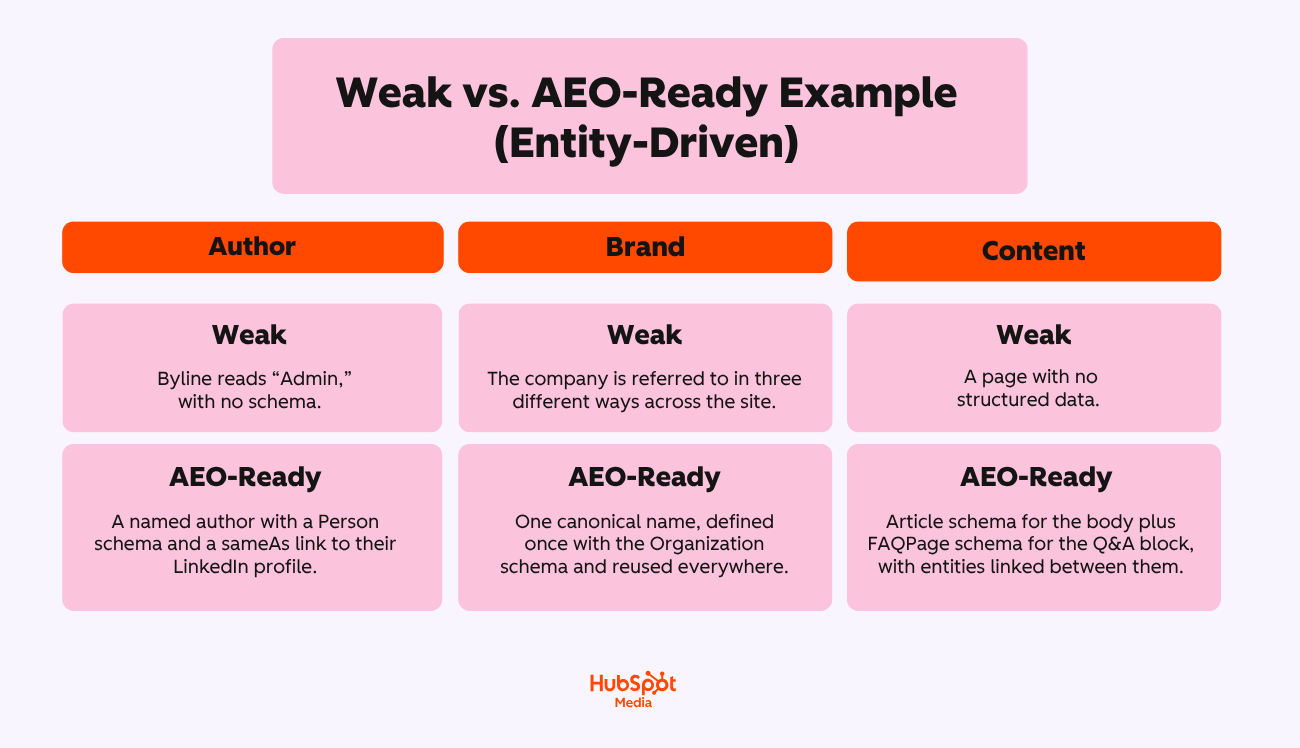
Beyond human readability, content must also be machine-readable. Semantic schema and robust entity modeling form this crucial layer, providing explicit facts about a page, its authorship, and the brand behind it. This directly addresses the "weak-schema gap" that can prevent otherwise high-quality content from being cited. While clear prose communicates meaning to humans, schema translates that meaning into a format that machines can directly act upon. An engine can only confidently attribute a citation when it can reliably identify the source.
- Key Schema Types: Structured data labels specific elements on a page, removing ambiguity for search engines. The most critical schema types for citations include:
ArticleorBlogPosting: Identifies the content type.OrganizationandPerson: Establishes the brand and author credibility.ProductorService: Clearly defines what is being offered.FAQPage: Explicitly marks question-and-answer pairs for easy extraction.
- Entity Modeling: This involves consistently defining people, brands, and products on a site as interconnected entities rather than isolated terms. A deliberate entity model strengthens consistency across authors, brands, and products, building an engine’s confidence in the source over time. This involves creating dedicated author pages, comprehensive "About Us" sections, and consistent branding across all digital touchpoints. Tools like HubSpot’s AEO Grader can benchmark how answer engines perceive a brand, flagging missing entity signals before they impact citations.
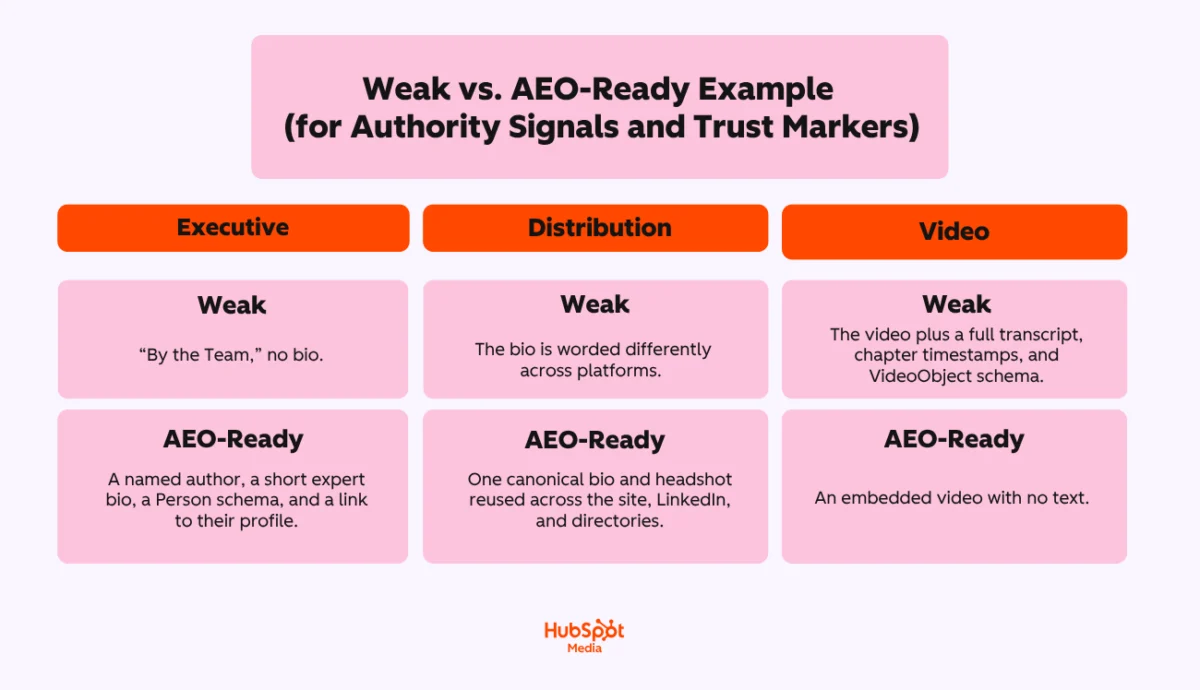
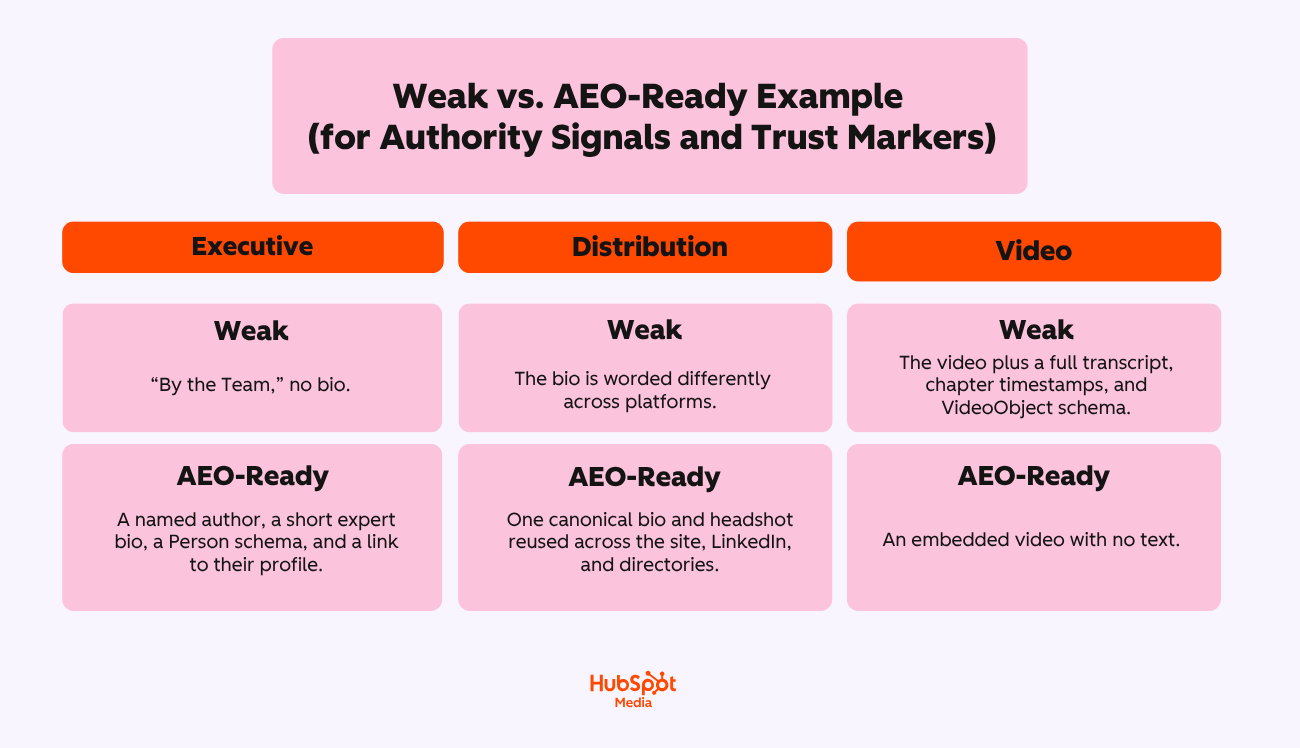
III. Authoritative Signals and Trust Markers: Earning AI’s Confidence

Answer engines do not cite content indiscriminately; they prioritize trustworthiness. Two pages might offer equally accurate answers, but the engine will favor the source it can verify as authoritative. These authoritative signals are fundamental to earning citation quality.
- Authoritative Profiles: Robust, well-described profiles for brands, executives, and product lines are essential. These profiles should explicitly state who and what they represent, including credentials, experience, and affiliations. This layer transforms vague mentions into verifiable entities for the AI.
- Distribution Across Trusted Ecosystems: Where content and entities appear beyond a brand’s own site also acts as a trust signal. Corroboration across reputable external sources—such as industry publications, academic journals, news outlets, or influential social media platforms—enhances an engine’s perception of authority.
- Video Transcripts and Structured Data: Video content, while rich, is often challenging for AI to parse. Providing comprehensive transcripts, specific timestamps, and
VideoObjectschema enables engines to "read" the video content and extract citable passages, significantly increasing its visibility potential in AI Overviews.
IV. Strategic Internal Linking Architecture: Site-Level Organization
Internal linking is the site-wide expression of structural integrity, often overlooked but critical for AEO. A strong internal linking strategy helps engines crawl, group, and establish trust among related content. Conversely, weak or random linking can leave valuable answers isolated and difficult to associate with broader topics. Optimizing internal links is one of the most effective ways to prepare content for AI Overviews at a holistic site level.
- Hub-and-Spoke Structure: This model organizes content around a central, authoritative "hub" page that links to more focused "spoke" pages addressing specific sub-topics. This architecture clearly signals topical authority and relationships to search engines.
- Clear Anchor Text and Early Link Placement: The text used for internal links (anchor text) should be descriptive and relevant, telling search engines what the linked page is about. Placing important internal links early in the content also signals their significance.
- Topic Clusters: Grouping interlinked pages that comprehensively cover a subject strengthens topical authority and makes it easier for AI to understand the depth of coverage your site offers on a given theme.
V. Passage-Level Optimization for Extraction: The Atomic Unit of AEO
At its most granular level, AEO demands that individual passages be optimized for independent extraction. A "passage" refers to any self-contained chunk of content—a paragraph, a list item, a table row, or a definition. The goal is for each passage to make complete sense even when lifted out of its original context. This "passage-first" mindset is the core of AEO at the content level.
- Stand-Alone Paragraphs: Each paragraph should ideally answer a single question and be self-sufficient. This means opening with the answer and then providing supporting details, avoiding pronouns or phrases that rely on preceding text for context (e.g., "this approach").
- Structured Formats: Lists, tables, and definition boxes are inherently snippet-friendly. They present information in a concise, organized manner that is highly conducive to AI extraction. Using bulleted lists for key points, tables for comparative data, and dedicated definition boxes for important terms significantly boosts citability.
- Concise, Extractable Sentences: Sentence length and clarity directly impact how cleanly an engine can quote content. Employing active voice, precise vocabulary, and avoiding overly complex sentence structures ensures that AI can easily parse and present your information.
Aligning AEO with Google’s Quality Guidelines: The Ethical Imperative
Structural optimization is only effective when the underlying content is genuinely helpful and high-quality. Google consistently rewards "people-first" content, and AEO strategies that attempt to game the system without substance are prone to backfiring. The structural themes discussed—clear headings, direct answers, schema—are designed to amplify quality, not to mask its absence. The foundational principle remains: "Would this answer satisfy the searcher even if no AI summarized it?" If not, the content’s substance requires immediate attention.
- Accuracy, Quality, Relevance, and User Context: These are the core dimensions against which Google evaluates content. Any AEO work must treat these as prerequisites. Content must be factually correct, well-written, directly relevant to the query, and tailored to the user’s intent.
- Disclosure When Automation Assists: Google considers AI-assisted content acceptable when it is genuinely helpful and not primarily produced to manipulate rankings. Transparency regarding AI involvement protects reader trust. A common practice is to add an editor’s note, such as "Reviewed and fact-checked by [Name], [Title]," signaling human oversight and accountability.
- Helpful Content Guardrails: Establishing clear "Do" and "Do Not" guidelines helps content teams maintain consistency and quality. "Do" focus on original research, unique insights, and comprehensive answers. "Do Not" produce content solely for search engines, generate large volumes of low-quality AI content, or create misleading information. Consistent entity signals and honest attribution reinforce Google’s perception of trustworthiness.
Measuring Success in the AEO Landscape: Proving Impact
A critical challenge in AEO is quantifying its effectiveness. Marketers need to move beyond simply publishing structured content to demonstrably proving that these structural changes lead to more citations. Measurement is the bridge between strategy and tangible results, confirming that AEO efforts are yielding returns.
- Key Performance Indicators (KPIs): Three primary KPIs are crucial for tracking AEO performance:
- Citation Volume: The number of times your content is cited by answer engines.
- Citation Quality: The prominence and context of these citations (e.g., direct quotes, featured snippets, full attribution).
- Answer Engine Visibility: Overall presence and performance of your content within AI Overviews and similar features.
- The Measurement Loop: AEO should be treated as a continuous cycle of testable hypotheses:
- Diagnose: Identify areas where content structure can be improved.
- Test: Implement specific structural changes (e.g., adding Q&A blocks).
- Measure: Track the impact of these changes on citation volume, quality, and visibility.
- Iterate: Refine strategies based on data, applying successful tactics more broadly. This iterative process is the practical core of optimizing content for answer engines.
Operationalizing High-Citation Content Themes: From Strategy to Workflow
For AEO gains to be sustainable, winning structural themes must be systematized. Operationalizing AEO means transforming one-off successes into repeatable workflows, ensuring that every piece of content consistently adheres to citation-ready structures, regardless of the individual creator. This consistency is paramount, as answer engines favor content with clear structure and direct answers.
- Role-Based Checklists: Assigning clear ownership for each stage of the AEO process prevents critical steps from being overlooked. This includes roles for content strategists (defining structure), writers (implementing Q&A, paragraphs), editors (ensuring clarity, schema adherence), and technical SEO specialists (managing schema, internal linking).
- Content Templates: Reusable templates integrate structural themes directly into the content creation process, removing guesswork for writers. Platforms like HubSpot’s Content Hub can facilitate the creation of templates that default to AEO best practices, including predefined sections for question-led headings, direct-answer summaries, and schema-friendly layouts. AI tools such as Breeze AI can even assist in generating initial drafts of Q&A blocks and TL;DR summaries based on these templates, which are then reviewed and refined by human editors to meet quality guardrails.
Navigating Key AEO Implementation Queries
Marketers frequently encounter specific questions when implementing AEO strategies. Addressing these proactively can streamline the transition.
- Optimizing Existing Content: A new page is rarely necessary for AI Overviews. Existing content can almost always be optimized by reformatting, adding direct answers, and applying schema. This leverages established authority and avoids content duplication.
- B2B Schema Types: For B2B content, prioritizing
Organization,Person,Product/Service, andArticleschema types is crucial. These establish credibility, clearly define offerings, and structure content for machine understanding, strengthening AEO. - Content Refresh Rates: Refreshing content should be tied to the pace of topic change rather than a fixed calendar. Update facts, re-confirm direct answers, and refresh structured data to signal freshness. Stale answers quickly lose citations to more current sources.
- Restricting LLMs: While possible via robots.txt, blocking AI crawlers means forfeiting potential citation upside without necessarily improving traditional SEO. The structural elements that earn AI citations also benefit traditional rankings. The more common and beneficial approach is to compete on structure by staying open to answer engines.
- Aligning AEO with CRM Funnel: Map content structure to specific funnel intents (awareness, consideration, decision) and connect this to CRM data for performance measurement. This allows businesses to track how AEO-optimized content drives revenue, not just reach.
The Road Ahead: A New Era of Digital Visibility
The transition to AEO, while initially daunting, is fundamentally about mastering a systematic discipline: structure. Large Language Models prioritize content that is clear, direct, and well-organized. Every format that successfully earns citations is merely a different manifestation of this core principle. Marketers are not required to reinvent their entire content strategy but rather to refine it, making their most valuable answers effortlessly discoverable, extractable, and attributable.
The work involved in AEO is manageable because it is systematic rather than reliant on elusive "magic." The immediate steps include diagnosing current citation performance, establishing clear structural templates, and implementing role-based checklists. Consistent entity modeling, linking brand, product, and author relationships, ensures that these efforts compound over time. By treating AEO as a repeatable, data-backed workflow instead of a speculative endeavor, businesses can transform it into a durable competitive advantage in the rapidly evolving AI search landscape.
To embark on this journey and convert content structure into tangible citations, platforms like HubSpot AEO offer comprehensive tools to assess current standing and guide optimization efforts. The future of digital visibility is here, and it is undeniably structured.








