Raul Delapena Setiawan

Conversion marketing has emerged as the critical focal point for digital enterprises seeking to stabilize their return on investment (ROI) amid rising customer acquisition costs and increasingly saturated digital marketplaces. As traditional traffic acquisition strategies—such as Search Engine Optimization (SEO) and Pay-Per-Click (PPC) advertising—become more expensive and competitive, industry analysts and marketing professionals are pivoting toward a "conversion-first" methodology. This approach prioritizes the optimization of existing traffic, ensuring that every visitor to a digital property is guided toward a specific, value-generating action. The shift represents a fundamental move from quantitative metrics, like total hits or page views, to qualitative outcomes that directly impact a company’s bottom line.
The Economic Context of Conversion Marketing
The modern digital landscape is characterized by a significant inflation in the cost of attracting visitors. Market data indicates that as major platforms like Google and Meta refine their advertising algorithms and face increased bidding competition, the cost-per-click (CPC) for high-intent keywords has seen a steady upward trend. For many businesses, simply "buying more traffic" is no longer a sustainable growth strategy.
Conversion marketing addresses this inefficiency by focusing on the Conversion Rate (CR). The mathematical advantage of this strategy is profound: if a website receiving 10,000 monthly visitors increases its conversion rate from 2% to 4%, it effectively doubles its leads or sales without increasing its advertising spend. This efficiency is particularly vital for Small and Medium Enterprises (SMEs) and Software-as-a-Service (SaaS) companies, where marketing budgets are often under intense scrutiny and must be justified by immediate performance data.
Defining Conversion: Macro and Micro Goals
To implement a successful conversion marketing strategy, organizations must first define what constitutes a "win." Professional marketers categorize these wins into macro and micro conversions. A macro conversion is the primary goal of a website, such as a completed product purchase, a subscription signup, or a booked software demo. Conversely, micro conversions are smaller, incremental steps that indicate interest and move a visitor closer to the final goal, such as downloading a whitepaper, viewing a pricing page, or signing up for a newsletter.
Industry benchmarks for these rates vary significantly by sector. According to data updated in mid-2025, B2B SaaS companies often see average conversion rates between 1% and 5%, while high-performing e-commerce sites may reach 3% to 10% depending on the niche. However, analysts suggest that internal benchmarking—measuring current performance against historical data—is more valuable than chasing broad industry averages, as variables like brand authority and product price points heavily influence user behavior.
The Psychological Framework of Conversion
At the heart of conversion marketing is the application of behavioral psychology to digital design. Visitors do not convert by accident; they do so when the perceived value of the offer outweighs the friction of the process.
The Value Proposition
The value proposition is the foundational element of any landing page. It must clearly and instantly communicate what the visitor stands to gain. Successful value propositions are characterized by clarity over cleverness. Research into user attention spans suggests that a website has less than five seconds to convey its message before a visitor decides to stay or bounce. A compelling proposition addresses a specific pain point and offers a unique solution that competitors do not provide.

Trust and Social Proof
In an era of heightened digital skepticism, trust is a non-negotiable currency. Conversion marketing relies heavily on "social proof"—the psychological phenomenon where people mirror the actions of others in an attempt to reflect correct behavior. This is manifested through customer testimonials, case studies, industry certifications, and trust badges (such as security seals).
Data shows that specific social proof is significantly more effective than generic praise. For instance, a testimonial stating, "This software saved our team 15 hours per week," provides a quantifiable benefit that resonates more deeply with potential buyers than a simple "Great product" quote.
Urgency and Incentives
Human psychology is wired to avoid loss, a concept known as loss aversion. Marketers leverage this by creating legitimate urgency through limited-time offers, countdown timers, or low-stock alerts. When combined with incentives like free shipping, a discount code, or a "buy-one-get-one" offer, urgency acts as a catalyst for immediate action, reducing the likelihood that a visitor will leave the site to "think about it" and never return.
The Role of Site Usability and Performance
Technical performance is a primary driver of conversion rates. Site design and usability are often the silent killers of ROI. A study on digital consumer behavior revealed that a one-second delay in page load time can result in a 7% reduction in conversions.
Furthermore, mobile responsiveness is no longer optional. With more than half of global web traffic originating from mobile devices, sites that are difficult to navigate on a smartphone—featuring tiny buttons, unreadable text, or complex forms—see massive abandonment rates. Form optimization is another critical area; statistics indicate that approximately 27% of users abandon online forms due to excessive length or unnecessary questions. High-converting strategies typically involve reducing form fields to the absolute minimum required for lead qualification.
Tactical Implementation: Landing Pages and A/B Testing
The most effective vehicle for conversion marketing is the dedicated landing page. Unlike a general homepage, which offers multiple paths and distractions, a landing page is laser-focused on a single Call to Action (CTA).
Strategic Landing Page Design
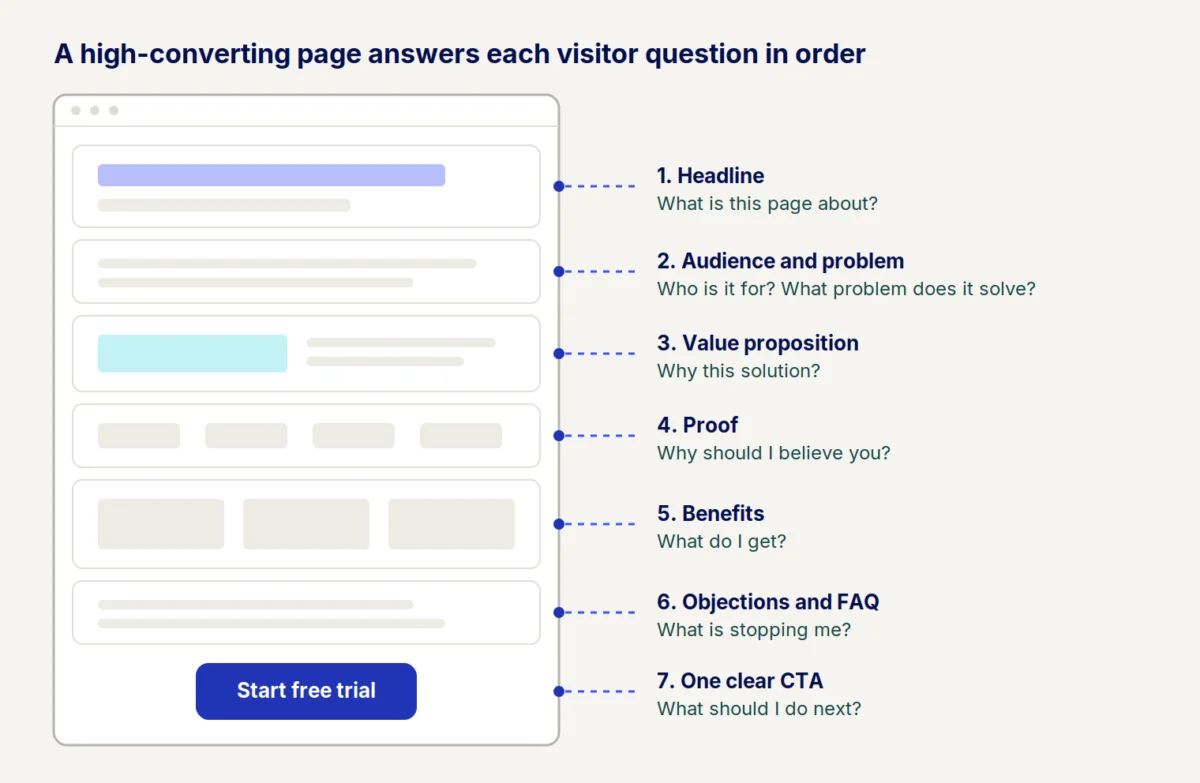
High-impact landing pages typically follow a specific hierarchy:
- Headline: A bold statement of the value proposition.
- Visuals: High-quality images or videos that demonstrate the product in action.
- Benefits: Bulleted lists explaining how the product solves the user’s problem.
- Social Proof: Evidence of success from other customers.
- CTA: A clear, high-contrast button that tells the user exactly what to do next.
The Necessity of Experimentation
A/B testing, or split testing, is the scientific method of conversion marketing. It involves creating two versions of a page (Variant A and Variant B) and splitting traffic between them to see which performs better. Professional marketing teams test a variety of elements, including headline copy, button colors, imagery, and the placement of trust signals.

The industry has seen a move toward "Smart Traffic" solutions, which utilize Artificial Intelligence (AI) to automatically route visitors to the page variant they are most likely to convert on based on their geographic location, device type, and past behavior. This automation allows smaller teams to achieve enterprise-level optimization without manual oversight.
Data Mining and Continuous Improvement
Conversion marketing is an iterative process, not a one-time project. It requires a robust feedback loop powered by both quantitative and qualitative data.
Analytics and Heatmaps
Tools like Google Analytics provide the "what"—showing bounce rates and conversion paths. However, heatmapping software (such as Hotjar or Microsoft Clarity) provides the "why" by visualizing where users click, how far they scroll, and where they encounter friction. If a heatmap shows that 90% of users are not scrolling far enough to see the CTA, the marketer knows to move the button higher on the page.
Sales and Support Feedback
Some of the most valuable insights come from the front lines of a business. Sales and customer support teams interact with prospects daily and can identify recurring objections or points of confusion. By addressing these concerns directly in the marketing copy, businesses can preemptively remove barriers to conversion.
Integration into the Broader Marketing Ecosystem
Conversion marketing does not exist in a vacuum; it serves as the connective tissue for all other marketing efforts. Whether a lead comes from an organic search result, a social media ad, or an email campaign, the destination must be optimized for conversion.
- PPC: Optimized landing pages lower the Cost Per Lead (CPL) and improve the Quality Score in ad platforms, leading to lower ad costs.
- SEO: While SEO brings visitors to the door, conversion tactics ensure those visitors become customers, justifying the long-term investment in content creation.
- Email Marketing: Segmented email campaigns that drive traffic to personalized landing pages see significantly higher conversion rates than those pointing to a generic homepage.
Conclusion: The Future of Digital Growth
As digital markets continue to evolve, the distinction between "marketing" and "conversion marketing" is blurring. The most successful organizations of 2025 and beyond are those that recognize that traffic is a means to an end, not the end itself. By focusing on the psychology of the user, the technical performance of their platforms, and a culture of continuous experimentation, businesses can build resilient growth engines that are less dependent on fluctuating ad prices and more focused on providing genuine value to their visitors.
The move toward no-code platforms and AI-enabled optimization tools has democratized these strategies, allowing teams of all sizes to compete on the basis of efficiency. In a landscape where every click counts, conversion marketing remains the most reliable path to sustainable digital success.

 Muslim
 Laily UPN