

In an increasingly competitive digital marketplace, the strategic deployment of post-purchase Short Message Service (SMS) has emerged as a critical component for e-commerce businesses aiming to optimize customer experience, foster loyalty, and stimulate sustained revenue growth. This direct, immediate communication channel, when integrated thoughtfully into the customer journey, moves beyond mere transactional updates to become a powerful tool for engagement and retention. The shift towards a mobile-first consumer base has amplified the efficacy of SMS, positioning it as an indispensable element in a comprehensive omnichannel marketing strategy.
The Evolving Landscape of E-commerce Communication
![Post-Purchase SMS: Examples and Strategy [2026]](https://www.omnisend.com/blog/wp-content/uploads/2021/12/Post-Purchase-Messaging-for-First-Time-Customers.png)
The proliferation of smartphones and the constant connectivity they afford have fundamentally reshaped consumer expectations. Today’s customers demand instantaneous information and personalized interactions throughout their purchasing journey, including the crucial post-transaction phase. While email remains a vital channel for detailed communication, its asynchronous nature and often-cluttered inboxes can delay critical updates or dilute marketing messages. SMS, by contrast, offers unparalleled directness and immediacy, boasting significantly higher open and engagement rates compared to email. This immediacy makes it uniquely suited for time-sensitive notifications, building trust through proactive communication, and nurturing customer relationships long after the initial sale.
Historically, SMS was primarily utilized for basic alerts. However, advancements in marketing automation platforms have transformed it into a sophisticated tool capable of delivering highly contextualized and personalized messages triggered by specific customer behaviors or order statuses. This evolution is not merely a technological convenience but a strategic necessity, as businesses vie for customer attention and loyalty in a crowded digital space. Industry reports consistently highlight the superior performance of automated SMS, particularly in the post-purchase phase, underscoring its financial viability and strategic importance.
The Dual Role: Transactional vs. Promotional SMS
![Post-Purchase SMS: Examples and Strategy [2026]](https://www.omnisend.com/blog/wp-content/uploads/2026/07/1.-Post-purchase-SMS-example.png)
Post-purchase SMS fundamentally serves two distinct yet interconnected purposes: transactional and promotional. Understanding the nuances and legal requirements of each is paramount for effective implementation.
- Transactional SMS: These messages are non-promotional in nature and directly relate to a customer’s purchase. They include order confirmations, shipping updates, delivery notifications, and critical alerts. Crucially, transactional texts can be sent to any customer who provides their phone number during checkout, as they are considered essential service messages rather than marketing communications. Their primary goal is to inform, reassure, and build confidence in the brand’s reliability. The directness of SMS ensures these critical updates reach the customer promptly, mitigating anxiety and enhancing the overall purchase experience.
- Promotional SMS: These messages carry a marketing intent, aiming to drive future purchases, encourage engagement, or build brand loyalty. Examples include thank-you messages with future discounts, requests for product reviews, loyalty program invitations, replenishment reminders, and win-back offers. Unlike transactional messages, promotional SMS strictly requires explicit opt-in consent from the customer. Non-compliance with opt-in regulations (such as TCPA in the U.S. or GDPR in Europe) can lead to significant legal penalties and damage brand reputation. It is essential for businesses to clearly distinguish between these two categories and manage consent appropriately.
A transactional message can inadvertently become a marketing message if it includes promotional elements, such as a link to a sales page within an order confirmation. In such cases, the message must adhere to marketing opt-in requirements. This distinction is vital for maintaining legal compliance and customer trust.
The Economic Impact: Data-Backed Benefits
![Post-Purchase SMS: Examples and Strategy [2026]](https://www.omnisend.com/blog/wp-content/uploads/2026/07/2.-Order-confirmation-SMS.png)
The effectiveness of automated post-purchase SMS is not merely anecdotal; it is substantiated by compelling data. Statistics from 2025 reveal that automated SMS messages, including those deployed post-purchase, generated an average of $0.74 per send, a substantial increase compared to $0.15 per send for general marketing campaigns. This significant difference highlights the power of contextual and timely communication. Furthermore, automated SMS boasted a 3.81% click-to-conversion rate, far surpassing the 0.97% achieved by campaigns. These figures underscore the robust return on investment (ROI) that businesses can expect from a well-structured post-purchase SMS strategy.
Beyond direct revenue, the benefits extend to crucial aspects of business health:
- Enhanced Customer Satisfaction: Proactive communication reduces customer anxiety, builds trust, and fosters a positive perception of the brand.
- Increased Retention and Loyalty: Engaged customers are more likely to make repeat purchases and become brand advocates. Loyalty programs and personalized offers delivered via SMS reinforce these bonds.
- Improved Operational Efficiency: Automation streamlines communication processes, freeing up customer service resources that would otherwise be spent responding to "where is my order?" inquiries.
- Valuable Feedback Collection: SMS provides a quick and convenient channel for soliciting product reviews and feedback, crucial for product development and social proof.
- Higher Customer Lifetime Value (CLTV): By nurturing relationships and driving repeat purchases, post-purchase SMS directly contributes to increasing the long-term value of each customer.
Crafting the Customer Journey: The Post-Purchase SMS Sequence
![Post-Purchase SMS: Examples and Strategy [2026]](https://www.omnisend.com/blog/wp-content/uploads/2026/07/3.-Shipping-update-SMS.png)
A truly effective post-purchase SMS strategy is not a one-off message but a carefully designed sequence of communications that guide the customer through various stages, from initial transaction to long-term loyalty. This sequence can be broadly categorized into three phases:
-
Transactional (Order placed to delivery): This phase focuses on essential updates, ensuring transparency and reassurance.
- Order Confirmation: Sent immediately after purchase, acknowledging the order and providing an order number. This is the foundational message.
- Shipping Updates: Notifies the customer when their order has shipped, often including a tracking link.
- Delivery Notice: Informs the customer that their package has been delivered. This helps prevent package theft and confirms successful fulfillment.
- Consent Requirement: No marketing opt-in needed, as these are service messages.
-
Engagement (Days after arrival): Once the product has arrived, this phase shifts to fostering deeper engagement and gathering feedback.
![Post-Purchase SMS: Examples and Strategy [2026]](https://www.omnisend.com/blog/wp-content/uploads/2026/07/4.-Delivery-notice-SMS.png)
- Thank-You Message: A personalized note expressing gratitude for their business, often hinting at future benefits or exclusive offers.
- Review Request: Asks the customer to rate their product or overall experience, typically a few days after delivery to allow time for product use.
- Product Onboarding/Tips: For complex products, this might include helpful tips, links to guides, or usage instructions to ensure customer satisfaction and product adoption.
- Consent Requirement: Marketing opt-in needed.
-
Retention (Weeks to months later): This long-term phase aims to encourage repeat purchases and cement customer loyalty.
- Replenishment Reminder: For consumable products, a timely reminder when a reorder might be necessary.
- Loyalty Invite: Invites customers to join a loyalty program, offering exclusive benefits and rewards.
- Win-back Offer: Targets customers who haven’t purchased in a while, offering incentives to return.
- Consent Requirement: Marketing opt-in needed.
Exemplary Messages: Anatomy of Effective Post-Purchase SMS
Each message in the sequence plays a specific role and should be crafted with precision, adhering to character limits and best practices.
![Post-Purchase SMS: Examples and Strategy [2026]](https://www.omnisend.com/blog/wp-content/uploads/2026/07/5.-Thank-you-message-SMS.png)
-
Order Confirmation:
- Example: "Thanks [Name]! Your [Brand] order #[Number] is confirmed. We’ll text you when it ships. Track here > [Link]."
- Key Elements: Personalization (name), brand mention, order number, clear next steps, tracking link, brevity, and an implied opt-out (e.g., "Reply STOP to opt-out" for compliance).
- Why it works: Immediate reassurance, clear information, sets expectations.
-
Shipping Update:
- Example: "Good news, [Name], order #[Number] is on its way via [Courier Partner]! Track shipping at [Link]."
- Key Elements: Personalization, order number, courier details, tracking link, sense of excitement.
- Why it works: Keeps customers informed, reduces "where is my order" queries.
-
Delivery Notice:
![Post-Purchase SMS: Examples and Strategy [2026]](https://www.omnisend.com/blog/wp-content/uploads/2026/07/6.-Feedback-request-SMS.png)
- Example: "Order #[Number] from [Brand] has been delivered. Thank you for your purchase. Need help? Visit [Link]."
- Key Elements: Order confirmation, brand, confirmation of delivery, customer support link.
- Why it works: Confirms receipt, offers support proactively, completes the transactional loop.
-
Thank-You Message:
- Example: "Thank you for your recent order of [Product]. We’ll send you an exclusive discount for your next order soon. Stay tuned!"
- Key Elements: Gratitude, specific product mention, anticipation of future value.
- Why it works: Builds goodwill, encourages future engagement.
-
Feedback Request:
- Example: "Hi [Name], how would you rate your recent [Brand] experience? Review us at [Link], and we’ll send you 20% off."
- Key Elements: Personalization, clear call to action (CTA), incentive for feedback, direct link.
- Why it works: Gathers valuable social proof and product insights, incentivizes participation.
-
Loyalty Invite:
![Post-Purchase SMS: Examples and Strategy [2026]](https://www.omnisend.com/blog/wp-content/uploads/2026/07/7.-Loyalty-invite-SMS.png)
- Example: "Dear [Name], you’re invited to be a [Brand] VIP! Collect 10% off now & points to spend. Register free > [Link]."
- Key Elements: Personalization, exclusive offer, clear benefits, direct registration link.
- Why it works: Drives long-term commitment, increases CLTV.
-
Replenishment Reminder:
- Example: "Hi [Name], your [Product] is due for a refresh on [Date]. We’ll take payment automatically. To change subscription, visit [Link]."
- Key Elements: Personalization, product name, specific date, clear instructions for subscription management.
- Why it works: Drives recurring revenue for subscription-based products, provides convenience.
-
Win-back Offer:
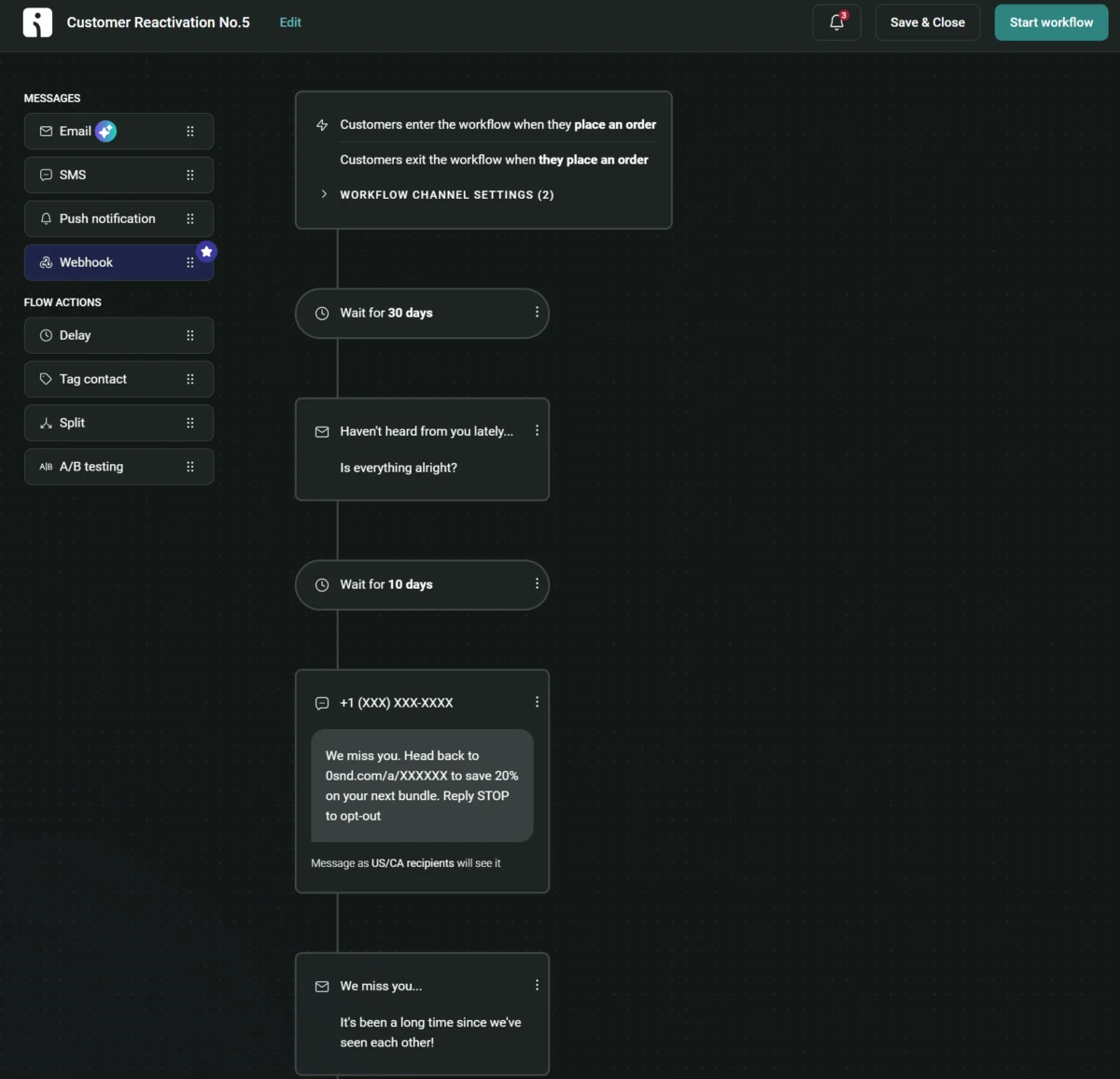
- Example: "[Name], it’s been a while since you last shopped with us. Here’s 20% off your next order! Use code [Code]. Shop at [Link]."
- Key Elements: Personalization, recognition of inactivity, compelling discount, clear CTA with code and link.
- Why it works: Re-engages lapsed customers, recovers potential lost revenue.
Mastering the Message: Best Practices for Post-Purchase SMS
![Post-Purchase SMS: Examples and Strategy [2026]](https://www.omnisend.com/blog/wp-content/uploads/2026/07/8.-Replenishment-reminder-SMS.png)
To maximize the impact of post-purchase SMS, several best practices should be observed:
- Adhere to Character Limits: Standard GSM messages allow 160 characters, while Unicode (for emojis or special characters) limits to 70. Exceeding these limits segments messages, incurring additional costs and potentially reducing impact. Concise, impactful language is key.
- Personalize Your Message: Addressing customers by their first name ("Hi Sarah," "Your order’s confirmed, Joe") significantly increases engagement. Leveraging customer segments for tailored content further enhances relevance.
- Clear Call-to-Action with Single Link: Guide the customer with actionable text before a link (e.g., "Tap here to track >"). Limit messages to a single URL to avoid confusion and maximize click-through rates.
- Brand Identification: Always include your brand name, especially for U.S./Canadian recipients where texts often display a number rather than a brand name. This builds recognition and trust.
- Strategic Timing for Engagement: While transactional messages are immediate, schedule promotional and follow-up texts during optimal engagement windows. Data suggests 8 AM–9 AM often yields the best conversion rates for non-urgent communications.
Technological Imperatives: Automating SMS Workflows
The scalability and effectiveness of a robust post-purchase SMS strategy hinge on automation. Platforms like Omnisend offer intuitive workflow builders that enable businesses to create sophisticated, multi-channel sequences without extensive technical expertise.
![Post-Purchase SMS: Examples and Strategy [2026]](https://www.omnisend.com/blog/wp-content/uploads/2026/07/9.-Win-back-SMS.png)
- Setting Up Automation Workflows: Businesses can design workflows triggered by specific customer actions (e.g., "Order Placed," "Order Fulfilled"). These workflows can incorporate various steps, including delays, SMS messages, emails, and webhooks, allowing for a truly integrated approach. Pre-built templates for common scenarios like product reviews, replenishment reminders, and cross-sells accelerate implementation.
- Customizing Message Timing: Automation tools provide granular control over message delivery, allowing businesses to set delays in minutes, hours, days, weeks, or months, or even schedule messages for specific times of day or days of the week. This precision ensures messages land at the most impactful moments.
- Personalizing Messages with Data: Advanced platforms integrate with customer profiles, allowing dynamic insertion of personalization tags (e.g.,
first_name,product_name). This ensures each message is tailored to the individual recipient, enhancing relevance and engagement. - Multichannel Integration: The most effective strategies combine SMS with other channels like email and web push notifications within a single workflow. This ensures a cohesive customer experience and leverages the strengths of each medium. For instance, Omnisend customers in 2025 generated an impressive $79 for every $1 invested across email, SMS, and web push notifications, demonstrating the power of a unified approach.
Measuring Success and Optimizing Strategy
Continuous monitoring and analysis of SMS performance are crucial for optimizing workflows and maximizing ROI. Automation platforms provide detailed analytics dashboards that track key metrics:
- Sent/Delivered Rates: Indicates message reach.
- Click-Through Rates (CTR): Measures engagement with links.
- Conversion Rates: Tracks direct sales attributed to SMS.
- Revenue Generated: Quantifies the financial impact.
- Opt-Out Rates: Monitors customer sentiment and helps identify messages that may be perceived as intrusive.
These metrics, available at both the overall campaign and individual workflow level, enable businesses to make data-driven decisions on timing, content, segmentation, and overall strategy, ensuring ongoing improvement.
![Post-Purchase SMS: Examples and Strategy [2026]](https://www.omnisend.com/blog/wp-content/uploads/2026/07/10.-Setting-up-automation-workflows.png)
Regulatory Compliance: A Critical Consideration
Navigating the legal landscape of SMS marketing is non-negotiable. Regulations such as the Telephone Consumer Protection Act (TCPA) in the United States, the General Data Protection Regulation (GDPR) in Europe, and similar laws globally mandate explicit consent for marketing messages.
- Opt-In Requirements: For promotional SMS, customers must provide clear, unambiguous consent. This is typically achieved via an unticked checkbox at checkout, a dedicated sign-up form, or a double opt-in process.
- Opt-Out Mechanisms: Every marketing SMS must include a clear and easy way for recipients to opt out, such as "Reply STOP to opt-out." Platforms like Omnisend automatically include this for U.S. and Canadian recipients. For international audiences, an unsubscribe link within the message or a clear instruction on how to opt-out via a web page is often required.
- Transactional vs. Marketing Distinction: Businesses must be vigilant in distinguishing between transactional and marketing messages to ensure appropriate consent is obtained. Misclassifying a promotional message as transactional to bypass opt-in requirements can lead to severe penalties.
Choosing the Right Tool for Post-Purchase SMS
![Post-Purchase SMS: Examples and Strategy [2026]](https://www.omnisend.com/blog/wp-content/uploads/2026/07/11.-Pre-built-workflows.png)
Selecting an appropriate SMS marketing platform is a strategic decision. Key considerations include:
- Scope of Features: Does it support both transactional and promotional SMS? Are there robust behavioral triggers for automation?
- Global Reach: Does it support sending to all target regions (U.S., Canada, Europe, Asia, etc.) with local compliance?
- Multichannel Capabilities: Can it consolidate email, SMS, and web push notifications into unified workflows?
- E-commerce Integration: Does it seamlessly integrate with your existing e-commerce platform (e.g., Shopify, Magento) and other essential apps?
- Analytics and Reporting: Are comprehensive performance tracking tools available?
Platforms like Omnisend are designed to meet these needs, offering enterprise-level automation, global SMS capabilities, multichannel mastery, and extensive integrations, making them a powerful choice for e-commerce businesses serious about optimizing their post-purchase customer journey.
Conclusion: The Future of E-commerce Engagement
![Post-Purchase SMS: Examples and Strategy [2026]](https://www.omnisend.com/blog/wp-content/uploads/2026/07/12.-Customize-message-timing.png)
Post-purchase SMS is no longer a peripheral marketing tactic but a foundational element of modern e-commerce strategy. Its unparalleled immediacy and directness, combined with the power of automation and personalization, empower businesses to forge stronger relationships with their customers, drive repeat purchases, and significantly enhance customer lifetime value. As consumer expectations continue to evolve towards instant, personalized, and seamless interactions, mastering the art and science of post-purchase SMS will be a key differentiator for brands seeking sustained success in the dynamic world of online retail. By prioritizing compliance, strategic sequencing, and data-driven optimization, businesses can transform simple text messages into powerful engines of growth and customer loyalty.








