The rapid integration of artificial intelligence into marketing workflows, while initially heralded for its potential to dramatically increase output speed, is inadvertently creating a significant bottleneck for senior reviewers, a phenomenon dubbed the "revision tax." This unforeseen consequence, stemming from an incomplete understanding of AI’s return on investment, is forcing marketing leaders to implement new strategies to maintain quality and efficiency without sacrificing production velocity. Recent studies and anecdotal evidence from industry professionals reveal that the perceived time savings from AI-generated content are often offset by the substantial hours required for editing, fact-checking, and refining the output, leading to a critical re-evaluation of AI implementation in B2B marketing.
The Flawed ROI Equation of AI in Marketing
The initial business cases for AI adoption in B2B marketing predominantly focused on quantifiable gains on the production side. Metrics such as reduced time for first drafts, increased asset production per week, repatriation of agency work, and avoidance of headcount were highlighted as key benefits. This narrow focus, however, overlooked a crucial aspect of the workflow: the significant increase in the burden placed upon those responsible for reviewing and approving content.
As marketing teams began leveraging AI to generate content at an unprecedented volume, the existing review processes, designed for a much lower output, became unsustainable. The problem is not with the AI tools themselves, but with the failure to account for the cost of meticulously reading and rectifying the extensive volume of content they produce. This oversight has led to a situation where the very tools intended to accelerate marketing efforts are now slowing down the critical final stages of content creation.
Quantifying the "Revision Tax" and "Workslop"
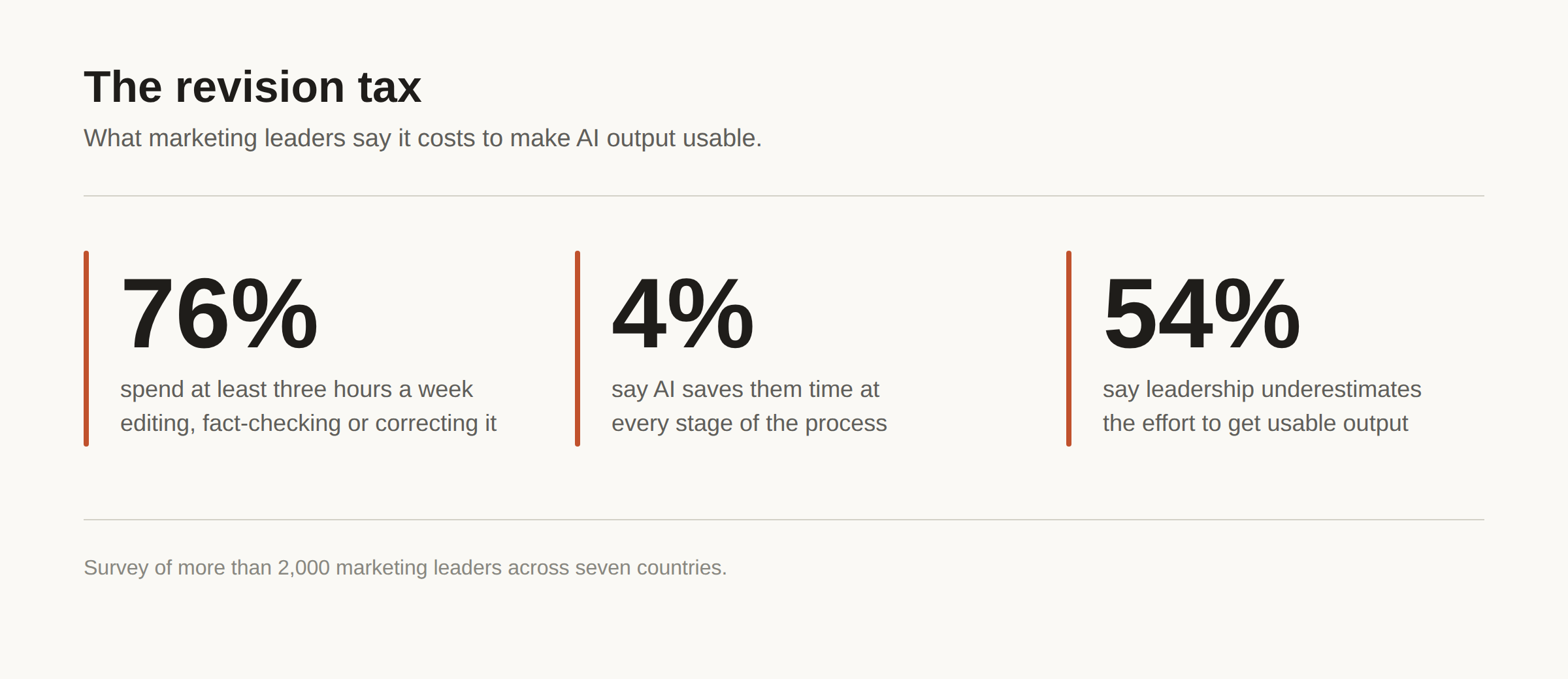
The impact of this oversight is becoming increasingly evident through recent research. A global survey of over 2,000 marketing leaders across seven countries revealed that a staggering 76% of respondents dedicate at least three hours per week to editing, fact-checking, or correcting AI-generated output. alarmingly, only 4% of these leaders reported that AI saves them time at every stage of the content creation process. This survey, conducted by a company specializing in AI marketing software, lends significant credibility to the findings, which were collectively termed the "revision tax."
Further compounding the issue, 54% of survey respondents indicated that their leadership underestimates the actual effort required to transform raw AI output into usable marketing materials. This perception gap highlights a fundamental misunderstanding of AI’s current capabilities and the human oversight necessary for effective deployment.
Researchers from Stanford University and BetterUp Labs have provided a more precise definition for this phenomenon, coining the term "workslop." They describe it as content that appears polished and well-formatted but lacks substantive thought or originality, effectively offloading the intellectual heavy lifting back to the recipient. A survey of over 1,000 desk workers indicated that approximately 40% had encountered "workslop" in the preceding month, with each instance costing an estimated two hours of their time. When extrapolated across larger organizations, this translates to a significant financial burden; an estimated $186 per employee per month, or approximately $9 million annually for a company of 10,000 employees.
The Cognitive Dissonance of AI Productivity
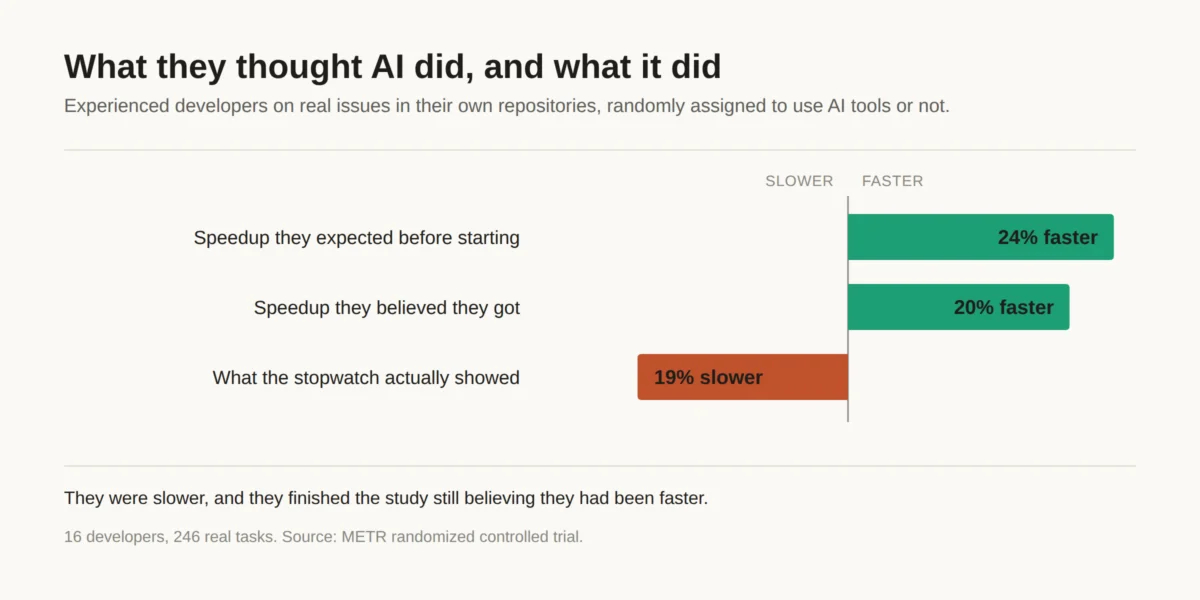
The discrepancy between perceived and actual AI productivity gains is further illustrated by a randomized study involving experienced software developers. In this experiment, developers using AI tools to work on real-world projects actually took 19% longer to complete their tasks. Paradoxically, before commencing the project, they had anticipated the AI tools would increase their speed by approximately 25%. Even after experiencing a slower workflow, a significant portion of these developers still believed that AI had, in fact, accelerated their efforts by about 20%.
This stark contrast between measured outcomes and felt experiences underscores a critical flaw in how AI’s impact is assessed. The immediate gratification of seeing content generated quickly is palpable, but the subsequent, often invisible, cost of reading, understanding, and refining that content is rarely factored into the initial economic calculations. This disconnect is largely due to the fact that the individual generating the AI output is often not the same person bearing the cost of its review and correction.
The Bottleneck Effect: Senior Reviewers Under Pressure
The implication of this "revision tax" is that the individuals in an organization best equipped to identify quality issues and provide strategic direction—often the most senior and trusted reviewers—are becoming the primary choke point. When each team member, empowered by AI, begins producing several times their previous output, all of this content funnels towards a limited number of individuals whose workloads have not correspondingly decreased.
This scenario mirrors established principles in operational management: speeding up processes upstream of a bottleneck only serves to lengthen the queue at that critical juncture. Marketing departments, in particular, appear to be facing this challenge repeatedly. The AI programs implemented to enhance efficiency are, in effect, exacerbating the workload for the very people whose expertise is most crucial for ensuring strategic alignment and brand integrity.
The Rise of the "Hollow Expert" and Diminished Critical Thinking
This situation gives rise to the concept of the "hollow expert"—an individual who can produce a remarkable volume of work but lacks the deep understanding or critical insight to elaborate on any specific piece. This is how mediocrity is scaled. The analogy of a calculator user versus someone performing long division is relevant here. While a calculator user may be faster, their ability to understand the underlying numerical concepts and articulate the reasoning behind the calculation is paramount. The calculator user still grasps the ‘why’ and the ‘what it means,’ which is essential for problem-solving and strategic decision-making. In the context of AI-generated content, if the human element of critical thinking and deep understanding is bypassed in favor of sheer volume, the output loses its strategic value, especially for complex tasks like developing business strategies.
Writing, at its core, is an act of thinking. When content is handed off to a model for generation, it implies that the complete thought process has not been undertaken by the originator. While this may be acceptable for simple updates, it becomes prohibitively expensive and counterproductive for strategies that require nuanced understanding and foresight.
Strategies for Mitigating the "Revision Tax"
Recognizing the unsustainable nature of the current trajectory, marketing leaders are actively seeking solutions to rebalance the AI equation. These strategies focus on improving quality at the source and optimizing the review process without impeding overall production.
One effective approach, championed by a marketing leader who explicitly prohibited the use of AI-generated content for internal review, places the responsibility for quality control directly back on the content creator. This rule, which mandates that content must be thoroughly reviewed and edited by the originator before submission, effectively addresses the financial accountability issue at its root. It ensures that the cost of revision is borne by the individual responsible for the initial generation, incentivizing more thoughtful and accurate output.
To make a compelling internal case for these changes, organizations are advised to present a holistic view of AI’s impact, accounting for both the claimed hours saved in production and the actual hours spent by reviewers. The difficulty in quantifying the latter underscores the ease with which this cost can be overlooked.
Beyond stricter review policies, several other practical solutions are emerging:
- Integrating Context into Universal Tools: A significant portion of the "workslop" originates not just from marketing but also from sales, product development, and customer success teams. To address this, companies are focusing on embedding brand voice, positioning, and operational context directly into the tools used across the entire organization, not just within marketing departments. This ensures that AI-generated content is more aligned with organizational standards from the outset, regardless of its source.
- Making Edits Visible and Actionable: Some Chief Marketing Officers have begun tracking the volume of edits required for incoming content and discussing these metrics in one-on-one meetings. This practice serves not as a punitive measure but as a signal to employees about the importance of self-review before submitting work. It encourages a more proactive approach to quality assurance.
- Prioritizing Pain Points: Instead of broadly accelerating all AI adoption, leaders are advised to first identify and address existing process inefficiencies. By asking teams to pinpoint what is "not working," organizations can strategically apply AI to solve specific, well-understood problems. This approach not only targets areas with the highest potential for improvement but also garners buy-in from stakeholders who are already experiencing these frustrations. Fixing a universally acknowledged problem is often politically easier than implementing a broad, top-down change.
Orchestrating for Sustainable AI Integration
Ultimately, effectively managing AI in marketing requires a commitment to what is known as "orchestration work"—a comprehensive approach that defines intake processes, designs workflows, clarifies ownership, and establishes where essential context resides. A case study involving a 200-person marketing team that had previously struggled with AI integration highlighted the success of such an orchestrated approach. The implementation resulted in a single point of intake for all requests, trackable service-level agreements (SLAs), and capacity planning that the execution team could rely upon. While these aspects may not be glamorous, they are crucial for differentiating between teams that have merely increased their speed and those that have enhanced their efficiency in strategically important areas.
The current marketing landscape is characterized by a proliferation of content generators. The true challenge and the mark of a mature marketing operation lie in the ability to defend the quality and strategic value of the content produced. As AI continues to evolve, the focus for marketing leaders must shift from simply increasing output volume to ensuring that AI serves as a tool to enhance thoughtful, strategic, and defensible communication.