The Architectural Shift from Linear to Iterative Workflows
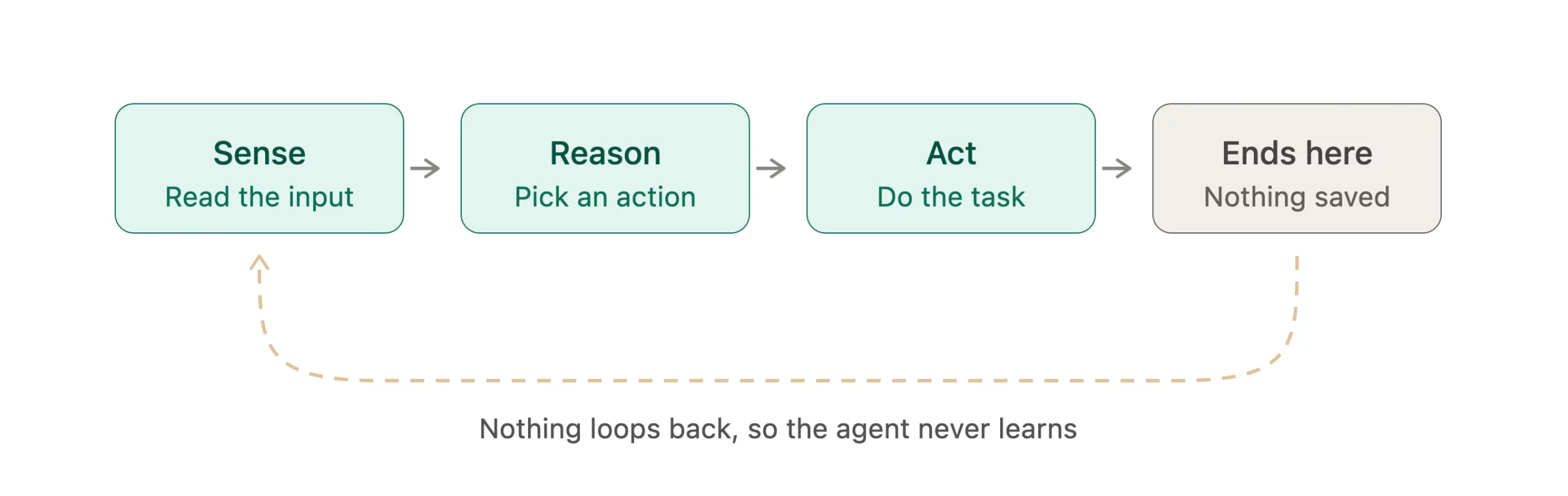
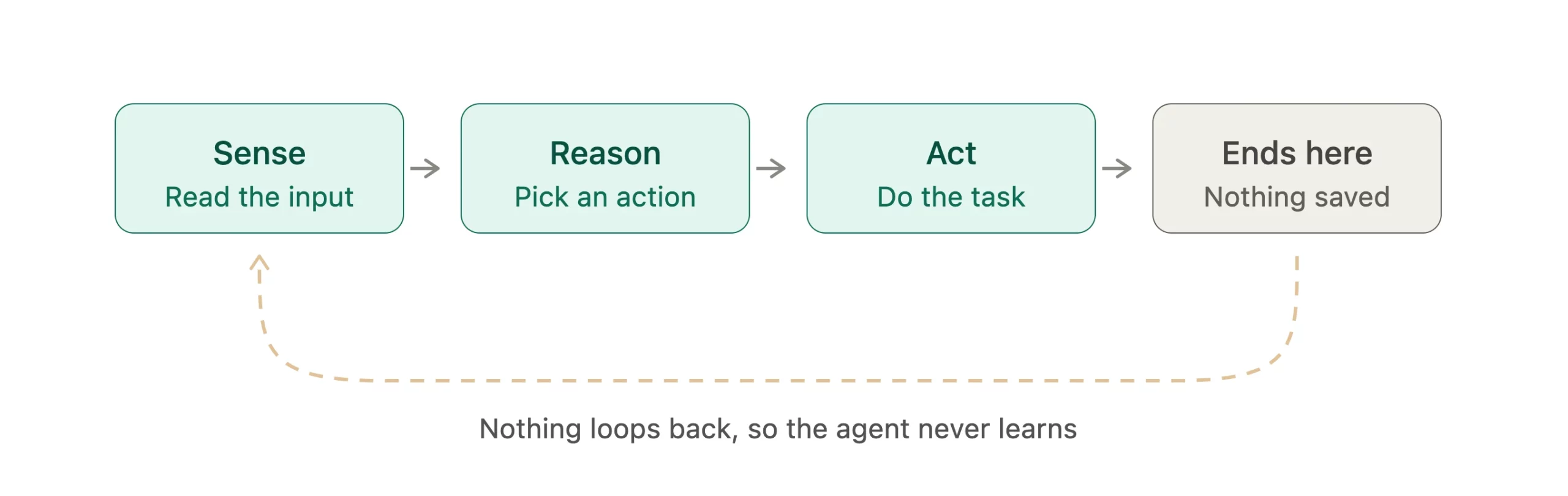
To understand the impact of self-improving loops, one must first examine the limitations of traditional agentic workflows. In a standard setup, an AI agent receives a prompt, processes it through a model, and produces an output. This workflow is linear; once the task is finished, the context is usually discarded. While these systems are reliable for simple, predictable tasks such as basic customer service inquiries or data extraction, they lack the capacity for long-term performance optimization.
In a traditional workflow, the agent operates within a “fixed-knowledge” state. If a prompt is poorly structured or if the model misinterprets a specific nuance of a business requirement, the error will persist every time that specific task is triggered. Human intervention is required to manually update the system prompt or the underlying code to correct the behavior. This manual maintenance creates a bottleneck, limiting the scalability of AI operations in complex enterprise environments.
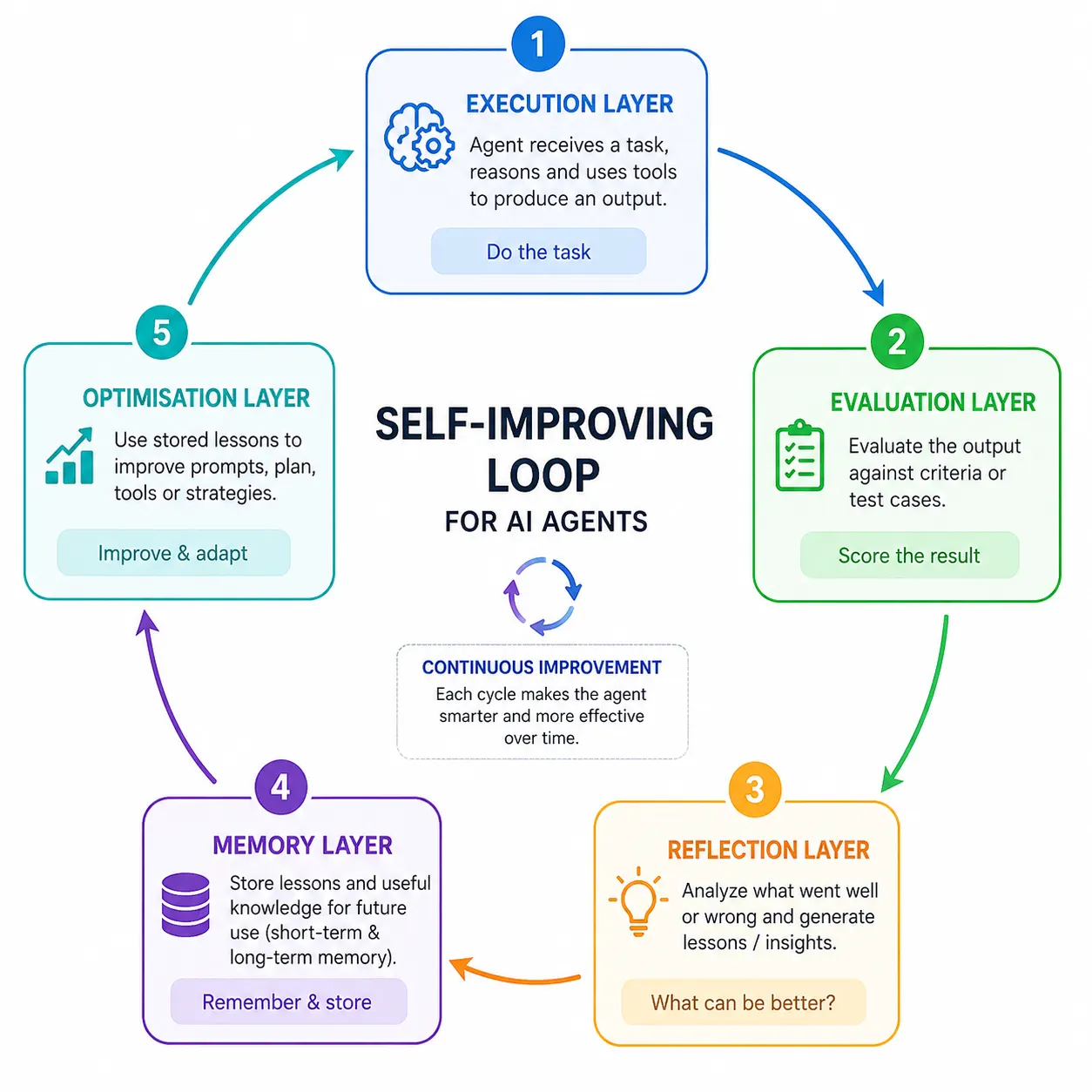
The self-improving loop breaks this cycle by introducing a recursive element. Instead of ending the process at the “Act” phase, the system moves into an “Evaluate and Reflect” phase. Here, the agent reviews its own work—or is reviewed by a separate, “critic” model—to identify gaps between the output and the desired goal. These insights are then stored in a persistent memory layer, allowing the agent to “remember” its mistakes and adjust its strategy for future tasks.
The Five Pillars of a Self-Improving Agent
The transition toward self-improving systems is built upon five core functional layers. Each layer plays a specific role in ensuring the agent does not merely repeat tasks but evolves its proficiency over time.
1. The Execution Layer
This is the “worker” component of the agent. It utilizes an LLM to perform the primary task, such as writing a report, generating code, or analyzing a dataset. In a self-improving system, this layer is dynamic; its instructions are modified by the lessons learned in previous cycles.
2. The Evaluation Layer
Crucial for quality control, this layer acts as a “judge.” Often, developers employ a more robust model (such as GPT-4o or Claude 3.5 Sonnet) specifically to grade the output of the execution layer against a set of strict criteria. This separation of concerns—where one model “does” and another “checks”—is a best practice that reduces the likelihood of hallucinations being reinforced.
3. The Reflection Layer
Once a score or critique is generated, the reflection layer translates that feedback into actionable lessons. If the evaluation layer notes that a market research report failed to cite its sources, the reflection layer generates a new rule: “Always include citations for every data point.” This turns a specific failure into a general heuristic.
4. The Memory Layer
Self-improvement requires persistence. The memory layer stores the lessons generated during reflection. This can be implemented through simple text files, relational databases, or sophisticated vector databases like Pinecone or Milvus. By retrieving these lessons at the start of a new task, the agent ensures it does not start from zero.
5. The Optimization Layer
The final pillar is the mechanism that integrates learned lessons back into the agent’s system prompt. This creates a “flywheel effect” where the agent becomes increasingly specialized for its specific environment without requiring an engineer to write new code.
Case Study: Performance Gains in Market Research Automation
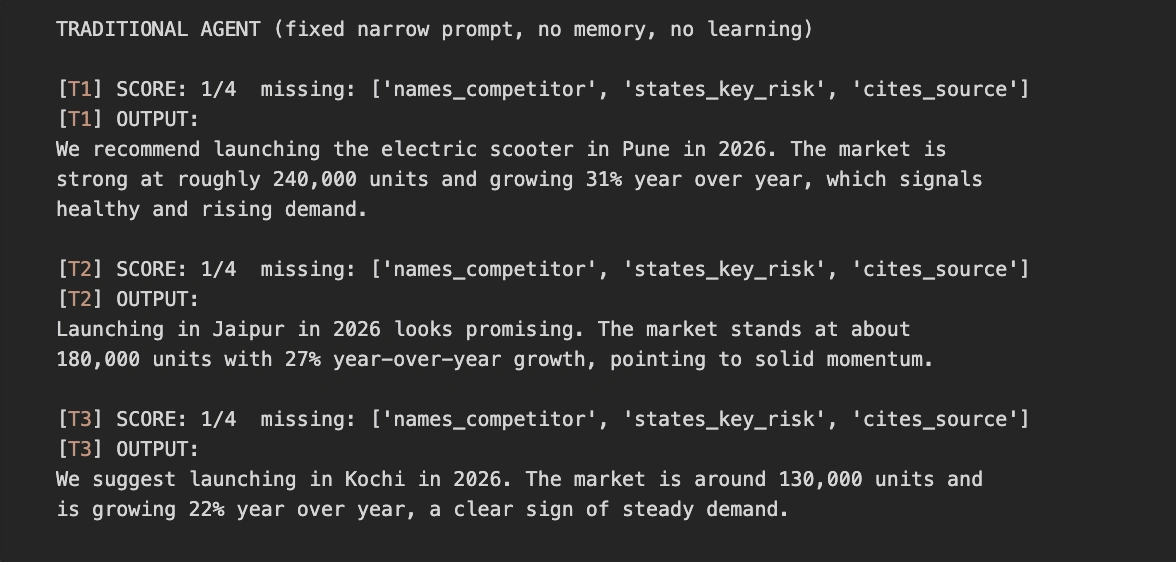
A practical comparison of traditional versus self-improving agents reveals a stark difference in operational efficiency. Consider a scenario where an agent is tasked with producing market launch recommendations for electric scooters in various Indian cities, such as Pune, Jaipur, and Kochi.
In a traditional setup, an agent might be given a narrow prompt focusing only on market size and growth. When tasked with analyzing the Pune market, the agent provides those two metrics but ignores critical factors like competitor analysis, regional risks, and data sourcing. Because the traditional agent has no feedback loop, it will repeat these omissions for Jaipur and Kochi, consistently scoring low on comprehensive quality assessments.
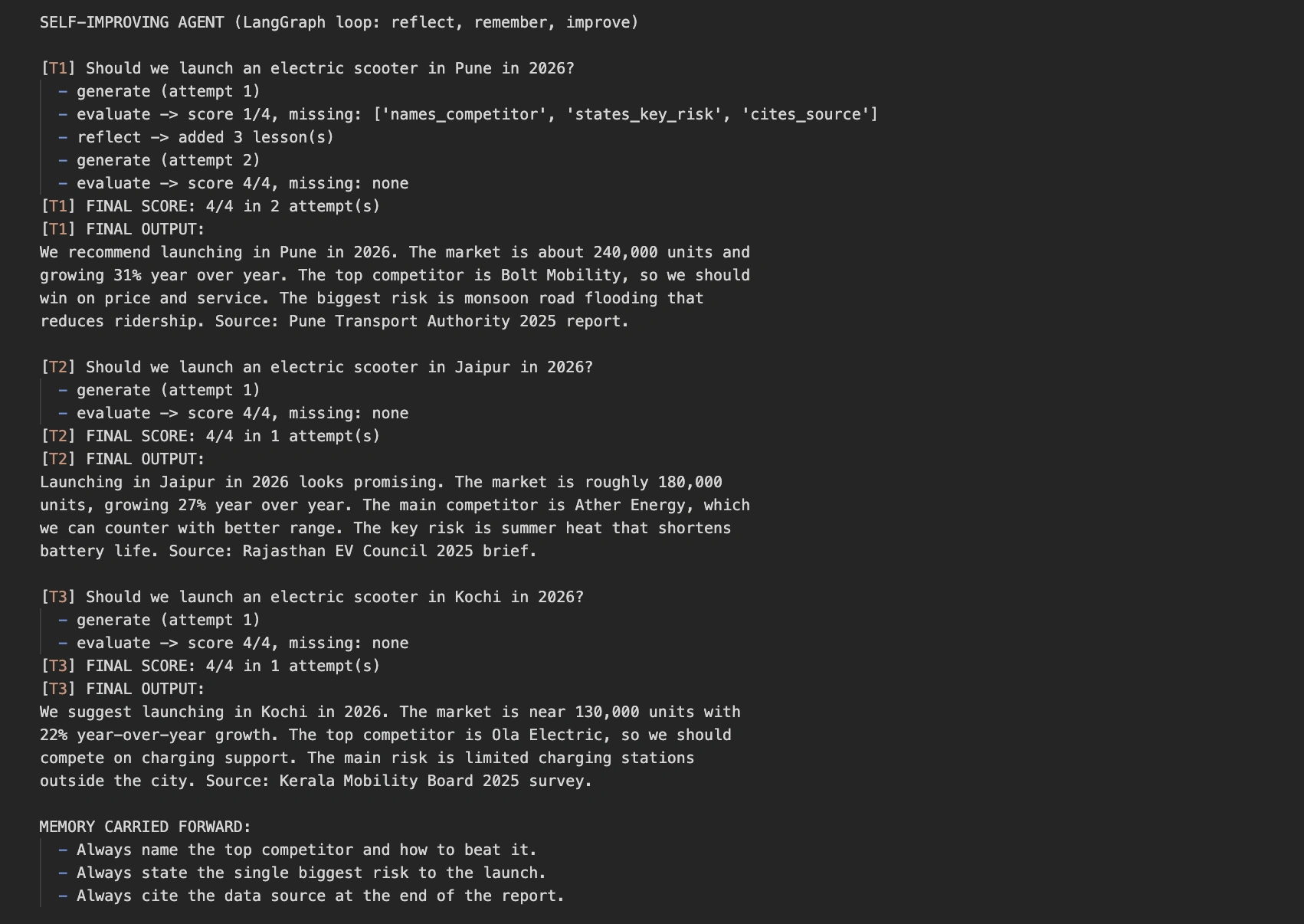
Conversely, a self-improving agent utilizing a framework like LangGraph follows a different trajectory. Upon completing the Pune report, the evaluation layer flags the missing risk factors and competitor data. The reflection layer generates rules to include these elements in the future. When the agent begins the Jaipur analysis, it retrieves these new rules from its memory. Consequently, while the first report might score a 1 out of 4, the subsequent reports for Jaipur and Kochi achieve perfect scores on the first attempt. This demonstrates a 300% improvement in output quality through autonomous adaptation.
Technical Infrastructure and Industry Adoption
The rise of self-improving agents is supported by a maturing ecosystem of development tools. Frameworks like LangGraph (developed by the LangChain team) allow developers to build stateful, multi-actor applications with built-in cycles. Unlike standard chains, these graphs allow for conditional edges, where an agent can be sent back to a “generate” node if its “evaluation” node returns a failing grade.
Supporting this infrastructure are “Structured Outputs” and “Vector Databases.” Structured outputs, often enforced through Pydantic in Python, ensure that the evaluation layer provides feedback in a machine-readable format. Vector databases provide the “Long-Term Memory” necessary for agents to store and retrieve thousands of learned lessons across different sessions and users.
Industry leaders have signaled that this move toward agentic reasoning is the next frontier of AI. Andrew Ng, a prominent figure in the AI community, has noted that agentic workflows—where models iterate on a problem—often yield better results than simply using a more powerful model in a single-shot prompt. This has profound implications for businesses, as it suggests that smaller, more cost-effective models (like GPT-4o-mini or Llama 3) can outperform larger models if they are wrapped in a self-improving loop.
Challenges, Risks, and Governance
Despite the clear advantages, self-improving agents introduce new complexities that require careful governance. One of the primary risks is “over-correction” or “instruction drift.” If an agent learns a rule based on a single, idiosyncratic failure, it may apply that rule too broadly, degrading performance in other areas. This is known as “over-fitting” in the context of agentic behavior.
Furthermore, there is the “infinite loop” risk. If the evaluation criteria are too strict or the model is unable to meet them, an agent could potentially run in a continuous cycle, consuming excessive API tokens and increasing operational costs without ever reaching a conclusion. Developers must implement “guardrails” or “max iteration” caps to prevent such runaway processes.
Data privacy also remains a concern. As agents store lessons in persistent memory, there is a risk of sensitive information being “remembered” and inadvertently leaked in future outputs. Robust data anonymization and filtering at the reflection layer are essential for enterprise-grade deployments.
The Future of Autonomous Intelligence
The verdict on self-improving loops is that they represent the future of high-stakes, repetitive AI tasks. While traditional agents will remain the standard for simple utility functions—such as translating a single sentence or summarizing a brief email—self-improving systems will become the backbone of complex operations like automated software engineering, financial auditing, and strategic research.
The transition from “AI as a tool” to “AI as a self-optimizing colleague” is underway. As these systems become more adept at identifying their own weaknesses and correcting them, the burden of manual prompt engineering will diminish. The value of an AI system will no longer be measured solely by the size of its training data, but by its ability to learn from the specific feedback and experiences it encounters in the real world. This shift promises a new era of reliability and autonomy in artificial intelligence, where growth is built into the code.