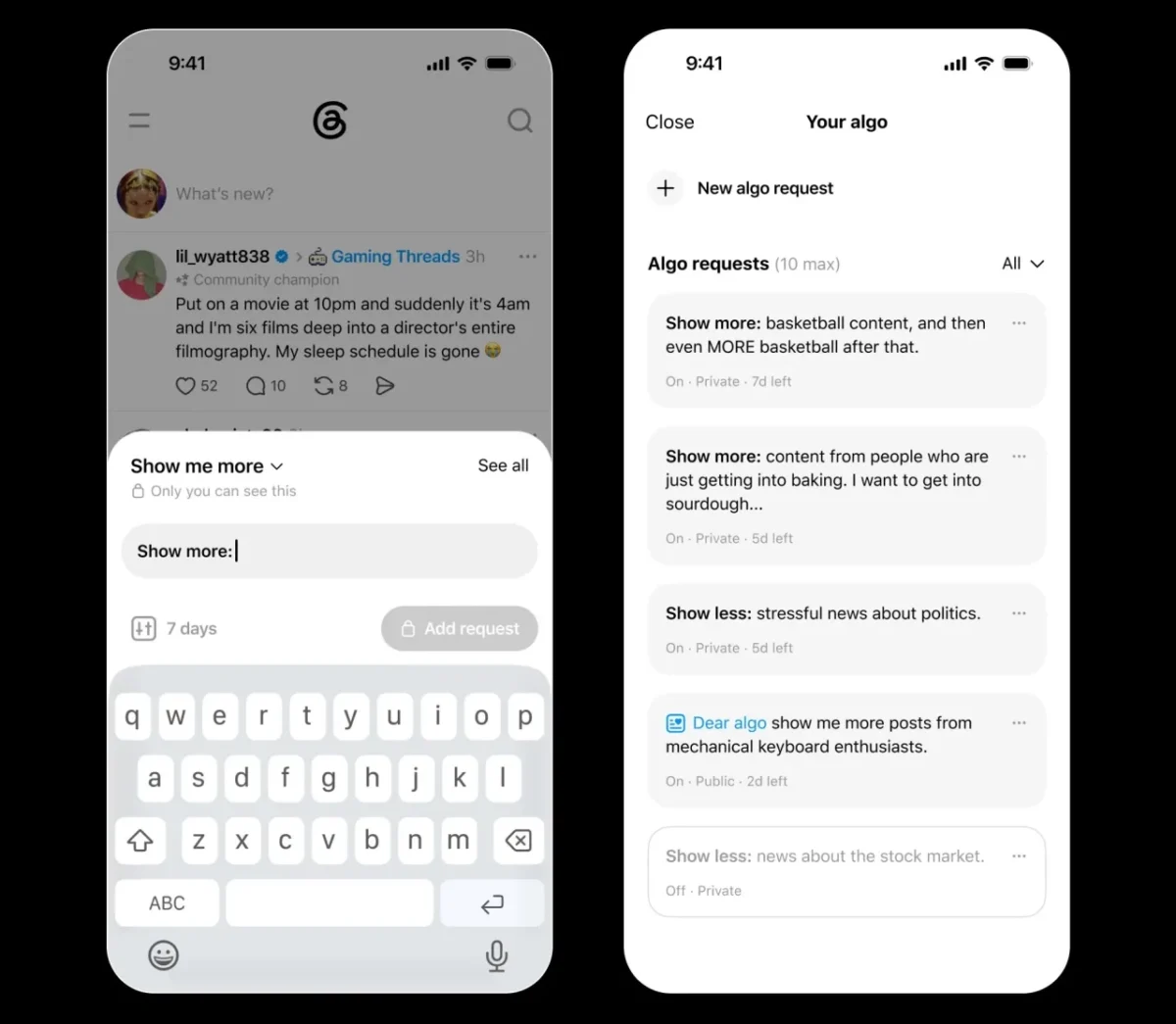
In a significant shift that has rippled across the digital landscape, major social media platforms like Meta’s Threads and Instagram, alongside rivals such as TikTok, are increasingly introducing new features designed to give users explicit control over their content feeds. These innovations, manifesting as "topic sliders," "interest toggles," and detailed "content preference menus," are being widely marketed as a groundbreaking empowerment of the user, promising a personalized and curated online experience. However, a closer examination reveals a more nuanced reality: while these tools offer a veneer of agency, the true engine of algorithmic personalization has long been driven by user behavior, a far more granular and potent signal than any declared preference.
The underlying premise of these new features is that users are finally taking the reins, actively dictating the type of content they wish to consume. This narrative, while appealing, overlooks a fundamental truth about digital interaction: users have always been in control, albeit through a less explicit, more subconscious form of engagement. Every scroll halted, every video watched to completion, every post replayed, and every moment spent lingering on a piece of content serves as a profound, real-time signal to the algorithm. These micro-interactions, accumulated over countless sessions, paint a far more detailed and honest portrait of a user’s true interests than any pre-defined menu could ever capture.
Consider, for instance, the algorithm’s understanding of a user’s obsession with a particular show. It doesn’t rely on a user ticking a box that says "interested in animation." Instead, it registers the hours spent watching fan edits at 1 AM on a Tuesday, the repeated viewings of specific character arcs, and the engagement with related discussions. This granular behavioral data allows platforms to infer a deep-seated affinity, a level of detail that a broad "interest in animation" toggle simply cannot replicate. The distinction is critical: explicit preferences are often broad and categorical, while behavioral signals are specific and deeply contextual. A user who declares an interest in musicals might receive general musical content, but it’s their sustained engagement with a mashup of characters from "Avatar: The Last Airbender" singing songs from "Hamilton" that truly reveals their unique, niche preferences.
The Political and Practical Motivations Behind Algorithmic Control Features
The question then arises: why are platforms investing in these seemingly redundant features if user behavior is already the dominant driver of content personalization? The answer lies in a confluence of political maneuvering and pragmatic product development. In an era marked by increasing public and regulatory scrutiny surrounding data privacy, algorithmic transparency, and the ethical implications of content moderation, offering users visible dials to turn serves as a strategic response to mounting pressure. These features act as a public relations mechanism, signaling accountability and providing regulators with tangible evidence of user empowerment. They offer a visual representation of control, even if the underlying mechanics of personalization remain largely unchanged for established users.
Furthermore, these tools offer a genuine and valuable utility for new users onboarding onto a platform. For individuals with no existing watch history or engagement data, explicitly stating preferences such as "I am interested in cooking and I do not want to see football content" provides the algorithm with a crucial starting point. This "cold start" problem, where the algorithm has insufficient data to begin personalization, is significantly alleviated by these direct declarations. It allows users to bypass the initial period of irrelevant content and quickly arrive at a more tailored experience, accelerating the onboarding process and fostering initial engagement.

However, for the vast majority of long-term users, whose digital footprints are already extensive, the impact of these new preference menus is likely to be minimal. Their feeds have been meticulously shaped over years of interaction, reflecting a rich tapestry of behavioral data. The algorithm has already constructed a detailed portrait of their viewing habits, a mosaic pieced together from thousands of subtle signals gathered since their first day on the platform. Introducing a slider or toggle at this stage is akin to rearranging a few tiles in an already complete mosaic; it offers a slight adjustment rather than a fundamental redesign.
Implications for Advertisers: Shifting Focus from Declared Interests to Earned Engagement
The implications of this algorithmic paradigm are particularly significant for advertisers operating within the social media ecosystem. If the primary determinant of content delivery is behavioral engagement rather than declared interests, then the most effective creative strategies must focus on eliciting and earning that behavioral engagement. This means that the core task for social media advertisers has not fundamentally changed with the introduction of these new user-facing features.
The imperative remains to produce creative content across a diverse range of formats and messages, allowing the platform’s algorithm to discern which variations resonate most effectively with different user segments. A user who watches a product video twice sends a far more potent signal of interest and intent than one who skips it within the first two seconds. Crucially, both of these behavioral signals are infinitely more valuable to an advertiser than simply knowing that a user has ticked a box indicating an interest in "fashion." The nuance of engagement—the duration, the repetition, the completion rate—provides a far deeper understanding of consumer intent and preference.
This understanding translates directly into media planning strategies. Advertisers are strongly advised to diversify their creative output, testing various formats, messaging, and visual styles against each other. The ultimate arbiter of success is not the advertiser’s initial hypothesis about what might work, but the actual delivery data generated by user behavior on the platform. The most effective version of an advertisement is not necessarily the one that the advertiser believes is superior upfront, but rather the one that the collective behavior of users, over time, selects and amplifies. This requires a commitment to iterative testing, data analysis, and a willingness to let user engagement guide strategic adjustments.
The Enduring Power of Behavioral Signals in the Algorithmic Age
In conclusion, the advent of user-controlled algorithmic features on platforms like Threads, Instagram, and TikTok represents a significant moment in the ongoing evolution of social media. For individuals new to these platforms, these tools offer a valuable pathway to a more personalized experience, accelerating the learning curve of the algorithm. Politically, they serve as a vital response to the current climate of scrutiny, demonstrating a commitment to transparency and user agency.
However, for the established user base and, critically, for advertisers, these features are unlikely to represent a seismic shift. The fundamental mechanism driving content delivery remains the granular, implicit signals derived from user behavior. The ability to capture attention, foster engagement, and encourage lingering interaction with content is still paramount. Advertisers must continue to prioritize the creation of compelling content that earns these behavioral signals, fostering a deeper connection with audiences. The playbook for success in the social media advertising landscape remains remarkably consistent: build content that is intrinsically worth engaging with, deploy sufficient creative variation to allow the algorithm to learn and optimize, and place unwavering trust in the behavioral data that reveals what truly resonates with users, rather than relying solely on their declared preferences. This enduring focus on earned engagement is the bedrock of effective digital marketing and will continue to be the guiding principle in the ever-evolving world of algorithmic content distribution.