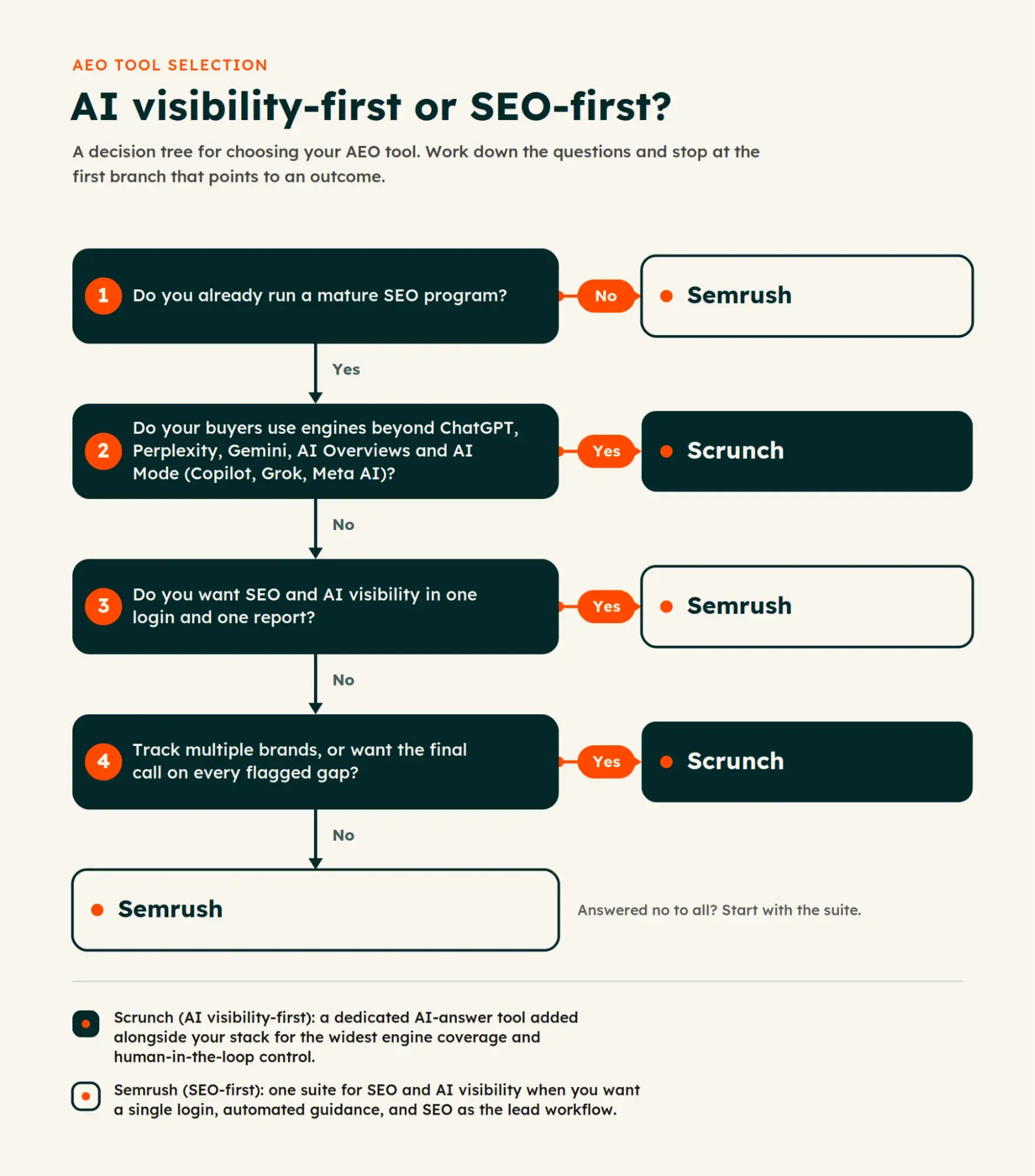
The digital marketing arena is undergoing a profound transformation, driven by the rapid ascendancy of generative artificial intelligence in search. As AI-powered answer engines like Google AI Overviews, ChatGPT, and Perplexity become primary conduits for information, businesses face a critical choice: adapt their digital presence for this new paradigm or risk fading into obscurity. At the heart of this adaptation lies Answer Engine Optimization (AEO), a specialized discipline focused on ensuring brand visibility and favorable representation within AI-generated responses. This shift has given rise to a new generation of tools, prompting marketers to weigh the merits of dedicated AEO specialists like Scrunch against comprehensive SEO suites, such as Semrush, which have integrated AI visibility capabilities into their established platforms. The fundamental question for businesses is whether to adopt a targeted AI visibility tool or leverage a full SEO suite that now incorporates AI answer tracking.
The Dawn of Answer Engine Optimization (AEO)
The emergence of AEO as a distinct marketing discipline is a direct consequence of the widespread integration of AI into search. For decades, Search Engine Optimization (SEO) governed digital visibility, focusing on algorithms designed to rank web pages. However, generative AI has introduced a new layer, where users often receive synthesized answers directly from AI models, sometimes without needing to click through to original sources. This paradigm shift means that appearing prominently in these AI answers – with accurate citations, positive sentiment, and strong brand presence – is becoming as crucial as traditional organic search rankings.
Industry analysts estimate that generative AI could influence a significant portion of online searches in the coming years, potentially reshaping traffic patterns and customer journeys. This necessitates a strategic response from brands, compelling them to monitor, audit, and optimize their content specifically for AI systems. Companies that fail to adapt risk losing a substantial share of voice and customer engagement in this evolving digital landscape. The challenge is not merely about being found but about being accurately and favorably represented when AI summarizes information about a brand.
Specialist vs. Suite: The Core Dichotomy

The central difference between Scrunch and Semrush in this context lies in their foundational approach: specialization versus breadth. Scrunch positions itself as “The AI Customer Experience Platform,” a pure-play AEO tool meticulously engineered to monitor and optimize how a brand manifests within AI-generated answers. Its design is singularly focused on tracking brand presence, sentiment, citations, and share of voice across various answer engines.
Conversely, Semrush, a long-standing titan in the SEO industry, describes itself as a “brand visibility management platform” that spans SEO, AI search, content marketing, and paid media. While its reputation is built on robust traditional SEO features—such as keyword research, rank tracking, site audits, and backlink analysis—it has strategically integrated an AI Visibility Toolkit. This toolkit can function as a standalone add-on or as part of a comprehensive bundle, allowing existing Semrush users to extend their optimization efforts into the AI realm without migrating to a new platform.
This fundamental divergence—Scrunch offering AEO features without native SEO capabilities, and Semrush providing both SEO and AEO features—drives nearly every practical distinction that follows, from pricing structures and monitoring coverage to optimization workflows and content delivery strategies. Both vendors, importantly, emphasize that AEO is a complementary strategy to SEO, not a replacement, underscoring the continued relevance of traditional search optimization alongside AI adaptation.
Scrunch: The Dedicated AEO Specialist
Scrunch, with its laser focus on AI visibility, offers a specialized solution for brands keen on mastering their presence in AI answers. Its core strength lies in comprehensive monitoring across a significant number of answer engines. On its self-serve Core and Agency Core plans, Scrunch tracks four key engines: ChatGPT, Perplexity, Google AI Overviews, and Copilot. For Enterprise clients, this expands significantly to as many as nine engines, including Claude, Gemini, Meta AI, Google AI Mode, and Grok. This broad coverage positions Scrunch as a robust option for brands requiring deep insights into their AI footprint.
The platform employs a “prompt-native” approach, estimating AI search volume at the topic level by clustering related prompts. It refreshes new prompts daily for 14 days, then every 72 hours, with options for on-demand data pulls. Scrunch provides detailed benchmarking against competitors, analyzing share of voice, identifying content gaps, and tracking citations. A key feature is its sentiment analysis, labeling brand mentions as positive, mixed, or negative, offering crucial insights into brand perception within AI responses.

Pricing and Workflow: Scrunch’s pricing model reflects its specialization, offering AI visibility as a standalone subscription. The Core plan starts at $250/month, providing 5 user licenses, 1 brand workspace, and tracking 125 prompts across 4 engines. The Agency Core plan, at $500/month, expands to unlimited seats, 3 brand workspaces, and 250 prompts across the same 4 engines, catering specifically to agencies managing multiple clients. The Enterprise tier offers custom pricing, seats, and prompt tracking, alongside monitoring across all nine supported engines.
For optimization, Scrunch’s workflow is designed to keep a “human in the loop.” Its Content Gaps feature flags instances where a brand is absent or underrepresented in AI answers, then generates content briefs. These briefs can be handed to a content team or directly integrated into generative AI tools like ChatGPT or Claude for draft creation. Scrunch also emphasizes data outward, offering integrations via a Data API, Looker Studio, GA4, and Adobe Analytics, allowing teams to channel AEO data into their existing analytics and content management systems. This approach suits teams that prefer to maintain editorial control over content creation and validation. Notably, Scrunch’s AI Referrals tab, when connected to GA4, allows tracking of revenue and conversions specifically attributed to AI visibility, offering a direct link between AEO efforts and business impact.
The AXP Controversy: A distinctive and potentially contentious feature of Scrunch’s Enterprise plan is its Agent Experience Platform (AXP). This content-delivery layer operates at the Content Delivery Network (CDN) level, serving a simplified, AI-bot-optimized version of a webpage to AI crawlers while human visitors continue to see the standard site. Scrunch explicitly states that AXP does not use llms.txt and does not serve the bot-friendly version to Google crawlers, thereby aiming to avoid affecting traditional search indexing. Scrunch defends AXP by arguing it reflects the “same intent” as the human-facing page, positioning it as a technical optimization rather than a deceptive practice akin to cloaking. However, the concept of serving different content versions, even to different types of crawlers, raises eyebrows in the SEO community, where Google’s stringent anti-cloaking rules are well-known. This makes AXP a feature that warrants careful consideration regarding potential, albeit unconfirmed, risks.
Semrush: The Integrated SEO and AEO Ecosystem
Semrush, a dominant force in digital marketing tools, has strategically extended its capabilities to encompass the AI search landscape. Rather than developing a separate platform, Semrush integrates its AI Visibility Toolkit directly into its comprehensive suite, allowing marketers to manage traditional SEO and AEO from a single login. This approach caters to teams that value a unified platform for all their brand visibility needs.
The AI Visibility Toolkit tracks five primary engines on its self-serve plans: Google AI Mode, AI Overviews, ChatGPT, Perplexity, and Gemini. This coverage expands to nine engines for its custom Enterprise AIO tier, adding Claude, Microsoft Copilot, Grok, and DeepSeek, alongside daily prompt tracking for up to 15,000 prompts. Semrush frames its AEO work around “prompt and topic research,” updating core reports daily and Brand Performance metrics weekly. Similar to Scrunch, it benchmarks competitors on share of voice and identifies gaps, labeling sentiment as “favorable versus neutral.” Its Prompt Research report leverages a vast database of over 289 million AI queries to estimate demand for related topic clusters.
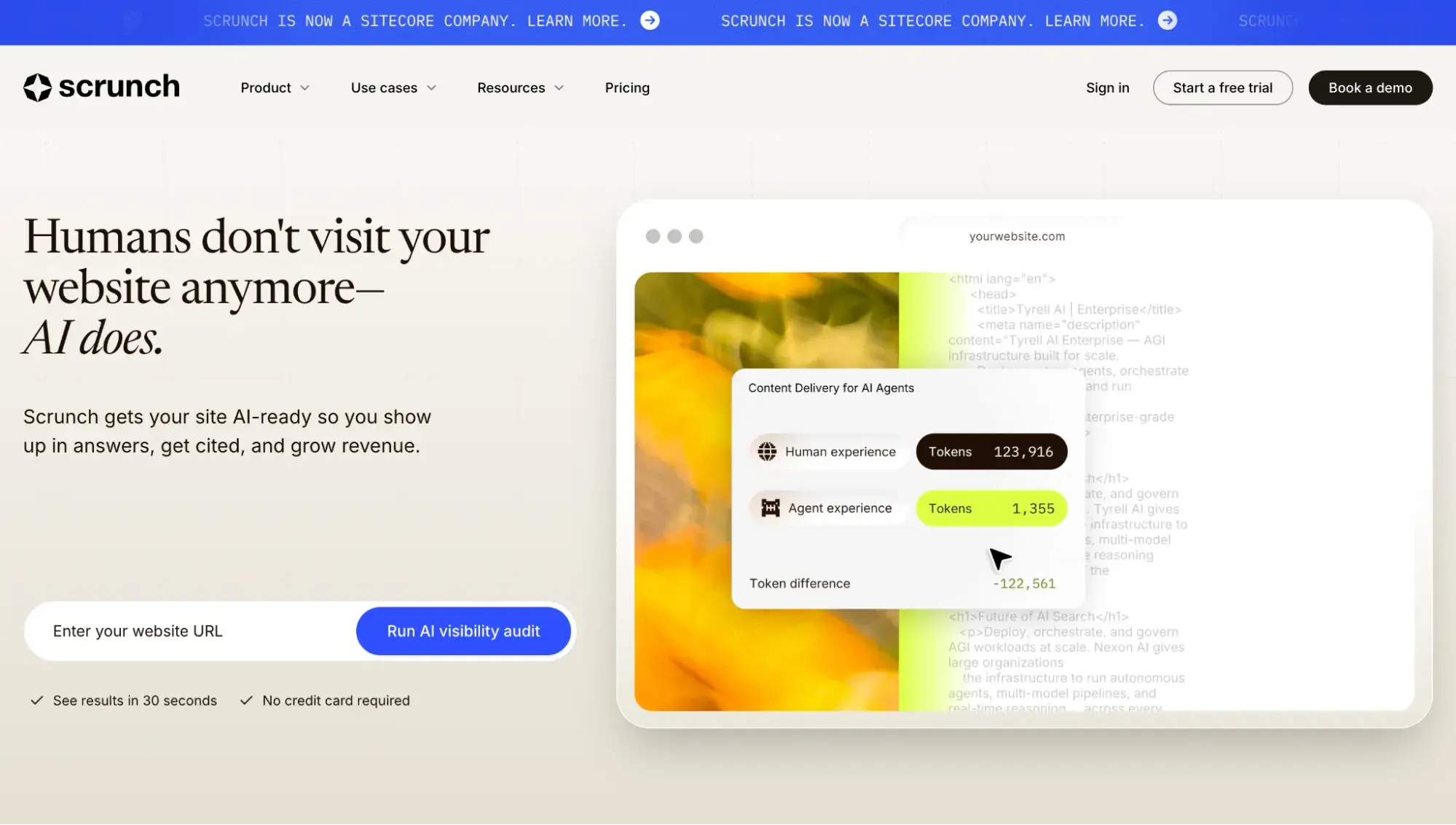
Pricing and Workflow: Semrush’s pricing structure reflects its integrated nature. The AI Visibility Toolkit can be purchased as a standalone add-on for $99/month, in addition to an SEO Classic plan (starting at $139.95/month). This option provides AEO monitoring but no native rank tracking or backlink features. Alternatively, users can opt for Semrush One bundles, which combine both SEO and AI visibility. The Semrush One – Starter plan begins at $199/month, offering 50 prompts tracked across 5 engines and access to broader SEO features. Higher tiers like Pro+ ($299/month) and Advanced ($549/month) increase prompt limits, domains, and other SEO functionalities. The Enterprise tier offers custom pricing, extensive prompt tracking (15,000), and access to all nine supported engines.
Semrush’s optimization workflow leans towards automated recommendations and seamless integration. Its Brand Performance reports highlight “AI Strategic Opportunities,” converting data into suggested action plans. A significant advantage is the one-click capability to push a topic from the Prompt Research report directly into the Content Toolkit, streamlining the content drafting process. Furthermore, its AI Search Site Audit brings SEO-style crawl checks into the AI workflow, ensuring content is optimized for both human readability and AI extraction. For re-measurement, its Prompt Tracking logs daily visibility changes, allowing marketers to directly correlate content updates with shifts in AI visibility. Semrush also facilitates GA4 integration via its “My Reports” tool, enabling users to filter for “AI Referral” traffic to understand AI-driven sessions and conversions, though it doesn’t offer direct pipeline or CRM reporting integration as deeply as some specialized marketing hubs.
Feature-by-Feature Breakdown and Nuances
- Monitoring Coverage: At entry-level pricing, Semrush holds a narrow edge, tracking five engines (including Gemini and Google AI Mode) compared to Scrunch’s four. Scrunch’s unique entry-level inclusion of Copilot offers a specific advantage there. At the Enterprise level, both platforms converge, tracking nine engines. Scrunch uniquely covers Meta AI, while Semrush uniquely covers DeepSeek. The choice here depends on the specific AI assistants a brand prioritizes for monitoring.
- Optimization Workflow & Execution: Semrush’s integrated suite allows for one-click content drafting and automated recommendations, providing a faster path from insight to action. This is ideal for teams seeking efficiency and a unified platform. Scrunch, with its human-in-the-loop model and content brief generation, is better suited for teams that prefer to review and approve every content gap and maintain tighter editorial control, especially if they route AEO data into an existing, separate analytics and content stack via its open integrations.
- Content Delivery and Risk Mitigation: Semrush’s approach of optimizing a single, user-facing page for all audiences inherently carries lower risk, avoiding the potential duplicate-content concerns associated with Scrunch’s AXP. While AXP is an Enterprise-only and optional feature, its very existence highlights a philosophical difference in how each platform addresses content delivery for AI. The consensus in the broader SEO community leans towards creating universally accessible, AI-friendly content on a single page.
- Connecting AEO to Business Outcomes: Both tools offer mechanisms to link AI visibility to revenue. Scrunch’s AI Referrals tab, integrated with GA4, provides direct tracking of AI-driven purchase revenue and conversion rates. Semrush’s “My Reports” with an “AI Referral” filter offers similar functionality. For deep CRM integration and tracing AI visibility from prompt to lead and pipeline, other platforms, such as HubSpot Marketing Hub with AEO, offer a more direct connection to sales and customer relationship management.
Strategic Choice: Tailoring the Tool to Your Goals
The decision between Scrunch and Semrush ultimately hinges on a brand’s existing digital marketing maturity, budget, and specific AEO objectives.
- Best for Scrunch: Teams that already possess a robust, mature SEO program and wish to layer on dedicated AI-answer monitoring without disrupting their existing SEO stack. Agencies, with their need for multiple brand workspaces and unlimited seats (Agency Core), also find Scrunch highly suitable. Brands prioritizing a human-in-the-loop content review process, or those specifically needing Meta AI tracking, will find Scrunch to be the better fit. Its strong external data integration capabilities are also a draw for those with complex analytics ecosystems.
- Best for Semrush: Leaner teams or SMBs that prefer a unified platform for both SEO and AI visibility, minimizing subscription management and context-switching. It’s ideal for organizations that still primarily lead with traditional SEO metrics (rank tracking, audits, backlinks) and view AI visibility as an integral component of that broader workflow. Teams that appreciate automated recommendations and a streamlined, one-click content drafting process will also benefit from Semrush’s integrated approach.
The rapid evolution of AI search dictates that no single solution is universally superior. A brand’s existing technology stack, internal team structure, and strategic priorities for AI visibility will ultimately dictate the most appropriate choice.
Broader Market Landscape and Alternatives
Beyond Scrunch and Semrush, the AEO tool market is burgeoning. Alternatives cater to various needs:
- Comprehensive Marketing Hubs: Platforms like HubSpot AEO (integrated within Marketing Hub) aim to connect citation data directly to CRM records, providing end-to-end visibility from AI prompt to lead and pipeline influence.
- Emerging AEO Specialists: Other dedicated AEO tools such as Profound, AthenaHQ, Peec AI, and Otterly AI are also entering the market, each with unique features and pricing models, offering more niche solutions for specific aspects of AI visibility.
- Manual Monitoring & Custom Solutions: For very small businesses or those with limited budgets, a combination of manual monitoring (directly querying AI models) and custom scripting can provide basic insights, though this lacks the scalability and depth of dedicated platforms.
Best Practices for AI-Optimized Content Without Risk
Regardless of the chosen tool, the efficacy of AEO ultimately depends on how content is structured and presented. The goal is to optimize a single page for both human readers and AI answer engines, thereby avoiding the risks associated with serving different content versions. Here’s a checklist for creating AI-friendly content:
- Direct Answers at the Top: Begin each page or relevant section with a concise, direct answer to a likely user query, mimicking how AI answers are structured.
- Question-Matching Headers: Utilize clear, question-based H2/H3 headings that align with common AI queries, making it easier for AI models to extract relevant information.
- Factual Specificity and Clarity: Ensure content is factually accurate, unambiguous, and presented in a clear, digestible format. Avoid jargon where possible.
- Structured Data Implementation: Employ schema markup (structured data) to explicitly define entities, facts, and relationships on the page, providing AI with explicit signals about the content’s meaning.
- Scannable Formatting: Use bullet points, numbered lists, short paragraphs, and bold text to enhance readability for both humans and AI crawlers, facilitating quick information extraction.
- Authoritative External Links: Link to reputable, authoritative external sources to bolster credibility and provide AI with additional context and validation.
- Internal Linking Strategy: Ensure a robust internal linking structure that guides AI crawlers through related content on your site, reinforcing topical authority.
By adhering to these structural best practices, a webpage remains highly legible for human readers and optimally extractable by AI systems, eliminating the need for parallel, bot-only versions and mitigating potential duplicate-content exposure. The measurement loop for AEO then involves auditing AI answers, identifying content gaps, updating or creating new content based on insights, and then re-checking visibility after a reasonable refresh cycle. Integrating content creation and publishing within a unified content operations platform can significantly accelerate this loop, allowing marketers to move from insight to live content with greater efficiency.
In conclusion, the rise of AI in search has fundamentally altered the digital marketing landscape. Both Scrunch and Semrush offer compelling solutions for navigating this new terrain, albeit with distinct philosophies. Scrunch provides a deep, specialized dive into AI visibility, ideal for those with established SEO stacks. Semrush offers a comprehensive, integrated approach, suitable for teams seeking a unified platform for all their visibility needs. The strategic choice will empower businesses to not only track their presence in AI answers but also to proactively shape their narrative and influence customer experience in the age of intelligent search.