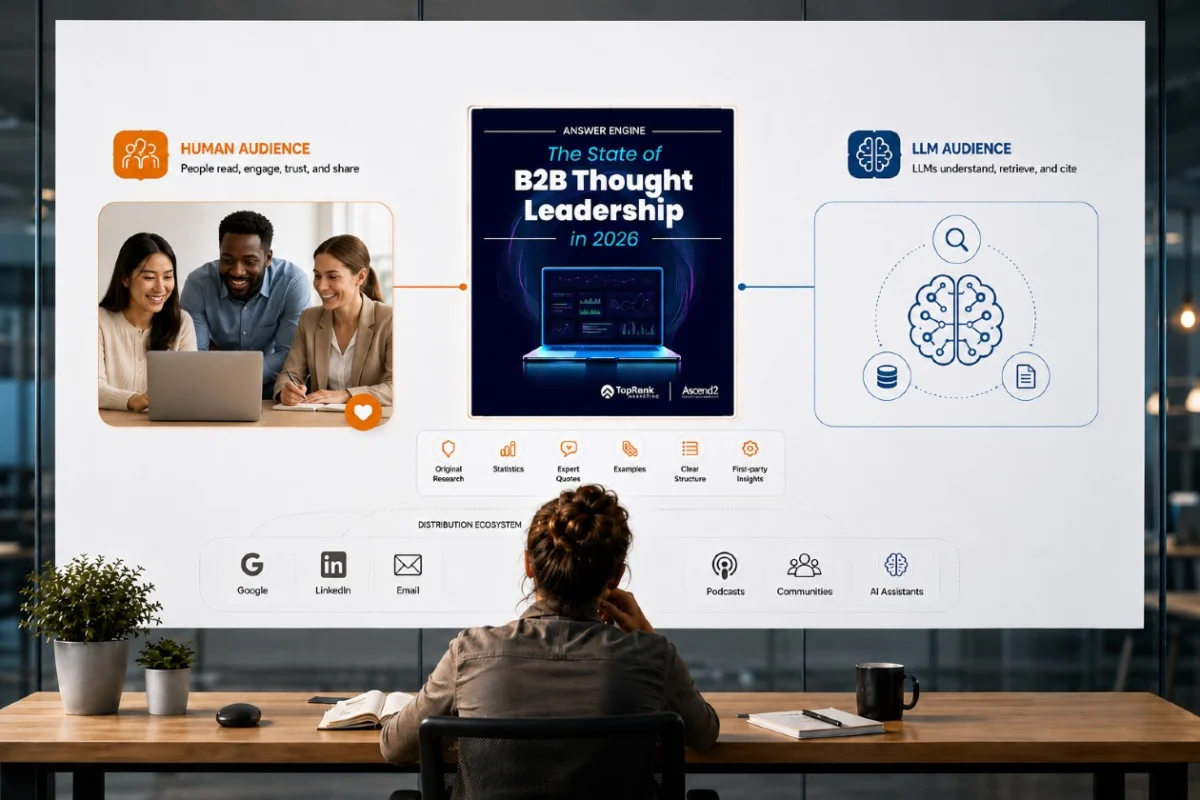
In the dynamic realm of business-to-business marketing, a significant shift is underway, fundamentally altering how content is created, consumed, and perceived. Modern B2B buyers, armed with increasing skepticism and a scarcity of time, are no longer the sole arbiters of content value. They are now joined by sophisticated AI answer engines, which are rapidly becoming integral to the information discovery process. These AI systems, much like their human counterparts, evaluate content based on critical criteria: proof, source authority, and consensus among credible sources. The challenge for B2B marketers in 2026 is to effectively engage both these audiences simultaneously, a task that necessitates a strategic evolution in content development and distribution.
A recent comprehensive survey, "Answer Engine: The State of B2B Thought Leadership in 2026," conducted by Ascend2 with the participation of 797 B2B marketers, underscores the critical importance of thought leadership for full-funnel success. The findings reveal that an overwhelming 97% of respondents consider thought leadership vital for achieving their marketing objectives across the entire buyer journey. Furthermore, 93% attest to the effectiveness of research-based content in driving engagement and generating leads, with a significant 48% labeling it as "very effective." This effectiveness is amplified when collaboration with industry influencers is a key component of the content strategy. The survey indicates that 72% of marketers who frequently partner with influencers rate their research content as "very effective," a stark contrast to the 29% efficacy reported by marketers who do not engage in such collaborations.
Adding a new layer of complexity, the survey highlights the burgeoning influence of Artificial Intelligence in content discovery. A substantial 32% of buyers now utilize Generative AI tools to discover thought leadership content, a channel that was virtually absent from most marketer distribution lists just a year prior. This burgeoning reliance on AI necessitates a re-evaluation of content creation and a deeper understanding of how these systems process and prioritize information.
The Dual Audience: Buyers and AI in Tandem
The modern B2B buyer landscape is characterized by a complex buying committee, often comprising eight to ten individuals. These stakeholders are inherently skeptical, pressed for time, and acutely aware of the personal repercussions should their recommendations prove misguided. Simultaneously, a new, albeit non-human, audience has emerged: retrieval and reasoning systems. These AI engines, such as ChatGPT, Perplexity, Google AI Mode, and Claude, actively read, summarize, and ultimately decide which brands are presented as viable options when a user poses a query.
Many B2B marketers have historically approached these two audiences as distinct entities, allocating separate resources and employing divergent strategies for each. However, the latest research suggests a more integrated approach is warranted. The signals that resonate with human buyers are remarkably similar to those that inform AI decision-making. Buying groups seek irrefutable proof that can be defended within their organizations, while answer engines require verifiable evidence that can be readily attributed and corroborated. The good news, as indicated by the Ascend2 study, is that original research, proprietary data, credible human voices, and a consistent brand point of view can effectively satisfy the expectations of both.
The value proposition of original research in this new paradigm is particularly pronounced. The "State of B2B Thought Leadership in 2026" report reveals that 35% of B2B marketers consider original research significantly more valuable than AI-generated content for building trust and authority. An additional 32% find it more impactful overall. This insight is crucial for marketers who may be tempted to over-rely on AI for content generation. The content most likely to be replicated and cited by machines is that which possesses a level of originality that AI cannot independently create. Even synthetic data, the foundation of many AI outputs, ultimately derives from original source material at some point in its lifecycle.
Original Research: The Engine for Becoming the Premier Answer
The creation of new knowledge stands as one of the few truly unique assets within a content program that cannot be readily synthesized from existing information. When a brand publishes insights that are novel and exclusive, it establishes itself as the definitive, citable source for that particular piece of information. This originality acts as a powerful trust signal, leading to its citation by journalists, its referencing by analysts, its discussion among influencers, and its attribution by AI systems. Each of these actions directly points back to the originating brand, building its authority and visibility.
The performance data supporting research-based content further solidifies its strategic importance. As previously mentioned, 93% of B2B marketers employing original research-based content report its effectiveness in driving engagement and leads, with 48% deeming it "very effective." This compelling performance metric is driving increased investment, with 47% of B2B marketers planning to expand their utilization of original research and data-driven content in the coming year.
The genesis of this valuable original research is also a critical consideration. The Ascend2 study found that direct customer feedback emerged as the top influence on topic selection for research-based thought leadership, cited by 53% of B2B marketers. This was closely followed by CRM data (44%) and competitor or market trend analysis (44%). Research that directly addresses questions already being posed by buyers is inherently more likely to be utilized and disseminated. Conversely, research that merely serves to validate pre-existing opinions risks being overlooked.
The Influencer Multiplier: Enhancing Credibility and Discoverability
While data provides the foundation, its true relevance is unlocked when trusted voices within the industry engage with it, offering context and validation. This is a particularly significant revelation from the B2B thought leadership research. The aforementioned 72% of B2B marketers who frequently collaborate with influencers rate their research-based content as "very effective," compared to just 29% for those who do not. This disparity highlights how third-party validation transforms content from a mere brand claim into a credible and consumable asset, a crucial distinction in an era where buyer trust in brand claims is often diminished.
B2B marketers are cognizant of this dynamic, with 45% indicating that featuring industry influencers or experts would significantly enhance the impact of their thought leadership content. However, a notable gap exists between this recognition and consistent action.
Independent research corroborates these findings. A study titled "The Credibility Code," conducted by the B2B Institute at LinkedIn and Ipsos, revealed that 94% of B2B marketers identify trust as the paramount factor for success. Furthermore, an earlier report, the "2025 B2B Marketing Benchmark Report" from LinkedIn and Ipsos, stated that 82% of B2B buyers acknowledge the influence of creator content on their purchasing decisions.
However, there is a divergence in perspective regarding the role and reach of influencers. While LinkedIn’s findings often frame creators as a mechanism for scaling credibility within a single professional feed, this view can be incomplete when considering the entirety of the B2B buyer journey. The Ascend2 research indicates a disconnect between where marketers distribute thought leadership and where buyers actually consume it. For instance, while 54% of marketers use LinkedIn for distribution, only 38% of professionals report consuming thought leadership content there most frequently. A similar pattern is observed on YouTube (50% distribution vs. 34% consumption) and webinars (48% distribution vs. 34% consumption). This suggests a concentration of distribution efforts in channels that may not align with peak buyer consumption.
The core principle here is that credibility built within the confines of a single platform often remains siloed. In contrast, credibility forged through verifiable evidence, validated and contextualized by trusted experts, and published across diverse formats and channels, possesses a far greater degree of portability. This portable credibility travels into search results, garners media attention, permeates peer communities, and ultimately influences the training and retrieval data that AI answer engines rely upon. This ability to be the "best answer" across multiple touchpoints is the ultimate objective for brands seeking to connect with their audience.
The Six Drivers of Best Answer Marketing: A Synergistic Approach
The "Best Answer Marketing" framework, developed by TopRank Marketing, outlines six key drivers designed to create content that resonates with both human buyers and machine discovery systems. These drivers operate synergistically, with each element performing a distinct yet complementary role. When implemented collectively, their impact is amplified, leading to compounding marketing results.
- Original Research: As discussed, this forms the bedrock of unique insights and establishes the brand as a primary source.
- Influence: Leveraging credible voices to add context, validation, and reach.
- Thought Leadership: Articulating a distinct, well-supported point of view that educates and guides the audience.
- SEO: Optimizing content for discoverability by both search engines and AI algorithms.
- Content Experience: Creating engaging and accessible formats that cater to diverse consumption preferences.
- Distribution: Strategically disseminating content across owned, earned, and social channels to maximize reach and impact.
Content Formats that Bridge Research, Influence, and Thought Leadership
The efficacy of a content strategy in 2026 hinges on formats that skillfully integrate original research, expert influence, and compelling thought leadership. The most successful formats share three critical characteristics: they are inherently research-based, they are championed by credible voices, and they are designed for broad discoverability.
The Ascend2 survey reveals what B2B marketers believe would elevate their thought leadership:
- Featuring industry influencers or experts (45%)
- Including original research or data (35%)
- Utilizing more engaging content formats (33%)
- Providing deeper insights and analysis (30%)
- Enhancing content quality and production value (27%)
- Adopting a more conversational tone (25%)
Translating these beliefs into a functional B2B content mix, based on the original research data, suggests prioritizing the following formats:
- Flagship Original Research Report: This serves as the foundational asset, featuring a documented methodology and unique proprietary data. It becomes the undisputed source for subsequent content and demands attribution from competitors.
- Research Statistics Hub: A permanent, well-organized web page presenting key findings as discrete statistics, complete with dates, sample sizes, and methodologies. Such pages are prime candidates for citations and inbound links, providing AI answer engines with unambiguous source material.
- Video Podcast Series: Recorded conversations with practitioners and analysts reacting to research findings offer multiple content assets: video, audio, transcripts, quote graphics, and short clips. The transcript is particularly valuable for search and AI system indexing.
- Research-Backed Webinars and Virtual Roundtables: Live sessions featuring credible voices interpreting data for specific segments provide immediate audience engagement and nuanced discussion. The recordings then become on-demand resources with searchable transcripts.
- Interactive Data Experiences: Tools like assessments, benchmark calculators, and data explorers allow buyers to see their own situations reflected in the research. Participation yields first-party data for the brand and personalized results for the buyer, often shared internally.
- Earned Media and Digital PR: Pitching research findings to trade publications, industry newsletters, and analysts generates third-party validation for human readers and creates the off-site mentions that significantly influence AI system attribution.
- Co-Created Guides and eBooks: Longer-form content where influencers and internal experts contribute original commentary alongside the data. Contributors gain a credible byline and act as genuine distribution partners.
- Executive and Influencer Bylines: Opinion pieces placed in trusted publications, authored by recognized individuals with established track records, carry an authority that brand-authored content often struggles to achieve.
- Real-World Events: Conference sessions, executive dinners, and on-site studio recordings at industry events foster in-person relationships with experts and generate a pipeline of content for future quarters.
- Digital Events and Livestreams: Recurring LinkedIn Live sessions, AMAs, and virtual panels with a less formal production footprint prioritize consistency and allow for reactive content based on industry news and proprietary data.
- Short-Form Video: Concise, person-on-camera delivery of individual findings (under 90 seconds) effectively disseminates statistics across feeds where buyers are actively scrolling, extending the report’s lifecycle beyond its initial launch.
- Documentary and Masterclass Content: Cinematic or instructional treatments that transform research into compelling narratives featuring customers and experts. This approach, exemplified by Sprinklr’s Socialverse program, merges research with influencer collaboration and educational formats.
- Newsletters, Owned and Sponsored: Leveraging proprietary email lists and paid placements in trusted third-party newsletters reaches audiences who may not encounter organic content. Sponsorship capitalizes on established relationships.
- Peer Communities and Slack Groups: Active participation in private forums where buyers engage in candid discussions. Top-performing marketers are nearly twice as likely to diversify distribution across emerging channels, including YouTube (55%), podcasts (41%), and peer communities (28%).
- Serialized Blog and Article Program: Publishing research as a sustained series of articles, each addressing a specific buyer question in depth, transforms a single report into an ongoing supply of indexed, citable answers.
Measurement in the Age of Machine Audiences
Traditional B2B marketing funnel reporting may fail to capture the full impact of content in an era where machine audiences are prevalent. A buyer might encounter research via an AI summary, hear a podcast guest reference it, see an influencer’s social post about it, and then land on the company website through a branded search, with no discernible first-touch attribution.
Unified measurement is essential, connecting brand engagement, demand signals, and revenue outcomes within a single view. Crucially, visibility within answer engines must be incorporated as a tracked metric alongside organic rankings. This challenge is widely acknowledged, with 41% of marketers citing measurement difficulties as the primary reason for underperforming content. Consequently, teams that successfully navigate this complexity gain a significant competitive advantage.
Embarking on the Dual-Audience Strategy
The journey to becoming the definitive answer for both buyers and AI begins with identifying a critical question within your market that remains unanswered by credible evidence. Developing a focused piece of primary research around this question, and then enlisting five credible voices to contribute to its interpretation before publication, provides a strong starting point. Subsequently, leveraging the diverse content formats outlined above around this singular insight for at least two quarters can establish brand authority and findability.
This strategic sequence enables a brand to transition from competing for attention to becoming the indispensable answer. Original research grants the right to a distinct point of view. Credible voices lend believability to that perspective. And consistent, multi-format publishing ensures that the brand’s insights are discoverable wherever buyers and their AI assistants are actively seeking information.
The fundamental question for every B2B organization is: What unique data can your team uncover that no competitor in your market can? Answering this will pave the way for a robust "Best Answer Marketing" strategy.
For those seeking to deepen their understanding of how B2B thought leadership, influence, and content converge, an ungated report is available. Additionally, organizations interested in consulting with experts to position their brand as the premier answer for both LLMs and buyers are encouraged to connect for a discussion.

 Sagoh
Sagoh
 Asep Darmawan