Adidas is forging a new frontier in the digital commerce landscape by launching an ambitious e-commerce-as-a-service (EaaS) model, leveraging cutting-edge artificial intelligence (AI) agents from Salesforce. This strategic pivot, highlighted by the successful integration with the Audi F1 Team’s online store, represents a significant business evolution for the apparel giant, unlocking a substantial revenue stream estimated at over $100 million. The initiative underscores Adidas’s proactive approach to market disruption and its commitment to providing comprehensive digital solutions for its partners.
The revelation came from Dominik Seeberger, Senior Project Manager at Adidas, during a prominent session titled “Scaling Ecommerce as a Service with AI and Agents” at Salesforce Connections 2026 in Chicago. Seeberger detailed how this innovative business model, powered by Salesforce’s robust technology suite, not only facilitated the rapid launch of the Audi F1 e-commerce site in a mere eight weeks but also demonstrated the power of AI agents in enabling scalability without proportional increases in human capital. This technological integration is crucial for Adidas as it navigates an increasingly competitive market, particularly against agile disruptors like Fanatics.
The Genesis of E-commerce-as-a-Service: A Strategic Imperative
The strategic impetus behind Adidas’s foray into EaaS stems from a clear observation of market dynamics. Seeberger pointed to the success of companies like Fanatics, which have rapidly gained market share through their licensed partner businesses and their own e-commerce-as-a-service offerings. Fanatics, he noted, provides end-to-end e-commerce services to over 200 partners, many of whom are also collaborators with Adidas. This competitive pressure necessitated a re-evaluation of Adidas’s own capabilities. “You can imagine, we are not really happy about that,” Seeberger candidly admitted, referring to the potential loss of market share and direct customer engagement to competitors offering similar services.
In response, Adidas undertook a thorough assessment of its internal business and technological infrastructure to determine if it could replicate and even enhance the EaaS model. The conclusion was affirmative, paving the way for discussions with other partners interested in outsourcing their e-commerce operations to Adidas. The goal is not merely to compete but to offer a superior, end-to-end solution that encompasses product manufacturing, operational management, and global fulfillment – services that Seeberger identified as critical components of successful EaaS offerings in the current market.
The Audi F1 Partnership: A Blueprint for EaaS Success
The collaboration with Audi F1 serves as a prime example of Adidas’s EaaS strategy in action. This partnership, officially launched with the Audi F1 e-commerce store going live in February, capitalizes on an existing merchandise relationship between the two brands. For Audi, the choice was “quite obvious,” according to Seeberger, given Adidas’s established expertise in apparel and its demonstrated ability to deliver a premium online retail experience.
The Audi F1 e-commerce store operates under an Adidas-managed umbrella, presenting a seamless brand experience for the end consumer. “It is an Audi webstore,” Seeberger emphasized. “The consumer wouldn’t realize that Adidas is operating the site. In easy words, the partner could sit back and enjoy the show. There’s zero lift on their side. We, as Adidas, operate – on their behalf – the web shop. They don’t need to do anything.” This hands-off approach for partners is a cornerstone of Adidas’s EaaS proposition, allowing them to focus on their core competencies while Adidas handles the complexities of online retail.
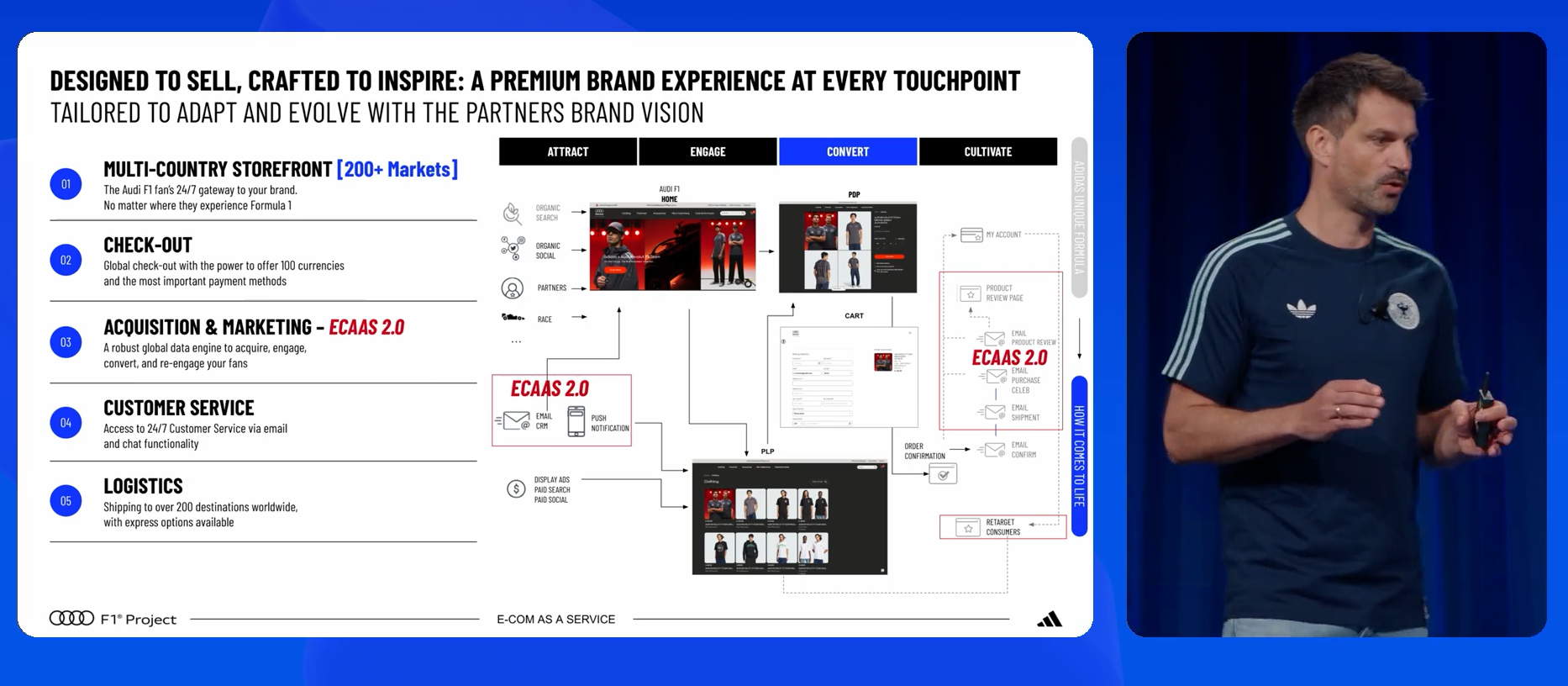
Adidas’s EaaS offering to Audi encompasses a comprehensive suite of services designed to maximize global reach and customer satisfaction. This includes the ability to sell into over 200 countries, offering a global checkout experience with support for 100 different currencies. Furthermore, the commitment to 24/7 customer service, available via email and chat, ensures that customers receive prompt assistance regardless of their location or time zone. The logistical backbone of this operation is equally impressive, with global fulfillment managed from Germany, shipping to destinations worldwide. This end-to-end capability is crucial for brands looking to expand their international footprint without the overhead of establishing their own global logistics networks.
AI Agents: The Engine of Scalability and Efficiency
A critical element enabling Adidas to manage such an extensive EaaS operation with a lean team is the integration of AI agents from Salesforce. Seeberger highlighted the stark reality: with a current team consisting of just one merchandiser, one computer scientist, and one site operations person, scaling further would be impossible without intelligent automation.
Adidas is actively developing AI agents for Audi, with a particular focus on merchandising. These agents are being built using Salesforce’s Agentforce offering, a platform designed to empower AI agents with specific functionalities and the ability to act autonomously. Andreas Kasper, an Account Director at Salesforce, who co-presented with Seeberger, elaborated on the necessity of AI in managing multiple e-commerce sites. “If you have 20, 30 different sites and you need to handle every site with one person, it’s not possible,” Kasper stated. “So either you hire an army of merchandisers, or you use AI.”
The Salesforce merchandising agent, Kasper explained, leverages natural language processing to strategically influence search rankings and automatically adjust product visibility based on predefined rules. Crucially, this is not a custom-built solution for each brand but rather a customizable template, significantly accelerating deployment and adaptation. This template-based approach ensures that Adidas can efficiently onboard and manage numerous EaaS clients, each with unique merchandising needs. The ability to run multi-million dollar businesses with minimal human intervention is a testament to the transformative power of AI in modern e-commerce operations.
Demonstrating the Power of AI: A Real-World Application
The session featured a compelling demonstration of the Adidas Agent for shopping on the Audi F1 e-commerce website, illustrating its practical application in enhancing the customer journey. In the demo, a user seeking a T-shirt engaged with the AI agent. The agent intelligently inquired about specific style preferences, such as short or long sleeves, and color choices. Upon receiving the user’s preference for a short-sleeve gray shirt, the agent presented three hyperlinked product options. Furthermore, it leveraged the user’s past purchasing behavior to recommend an appropriate size, proactively asking if the item should be added to the cart. This personalized and proactive assistance significantly streamlines the shopping process, potentially increasing conversion rates and customer satisfaction.
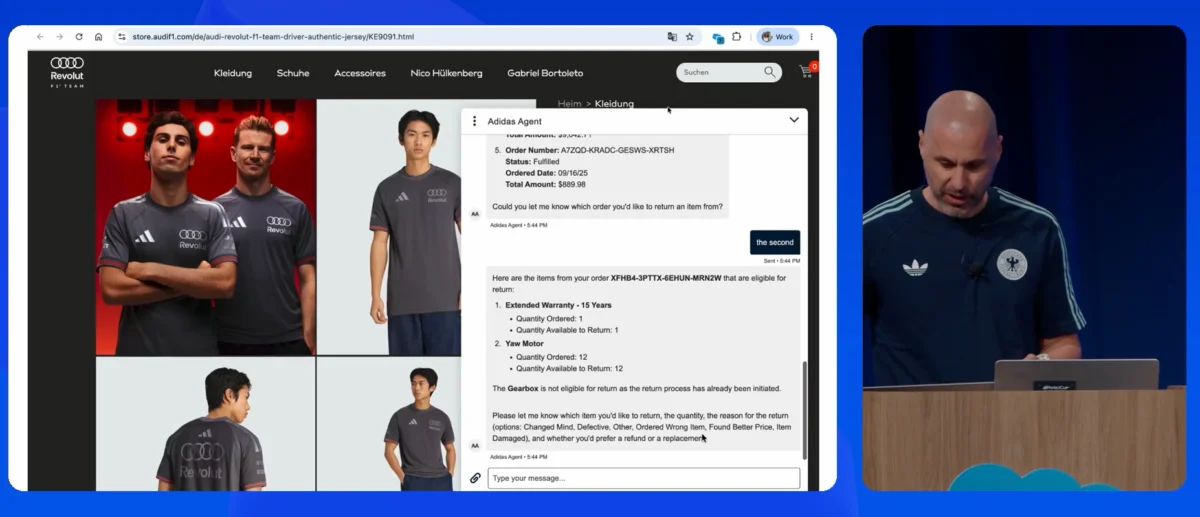
The AI agent’s capabilities extended beyond product discovery to post-purchase support, as demonstrated by a product return scenario. When a user initiated a return, the agent requested an order number and email address. Even with incomplete information (only an email provided), the agent was able to display several recent orders, allowing the user to identify the specific item for return. The agent then confirmed the return eligibility of the selected items, showcasing its ability to handle complex customer service interactions efficiently and accurately. This level of automated customer support can drastically reduce the burden on human support staff, further contributing to operational efficiency and cost savings.
Implications and Future Outlook

Adidas’s strategic move into EaaS, bolstered by Salesforce’s AI capabilities, has profound implications for the broader retail industry. It signals a shift towards brands acting as service providers, leveraging their established infrastructure and technological prowess to empower partners. This model offers several advantages:
- Enhanced Competitiveness: By offering EaaS, Adidas can directly counter competitors like Fanatics and retain its market share by providing its own robust digital commerce solutions.
- New Revenue Streams: The EaaS model opens up significant new revenue opportunities beyond traditional product sales, diversifying Adidas’s business model.
- Customer Data Insights: Managing e-commerce operations for partners provides Adidas with invaluable data and insights into consumer behavior across different brands and product categories, which can inform future product development and marketing strategies.
- Strengthened Partner Relationships: By offering a comprehensive service that alleviates the burden of e-commerce management, Adidas strengthens its relationships with existing partners and attracts new ones.
- Democratization of E-commerce: This model can empower smaller brands or those with limited e-commerce expertise to establish a strong online presence and compete more effectively in the global marketplace.
The integration of AI agents is not just about efficiency; it’s about enabling a level of personalization and proactive service that was previously unattainable with human resources alone. As AI technology continues to evolve, we can expect Adidas to further refine its EaaS offering, potentially incorporating more sophisticated AI functionalities such as predictive analytics for inventory management, dynamic pricing strategies, and hyper-personalized marketing campaigns for its partners’ customers.
The success of the Audi F1 partnership serves as a strong validation of Adidas’s vision. As the company continues to engage with potential partners, the EaaS model, powered by AI, is poised to become a significant pillar of its future growth strategy, reshaping how brands approach digital commerce and collaboration in the years to come. The commitment to innovation, exemplified by this AI-driven EaaS initiative, positions Adidas not just as an apparel leader but as a forward-thinking digital commerce enabler.