

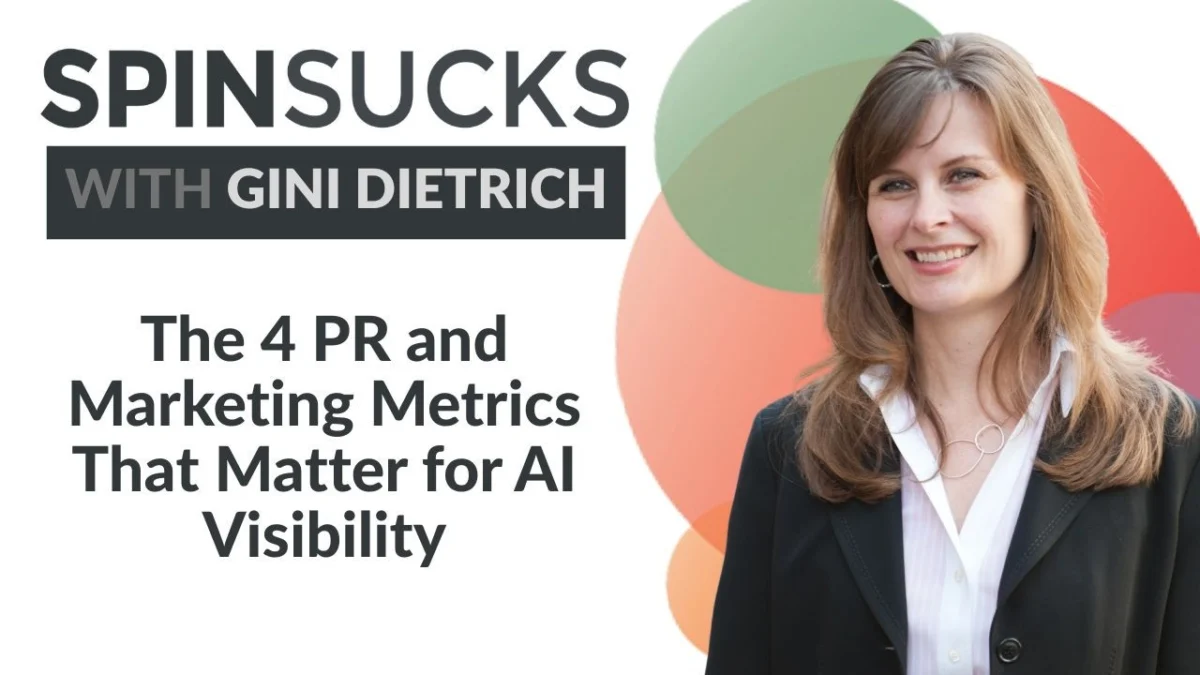
The global communications industry is facing a fundamental shift in how organizational success is quantified, moving away from legacy metrics toward a more integrated, data-driven approach known as the PESO Model® Operating System. As generative artificial intelligence (AI) and Large Language Models (LLMs) redefine how information is consumed, professional communicators are being forced to abandon vanity metrics such as impressions and Advertising Value Equivalents (AVEs) in favor of indicators that demonstrate direct business impact. This transition is not merely a change in reporting style but a structural overhaul of how marketing and public relations (PR) departments justify their budgets to executive leadership.
The core of this evolution lies in the realization that traditional digital visibility is no longer sufficient. For decades, the industry relied on "green-arrow dashboards"—reports where every metric showed growth, yet none could answer whether that growth moved the needle for the business. As the digital landscape transitions from a search-based economy to a synthesis-based economy, the metrics for 2026 and beyond are focusing on four specific areas: LLM visibility, citation frequency, narrative share of voice, and the credibility loop close rate.
The Historical Context of Communications Measurement
To understand the necessity of these new metrics, one must look at the chronology of PR measurement. For much of the 20th century, PR was measured through "clip books," physical collections of newspaper mentions. In the late 1990s and early 2000s, this evolved into digital impressions and the controversial AVE, which attempted to assign a dollar value to earned media based on what a corresponding advertisement would cost.
By the 2010s, the industry began to push back against these "nonsense numbers." The Barcelona Principles, first established in 2010 and updated in 2015 and 2020, provided the first global framework for effective PR measurement, explicitly stating that AVEs are not a proxy for the value of public relations. However, despite these professional standards, many organizations remained stuck in a "Pilot" or "Foundation" phase, measuring traffic and followers because they were easy to track, even if they lacked relevance to the Chief Financial Officer (CFO).
The emergence of generative AI in late 2022 served as the catalyst for the current measurement crisis. When consumers stopped clicking through ten blue links on a Google search results page and started asking ChatGPT or Perplexity for synthesized answers, the traditional "ranking" system collapsed. This shift created what industry experts call the "Visibility Gap," where an organization might rank highly on Google but remain completely invisible to the AI models that now mediate the buyer’s journey.
Defining the Four Essential Metrics for 2026
The PESO Model® Operating System identifies four key metrics that bridge the gap between communication activities and business outcomes. These metrics are designed to survive the scrutiny of a budget meeting by connecting reputation to revenue, recruiting, and risk management.
1. LLM Visibility
LLM Visibility measures an organization’s presence within the synthesized responses provided by AI models. Unlike Search Engine Optimization (SEO), which focuses on keywords and backlinks to drive traffic to a website, LLM Visibility focuses on "Generative Engine Optimization" (GEO). The goal is to ensure that when a potential buyer asks an AI for a recommendation or a solution to a problem, the organization is included in the response.
Tracking this metric requires a shift from monitoring click-through rates to monitoring model responses. Organizations are now advised to build a list of 20 to 30 core questions their ideal buyers ask and run these queries across major models like ChatGPT, Gemini, and Claude on a regular cadence. This allows communicators to identify whether the AI’s description of their brand is accurate or if there is a "hallucination" problem that needs to be addressed through structured data and authoritative owned content.
2. Citation Frequency
In an AI-mediated world, the distinction between a "mention" and a "citation" has become critical. A mention indicates that a brand was named; a citation indicates that the brand was the authoritative source of a fact, idea, or claim. Citation Frequency replaces the outdated clip count. It tracks how often journalists, AI models, and industry creators refer back to an organization’s original research or thought leadership.
High citation frequency serves as a leading indicator of authority. When a reporter cites a company executive as the definitive expert or an AI model attributes a specific statistic to a brand’s white paper, it signals that the organization is "load-bearing" in its category. This metric is essential for building long-term trust and reputation, which are the foundations of pricing power and market share.
3. Narrative Share of Voice
Traditional Share of Voice (SoV) measured volume—who was the loudest in the room. Narrative Share of Voice measures influence—who is setting the terms of the conversation. This metric evaluates whose framing, language, and problem-definitions the industry has adopted.
Narrative Share of Voice is achieved when competitors are forced to use your terminology to describe the market, or when analysts adopt your specific category definitions. It is a qualitative metric that has been quantified through sentiment analysis and linguistic tracking. Because narrative cannot be easily bought through advertising but must be earned through consistent, integrated communication, it is one of the hardest metrics for a competitor to disrupt.
4. Credibility Loop Close Rate
The Credibility Loop Close Rate is the ultimate performance metric. it tracks the reliability with which a prospect moves from initial visibility (seeing a brand in an AI answer or a news article) to trust (consuming owned content) to action (becoming a lead or a customer).
This metric provides the "memory" that standard lead generation often lacks. It attributes a sale not just to the last click, but to the entire ecosystem of earned, owned, shared, and paid media that built the credibility necessary for the buyer to act. For a CFO, this is the most valuable line on the dashboard because it demonstrates how the communications system reduces the cost of acquisition and increases the conversion rate.
Supporting Data: The PESO Maturity Gap
Recent data from the PESO Model® Diagnostic, an assessment of nearly 100 organizations, reveals a significant gap between communications theory and practice. The study found that two dimensions are more tightly correlated with overall communications maturity than any others: Integration and Measurement.
The data shows a 0.83 correlation between Integration and maturity, and a 0.68 correlation between Measurement and maturity. Essentially, these two factors serve as the "litmus test" for whether an organization is running a functional system or merely executing a series of disconnected tactics.
However, the findings also highlight a widespread lack of readiness. Only 7% of organizations assessed have reached the "Systemize" stage of the PESO Maturity Ladder. The majority (56%) remain parked at the "Foundation" or "Pilot" stages. Most tellingly, measurement scores quadrupled as organizations climbed the ladder—moving from an average score of 19 at the Foundation stage to 77 at the Systemize stage. This suggests that as organizations become more sophisticated, they stop relying on easy-to-track vanity metrics and start investing in the complex infrastructure required to track business-aligned outcomes.
Official Responses and Industry Implications
The move toward these advanced metrics has drawn reactions from both the technology and communications sectors. Software developers are responding by creating tools specifically designed to track AI visibility. Platforms like Brandi are emerging to provide week-over-week tracking of LLM responses, offering recommendations on which content to optimize to improve AI-driven authority.
From a strategic standpoint, industry leaders argue that these metrics are not a "bolt-on" project but a "maturity project." The implication is that an organization cannot measure a system that does not exist. If a company’s social media team, PR team, and content team are operating in silos, they will never be able to track a "Credibility Loop Close Rate" because the data is fragmented across different departments.
For the broader business landscape, the shift signifies a move toward "accountable communications." In an era of economic uncertainty, communications departments are being held to the same standards of accountability as sales and operations. The ability to demonstrate that a specific narrative led to a decrease in the sales cycle or an increase in organic leads is becoming the baseline requirement for budget retention.
Broader Impact and Future Outlook
As we move toward 2026, the organizations that successfully implement these four metrics will likely see a significant competitive advantage. By focusing on LLM visibility and citation frequency, they will capture the "top of the funnel" in the new AI-driven search environment. By mastering narrative share of voice, they will define the categories in which they compete, making it harder for challengers to gain a foothold.
The broader impact on the workforce is also notable. PR professionals and marketers must now possess a level of data literacy that was previously reserved for data scientists. Understanding how LLMs crawl data, how structured data affects visibility, and how to build attribution models for "earned" media are now essential skills.
The final takeaway for the industry is a call to action: the "wall of green arrows" is no longer enough to protect a communications budget. The question "Did any of this move the business?" is now the only question that matters. By adopting the PESO Model® Operating System and its associated metrics, communicators can finally provide an answer that is both accurate and relevant, ensuring their seat at the table when the most important organizational decisions are made.









