Nila Kartika Wati
The influencer marketing landscape has reached a critical inflection point in 2026, driven by a fundamental shift in the mathematics of digital engagement. As the number of active content creators worldwide surpasses several hundred million, the manual processes that once defined the industry—vetting candidates via spreadsheets, manual inbox outreach, and subjective "gut-feel" selection—have become mathematically impossible for human teams to sustain. Modern marketing departments are now turning to sophisticated artificial intelligence (AI) tools to manage the sorting, scoring, and recruitment tasks that previously required large dedicated teams. This transition has enabled two-person marketing departments to execute complex, global campaigns that would have necessitated a six-person team only a few years ago.
The Paradigm Shift: From Manual Selection to AI-Driven Automation
The integration of AI into influencer marketing is not merely a matter of convenience but a response to the overwhelming volume of social data. According to industry analysis, identifying, vetting, and recruiting a viable shortlist of influencers can consume more than 20 hours of a marketer’s week when performed manually across disconnected systems. AI tools solve this by automating four primary pillars of the workflow: discovery, vetting, relationship management, and ROI measurement.
A distinction must be made between "AI influencers"—computer-generated virtual personas—and "AI tools for influencer marketing." While the former represents a niche creative trend, the latter constitutes the essential infrastructure of modern commerce. These software platforms utilize machine learning and natural language processing (NLP) to analyze audience behavior, detect fraudulent activity, and predict campaign performance with a degree of accuracy that human observation cannot match.
Chronology of Innovation in Creator Management
The evolution of these tools has followed a distinct timeline, moving from simple directories to autonomous agents:
- 2010–2015: The Manual Era. Brands relied on internal lists and "top 10" blog posts to find talent. Outreach was handled through personal DMs and standard email.
- 2016–2020: The Database Era. Platforms emerged that indexed creators based on follower counts and basic category tags. This period saw the rise of the first "influencer marketplaces."
- 2021–2024: The Integration Era. Software began connecting social data with e-commerce backends (Shopify, Amazon), allowing brands to track sales rather than just likes.
- 2025–2026: The Agentic Era. The current generation of tools features "AI Agents"—autonomous systems capable of drafting personalized messages, vetting for brand safety in real-time, and recommending budget allocations based on historical ROI.
Analysis of Core AI Functionalities and Industry Benchmarks
The effectiveness of AI in this space is best measured through its impact on engagement and authenticity. Recent data from Q2 2026, analyzing 10.9 million creator profiles across Instagram, TikTok, and YouTube, reveals a stark inverse relationship between audience size and engagement. Nano-influencers (under 10,000 followers) currently maintain a median engagement rate of 2.5% on Instagram, whereas mega-influencers (over 1 million followers) see that figure drop to 0.8%. AI discovery tools allow brands to identify these high-engagement nano-creators at scale, a task that was previously too labor-intensive to be profitable.
Influencer Vetting and Fraud Mitigation
Vetting remains the most critical stage for budget protection. AI-driven fraud detection has become a non-negotiable requirement as the prevalence of "engagement pods" and bought followers continues to rise. Analysis of approximately 4 million Instagram profiles indicates that the median creator profile carries an estimated 7% fake followers. More alarmingly, 1 in 16 profiles shows a fake-follower share exceeding 25%.
AI tools now employ pattern recognition to flag suspicious growth curves and analyze the quality of comments to distinguish between genuine community interaction and bot-generated spam. Beyond fraud, "Brand Safety" AI scans years of historical content—including video transcripts and captions—to ensure creators do not have a history of promoting content that conflicts with a brand’s values, such as the promotion of unregulated substances or controversial social stances.
Comparative Profile of Leading AI Influencer Tools
The following seven platforms represent the current state-of-the-art in the industry, each optimized for specific organizational needs and workflows.
1. Upfluence: The End-to-End AI Agent
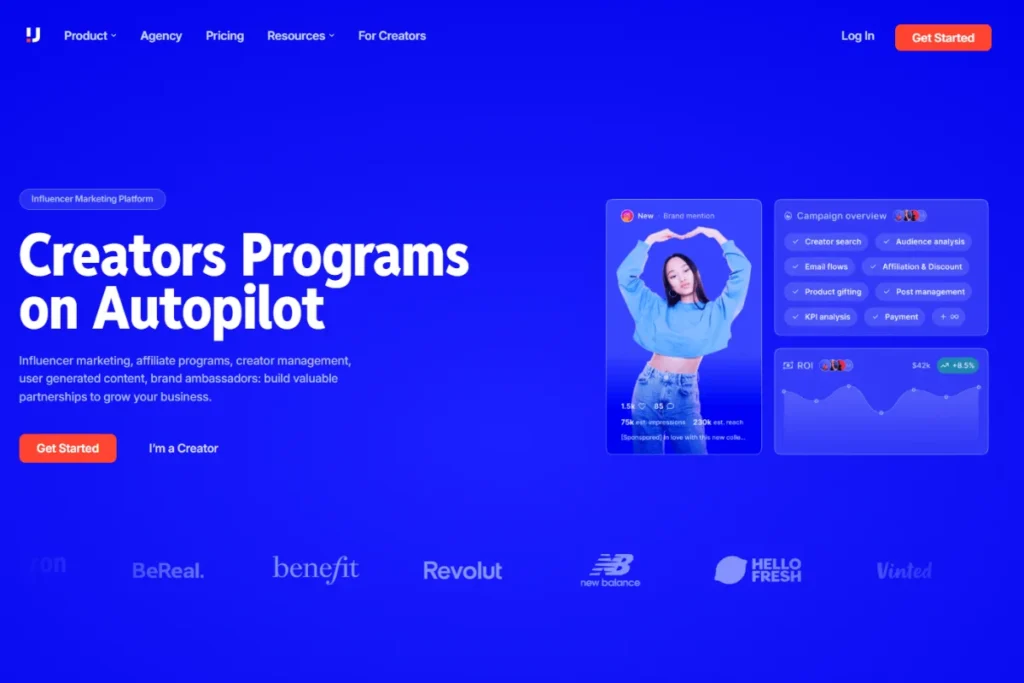
Upfluence has positioned itself as an all-in-one solution for Direct-to-Consumer (DTC) and e-commerce brands. Its standout feature is "Jaice," an AI agent that handles the entire lifecycle of a campaign—from search and vetting to automated outreach and performance reporting. A unique differentiator is its "Live Capture" technology, which integrates with e-commerce platforms like Shopify and BigCommerce to identify existing customers who are also influencers. This allows brands to recruit advocates who already have a genuine affinity for their products.
2. Modash: Cross-Platform Discovery
Modash focuses on the "top of the funnel," providing an expansive database that indexes creators across Instagram, TikTok, and YouTube. Its AI is designed for teams that need to find niche creators across multiple platforms simultaneously. While it includes campaign tracking and payments, its core strength lies in its filtering capabilities, which allow for granular searches based on audience demographics and interests.
3. Grin: Relationship and Revenue Management
Grin is tailored for brands that view creators as long-term revenue partners rather than one-off tactical spends. It emphasizes relationship management and product gifting. Recently, Grin has introduced an "AI Copilot" to assist with revenue attribution, helping brands understand the exact dollar value generated by each creator relationship.
4. CreatorIQ: Enterprise Governance
For large-scale organizations and global agencies, CreatorIQ provides a robust framework for managing complex, multi-team campaigns. Its AI focuses on "similar-creator matching" and high-level brand-safety analysis. It is built to handle the governance requirements of enterprise-level programs where compliance and cross-departmental reporting are paramount.
5. HypeAuditor: The Vetting Specialist
HypeAuditor is the industry benchmark for audience quality and fraud detection. While it offers discovery and analytics, its primary utility is its AI-powered fraud scoring. Brands use HypeAuditor to perform deep-dive audits of a creator’s audience before committing a marketing budget, ensuring that they are paying for reach among real, active humans.
6. Aspire: The UGC and Ambassador Engine
Aspire operates as both a creator marketplace and a management platform. It is particularly effective for brands looking to scale user-generated content (UGC) and ambassador programs. Its AI assists in matching creators to specific collaboration briefs, streamlining the workflow for brands that rely on a high volume of content creation.

7. Traackr: Global Market Benchmarking
Traackr is designed for enterprise teams operating across multiple geographic regions. Its AI assists with cross-market benchmarking, allowing global CMOs to compare the performance of their influencer programs in Europe versus North America or Asia. It provides the data depth necessary for large-scale strategic optimization.
Strategic Implications for Brand Marketing
The shift toward AI-integrated platforms has significant implications for how brands allocate their resources. When creators, sales data, and payouts reside in separate, disconnected systems, tying a specific social post to a financial outcome is often reduced to guesswork. AI-backed analytics now connect affiliate links, promo codes, and store data in a single dashboard.
Furthermore, the "AI-human" division of labor is becoming clearer. While AI is superior at narrowing down 10,000 options to a defensible shortlist of 50, the final judgment regarding "creative taste" and "brand fit" remains a human prerogative. The technology is designed to remove the "busywork"—the 20 hours of manual searching—so that marketers can focus on the high-level strategy and creative direction that ultimately drives brand resonance.
Official Responses and Industry Sentiment
Marketing executives at major DTC firms have increasingly voiced their support for consolidated AI platforms. In recent industry forums, the consensus among Chief Marketing Officers is that the "point tool" era—where a brand might use one tool for discovery, another for email, and a third for payments—is ending. The operational "handoffs" between these tools are seen as the primary source of campaign delays and data inaccuracies.
Industry analysts suggest that the next frontier for these tools will be predictive budgeting. By analyzing over a decade of campaign data, platforms like Upfluence are beginning to offer recommendations on exactly how much a brand should spend on a specific creator to achieve a desired return on ad spend (ROAS).
Conclusion: Navigating the Future of Influencer Commerce
Choosing the correct AI tool for influencer marketing in 2026 requires a match between the software’s coverage and the brand’s specific workflow. For small to mid-market teams, an all-in-one platform that handles discovery through to global payouts is often the most cost-effective choice, as it eliminates the need for multiple contracts and manual data migration.
As the creator economy continues to expand, the brands that succeed will be those that use AI not to replace the human element of marketing, but to empower it. By automating the "math" of influencer marketing, these tools allow brands to return to the "art" of storytelling and relationship building, ensuring that influencer programs are both scalable and authentically connected to the consumer.

 Ali Ikhwan
 Muslim