The advent of sophisticated AI-powered answer engines has fundamentally reshaped the digital search landscape, making Answer Engine Optimization (AEO) audit tools an indispensable asset for any organization seeking to maintain visibility and accuracy in the new era of direct recommendations. While traditional Search Engine Optimization (SEO) audits have long focused on tracking organic rankings and website crawl health, AEO audit tools introduce a critical new layer of measurement, specifically designed to gauge a brand’s presence and the veracity of its citations across platforms where consumers increasingly obtain instant, synthesized answers. This paradigm shift mandates that SEO managers, content strategists, and growth marketers integrate AEO into their core strategy, addressing a measurement gap many teams are only now beginning to recognize.
The Dawn of Answer-Driven Discovery and the AEO Imperative
The rapid proliferation of generative AI models such as ChatGPT, Perplexity AI, and Google Gemini, particularly since late 2022, has ushered in a new epoch of information consumption. Users are no longer solely navigating pages of links; instead, they are directly querying AI for succinct, authoritative recommendations and summaries. This behavioral transformation means that for brands to remain relevant and discoverable, they must not only appear in these AI-generated citations but also ensure those citations are consistently accurate and aligned with their messaging. AEO audit tools serve as the primary mechanism to measure this critical answer engine visibility, identifying instances where a brand is cited, the context of the citation, and any potential inaccuracies.
The dynamic nature of AI models further underscores the necessity of continuous AEO auditing. Unlike traditional search algorithms, which update periodically, AI models undergo frequent retraining, incorporating new data and evolving their understanding of information. Consequently, a brand prominently cited in a Perplexity AI answer today could vanish or be misrepresented weeks later if stronger, more optimized sources emerge. This volatility necessitates treating visibility tracking as an ongoing, iterative process rather than a static snapshot, demanding tools capable of sustained monitoring and rapid alerting.
Navigating the Complexities of AEO Tool Selection
The market for AEO solutions is rapidly expanding, offering a diverse array of options ranging from enterprise-level optimization platforms to specialized AEO trackers and enhanced keyword research tools. The core challenge for marketing teams lies not in the absence of choices, but in the nuanced evaluation of these options. It requires a clear understanding of whether existing SEO infrastructure can adequately cover AEO requirements or if dedicated tools are essential. This guide aims to demystify this evaluation process, providing a structured approach to auditing AEO performance and diagnosing visibility gaps effectively.
Establishing a Robust AEO Audit Workflow
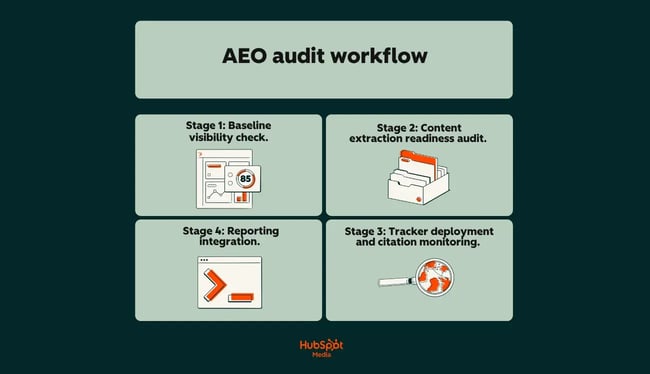
An effective AEO audit follows a methodical, multi-stage process, ensuring comprehensive coverage and actionable insights.

Step 1: Baseline Visibility Check – The Foundation
Before committing resources to advanced software, a foundational baseline check is imperative. Tools like HubSpot’s AI Search Grader offer a free diagnostic, allowing teams to ascertain their brand’s current presence—or absence—within major answer engines. This initial assessment provides crucial data on where a brand is cited, for which queries, and across which platforms, informing subsequent strategic decisions without immediate financial outlay.
Step 2: Content Extraction Readiness Audit – Optimizing for AI Consumption
Visibility alone is insufficient if content is not structured for optimal AI extraction. Answer engines are designed to scan and synthesize specific "chunks" or paragraphs of information. Therefore, a critical audit step involves reviewing existing content to ensure it adheres to AI-friendly best practices. This includes reformatting introductions to provide immediate answers, integrating explicit Q&A blocks, and utilizing comparison tables that AI models can easily parse. Teams should audit their top 50 to 100 pages against these structural criteria, prioritizing improvements on high-value content.
Step 3: Tracker Deployment and Citation Monitoring – Continuous Insight
Once a baseline is established and content is optimized for extraction, the deployment of dedicated AEO trackers becomes essential. These tools move beyond manual checks, providing automated monitoring of citation coverage and brand accuracy. They map specific queries to AI-generated responses, indicating when and where a brand appears, and critically, verifying the accuracy of the information presented. This automated monitoring is vital for maintaining an up-to-date understanding of AEO performance.
Step 4: Reporting Integration – Measuring Impact
The final stage involves integrating AEO citation data into existing marketing dashboards. AEO success is not an isolated metric; it must be viewed in conjunction with broader marketing objectives. By connecting AEO performance—measured by citation share, accuracy, and customer sentiment—with traditional SEO gains and other key performance indicators (KPIs), marketing teams can demonstrate the tangible impact of their AEO efforts on overall business outcomes, such as brand awareness, lead generation, and ultimately, revenue.
Tailoring AEO Solutions to Organizational Maturity and Scale
The optimal AEO audit tool stack varies significantly based on an organization’s size, budget, and the maturity of its marketing operations.
Startup and SMB Stack: Validating Initial Presence
For nascent businesses or small marketing teams (1-5 marketers), the primary objective is to answer a fundamental question: "Does AI search even acknowledge our brand?" The focus is on validating initial AI visibility without significant investment.
- Recommended Stack: Manual checks across ChatGPT, Perplexity, and Gemini, augmented by free tools like HubSpot’s AI Search Grader.
- Benefits: This zero-cost approach provides crucial early validation. If initial audits reveal negligible brand presence, the immediate priority should be content reformatting for AI readiness, rather than software acquisition.
- Pro Tip: Ensure at least 30% of key pages feature answer-first intros, Q&A sections, and comparison tables before evaluating paid tools. Content readiness is a prerequisite for AI visibility.
Mid-market Stack: Scaling Monitoring and Integration
Mid-market teams (5-20 marketers) often have a dedicated SEO function and require more scalable solutions than manual spot-checks. Enterprise platforms might be budget-prohibitive, so the ideal tools layer citation tracking onto existing SEO and CRM workflows, minimizing tool sprawl.
- Recommended Stack: Dedicated AEO trackers integrated with existing SEO platforms and CRM systems.
- Benefits: This approach allows for ongoing citation monitoring and query research with reduced manual effort, seamlessly integrating AEO data into established marketing reporting structures. This tier supports a more proactive and data-driven AEO strategy.
Enterprise Stack and Compliance Checklist: Standardization and Governance
Large enterprise organizations (20+ marketers, multi-brand, regulated industries) demand standardized measurement across diverse business units, regions, and product lines. The best enterprise AEO tools consolidate citation tracking and content governance within existing organizational systems.

- Recommended Stack: Enterprise AEO platforms integrated with comprehensive marketing attribution tools (e.g., HubSpot Marketing Hub).
- Benefits: This integration addresses the critical measurement challenge for CMOs, allowing AEO success to be correlated with established metrics like pipeline data and campaign attribution.
- Enterprise Vendor Considerations: Before contracting, verify data source transparency, API integration capabilities, regulatory compliance (e.g., GDPR, CCPA), and the vendor’s data retention policies. Pricing models should be negotiated based on tracked queries and answer engines, not seat count, as data volume is the primary cost driver.
A Practical AEO Audit Workflow for Immediate Implementation
To kickstart AEO efforts, a focused workflow can be deployed within a week:
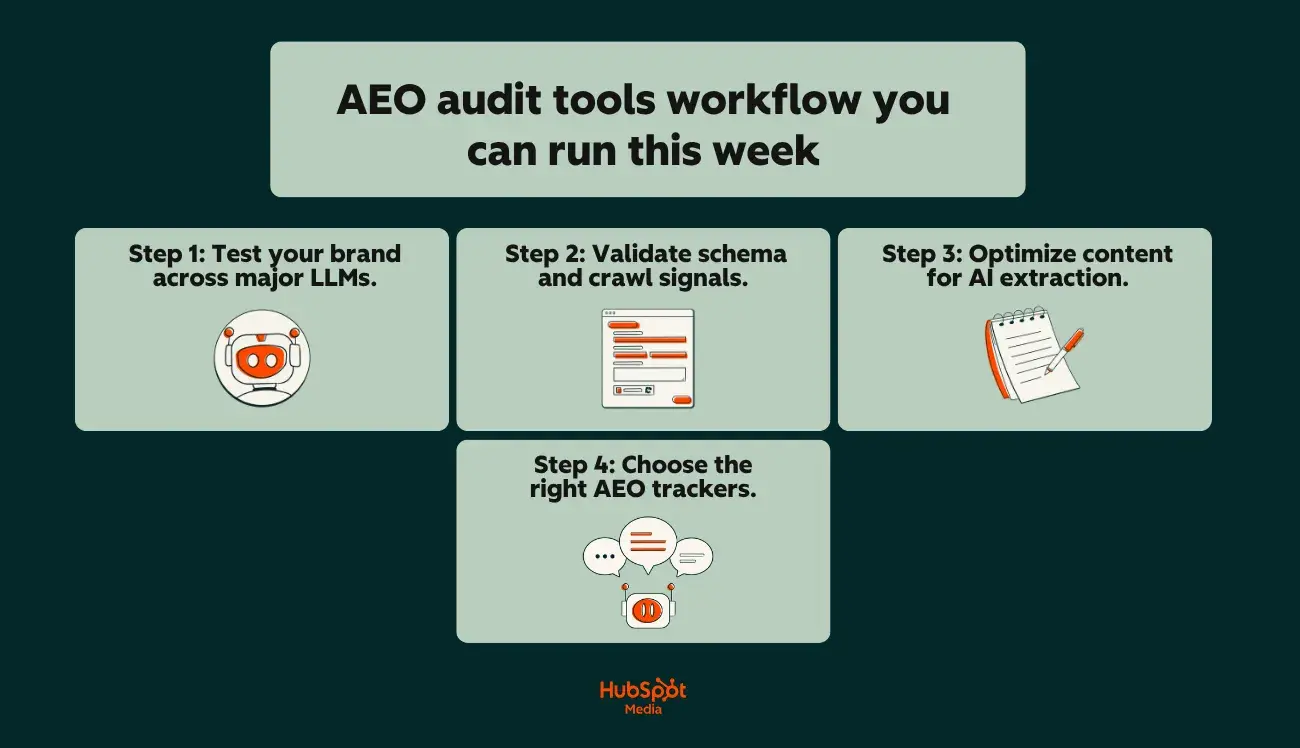
Step 1: Test Brand Across Major Answer Engines.
Initiate baseline testing by manually querying ChatGPT, Perplexity, and Gemini with brand-specific questions, competitor comparisons, and industry-related queries. Document the exact query list for consistent re-testing. Supplement manual efforts with tools like HubSpot’s AI Search Grader for automated baseline checks and cross-referencing. The goal is to gather raw data on brand appearance and accuracy.
Step 2: Validate Schema and Crawl Signals.
AI engines rely on accessible and parseable content. Verify technical visibility by ensuring pages are indexed (using Google Search Console), conducting structured data audits (schema markup), checking for crawl errors, and ensuring mobile responsiveness. These technical foundations are crucial for AI discoverability.
Step 3: Optimize Content for AI Extraction.
Focus on adapting content structure for AI. Audit top pages for answer-first introductions, dedicated Q&A blocks, and comparison tables. Prioritize the top 20-50 pages for reformatting, recognizing that content structured for AI extraction is a prerequisite for visibility. Tools like HubSpot’s Content Hub offer AI-optimized modules to streamline this process.
Step 4: Choose the Right AEO Trackers.
With baseline data and content improvements underway, evaluate paid AEO audit tools. Select tools that align with the organization’s size, budget, and specific needs identified during the baseline audit. Consider factors like real-time alerts, query mapping, and integration capabilities.
Automating Recurring AEO Reports for Sustained Performance
A one-time audit is merely a snapshot; a recurring system ensures continuous improvement and adaptation. A three-tier reporting cadence is recommended:
Weekly: Citation Alerts and Brand Accuracy Flags
Weekly monitoring is crucial for proactive problem detection. Automate alerts for new citations, changes in brand representation, or potential inaccuracies. Route these alerts to relevant Slack channels or email lists, integrating them with existing SEO alert systems to prevent disconnected workflows.
Monthly: Citation Share Reviews and Content Performance
Monthly reviews transition from reactive monitoring to strategic analysis. Analyze citation share trends, identify top-performing content driving AI citations, and correlate AEO performance with other marketing metrics like customer sentiment and share of voice. This cadence addresses the critical question of AEO’s measurable success.
Quarterly: Full Engine Tests and Stack Evaluation
Quarterly reviews offer a strategic zoom-out. Re-run comprehensive baseline tests across the full query set, evaluate the efficacy of current AEO software, and present findings to leadership. This is the opportunity to assess long-term strategy, budget allocation, and tool suitability.
Avoiding Common AEO Audit Tool Pitfalls
While the imperative for AEO is clear, several pitfalls can derail successful implementation:
Pitfall 1: Tool-First Buying
Purchasing AEO software without a preceding baseline visibility test or a content audit is a common mistake. Teams must first understand their current standing and identify specific improvement areas before investing in solutions.
Pitfall 2: Weak Documentation and Absence of a Measurement Framework
Deploying AEO trackers without a clear definition of success or a robust measurement framework leads to data without insight. Establish clear goals and KPIs before implementation, and store this framework alongside citation reports for continuous context. HubSpot’s Marketing Hub can centralize AEO reporting with broader campaign and attribution data.
Pitfall 3: Single-Engine Focus
Testing visibility solely in ChatGPT, or any single AI engine, creates dangerous blind spots. Each AI platform operates with distinct data sources, retraining schedules, and citation logic. A brand highly visible in one engine may be entirely absent from another. Prioritizing ChatGPT, Perplexity, and Gemini provides a more comprehensive view of the answer engine landscape.
Conclusion: The Evolving Search Landscape Demands AEO Audit Tools
The transformation of search from link-driven pages to direct, AI-generated answers represents a fundamental shift in digital marketing. Buyers are actively engaging with ChatGPT, Perplexity, and Gemini for product recommendations and information, making it imperative for brands to ensure their accurate and prominent appearance in these responses. AEO audit tools are no longer optional; they are critical for evaluating performance, identifying opportunities, and maintaining competitive advantage in this rapidly evolving environment. By establishing a robust audit workflow, tailoring solutions to organizational needs, automating reporting, and avoiding common pitfalls, organizations can effectively navigate the complexities of AEO and secure their position in the future of digital discovery. The time to embrace AEO is now, ensuring that brands are not merely present but accurately represented where buyers are actively seeking answers.