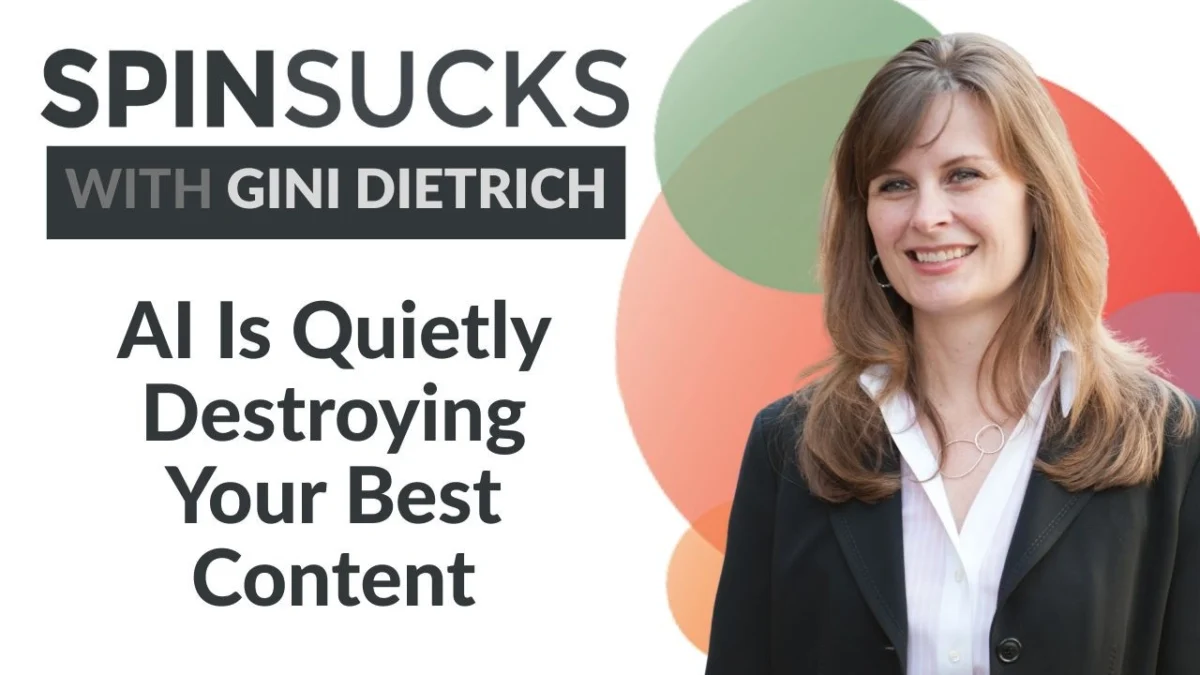
The rapid integration of Generative Artificial Intelligence (AI) into corporate communication workflows has created a critical paradox: while distribution has become effortless, brand authority is facing an invisible crisis of dilution. As marketing teams increasingly rely on large language models (LLMs) to repurpose flagship content into various social media formats, a phenomenon known as the "AI Telephone Game" is stripping away the specific data points, unique voices, and defensible claims that differentiate market leaders from their competitors. This erosion of specificity not only weakens human engagement but also compromises how "answer engines"—the AI-driven search platforms now dominating the digital landscape—perceive and rank brand authority.
The Mechanics of Content Dilution in the AI Era
The transition from high-quality original research to "content slop" occurs through a process of incremental simplification. In a traditional workflow, a "flagship" piece of content—such as a white paper or a case study—is manually distilled by human editors who understand the strategic importance of specific data. However, the modern AI-assisted workflow often involves a "cascade" of automated summaries.
In this cascade, a blog post is summarized for a newsletter; that newsletter is then summarized for LinkedIn; the LinkedIn post is paraphrased for a sales deck; and finally, that deck is converted into talking points for a podcast. Each generation of AI rewriting tends to "soften" the narrative. AI models are trained to be helpful and conversational, which often results in the removal of "friction"—the very numbers, dates, and specific names that make a claim defensible.
Industry analysts have observed that by the fourth or fifth iteration of this process, a specific claim, such as "reduced churn by 34% across 50 mid-market customers in 18 months," is often reduced to a generic platitude like "many organizations have found success with integrated communications." This transition from the specific to the generic is termed "content laundering," where the original evidence is scrubbed away, leaving behind a "beige soup" of information that is indistinguishable from competitor content.
Chronology of an Idea: From Authority to Invisibility
The lifecycle of diluted content typically follows a predictable timeline within a marketing department’s quarterly cycle:
- The Genesis (Month 1): An organization produces a primary asset based on proprietary data or unique expertise. This document contains "sharp" claims, specific attribution, and a distinct brand voice.
- The First Compression (Month 1, Week 2): AI tools are used to create "punchy" social media versions. The model, prioritizing brevity, begins to omit secondary data points.
- The Cross-Platform Proliferation (Month 2): These already-compressed versions are fed back into AI tools to generate email scripts and internal memos. At this stage, the connection to the original data source is often lost.
- The Feedback Loop (Month 3): The generic, AI-generated versions become the basis for new content. The brand begins to "echo" its own diluted summaries rather than its original research.
- The Search Engine Erasure (Month 4 and beyond): Answer engines, scanning the web for corroboration, find 40 versions of a generic claim and only one version of the specific data. The engines prioritize the "consensus" (the generic version), effectively burying the brand’s original authority.
Supporting Data: The Rise of Answer Engines and GEO
The stakes for content specificity have shifted from an aesthetic preference to a financial and visibility requirement. According to the G2 2026 AI Search Insight Report, a meaningful and growing share of buyers, candidates, and partners now use "answer engines" like Perplexity, ChatGPT, and Google’s AI Overviews as their primary research tools.
Unlike traditional search engines that provide a list of links, answer engines synthesize a single, authoritative response. These models are biased toward consistency and corroboration. If an organization’s claims are diluted across the web, the AI engine cannot verify the brand as a primary authority.
This has given rise to a new discipline: Generative Engine Optimization (GEO). Early research into GEO suggests that AI engines trust a brand more when independent sources and various platforms reinforce specific, consistent claims. When a brand’s own repurposing strategy removes those specifics, it actively sabotages its GEO potential. The "dilution effect" tells the AI that the brand is just another voice in the generic consensus, rather than the source of the insight.
The "Repurposing Rule" as a Strategic Framework
To combat this trend, communication experts are advocating for a strict "Repurposing Rule" within the PESO (Paid, Earned, Shared, Owned) Model™ framework. This rule dictates that while the format, length, and tone of content may adapt to different platforms, three elements must remain non-negotiable and constant across every iteration:
- The Claim: The core argument or insight must not be softened or generalized.
- The Evidence: Specific numbers, timeframes, and data points must survive every draft.
- The Attribution: The source of the expertise must remain clearly connected to the claim.
Industry veterans suggest treating AI as a "smart junior professional" rather than a creative lead. In this management model, the AI is permitted to handle the labor-intensive tasks of adapting format and length, but it is never given the authority to alter the structural integrity of the evidence or the voice.
Professional Reactions and Industry Analysis
The shift toward AI-driven content has met with mixed reactions from the public relations and marketing sectors. While the "speed advantage" is undeniable—allowing a single marketer to do the work of a small agency in terms of volume—the long-term impact on brand equity is a growing concern.
"The leverage AI gives us is real, but the cost is almost nobody is naming it," says Gini Dietrich, creator of the PESO Model™. "By the fourth generation of AI-rewriting, your best work reads like everyone else’s. This is not just an editorial problem; it’s a visibility problem. Answer engines are looking for authority, and you cannot be an authority if you sound like a generic summary."
Analysts suggest that the "ChatGPT Test" is becoming a necessary diagnostic for brands. By asking an AI model what a specific organization stands for without providing context, many teams are discovering that the AI’s perception of them is "the average of every AI-rewritten version of their content," leading to a significantly smaller and less differentiated market footprint than they realized.
Implications for the Future of Digital Visibility
As we move toward 2026, the editorial discipline of maintaining specificity will likely become a primary differentiator in digital marketing. Organizations that "hold the line" on their claims and evidence will be the ones cited by answer engines as primary sources. Those that succumb to the ease of automated dilution risk becoming invisible, as their unique insights are laundered into the "common knowledge" of the internet.
The transition of the PESO Model™ from a simple framework to a comprehensive "operating system" reflects this need for integration discipline. In an AI-driven environment, the ability to ensure that a specific insight from an "Earned" media placement is accurately reflected in "Owned" and "Shared" channels—without losing its factual "teeth"—is the difference between an AI-discoverable brand and an obsolete one.
Conclusion and Actionable Steps for Organizations
To mitigate the risks of content dilution, organizations are encouraged to implement three immediate changes to their content workflows:
- Audit the Output: Conduct a "Telephone Game" audit by comparing a flagship piece of content to its final social media variants. Identify where numbers and specific claims were dropped.
- Establish Constraints: Update AI prompts to include "negative constraints," explicitly forbidding the model from removing specific data points or generalizing claims.
- Human Verification: Require a "final mile" human review for every AI-generated piece, specifically tasked with verifying the "Repurposing Rule" (Claim, Evidence, Attribution).
The hard work of building a market-leading argument should not be undone by the "easy" work of repurposing it. In the age of AI, specificity is the only remaining defense against the rising tide of generic content. As answer engines continue to reshape the path to purchase, the brands that remain "sharp" will be the ones that survive the synthesis.