
 rifanmuazin
On January 24, 2026, organizations utilizing Salesforce Marketing Cloud (SFMC) for their email campaigns encountered widespread and severe disruptions, stemming from a critical security vulnerability that necessitated an urgent platform-wide encryption update. This incident, detailed in an official Salesforce security notification, led to a cascade of technical issues, impacting email deliverability, sender reputation, and crucially, the functionality of previously sent communications. The core of the problem lay in a shift to a new, incompatible authenticated encryption method, which rendered all email links generated before January 21, 2026, inoperative.
Understanding the Technical Genesis of the Disruption
The precipitating event was Salesforce’s proactive measure to address a potential security vulnerability within SFMC. To mitigate this flaw, Salesforce implemented a new, more robust method of authenticated encryption. While this action successfully resolved the underlying security concern, it introduced an unforeseen and significant compatibility challenge. The newly adopted encryption standard was not backward-compatible with the older method, meaning that any email links generated prior to January 21, 2026, became instantly obsolete. Subscribers attempting to click on these links were redirected to generic error pages, effectively severing the connection between sender and recipient for a vast volume of previously delivered emails.
Further compounding the issue was a secondary, yet equally impactful, technical problem related to link length and legacy email systems, particularly those operated by Microsoft. The new, more secure encryption method resulted in significantly longer URLs—in some cases, more than double the length of their predecessors. This increased length created an unexpected conflict with legacy email processing rules at Microsoft. These rules, designed to prevent excessively long lines of text in email bodies, automatically inserted line breaks when messages exceeded certain character limits. When applied to the newly elongated SFMC links, these line breaks corrupted the integrity of Domain Keys Identified Mail (DKIM) signatures. DKIM is a crucial email authentication method that allows an organization to cryptographically sign its emails, verifying to receiving mail servers that the email was indeed sent by an authorized sender and has not been tampered with in transit. The breakage of DKIM signatures is a severe blow to email deliverability, as it flags messages as potentially fraudulent or spoofed, leading to increased rejection rates by mailbox providers.
A Chronology of Compounding Events
The incident unfolded against a backdrop of related challenges, creating a perfect storm for SFMC users:

- Prior to January 21, 2026: Emails containing links encrypted with the old method were sent via SFMC.
- January 21, 2026: Salesforce implements the new authenticated encryption method to address the security vulnerability. All links generated after this date use the new method. Critically, all links generated before this date become invalid due to incompatibility.
- January 22-23, 2026: Microsoft experiences a significant outage affecting its email services, including Hotmail, Outlook, and Microsoft 365. This event independently causes a substantial increase in soft bounce activity for emails delivered to Microsoft-owned inboxes, impacting a broad spectrum of email senders, not just those using SFMC.
- January 24, 2026: The full impact of the SFMC encryption change becomes apparent. Teams sending emails from SFMC report major disruptions. Subscribers attempting to click on old links encounter errors. The extended length of new SFMC links begins to trigger Microsoft’s legacy character limit rules, leading to widespread DKIM signature breakage and authentication failures.
This unfortunate sequence meant that SFMC senders were grappling with the fallout of their own platform’s security update immediately after a major outage at one of the world’s largest email providers, creating a challenging environment for diagnosis and recovery.
The Far-Reaching Impact on Senders and Subscribers
The consequences of this incident were immediate and severe for both email senders and their subscribers. The most visible impact was the widespread failure of all click-through links in emails sent before January 21. This meant that any call to action, product link, informational resource, or crucial unsubscribe mechanism within those emails was rendered useless, directing users to generic error pages instead of their intended destinations.
From a compliance standpoint, the breakdown of unsubscribe links presented a serious legal and ethical dilemma. Email marketing regulations, such as CAN-SPAM in the United States or GDPR in Europe, mandate that recipients must have a clear and functional way to opt out of future communications. The inability to unsubscribe due to broken links exposed senders to potential regulatory violations, increased spam complaints, and significant damage to their brand reputation.
The technical ramifications extended to authentication failures and soaring bounce rates. With DKIM signatures being broken by Microsoft’s legacy systems, many emails from SFMC were either rejected outright or flagged as suspicious by receiving mail servers. This led to a massive increase in hard and soft bounces, further exacerbating deliverability problems. Validity’s data, a trusted source for email deliverability metrics, clearly illustrated the severity of the incident. Their analysis indicated a severe deterioration of sender reputations, characterized by sharp increases in authentication failures, bounces, and, critically, spam complaints. Recipients, encountering broken links and unusual email behavior, often interpreted these signs as potential fraud or phishing attempts, leading them to mark legitimate emails as spam.
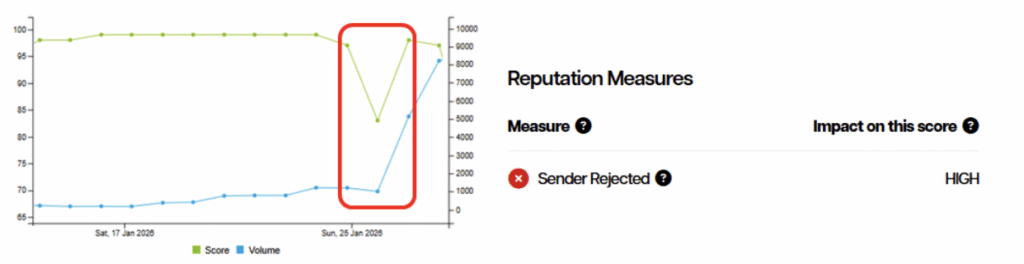
Visual data provided by Validity underscored the catastrophic impact:
- Sender Score Decline: For one large email program, the Sender Score—a measure of reputation on a scale of 0-100, with higher scores indicating better reputation—showed a precipitous drop during the incident period. A healthy Sender Score is crucial for consistent inbox placement; such a rapid decline signals a severe and immediate impact on a sender’s ability to reach their audience.
- Plummeting Microsoft Inbox Placement Rates: Average inbox placement rates at Microsoft inboxes experienced a dramatic fall. The data revealed an overall deliverability drop of approximately 25 percent across all senders to Microsoft. However, for the specific cohort of SFMC senders directly affected by the incident, inbox placement rates plummeted even more severely, with many experiencing rates close to zero percent in the immediate aftermath. This means that virtually none of their emails were reaching the primary inboxes of their Microsoft-based subscribers, effectively halting their email marketing operations to a significant segment of their audience.
Beyond the immediate technical metrics, the incident carried substantial financial and operational implications. Lost click-through traffic translates directly to lost conversions, sales, and engagement. Customer support teams likely faced an overwhelming influx of inquiries from frustrated subscribers unable to access content or unsubscribe. The effort and resources required to diagnose, mitigate, and recover from such a widespread deliverability crisis can be immense, impacting marketing budgets, team morale, and long-term brand loyalty.
Salesforce’s Response and Industry Recommendations
Salesforce promptly issued a security notification, acknowledging the disruption and detailing the technical nature of the encryption update. While the immediate focus was on securing the platform, the downstream effects highlighted the intricate dependencies within the email ecosystem.
In the wake of such an event, industry experts and deliverability specialists emphasize the critical importance of robust monitoring and proactive management of email programs. Key recommendations for safeguarding email programs and recovering from similar disruptions include:
- Continuous Reputation Monitoring: Tools like Sender Score are indispensable for tracking sender reputation metrics. Early detection of dips in reputation can provide crucial lead time for intervention before problems escalate.
- Detailed Bounce Profile Analysis: Utilizing tools like Bounce Lookups allows senders to analyze changes in their bounce profiles, identifying specific reasons for non-delivery. Understanding whether bounces are due to authentication failures, content issues, or recipient-side problems is vital for targeted remediation.
- DKIM Pass/Fail Rate Oversight: Close monitoring of DKIM authentication pass/fail rates is essential. A sudden increase in DKIM failures is a strong indicator of authentication issues that need immediate attention, whether originating from the sender’s infrastructure or intermediary platforms.
- Proactive Re-engagement Campaigns: For subscribers whose unsubscribe links were broken, senders should consider proactive, non-marketing communications to confirm their preferences or provide alternative, functional unsubscribe methods.
- IP Warm-up and Segmentation: For senders whose IPs suffered severe reputation damage, a gradual IP warm-up strategy may be necessary, involving sending small volumes of highly engaged emails before scaling up. Segmenting audiences to identify the most engaged recipients for initial sends can aid in rebuilding reputation.
- Content and Link Audits: A thorough audit of all active email campaigns and templates is advisable to ensure all links are functional and compatible with current encryption standards.
- Transparent Communication: Openly communicating with subscribers about technical issues and corrective actions can help rebuild trust and mitigate frustration.
Maintaining Consumer Trust in an Evolving Landscape
The Salesforce Marketing Cloud incident serves as a stark reminder that in the increasingly complex digital landscape of 2026, trust forms the bedrock of every sender-subscriber relationship. With consumers becoming more vigilant about email fraud and cyber threats growing ever more sophisticated, earning and maintaining that trust demands constant vigilance and adaptability.
Understanding the evolving requirements of mailbox providers, anticipating how artificial intelligence (AI) might reshape inbox access, and identifying new signals and regulations that will define email marketing success are paramount. Industry events, such as the upcoming Litmus Live session "Where is email marketing headed in 2026?", provide invaluable platforms for email professionals to gain insights from experts like Danielle Gallant and Al Iverson. Such discussions aim to equip senders with the knowledge to protect trust, cultivate stronger relationships with their audiences, and maximize long-term revenue generation within an email ecosystem that is perpetually in flux.
In conclusion, the SFMC disruption of January 2026 underscored the fragility of digital infrastructure and the cascading effects that security enhancements can have if not meticulously managed for backward compatibility. It highlighted the indispensable role of robust authentication protocols like DKIM, the critical need for continuous monitoring of deliverability metrics, and the enduring importance of consumer trust in an age where email remains a primary channel for communication and commerce. For marketers, the lesson is clear: proactive security, vigilant monitoring, and a deep understanding of the email ecosystem are not just best practices, but essential safeguards against unforeseen disruptions.









