


The modern corporate website is undergoing a fundamental transition from a static digital brochure to an active, high-performance sales asset. In an era where digital ad spend is under increasing scrutiny, marketing departments are shifting their focus from raw traffic acquisition to conversion rate optimization (CRO). Industry data indicates that while companies spend significant capital on driving traffic, only a fraction of that investment is typically allocated to converting that traffic once it arrives. This discrepancy has led to the rise of “no-code” marketing strategies that empower teams to bypass traditional IT bottlenecks and implement real-time strategic tweaks to their digital infrastructure.
The Strategic Shift: From Information to Conversion
Historically, the corporate website served as a centralized repository of company history, product lists, and executive bios. However, the contemporary buyer’s journey has become increasingly fragmented. Prospective leads often arrive at a site with a specific intent, driven by targeted social media campaigns, paid search ads, or niche content. When these visitors land on a generic homepage, the “paradox of choice” often leads to immediate abandonment.
To combat this, successful marketers are adopting a “landing page first” philosophy. By utilizing dedicated landing pages for specific campaigns, businesses can ensure a 1:1 match between the advertisement’s promise and the page’s content. Data from various marketing benchmarks suggests that companies with 10 to 12 landing pages see a 55% increase in leads, while those with over 40 landing pages see an increase of over 500%. This is because targeted pages eliminate distractions, such as global navigation menus and unrelated links, focusing the user entirely on a single conversion goal.
The Science of Incremental Gains: A/B Testing and AI
The evolution of lead generation has moved from subjective “gut feelings” to rigorous data-driven experimentation. A/B testing—the process of comparing two versions of a webpage to see which performs better—has become the gold standard for digital growth. Even minor linguistic shifts can yield massive financial returns. For instance, the travel deals company Going recently reported a 104% increase in conversions simply by changing their call-to-action (CTA) text from “Sign up for free” to “Trial for free.”
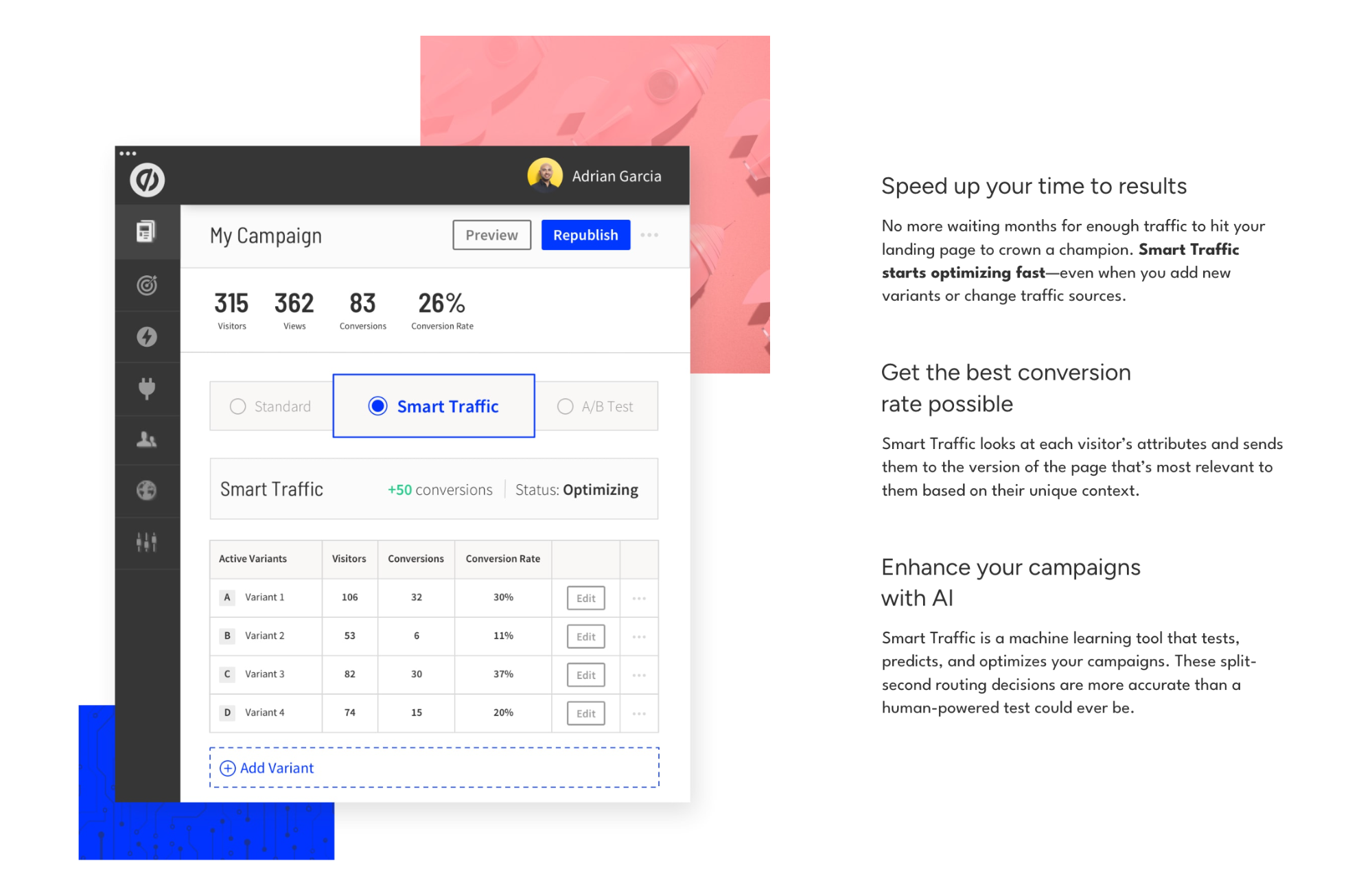
Beyond manual testing, the integration of Artificial Intelligence (AI) is redefining how traffic is managed. Modern platforms now utilize “Smart Traffic” algorithms that analyze visitor attributes such as geographic location, device type, and time of day in real-time. Instead of declaring a single winner in an A/B test, AI-powered systems route each individual visitor to the page variant they are most likely to convert on. This level of personalization was previously reserved for enterprise-level organizations with massive data science teams, but it is now accessible to mid-market marketing departments, significantly lowering the barrier to entry for high-level optimization.
Redefining the Value Exchange: Lead Magnets and Content
As consumers become more protective of their personal data, the “value exchange” required to capture an email address has escalated. The era of the generic “newsletter signup” is largely over. To generate high-quality leads, organizations must provide immediate, actionable value.
Strategic lead magnets now take the form of:
- Utility Tools: Calculators, templates, and audits that solve a specific problem instantly.
- Educational Depth: Comprehensive whitepapers or industry reports that address complex pain points.
- Gated Access: Exclusive webinars or early access to product features.
According to Josh Gallant, founder of Backstage SEO, the most effective lead magnets are those that “scratch an itch” and provide an immediate win for the visitor. This approach not only captures the lead but establishes the brand as an authoritative expert, facilitating a smoother transition from prospect to customer.
Reducing User Friction: The Architecture of the Lead Form
One of the primary causes of “conversion leak” is the complexity of lead capture forms. Every additional field in a form acts as a point of friction. Research into user behavior consistently shows that reducing form fields from five to three can increase conversion rates by up to 25%.

Marketers are now employing “conditional logic” or multi-step forms to mitigate this. By asking for the most basic information first (such as an email address) and only revealing subsequent questions based on previous answers, companies can build a detailed lead profile without overwhelming the user. This “progressive profiling” allows for high-quality data collection while maintaining a low barrier to entry.
Technical Performance as a Conversion Metric
The technical health of a website is no longer just an IT concern; it is a critical marketing metric. Site speed has a direct, linear relationship with conversion rates. Google’s internal data suggests that as page load time goes from one second to three seconds, the probability of bounce increases by 32%. At five seconds, it increases by 90%.
In the mobile-first era, a one-second delay in mobile load times can impact conversion rates by up to 20%. Optimization strategies now prioritize image compression, the use of Content Delivery Networks (CDNs), and the elimination of “render-blocking” JavaScript. A fast-loading site signals professional reliability and respects the user’s time, creating a psychological foundation of trust before the user even reads the copy.
The Psychology of Trust: Social Proof and Real-Time Engagement
In a digital landscape rife with skepticism, social proof serves as the “trust lubricant” of the conversion process. Strategic placement of customer testimonials, industry certifications, and real-time “activity notifications” (e.g., “500 people joined this week”) can significantly reduce perceived risk.
Furthermore, the rise of real-time engagement through live chat and AI-driven chatbots has shortened the feedback loop. Modern buyers expect immediate answers. A study by Harvard Business Review found that companies that try to contact potential leads within an hour of receiving a query are nearly seven times as likely to have a meaningful conversation with a key decision-maker than those who wait even an hour longer. Integrating chat functionality allows brands to address objections at the exact moment they arise, preventing the lead from bouncing to a competitor.
Operational Alignment: Qualifying Leads for Sales
The ultimate goal of website lead generation is not just volume, but “Sales Qualified Leads” (SQLs). A common point of friction in many organizations is the “alignment gap” between marketing and sales. Marketing may celebrate high lead counts, while sales complains about the lack of intent or budget among those leads.
To resolve this, sophisticated lead generation strategies now include automated qualification layers. By implementing lead scoring based on demographic data and on-site behavior (such as viewing a pricing page versus just reading a blog post), marketing teams can prioritize which leads are sent to the sales floor. This ensures that sales resources are focused on high-probability opportunities, while “Marketing Qualified Leads” (MQLs) are entered into automated email nurturing sequences to build readiness over time.
The Broader Impact on Market Competitiveness
The shift toward these 17 strategies represents a broader move toward “Growth Marketing,” where every element of the digital experience is measured and optimized. Organizations that fail to adapt to these standards risk being outpaced by competitors who can acquire and convert leads more efficiently.
As digital privacy laws like GDPR and CCPA make third-party data more difficult to acquire, “first-party data”—the information users give directly to a company on its own website—becomes the most valuable asset in a marketer’s toolkit. By transforming a website into a lead-generating powerhouse, companies are not just increasing their short-term revenue; they are building a sustainable, proprietary engine for long-term growth.
The implementation of these tactics—ranging from dedicated landing pages and AI traffic routing to site speed optimization and lead qualification—creates a comprehensive ecosystem. In this environment, the website stops being a passive participant in the sales process and becomes the organization’s most tireless and effective representative. As the digital marketplace continues to evolve, the ability to turn a casual browser into a qualified prospect will remain the definitive competitive advantage.







