
 rifanmuazin
With over 150 hours dedicated to researching and rigorously testing 10 of the leading print-on-demand (POD) platforms, our team has meticulously shortlisted the premier options for influencers and creators aiming to launch or significantly scale their merchandise lines in 2026. This comprehensive analysis delves into the nuances of each platform, providing actionable insights for creators navigating the increasingly competitive creator economy.
Printful emerges as our top recommendation for brand-first creators, distinguished by its unwavering commitment to premium quality, robust integration capabilities, and sophisticated branding options that consistently keep the creator’s identity at the forefront. In this guide, we will dissect the key features, pricing structures, and inherent trade-offs of each top-tier POD platform, empowering you to make an informed decision tailored to your specific audience and strategic objectives.
Our evaluation of these platforms has been updated to reflect the dynamic shifts in the influencer merchandise landscape of 2026. Key factors now include seamless TikTok Shop integrations, the rise of AI-powered search storefronts, and the critical importance of global fulfillment capabilities. These advancements underscore the need for creators to adapt and leverage cutting-edge tools to maintain a competitive edge.
POD Platform Comparison Table
To facilitate a clear understanding of the offerings, here is a side-by-side comparison of our top print-on-demand picks, designed to help you align platform capabilities with your specific merchandise goals:
| Platform | Best For | Starting Price | Storefront Integrations | Branding Options | Product Catalog |
|---|---|---|---|---|---|
| Printful | Brand-first merch stores | Free (Growth plan from ~$24.99/mo) | Shopify, Etsy, WooCommerce, Wix, Squarespace, BigCommerce, Amazon | Custom neck tags, inside labels, branded packaging, pack-ins | 350+ products |
| Printify | Margins and product variety | Free (Premium from $29.99/mo) | Shopify, Etsy, WooCommerce, Wix, BigCommerce | Limited (provider-dependent) | 900-1,000+ products |
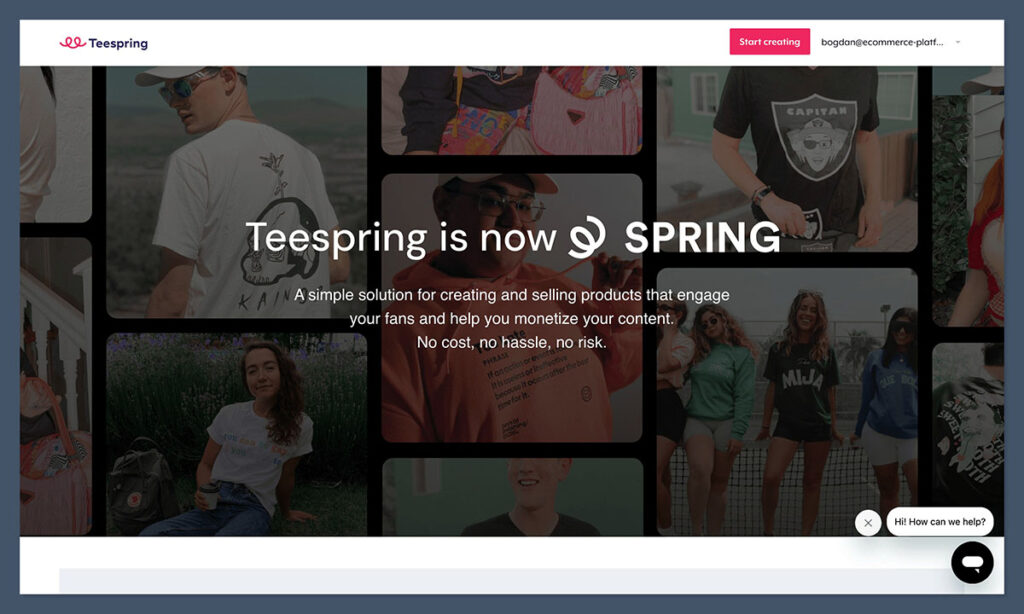
| Spring | YouTube and social creators | Free | YouTube merch shelf, TikTok, Instagram, native storefront | Basic | 200+ products |
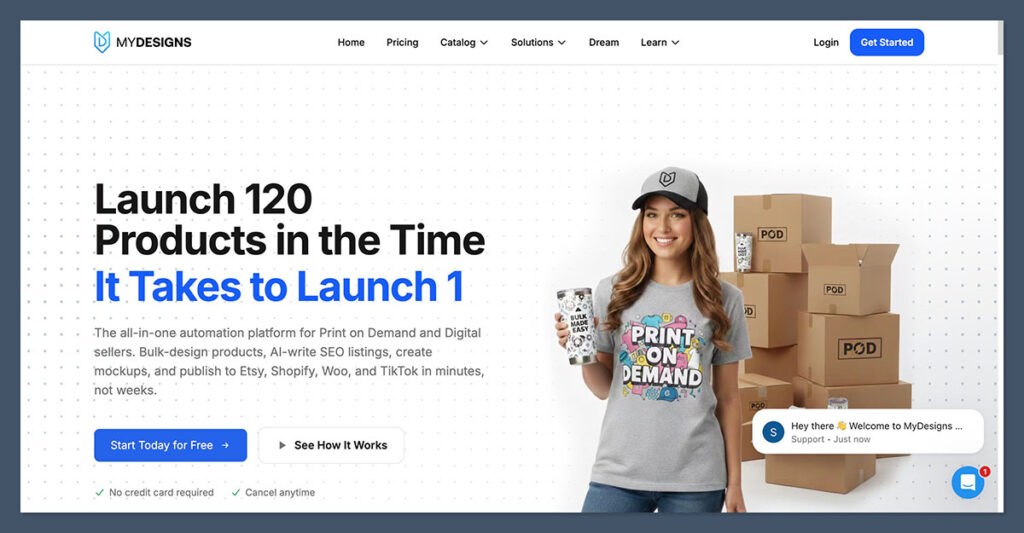
| MyDesigns | High-volume automation | From $19.99/mo | Etsy, Shopify, TikTok Shop | AI-assisted mockups | Provider-dependent |
| Merch by Amazon | Amazon-centric audiences | Free (approval required) | Amazon only | Minimal | Limited apparel categories |
1. Printful: Best for Brand-First Merch Stores
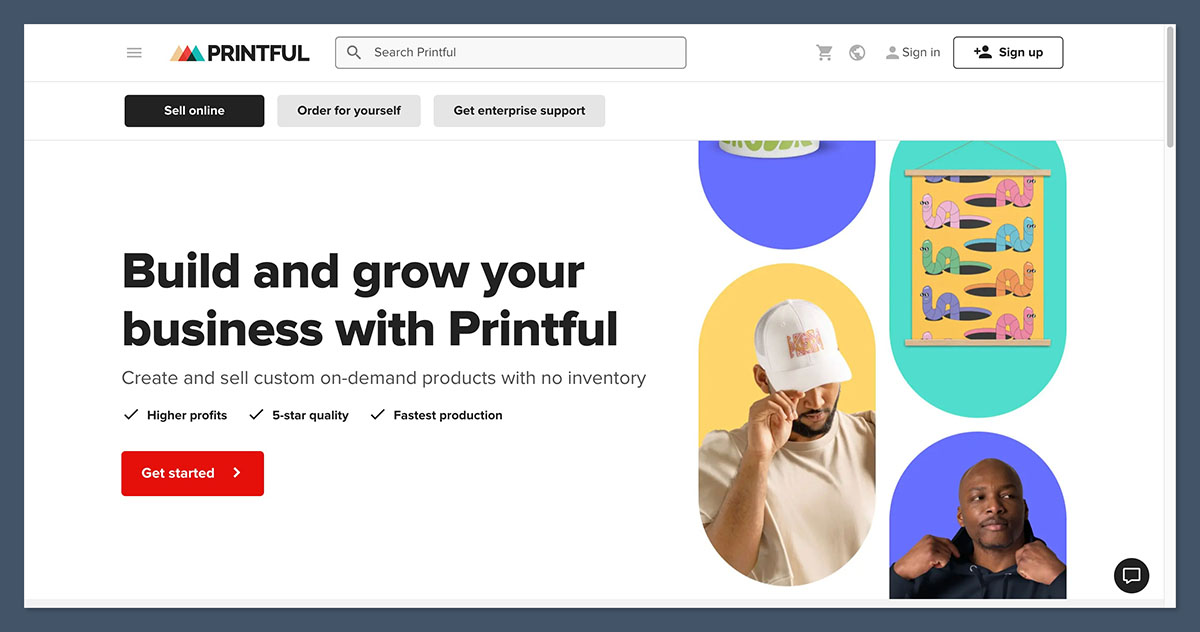
Printful stands out as the premier choice for influencers who aspire to establish their merchandise stores as genuine brands, moving beyond the perception of mere marketplace offerings. Its comprehensive suite of branding options—including custom inside labels, personalized neck tags, meticulously designed branded packaging, and thoughtful pack-ins—ensures that the creator’s unique identity remains the central focus, overshadowing the presence of the fulfillment partner.
During our testing, Printful’s integration with Shopify proved to be a seamless and exceptionally well-documented process. The platform consistently delivers high-quality products, particularly in embroidery and direct-to-garment (DTG) printing, earning it top-tier ratings within the POD sector. This commitment to quality is paramount for creators whose personal brands are synonymous with a certain standard of excellence.
Printful: Key Advantages and Considerations
Pros:
- Exceptional Branding Capabilities: Offers extensive options for custom labels, packaging, and inserts, fostering a strong brand identity.
- Premium Product Quality: Consistently delivers high-quality prints and durable products, aligning with premium brand positioning.
- Extensive Integrations: Seamlessly connects with major e-commerce platforms and marketplaces, providing flexibility in sales channels.
- Reliable Global Fulfillment: Maintains a strong network for efficient and dependable shipping worldwide.
- User-Friendly Interface: Intuitive design and order management tools make it accessible for creators of all technical levels.
Cons:
- Higher Base Costs: Compared to some competitors, Printful’s base product prices can be slightly higher, impacting profit margins on lower-priced items.
- Limited Product Variety: While substantial, its catalog is smaller than platforms like Printify, which may be a constraint for creators seeking highly niche items.
Printful’s Growth plan, which now incorporates priority processing and volume-based discounts, offers a compelling value proposition. This plan effectively becomes complimentary once a store achieves approximately $12,000 in annual sales, making it an attractive option for mid-tier influencers looking to scale their merchandise operations efficiently.
The cornerstone of Printful’s appeal for influencer merchandise lies in its white-label shipping experience. Every touchpoint, from the shipping label to the garment’s interior, is imbued with the creator’s brand. This level of meticulous detail is crucial for influencers focused on cultivating a direct-to-consumer (DTC) presence rather than merely monetizing their audience through fleeting merchandise drops.
How Much Does Printful Cost?
Printful operates on a freemium model, allowing creators to start without upfront costs. The platform offers various paid plans, such as the Growth plan, which introduces benefits like priority fulfillment and volume discounts, starting around $24.99 per month. These plans become particularly cost-effective as sales volume increases, with the Growth plan essentially becoming free once a store hits approximately $12,000 in annual sales. The pricing structure is designed to scale with the creator’s success, offering tangible benefits as the merchandise business expands.
Printful is suitable for:
- Creators prioritizing brand integrity and a premium customer experience.
- Influencers building a long-term, sustainable merchandise business.
- Those who value high-quality products and detailed branding control.
- Creators already integrated with platforms like Shopify, Etsy, or WooCommerce.
Printful isn’t suitable for:
- Creators primarily focused on maximizing short-term profit margins above all else.
- Those who require an exceptionally vast and niche product catalog.
- Beginners seeking the absolute lowest barrier to entry with minimal setup.
Why Use Printful in 2026?
In a market where consumers are increasingly discerning and often skeptical of generic, low-effort merchandise, Printful empowers creators to deliver products that resonate with intentionality and quality. The platform’s synergistic combination of superior product quality, unparalleled branding control, and steadfast reliability makes it the ideal foundation for any influencer who views merchandise as an integral extension of their personal brand, rather than a mere supplementary revenue stream. Furthermore, Printful’s enhanced mobile application in 2026 significantly streamlines order management for creators on the go, a vital feature for those balancing content creation, community engagement, and merchandise launches simultaneously.
2. Printify: Best for Margins and Product Variety
Printify is the preferred platform for influencers who aim to experiment with a broad spectrum of designs, execute frequent product drops, or optimize their profit margins. Its unique print-provider marketplace model allows creators to select suppliers based on geographical location, cost, and customer ratings, thereby granting granular control over product expenses and delivery timelines.
Boasting a catalog of over 900 to 1,000 products, encompassing apparel, accessories, home decor, and even specialized categories like pet products and custom supplements, Printify offers an unparalleled variety unmatched by any other platform on this list. This extensive selection is a significant advantage for creators looking to cater to diverse audience interests or test a wide array of product types.
Printify: Key Advantages and Considerations
Pros:
- Extensive Product Catalog: Offers a vast array of products, providing immense flexibility for diverse creative visions.
- Competitive Pricing & Margins: The marketplace model allows for sourcing lower-cost providers, leading to potentially higher profit margins.
- Global Fulfillment Network: Access to a wide network of print providers worldwide, enabling localized fulfillment.
- Flexible Supplier Selection: Ability to choose specific print providers based on cost, quality, and location.
Cons:
- Variable Quality: Product quality can differ significantly between print providers, necessitating careful selection and sample testing.
- Less Branding Control: Branding options are often dependent on the chosen print provider and are generally less comprehensive than Printful.
- More Complex Management: Requires more effort to curate and manage relationships with multiple print providers.
The inherent trade-off with Printify is evident: creators gain enhanced flexibility and potentially better pricing, but this necessitates a greater investment of time in curating and vetting their print suppliers. Unlike Printful’s uniform quality standard, Printify’s product excellence is contingent upon the specific print provider selected for each item. It is strongly recommended to order samples from at least two or three different providers before committing to a particular product line to ensure consistency and quality that aligns with your brand.
How Much Does Printify Cost?
Printify offers a free plan that provides access to its core services, making it an accessible entry point for creators. For users seeking enhanced features, such as up to 10% discounts on all products, a Premium plan is available, starting at $29.99 per month. This tiered pricing model allows creators to scale their investment in line with their business growth and profitability.
Printify is suitable for:
- Creators prioritizing profit margins and a wide product selection.
- Those who are willing to invest time in sourcing and managing suppliers.
- Influencers who frequently launch new designs or run limited-time merchandise drops.
- Creators targeting diverse niches with specialized product needs.
Printify isn’t suitable for:
- Creators who require a completely standardized and consistent brand experience across all products.
- Those who prefer a hands-off approach to supplier management.
- Influencers who are unwilling to order samples to verify product quality.
Why Use Printify in 2026?
For influencers who leverage merchandise as an experimental channel—testing slogans, designs, and product types across their audience—Printify’s combination of low base prices and an expansive catalog makes it the most efficient platform for iteration. The provider marketplace also enables localized fulfillment without the need to switch platforms, facilitating the routing of US orders to US-based printers and EU orders to European ones. Printify’s deep integration within the Shopify ecosystem, trusted by hundreds of thousands of merchants, signifies a mature and well-supported platform.
3. Spring (Teespring): Best for YouTube and Social Creators
For creators seeking the most expedient route from concept to live product without the complexities of establishing a dedicated e-commerce store, connecting a fulfillment partner, or incurring upfront costs, Spring presents the fastest pathway. Its native integration with YouTube’s merchandise shelf is a particularly powerful conversion tool for creators with highly engaged subscriber bases, enabling them to display products directly beneath their videos and on their channel pages.
While Spring’s greatest strength—its speed and simplicity—is also its core limitation, it is designed for rapid deployment rather than building a standalone brand identity. Creators will not find options for custom neck tags or branded packaging, and they will have less visibility into customer data compared to a combined Shopify and Printful solution.
Spring: Key Advantages and Considerations
Pros:
- Fastest Time to Market: Enables quick launch of merchandise without upfront setup or inventory costs.
- Native Platform Integrations: Seamless integration with YouTube, TikTok, and Instagram for direct selling.
- Zero Upfront Costs: Completely free to use, making it ideal for initial testing.
- Audience Reach: Leverages existing platform audiences for immediate visibility.
Cons:
- Limited Branding Options: Offers basic branding, lacking custom labels or packaging.
- Less Customer Data Access: Provides limited insight into customer behavior and data.
- Lower Profit Margins: Due to its streamlined model, profit margins may be lower compared to other platforms.
- Less Control Over Brand Experience: The customer experience is largely dictated by the Spring platform.
Spring’s primary advantage lies in its ability to remove nearly all barriers for creators testing whether their audience is receptive to merchandise purchases. For creators who have validated demand and are ready to elevate their merchandise strategy, Spring functions effectively as a secondary sales channel, complementing a primary, brand-owned store.
How Much Does Spring Cost?
Spring operates entirely free of charge for creators. There are no upfront costs or monthly subscription fees. Creators earn revenue through the profit margin between the product’s base cost and the selling price they set. This model makes it an extremely low-risk option for testing the waters of merchandise sales.
Spring is suitable for:
- New creators or those testing merchandise for the first time.
- YouTube, TikTok, and Instagram creators looking for direct integration.
- Influencers who prioritize ease of use and speed to market.
- Creators who want to offer merchandise without managing an e-commerce store.
Spring isn’t suitable for:
- Creators focused on building a strong, independent brand identity for their merch.
- Those who require detailed customer data and analytics for marketing.
- Influencers looking for advanced customization and premium branding elements.
Why Use Spring in 2026?
For YouTube creators, in particular, the merchandise shelf integration is a significant advantage, placing products directly within their audience’s viewing environment without requiring them to leave the platform. In 2026, where attention spans are increasingly fragmented and audiences are dispersed across multiple channels, this frictionless purchasing experience is invaluable. Spring also supports TikTok and Instagram integrations, positioning it as a robust multi-channel solution for social-first creators who are not yet prepared to manage a comprehensive e-commerce infrastructure.
4. MyDesigns: Best for High-Volume Automation
MyDesigns is engineered for a distinct segment of the influencer merchandise market: high-volume, automation-centric operations, often managed by teams or agencies rather than individual creators. Its bulk publishing capabilities allow for the simultaneous uploading of up to approximately 120 products, augmented by AI-assisted design workflows and thousands of automatic mockup generation tools, significantly reducing manual labor.
MyDesigns: Key Advantages and Considerations
Pros:
- Powerful Automation Tools: Streamlines high-volume product uploads and design creation.
- AI-Assisted Design: Features AI tools to aid in design generation and optimization.
- Bulk Publishing: Enables efficient management of large product catalogs across multiple platforms.
- Strong Etsy and TikTok Shop Integration: Well-suited for creators leveraging these marketplaces.
Cons:
- Steeper Learning Curve: The advanced features may require more time to master.
- Subscription-Based Pricing: Involves monthly fees, which might be a barrier for very small creators.
- Fulfillment is Provider-Dependent: Relies on third-party print providers, necessitating quality checks.
MyDesigns is exceptionally well-suited for agencies managing merchandise for multiple creators or for individual creators who aggressively test design variations, colorways, and slogans across Etsy, Shopify, and TikTok Shop. Its robust tooling for Etsy integration, in particular, makes it an ideal choice for creators whose audiences are accustomed to purchasing through that marketplace.
How Much Does MyDesigns Cost?
MyDesigns offers a tiered subscription model, with plans starting from $19.99 per month. This pricing structure provides access to its advanced automation and design tools, catering to creators and agencies managing a significant volume of merchandise. Higher-tier plans offer expanded features and capacity for larger operations.
MyDesigns is suitable for:
- Agencies and teams managing merchandise for multiple creators.
- High-volume creators who frequently test and launch new designs.
- Creators who heavily utilize Etsy and TikTok Shop for sales.
- Businesses seeking to automate significant portions of their merch workflow.
MyDesigns isn’t suitable for:
- Individual creators with very limited product lines and low sales volume.
- Those seeking a simple, one-click solution without advanced features.
- Creators who do not require advanced automation or bulk publishing capabilities.
Why Use MyDesigns in 2026?
The influencer merchandise sector is undergoing a maturation process. What was once a peripheral project for many creators has evolved into a significant revenue stream, managed with the same rigor as any established e-commerce operation. MyDesigns directly addresses this evolved segment. Its bulk workflows, AI-powered tooling, and multi-marketplace publishing capabilities empower creators to operate merchandise lines at scale without requiring a substantial team, a crucial advantage in 2026 as creators diversify income streams and compete for consumer attention across an expanding array of channels.
5. Merch by Amazon: Best for Amazon-Centric Audiences
Merch by Amazon grants creators access to Amazon’s vast organic traffic and its established Prime shipping network, a significant benefit for audiences that predominantly shop on the platform. With no upfront costs and Amazon managing production, shipping, and customer service, it presents a low-barrier entry point for leveraging Amazon’s ecosystem.
Merch by Amazon: Key Advantages and Considerations
Pros:
- Access to Amazon’s Traffic: Leverages Amazon’s massive customer base and search engine.
- Prime Shipping: Offers fast and reliable delivery for eligible products.
- No Upfront Costs: Creators only pay when a product sells, with Amazon handling all production.
- Automated Fulfillment: Amazon manages printing, shipping, and customer service.
Cons:
- Limited Brand Control: Minimal branding options; products are sold under the Amazon umbrella.
- Restricted Product Catalog: Primarily focused on apparel and a limited range of other items.
- Approval Process: Requires an application and approval to join the program.
- Minimal Customer Relationship: Creators have little direct interaction or data regarding their customers.
The primary trade-off with Merch by Amazon is the relinquishing of almost all brand identity in exchange for Amazon’s traffic and infrastructure. Merchandise is listed on Amazon’s marketplace, adhering to its design guidelines, with creators having limited ability to cultivate direct customer relationships. For influencers who already generate substantial Amazon affiliate revenue or whose audiences default to Amazon for purchases, it serves as a logical supplementary channel. However, as a primary strategy for building a distinct brand, it falls short.
How Much Does Merch by Amazon Cost?
Merch by Amazon is free to join, requiring creators to apply and be accepted into the program. There are no listing fees or upfront costs. Creators earn royalties based on the selling price minus Amazon’s costs for the product and fulfillment. The royalty rates vary depending on the product type and the price set by the creator.
Merch by Amazon is suitable for:
- Creators with a strong audience presence on Amazon or who are Amazon affiliates.
- Those seeking to leverage Amazon’s vast customer base and Prime shipping.
- Influencers who prioritize ease of use and minimal operational overhead.
- Creators testing designs with minimal risk and no upfront investment.
Merch by Amazon isn’t suitable for:
- Creators focused on building a strong, independent brand identity.
- Those who want direct control over the customer experience and data.
- Influencers looking for a wide variety of product types beyond apparel.
Why Use Merch by Amazon in 2026?
Amazon’s search traffic remains immense, and its Prime shipping network sets customer expectations that most POD fulfillment services struggle to match solely on speed. In 2026, with two-day delivery increasingly becoming the baseline expectation for shoppers, a Merch by Amazon presence offers a logistical advantage. It functions most effectively as a supplementary channel, complementing a brand-owned store by capturing the segment of an audience that defaults to Amazon for all their purchasing needs.
Overall Winner
Printful solidifies its position as the most robust option for influencers who approach merchandise as a strategic brand-building endeavor. For creators whose primary focus is on optimizing margins and experimenting with product offerings, Printify emerges as the superior choice. And for those just beginning their merchandise journey, Spring offers the most accessible and lowest barrier to entry.
How Do I Choose the Right POD Platform for Merch?
Selecting the optimal print-on-demand platform hinges on your current stage as a creator, your audience’s expectations, and the degree of control you desire over your brand experience. While this analysis provides a comparative framework, it is imperative to identify your personal priorities and determine the trade-offs you are willing to accept.
Consider the following key factors when evaluating or trialing a POD platform:
- Brand Control and Identity: Assess the extent to which you can incorporate custom labels, packaging, and inserts. Does the product presentation align with your brand, or does it appear to originate from a generic fulfillment center? White-label fulfillment services (like Printful and Printify) offer greater control, whereas marketplace-centric tools (Spring, Merch by Amazon) prioritize convenience over customization.
- Product Catalog and Fit: Ensure the platform offers the types of products your audience actually desires. While basic apparel is suitable for most platforms, niche creators in areas like gaming, pet care, home decor, or fitness may find Printify’s expanded catalog or specialized providers more appropriate.
- Margins vs. Quality: Lower base prices offered by some platforms (Printify, specific regional providers) can lead to higher profit margins per unit but may introduce variability in product quality. Conversely, higher base prices (Printful) can mitigate refund risks and support premium pricing strategies when a strong brand is established.
- Geography and Shipping: Consider the geographical distribution of your audience. For a US-centric fanbase, a US-based provider may suffice. However, for a global following spanning Europe, North America, and Latin America, a platform with distributed fulfillment capabilities is essential to minimize shipping costs and delivery times.
- Tech Stack and Integrations: Shopify continues to be the central hub for most creator merchandise stores, with both Printify and Printful offering the most robust integrations within this ecosystem. Increasingly, TikTok Shop and Etsy syncing are becoming crucial for influencer brands engaged in short-form content commerce.
- Scalability: Can the platform accommodate your growth? A creator launching their initial five products has different needs than one managing 200 SKUs across three marketplaces. MyDesigns and Printify are designed for scalability, while Spring and Merch by Amazon are more suited as initial entry points or supplementary sales channels.
How We Test POD Platforms
Our research team conducted an extensive testing process involving 10 leading POD platforms to establish our rankings and recommendations. Over 150 hours were invested in analyzing each platform across 85 distinct areas of investigation. Our methodology focused on six core categories, each weighted to reflect its significance for influencer merchandise sellers:
| Category | Weight | What We Assess |
|---|---|---|
| Product Quality & Fulfillment | 30% | Print consistency, fulfillment speed, shipping reliability, global coverage |
| Branding & Customization | 20% | Custom labels, packaging, white-label shipping, brand presentation |
| Integrations & Tech Stack | 20% | Storefront compatibility, social integrations, API quality |
| Pricing & Margins | 15% | Base costs, shipping, fees, achievable profit margins |
| Ease of Use | 10% | Onboarding, product creation, order management, dashboard clarity |
| Catalog & Scalability | 5% | Product variety, niche categories, bulk tools, multi-store support |
Each platform’s product creation workflow and storefront integrations were tested firsthand, including ordering samples to evaluate print quality and packaging.
After comprehensive testing, Printful remains the top choice for brand-first creators due to its unparalleled combination of quality, branding tools, and integration depth. Printify offers exceptional variety and margin potential for creators willing to manage suppliers diligently. Spring provides the most accessible entry point for social creators, while MyDesigns serves as a powerful tool for scaled operations. Merch by Amazon functions effectively as a low-overhead secondary channel for creators with an Amazon-aligned audience.
Key Takeaways
- Brand consistency is paramount: Influencers must prioritize platforms that allow for robust branding to reinforce their identity.
- Audience expectations evolve: With increasing consumer sophistication, quality and unique product offerings are crucial differentiators.
- Platform integrations matter: Seamless connections with existing sales channels (Shopify, Etsy, TikTok Shop) are vital for efficient operations.
- Global reach is increasingly important: Creators with international fanbases need platforms offering distributed fulfillment to minimize costs and delivery times.
- Scalability dictates long-term success: The chosen platform must be capable of growing alongside the creator’s business.
Final Verdict: Which POD Platform Do I Recommend?
Our extensive research process has identified the top five print-on-demand platforms for influencer merchandise. Printful stands out as the optimal choice for creators dedicated to cultivating a professional, brand-owned merchandise experience, offering the most comprehensive package of quality, branding tools, and integration depth.
However, each platform on this list caters to a distinct creator profile. For those uncertain about where to begin, a practical approach involves starting with a low-friction platform like Spring to validate demand with your audience. Subsequently, as demand is confirmed, transitioning to a brand-owned infrastructure—such as Shopify integrated with Printful or Printify—becomes the logical next step.
The most common pitfall observed among influencers in the merchandise space is over-investing in infrastructure before establishing proven demand. The recommended strategy is to commence with a simplified model, rigorously test your designs, and then scale into a premium setup once the business metrics justify the investment.
FAQ
What is the best POD site for influencer merch?
Printful is our leading recommendation for influencer merchandise due to its superior blend of print quality, branding control, and extensive storefront integrations. Creators aiming to present their merchandise as a legitimate brand, rather than a fleeting revenue opportunity, will find Printful’s custom labels, branded packaging, and white-label shipping particularly beneficial.
Can I start selling merch with no upfront cost?
Yes. All five platforms featured in this guide permit creators to commence merchandise sales without any initial inventory investment, as products are printed exclusively upon customer order. Spring and Merch by Amazon do not incur any monthly fees, while Printful and Printify offer complimentary plans with optional paid upgrades for enhanced branding and volume features.
Which POD platform has the best margins for creators?
Printify generally offers the most favorable margins for creators. Its print-provider marketplace model allows for the sourcing of lower base prices from various suppliers. The caveat is that product quality and shipping consistency can vary depending on the chosen provider, necessitating careful sample testing before full commitment.
Do I need a Shopify store to sell merch?
No, a Shopify store is not a mandatory requirement. Platforms like Spring and Merch by Amazon provide their own storefronts or marketplace listings, enabling sales without a separate e-commerce website. However, for creators seeking complete control over their brand, customer data, and upselling opportunities, a Shopify store integrated with Printful or Printify is the recommended configuration for serious merchandise operations.
What is the best POD platform for TikTok creators?
Specifically for TikTok creators, both Spring and MyDesigns offer direct TikTok Shop integrations. Spring is the more accessible starting point, while MyDesigns is better suited for high-volume creators who engage in frequent product testing through short-form content commerce.
Can I use multiple POD platforms at the same time?
Absolutely. Many successful creator merchandise ventures utilize a combination of platforms. For instance, a creator might maintain a Shopify store linked to Printful for a branded experience, alongside Merch by Amazon as a secondary channel to capture Amazon traffic, and Spring integrated with their YouTube merchandise shelf. The key to success lies in mastering one platform initially, then strategically layering additional channels as the business expands.









