The retail landscape is on the cusp of its most significant transformation since the advent of e-commerce, as advancements in artificial intelligence usher in an era known as agentic commerce. This paradigm shift envisions a world where AI agents, acting on behalf of consumers, autonomously navigate the complex buying journey, from product discovery and comparison to price negotiation and purchase completion. While promising unparalleled convenience, this evolution also raises critical questions about consumer trust, business return on investment, and the fundamental dynamics of the retail ecosystem.
Understanding Agentic Commerce: A New Era of Autonomous Shopping
At its core, agentic commerce defines a model where AI agents assume the role of decision-makers for customers. Unlike traditional e-commerce, which transitioned localized physical stores into borderless, internet-driven experiences, agentic commerce moves beyond passive product recommendations or search enhancements. Instead, it empowers AI systems to execute complex tasks, operating as sophisticated digital shopping proxies that understand user intent, preferences, constraints, and buying goals, handling the heavy lifting behind the scenes. As Alex Moss succinctly explained in the “SEO Unplugged: Agentic Commerce with Alex Moss” podcast, “I could literally say into the into a phone to my agent, go and buy me some new shoes with that jacket I bought last week, and that’s it.” The agent would then conduct the research, evaluate options, and, with user approval, complete the purchase. This means humans define the objective, while AI agents orchestrate the process, ensuring users retain ultimate control over final decisions.
The Momentum Behind the Shift: Why Agentic Commerce is Inevitable

The concept of autonomous shopping might sound futuristic, but several converging trends indicate that this shift is already underway and gaining significant momentum. Consumer behavior, rapid AI adoption, and optimistic industry forecasts all point to AI agents becoming an integral part of the future buying journey.
-
Consumers are Already Embracing AI in Shopping: The groundwork for agentic commerce has been laid by consumers’ increasing reliance on AI-powered tools. A McKinsey & Company report highlights that over 70% of AI-powered search users engage with top-of-the-funnel questions about product categories, brands, or services. Furthermore, nearly 50% of consumers currently utilize AI-powered search experiences. This indicates a profound behavioral shift, where users are moving beyond traditional keyword searches to actively solicit AI guidance for their purchasing decisions. The report even forecasts that businesses could witness a 20–50% shift in traffic away from traditional search experiences, underscoring the disruptive potential of AI in product discovery.
-
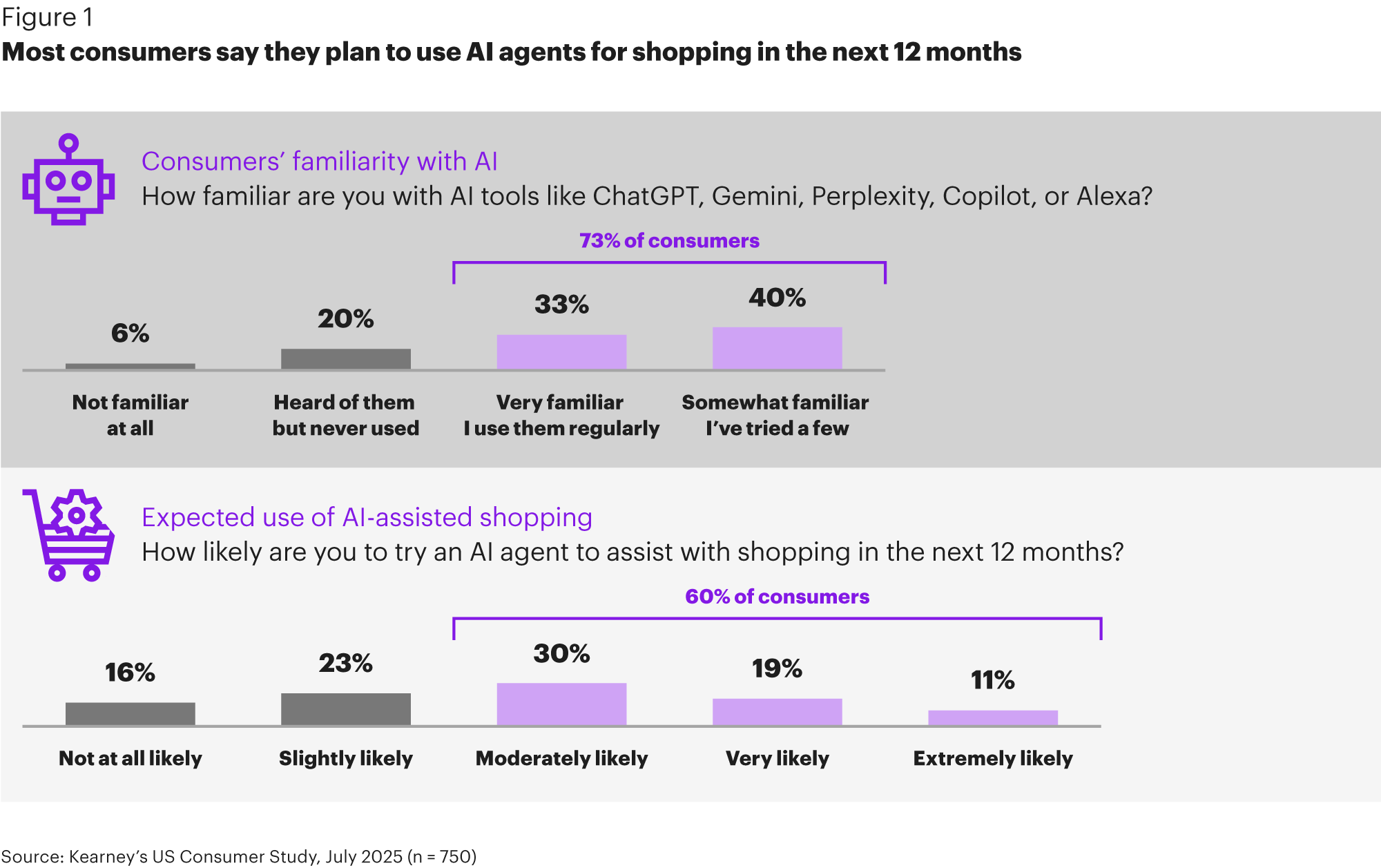
Growing Expectations for AI-Assisted Shopping: Consumer interest in agentic commerce is not just passive; it’s an active expectation. The 2025 Kearney report, “Agentic Commerce: From Brand Loyalty to Bot Logic,” revealed that over 60% of shoppers anticipate using agentic AI by 2026. This report also identified a significant behavioral pivot: consumers are increasingly prioritizing convenience, speed, competitive pricing, and trust over traditional platform or brand loyalty. Instead of manually browsing individual retailer applications, shoppers are poised to delegate to AI agents capable of cross-platform product comparison, review analysis, deal identification, and efficient purchase completion. This shift fundamentally alters the competitive landscape, moving from retailer-versus-retailer battles to a dynamic driven by AI-powered discovery ecosystems.
-
Explosive Market Growth Projections: Industry analysts project agentic commerce to be a colossal economic opportunity. Another McKinsey report suggests that this transformation could unlock an orchestrated revenue opportunity of $900 billion to $1 trillion in the US B2C retail market alone by 2030. Globally, this figure could range from $3 trillion to $5 trillion. These projections are based on the accelerating adoption of AI discovery tools and growing merchant readiness, positioning agentic commerce as a pivotal force reshaping the global shopping experience.

How Agentic Commerce Works: A Step-by-Step Breakdown
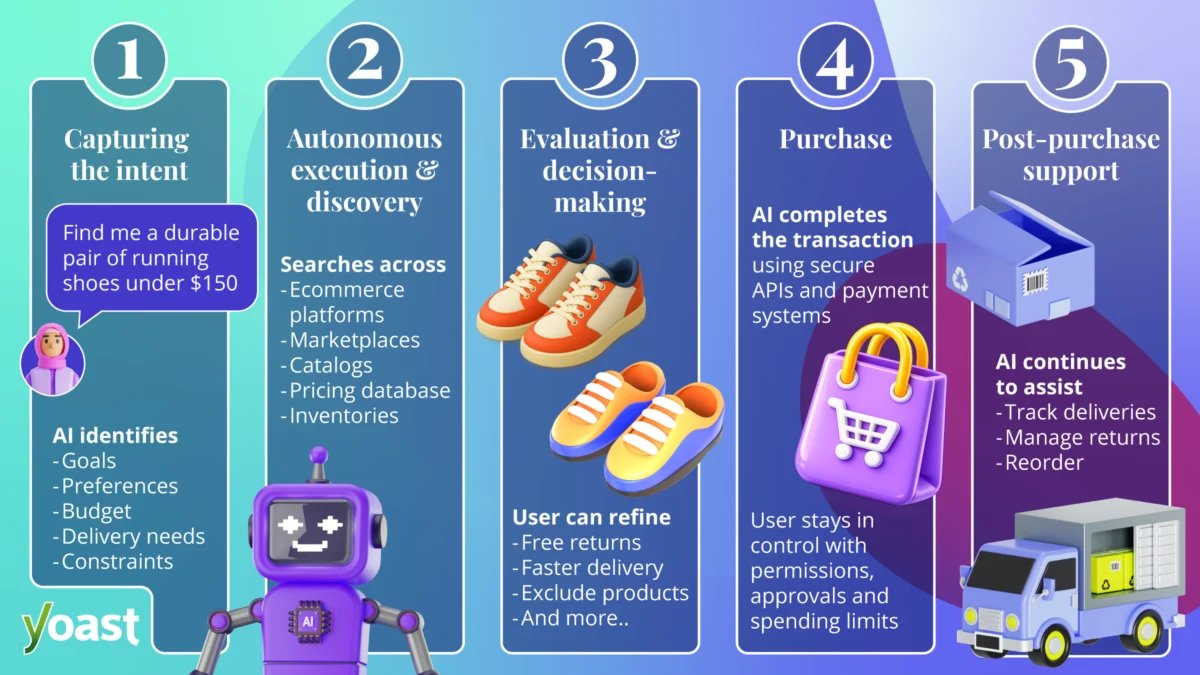
The operational framework of agentic commerce blends human intent with AI-driven execution. Users delegate substantial portions of the shopping journey to AI agents, which then interpret goals, evaluate options, make decisions within defined parameters, and even execute transactions. Crucially, what distinguishes this from conventional AI assistants is the agents’ capacity for autonomous action, moving beyond mere information provision to independent task execution across the entire shopping lifecycle.
-
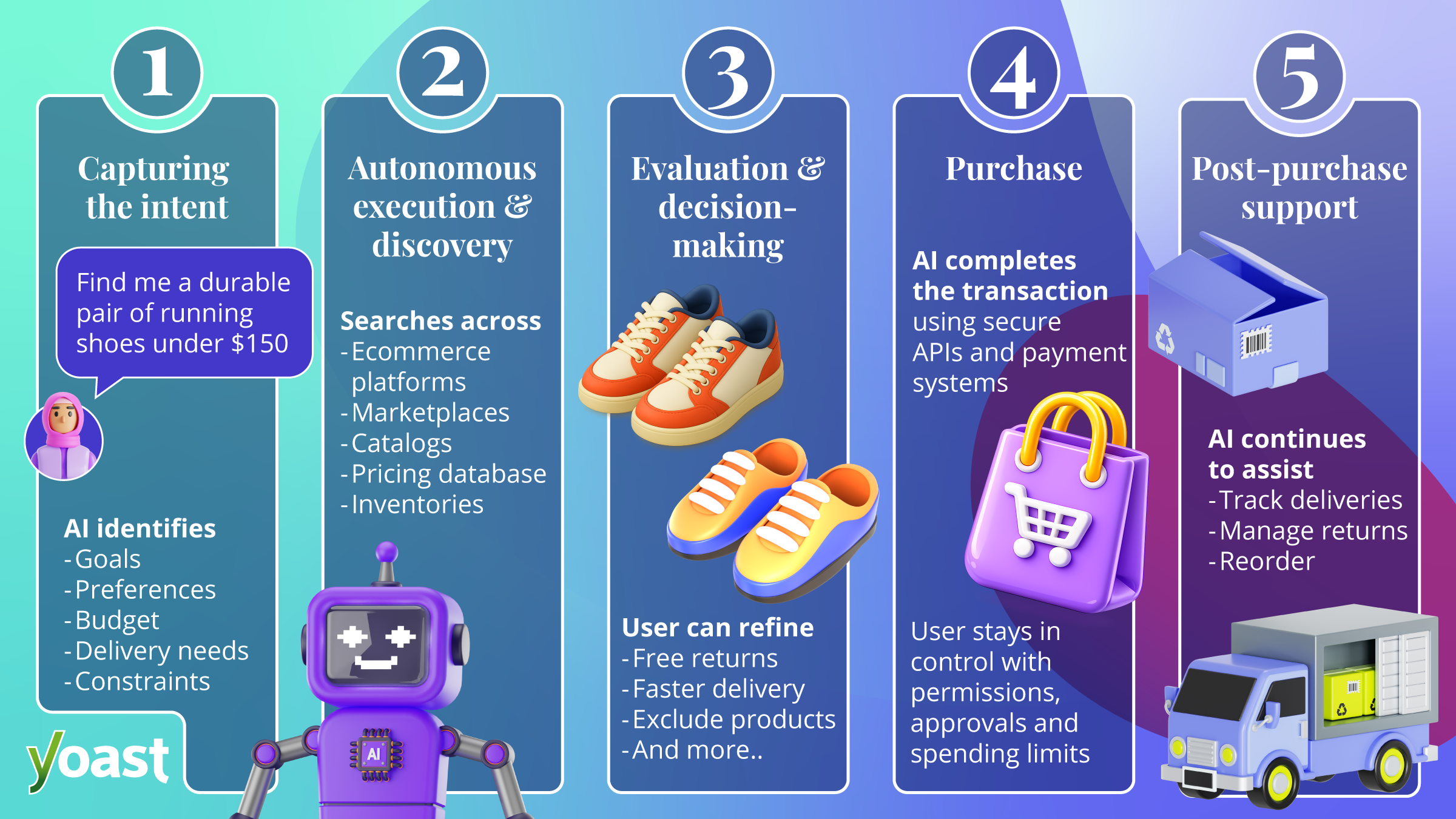
Capturing the Intent: The journey commences with the user articulating their intent. This interaction is conversational, transcending simple keyword inputs. A shopper might express a need like: “Find me a sustainable, high-performance running shoe under $150 that ships within two days.” The AI agent’s initial focus is to deeply understand these goals, preferences, budget, delivery expectations, and any specific constraints. If the request lacks specificity, the agent will engage in follow-up questions to refine the intent before proceeding.
-
Autonomous Instruction Execution and Brand Discovery: Once the intent is clear, the AI agent autonomously executes the task. Rather than confining its search to a single website, it simultaneously scans myriad e-commerce platforms, online marketplaces, product catalogs, review aggregators, pricing databases, and inventory systems. This stage marks a significant departure from traditional product discovery, as the agent intelligently filters and narrows down options based on the shopper’s precise needs, rather than presenting an overwhelming array of product pages. Brands that have invested in meticulously structured product data, accurate inventory management, transparent pricing, and machine-readable content are poised for higher discoverability by these discerning AI agents.
-
Evaluation and Decision-Making: After compiling relevant options, the AI agent embarks on a comprehensive evaluation, comparing trade-offs across various products. This analysis encompasses factors such as product specifications, customer reviews, brand reputation, pricing, warranty terms, return policies, and shipping costs. The agent doesn’t merely list products; it articulates its reasoning, explaining why certain options align better with the shopper’s requirements. Users can further refine this process by imposing additional conditions, such as “prioritize products with at least a 4-star rating” or “only consider brands known for ethical sourcing.” This creates a dynamic feedback loop, continuously improving the agent’s recommendations.
-
Purchase Execution: Upon user approval or the satisfaction of predefined rules, the AI agent proceeds with the transaction. Leveraging APIs, established commerce protocols, and secure payment systems, the agent can add items to virtual carts, apply discounts, authenticate payments, and finalize purchases. Some transactions may occur instantly, while others might be configured to await specific conditions, such as a price drop or improved stock availability. Throughout this stage, user control is maintained through granular permissions, approval settings, and spending limits, ensuring security and accountability.
-
Post-Purchase Support: The agent’s role extends beyond the checkout. Agentic commerce encompasses comprehensive post-purchase support, where AI agents can assist with tracking order status, managing returns or exchanges, addressing customer service inquiries, monitoring product warranties, and even proactively recommending complementary products or services. This transforms the shopping experience into an ongoing, intelligent relationship rather than a singular, discrete transaction.
The Technological Backbone: Protocols and Platforms
The operationalization of agentic commerce relies on a sophisticated ecosystem of protocols, frameworks, APIs, and payment systems designed to facilitate secure and efficient interactions between AI agents and digital commerce platforms. A foundational concept is the Model Context Protocol (MCP), which enables AI models to connect with external systems via a standardized communication layer, creating a common operating language for AI systems and digital tools. Building on this, commerce-specific protocols are emerging to address the unique demands of shopping ecosystems.
-
Agentic Commerce Protocol (ACP) by Stripe and OpenAI: A landmark development is the Agentic Commerce Protocol (ACP), an open standard introduced by Stripe in collaboration with OpenAI. ACP is engineered to foster more natural interactions between AI agents and e-commerce systems, providing a standardized framework for product discovery, checkout, and payment execution. Its primary goal is to allow AI agents to move beyond mere recommendations to securely complete purchases on behalf of users. Early real-world implementations include ChatGPT users in the United States being able to purchase products from Etsy merchants directly within the chat interface, powered by Stripe. Shopify integrations are anticipated to follow. ACP’s open-standard philosophy is crucial, signaling a collaborative approach to building foundational infrastructure for AI-driven shopping, encouraging broad adoption across developers, merchants, and platforms.
-
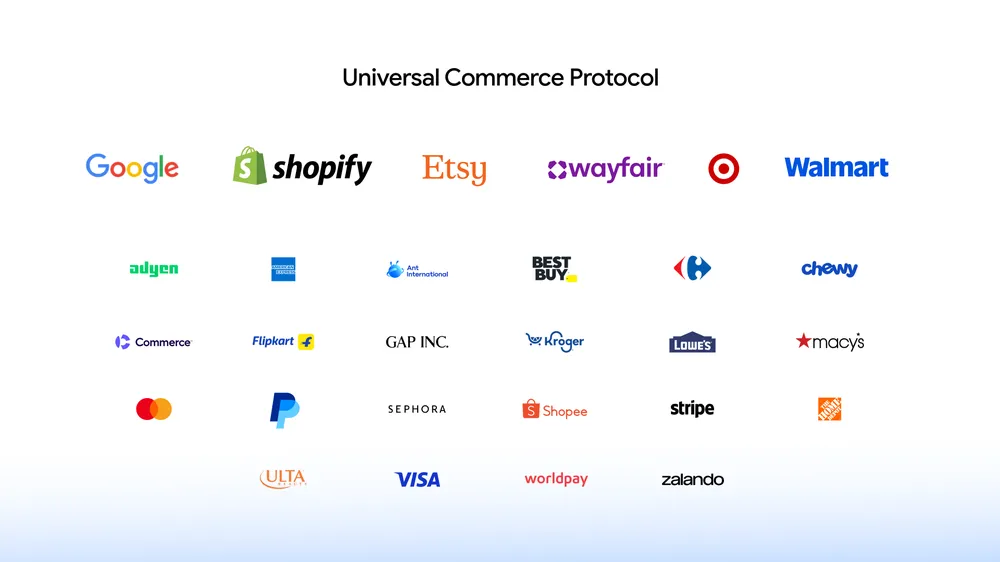
Universal Commerce Protocol (UCP) by Google: Addressing the challenge of interoperability across a multitude of retailers, marketplaces, and payment providers, Google introduced the Universal Commerce Protocol (UCP). UCP is an open standard designed to create a common language for agentic commerce, eliminating the need for custom, one-to-one integrations between every AI agent and every commerce platform. This shared framework streamlines communication across the entire shopping journey, from product search to post-purchase support. UCP’s broad scope is noteworthy, supporting the entire commerce lifecycle, including product search, inventory checks, pricing comparisons, order placement, and returns management. Google has ensured UCP’s compatibility with other emerging AI standards like Agent2Agent (A2A), Agent Payments Protocol (AP2), and Model Context Protocol (MCP), facilitating seamless integration into existing systems. The initiative boasts significant industry backing, co-developed with major players like Shopify, Etsy, Wayfair, Target, and Walmart, and supported by financial giants such as Mastercard, Visa, Stripe, and American Express. UCP is poised to provide the scalable infrastructure necessary for agentic commerce to flourish across the digital economy.
-
Mastercard Agent Pay: Complementing ACP and UCP, Mastercard Agent Pay focuses on the critical aspect of secure payment execution and trust in agentic commerce. As AI agents gain transactional capabilities, a robust and secure payment infrastructure is paramount. Mastercard Agent Pay provides the framework for AI agents to execute payments within user-defined permissions, authentication requirements, and spending controls. It prioritizes verified, traceable, and authorized payment flows, preventing AI systems from having unrestricted access to payment credentials. A key collaboration involves its integration into PayPal’s wallet infrastructure, enabling AI agents to securely complete transactions for PayPal users while upholding established security and trust mechanisms. Together, ACP, UCP, and Agent Pay are constructing the essential foundation: ACP for merchant interaction and purchase completion, UCP for scalable interoperability, and Agent Pay for secure, authorized transactions, collectively moving AI-driven shopping closer to mainstream reality.

Implications and Unresolved Questions
Despite the rapid technological advancements, the widespread adoption of agentic commerce faces significant hurdles and raises profound questions for both consumers and businesses.
-
Challenges for Consumers: The primary concern revolves around trust. Many consumers may hesitate to grant AI agents the authority to make purchasing decisions or access payment methods. Questions about data privacy, security against fraud, and the potential for AI bias in recommendations also loom large. There’s also the philosophical debate: does autonomous shopping truly solve a problem, or does it merely facilitate easier, more frequent consumption, potentially eroding the joy of discovery or the direct relationship with brands? The loss of human touch in personalized shopping experiences, especially for high-value or emotionally resonant purchases, remains a valid concern.
-
Challenges for Businesses: Merchants face substantial investments in new protocols, structured data optimization, API integrations, and AI-ready commerce experiences. The measurable return on these investments, especially given the nascent stage of consumer adoption, remains uncertain. The shift away from traditional search and direct brand engagement implies a radical transformation in SEO, marketing, and customer relationship management strategies. Brands will need to adapt to being discovered and chosen by algorithms rather than direct consumer interaction, potentially commoditizing products and shifting loyalty from brands to agent recommendations. Fraud prevention in an agent-driven ecosystem also presents new complexities.
-
Broader Economic and Ethical Implications: Agentic commerce could trigger significant market disruption, creating new economic opportunities while potentially displacing jobs in traditional retail and customer service. The concentration of power in a few dominant AI platforms could lead to monopolistic tendencies, and ethical considerations surrounding AI autonomy, accountability, and the potential for manipulation will require robust regulatory frameworks.
Nonetheless, practical applications are already emerging. Amazon’s “Buy for Me” feature allows AI agents to source and purchase products from third-party websites when items are unavailable on Amazon. Google is actively testing AI-powered shopping experiences that can monitor prices and automatically execute purchases when user-defined conditions are met. Beyond consumer retail, businesses are deploying AI agents to monitor inventory levels and autonomously reorder supplies, optimizing supply chains and reducing human intervention.
In conclusion, agentic commerce represents an exciting, transformative direction for digital shopping. Its long-term success, however, hinges on its ability to demonstrably create value for consumers, merchants, and the broader e-commerce ecosystem, extending beyond the capabilities of the AI platforms powering it. Addressing concerns around trust, security, ethics, and the evolving dynamics of brand-consumer relationships will be paramount in shaping this autonomous future of retail.