Nila Kartika Wati
A new CMO Field Guide, developed in partnership with Consensus, introduces a framework and strategic plays designed to align sales processes with evolving buyer expectations, asserting that traditional gated demo motions are actively hindering deal progression by misplacing crucial sales efforts. The guide proposes a shift in the sales funnel, emphasizing buyer-led research and validation, with sales engagements focused on the critical decision-making stages where consensus is built.
The prevailing B2B sales model, characterized by gated product experiences and lengthy discovery periods before a live demo, is increasingly out of sync with how buyers operate today. This approach, where potential customers must navigate forms and wait weeks to interact with a product, is often perceived as a disqualifying hurdle. Buyers, empowered by readily available product information, can quickly find answers to basic questions. When faced with artificial delays, they are likely to seek alternatives, potentially turning to competitors who offer a more frictionless experience. This observation was a recurring theme at a recent buyer enablement roundtable, where panelists universally highlighted the shortcomings of current gated demo strategies.
The core of the issue, according to the newly released "The CMO Field Guide to Sales Momentum & Product-Led Demos," is that most go-to-market strategies are designed for conversations that occur after a buyer has largely made their decision. This outdated paradigm fails to acknowledge the significant shift in buyer behavior, where extensive self-directed research is the norm.
Buyer Behavior: Research Without You, Decide With You
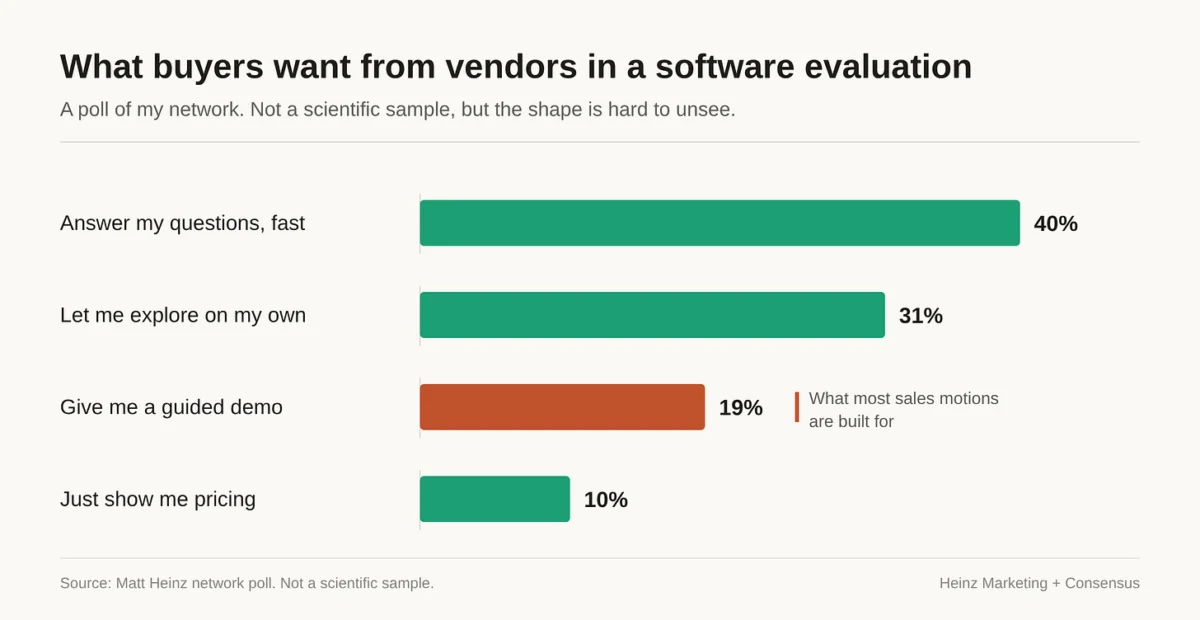
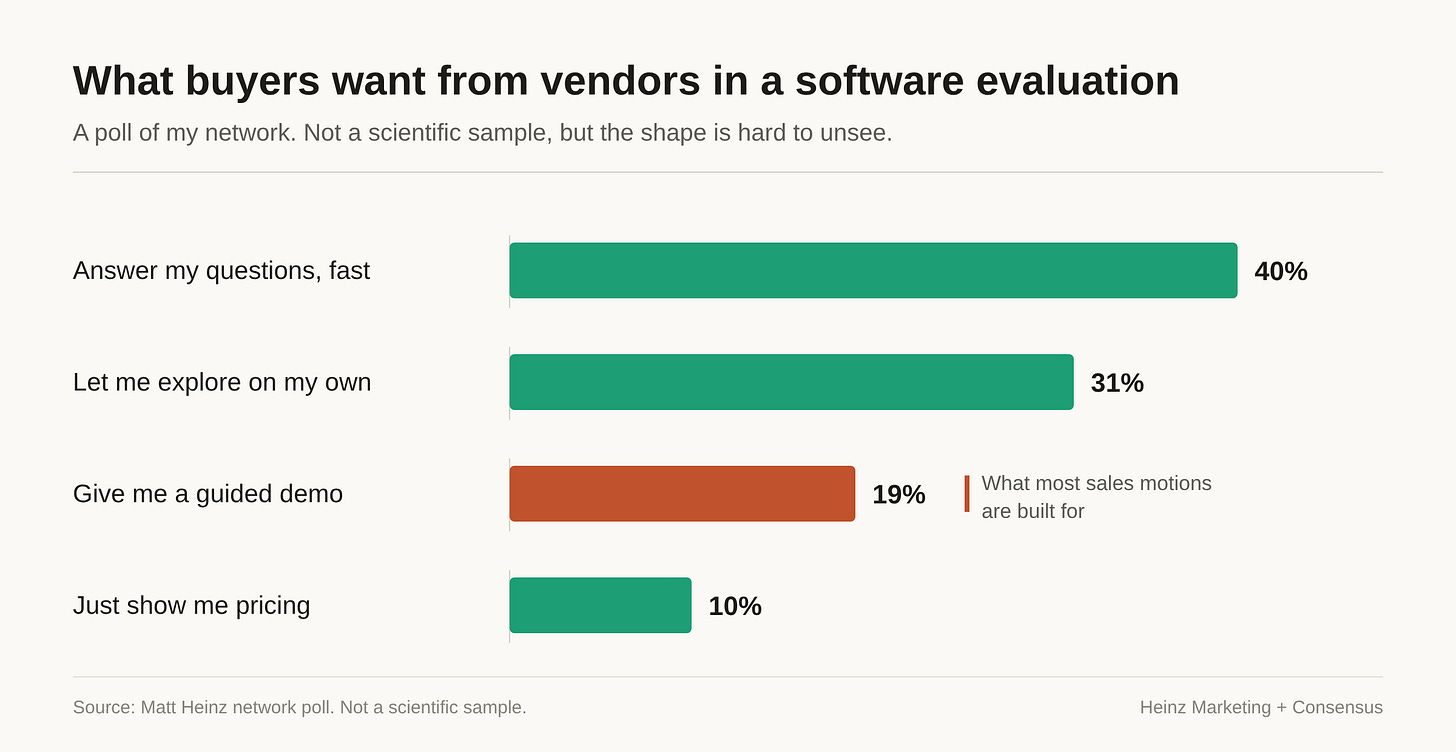
Recent data underscores this transformation. A poll of the author’s network regarding buyer preferences during software evaluation revealed that 40% prioritized quick answers, 31% desired the ability to explore independently, 19% opted for a guided demo, and 10% were primarily interested in pricing. This indicates that while guided demos still hold some appeal, a substantial majority of buyers prioritize self-service research and rapid information retrieval.
Further reinforcing this trend, a 6sense survey of over 4,000 buyers found that an overwhelming 94% had already ranked a preferred vendor before their initial contact with a seller. Of these, a significant 77% ultimately purchased their pre-selected favorite. The same research also highlighted a year-over-year shift, with the point of first seller contact moving earlier in the buyer’s journey, from 69% to 61% of the way through. This signifies that buyers are engaging with vendors at an earlier stage, armed with pre-existing shortlists and preliminary answers they seek to validate. Consequently, sales representatives who approach these interactions with a traditional discovery-first mindset are essentially addressing questions that have already been answered by the buyer.
The implications of this misalignment are profound. Win-loss analysis frequently identifies deals lost due to the champion’s inability to effectively navigate the internal buying group and secure consensus. This highlights a critical gap in sales enablement, where the focus has not adequately shifted to supporting the champion during the crucial decision-making phase.
The Apparent Contradiction: Rep-Free Research, Rep-Involved Validation
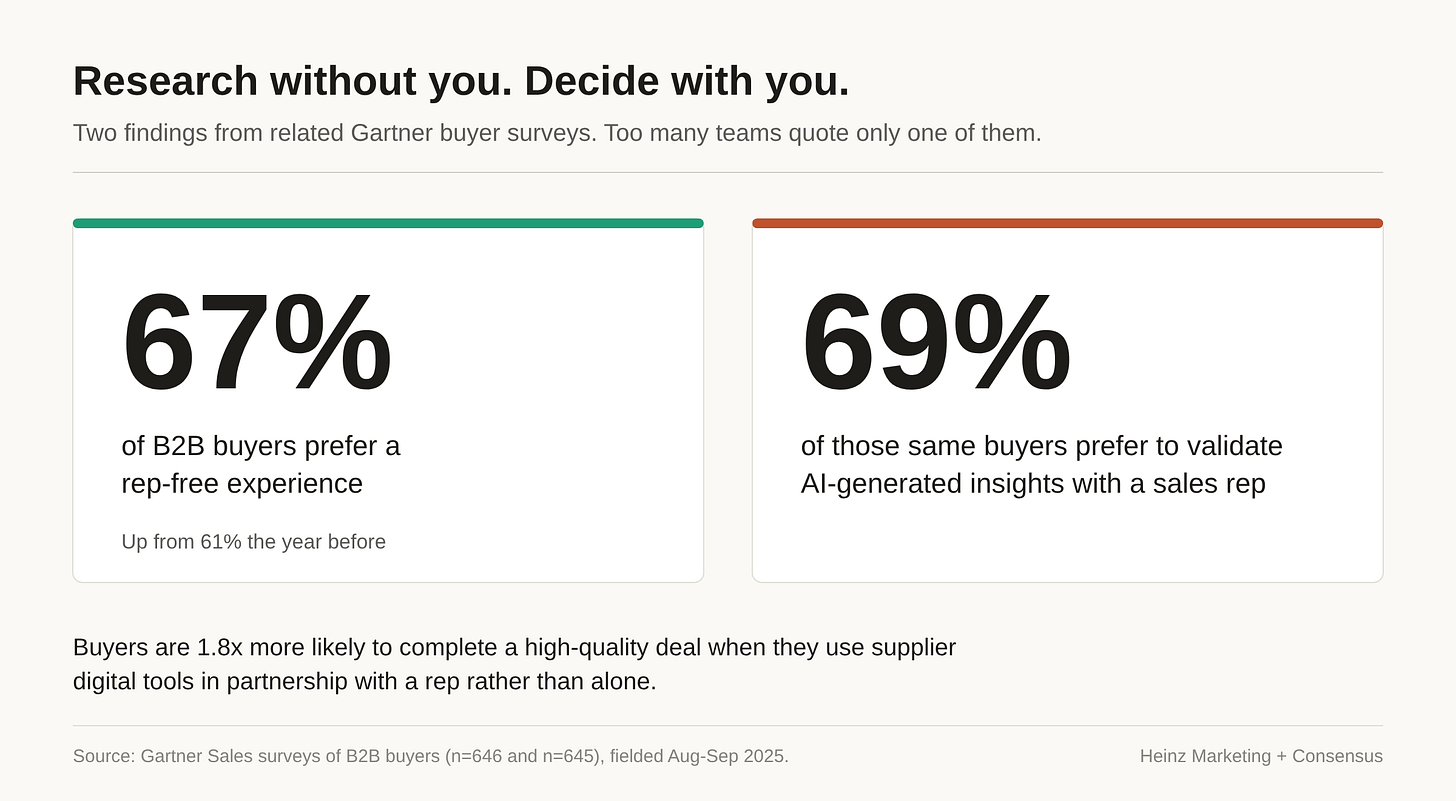
Gartner’s recent findings present a seemingly contradictory, yet ultimately coherent, picture of buyer preferences. Surveys indicate that 67% of B2B buyers prefer a rep-free experience for certain aspects of their evaluation, an increase from 61% the previous year. However, in a related finding, 69% of these same buyers prefer to validate AI-generated insights with a sales representative.
This duality—buyers wanting to research independently but needing human validation for critical decisions—forms the bedrock of the new guide’s strategic recommendations. The implication is that sales organizations should not aim to eliminate the sales representative, but rather to reposition their involvement. Buyers are not seeking to avoid human interaction entirely; they are seeking a more efficient and self-directed research phase, followed by targeted, high-value human engagement during the decision-making process. Gartner further supports this by noting that buyers are 1.8 times more likely to complete a high-quality deal when they leverage digital supplier tools in partnership with a sales representative, rather than attempting to navigate the process entirely alone.
The Buyer Confidence Curve: Mapping the Ideal Handoff
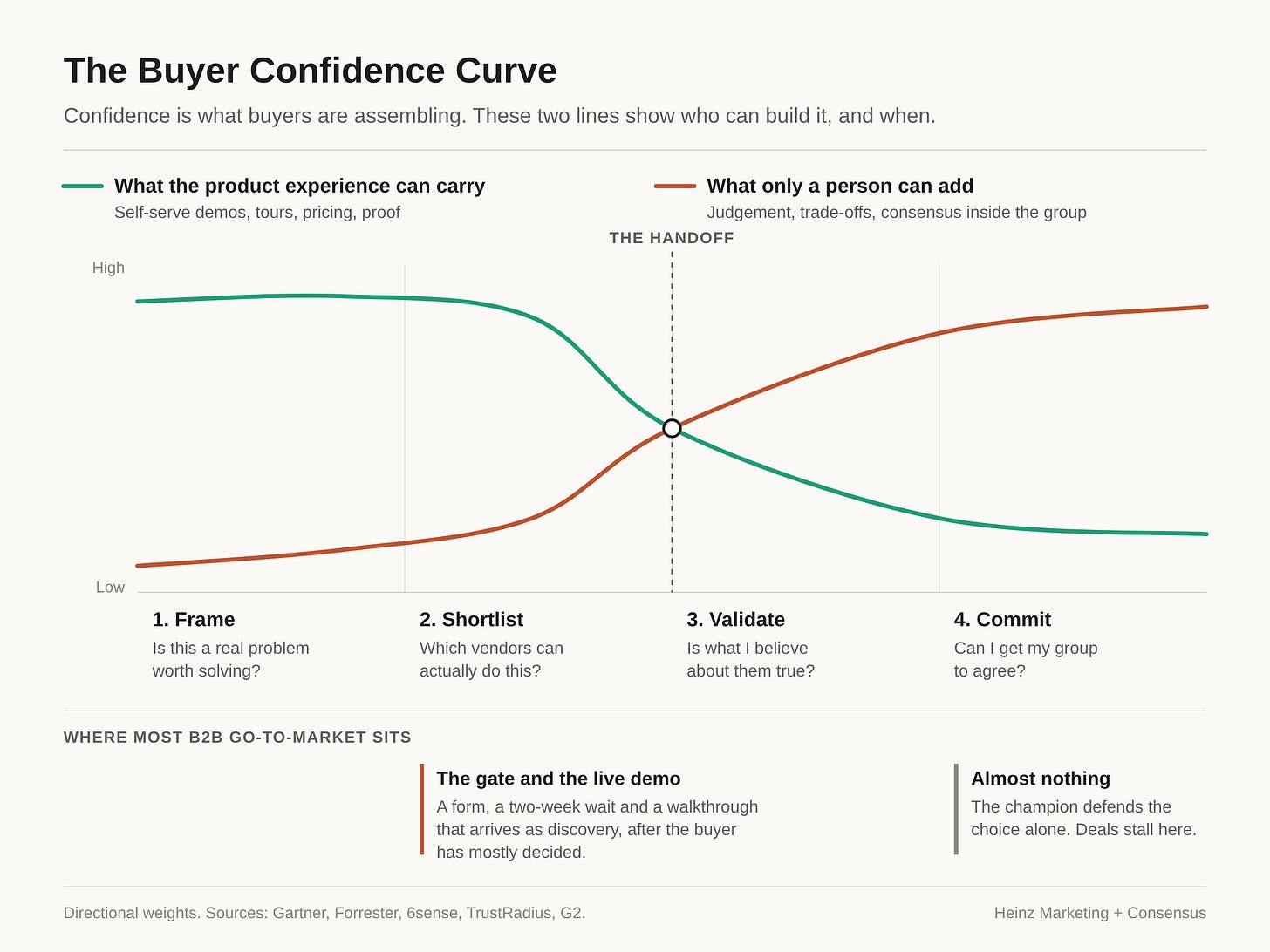
At the heart of "The CMO Field Guide to Sales Momentum & Product-Led Demos" is a novel framework dubbed "The Buyer Confidence Curve." This model maps two key capacities across the four stages of a buying decision: what the product experience can effectively deliver and what uniquely human elements a sales representative can contribute.
The framework posits that the product experience can handle the majority of the buyer’s needs during the "Shortlist" stage. The critical inflection point occurs at the "Validate" stage. This is where a buyer has identified a preferred vendor and has begun assembling an argument for their choice, drawing from various sources. At this juncture, they require a credible sales professional to critically pressure-test their assumptions and validate their nascent decision. This "Validate" stage represents the most leveraged opportunity for a sales team, offering the highest return on invested human hours.
However, many B2B companies inadvertently invert this curve. They place their most valuable human resources—sales representatives—on the wrong side of this critical transition. The gating mechanism, often in the form of a demo request form, is typically positioned at the "Shortlist" stage, precisely when buyers could be self-convincing. Similarly, live demos are frequently conducted as a discovery exercise after the buyer has largely settled on a solution, rather than as a validation of their existing conclusions. Crucially, the "Commit" stage, where final decisions are made and internal alignment is secured, often suffers from a severe lack of dedicated human support.
Commitment: The Unstaffed Battlefield of Deal Stalls
The "Commit" stage is where deals most frequently falter, yet it remains remarkably understaffed by sales teams. Gartner research indicates that 74% of B2B buying teams experience unhealthy conflict during the decision-making process. An earlier Forrester survey corroborated this, finding that 86% of B2B purchases stall at some point in the process.
The scenario is often as follows: four members of a buying committee express a positive inclination, but one influential member harbors reservations, leading to a quiet stall. The internal champion is left to defend a choice to a group that may not be fully aligned, often working in isolation and frequently utilizing sales collateral designed for a different purpose or audience. This lack of dedicated support during the critical consensus-building phase is a significant contributor to lost revenue.
Strategic Plays for a Modern Sales Landscape
The guide proposes four strategic "plays" to help organizations realign their sales efforts with buyer expectations and navigate the Buyer Confidence Curve effectively.
-
Move the Gate to Where It Buys You Something: The recommendation is to ungate the product experience during the "Shortlist" phase. This means making on-demand walkthroughs, interactive tours, transparent pricing information, and industry-specific proof points accessible without requiring a form submission. While ungating everything might seem like a loss of lead intelligence, the proposed solution is to implement robust instrumentation. This involves tracking user engagement—who watches, what sections are replayed, where users drop off, and who content is forwarded to. This data provides valuable insights into buyer behavior and interest without resorting to traditional lead gating. TrustRadius research supports the impact of free trials, reporting a high influence-to-usage ratio, with 74% of buyers citing them as the most influential evaluation resource.
-
Design the Demo to Travel: Sales teams should create product experiences that can be easily shared and customized by the internal champion. Since champions often need to retell the story to various stakeholders who were not present on the initial call, product demonstrations should be modular. This allows for selective forwarding of specific segments—for instance, the security lead may only need to see relevant security features, while the CFO might be more interested in financial implications. This approach also serves as a discovery mechanism in itself, identifying new stakeholders within the buying group as they begin engaging with shared content.
-
Repoint the Live Conversation at Validation: The focus of live sales conversations should shift from traditional discovery questions (which buyers have likely already answered through self-research) to validation. This involves beginning the conversation by acknowledging what the buyer already believes and demonstrating a willingness to identify areas where the product may not be a good fit. Given that buyers express skepticism towards both AI and sales representatives regarding the potential for misleading information, being specific about limitations becomes a critical and cost-effective way to build credibility.
-
Enable the Group, Not the Individual: This often-overlooked strategy involves focusing on building shared understanding and alignment across the entire buying group, rather than hyper-personalizing content for each individual stakeholder. While individual personalization can seem beneficial, it can paradoxically lead to divergent perspectives and difficulties in establishing a unified problem definition. Instead, the focus should be on creating a collective summary of what the group has reviewed, providing a concise answer to common procurement objections, and delivering proof points that can be easily shared and understood by all decision-makers, including executives like the CFO. Gartner data suggests that buyers who experience content relevance at the buying-group level are three times more likely to report a high-quality deal.
Self-Assessment and Future Direction
The guide concludes with a 10-question diagnostic tool designed to help organizations assess their current demo motion against the principles outlined in the Buyer Confidence Curve. It also advocates for replacing traditional demo requests, which offer limited insight into buyer intent, with more effective metrics. These include the number of stakeholders discovered per opportunity and the efficiency of the product experience in moving buyers through the initial stages of their evaluation.
The overarching message is clear: sales organizations must adapt to the modern buyer’s empowered research capabilities. By strategically repositioning sales efforts to focus on the critical validation and commitment phases, and by leveraging product experiences for self-directed research, companies can significantly improve deal velocity and increase their win rates. The full field guide, offering a detailed exploration of the Buyer Confidence Curve, the four strategic plays, and the diagnostic tool, is available for download, underscoring the commitment to providing actionable insights without further gating the information itself. This initiative represents a significant step in helping B2B companies navigate the complexities of contemporary buyer journeys and build more effective, buyer-centric sales processes.


 Suro Senen
 Muslim