Layla Zulfa

The disconnect between sales and marketing departments remains one of the most significant barriers to revenue growth for small and medium-sized businesses (SMBs), according to a comprehensive new study released by Unbounce. The 2026 Anatomy of Aligned Go-to-Market Teams Report, which surveyed over 500 go-to-market (GTM) professionals, reveals a stark contrast between organizational expectations and operational reality. While 87% of GTM teams believe that better alignment between sales and marketing would significantly lift overall performance, only 56% of respondents currently describe their organizations as "highly aligned."
This discrepancy highlights a persistent "alignment gap" that transcends simple communication issues. According to the report’s author, Josh Gallant, misalignment rarely surfaces as a single, identifiable strategy error. Instead, it manifests as a series of systemic frictions: marketing-qualified leads (MQLs) that sales reps do not trust, marketing campaigns launched without sales’ knowledge, and a revenue pipeline that appears robust until the final closing stages, where growth begins to stagnate.
The Perception Gap: Executives vs. Practitioners
One of the most revealing findings in the Unbounce report is the significant perception gap regarding the health of organizational alignment. The data suggests that the higher an individual is in the corporate hierarchy, the more optimistic they are about team synergy. Approximately 69% of executives report strong sales and marketing alignment, whereas only 47% of non-executive staff agree with that assessment.
This "structural information lag" suggests that leadership often views alignment through the lens of high-level strategy decks and scheduled meetings, while those on the front lines experience the daily friction of broken processes. Non-executives are more likely to encounter the barriers that leadership tends to underreport, including data inconsistencies (cited by 28% of non-executives vs. 22% of execs), limited communication (33% vs. 28%), and leadership silos (19% vs. 14%).

Furthermore, the report identifies a functional split in perception. Roughly 62% of sales professionals feel highly aligned, compared to only 53% of marketing professionals. This suggests that marketing teams often feel the burden of misalignment more acutely, particularly when their efforts do not receive the necessary feedback or follow-up from the sales side.
The Root Causes of Organizational Friction
The Unbounce report categorizes the causes of GTM misalignment into four primary areas: operational (53%), goal and incentive-based (43%), cultural (40%), and structural (34%).
Data Silos and Information Inconsistency
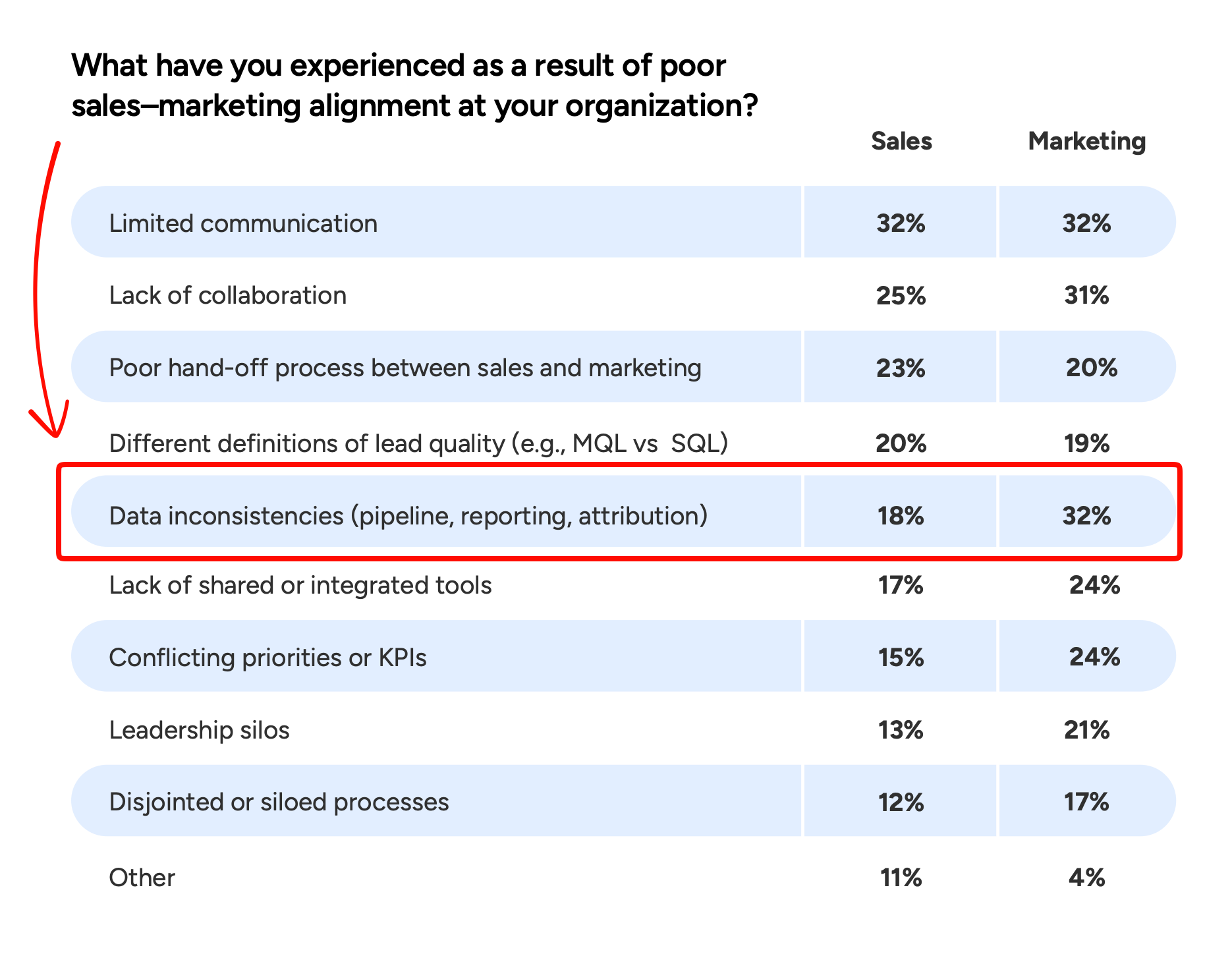
Despite the proliferation of "all-in-one" platforms, data sharing remains a primary point of failure. While 40% of GTM teams claim to have excellent cross-functional data sharing, 68% admit to encountering regular data inconsistencies. Marketing teams are particularly sensitive to this issue; 32% of marketers cite data inconsistency as a major barrier, compared to only 18% of sales professionals. This disparity often arises because marketing relies on data for attribution and campaign optimization, whereas sales teams focus on individual pipeline signals within the CRM.
Tool Bloat and Underutilization
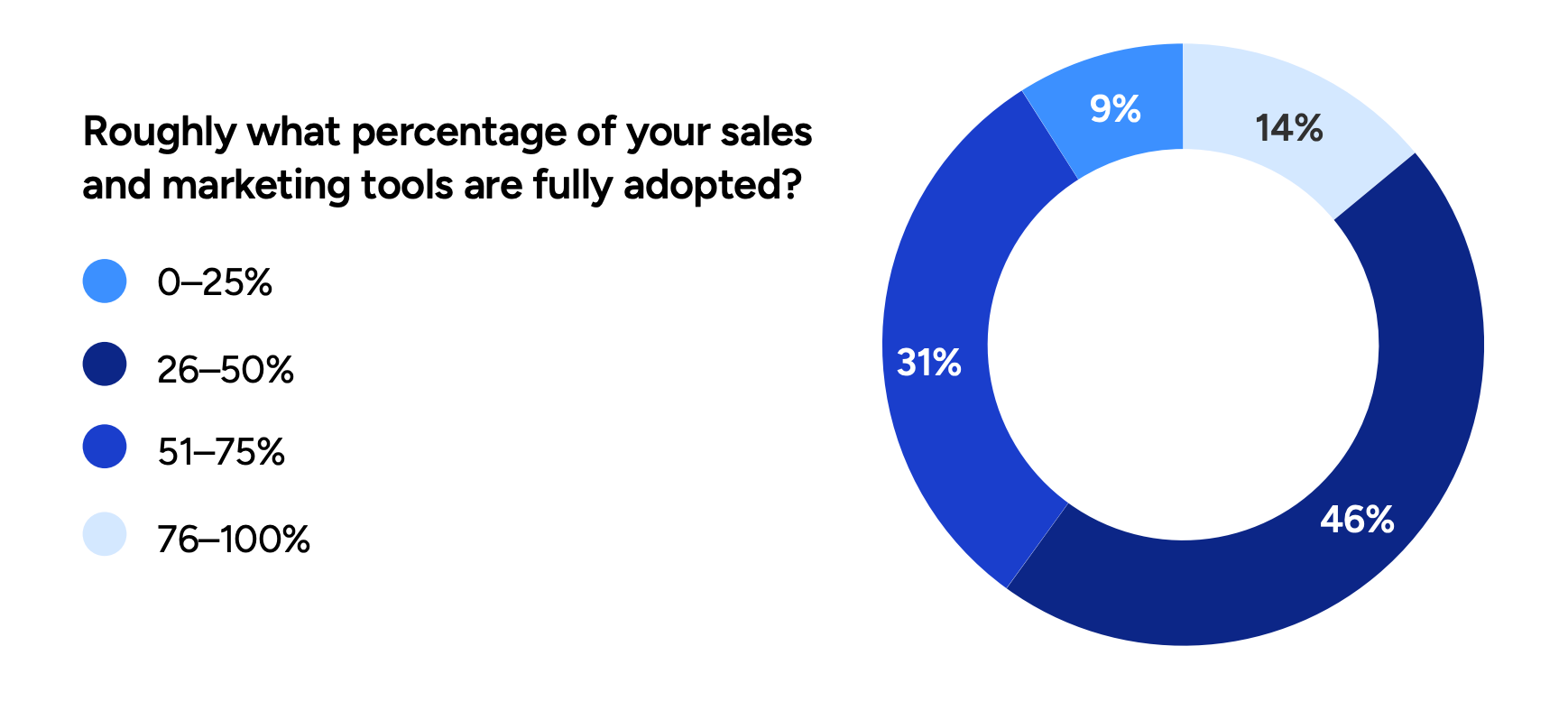
In an attempt to "buy" alignment, many organizations have over-invested in software. The report finds that 56% of GTM professionals believe tool bloat is a significant issue. Perhaps more concerning is the lack of adoption: 60% of respondents use less than half of their available tech stack. Specifically, 14% of teams utilize only 0-25% of their tools, and 46% utilize between 26-50%. This "sprawl" creates maintenance overhead and further fragments data rather than unifying it.
Misaligned Incentives
A significant portion of misalignment stems from how employees are rewarded. Approximately 43% of teams cite goal or incentive misalignment as a root cause of friction. When marketing is incentivized solely on the volume of leads and sales is incentivized only on closed deals, neither team is structurally motivated to bridge the gap. As the report notes, shared KPIs are often treated as a "philosophical exercise" rather than an operational reality because they do not align with compensation structures.

The Financial and Cultural Costs of Misalignment
Misalignment is not merely a logistical headache; it carries quantifiable costs that erode the bottom line. According to the survey, the first consequence of poor alignment to manifest is employee frustration, cited by 29% of respondents. However, the operational costs are equally damaging:
- Delayed Follow-up: 28% of teams report that leads are not contacted in a timely manner.
- Stalled Deal Cycles: 20% of respondents note that deals take longer to close or die in the pipeline due to a lack of coordination.
- Duplicated Effort: 19% of teams find themselves repeating work because of a lack of visibility into what the other department is doing.
Marketing teams are more likely to flag delayed follow-ups (32%) and unclear target customers (29%) as major issues, whereas sales teams tend to focus on the lack of lead quality. This creates a "lose-lose" scenario where marketing celebrates high lead volumes that sales ignores, leading to falling win rates despite a healthy-looking top-of-funnel.
Chronology of an Alignment Breakdown: A Typical Scenario
To understand how these statistics translate into real-world failure, industry analysts point to a common chronology of events within misaligned SMBs:
- Phase 1: The Campaign Launch. Marketing launches a high-spend PPC campaign based on internal personas. Sales is not briefed on the specific messaging or the "offer" used to entice leads.
- Phase 2: The Lead Surge. The campaign generates a high volume of MQLs. Marketing reports a successful month to leadership.
- Phase 3: The Handoff Failure. Leads are passed to sales via a CRM sync. However, because the "qualified" definition was never agreed upon, sales reps find the leads are outside their target firmographics or are not yet "ready to buy."
- Phase 4: The Follow-up Delay. Disenchanted by lead quality, sales reps prioritize their own outbound prospects. Marketing leads sit in the CRM for 48-72 hours before the first touchpoint.
- Phase 5: The Revenue Miss. At the end of the quarter, closed-won revenue is down. Marketing blames sales for not following up; sales blames marketing for "trash" leads.
Characteristics of High-Performing, Aligned Teams
The Unbounce report also analyzed the 56% of teams that consider themselves "highly aligned" to identify what they do differently. The results suggest that these teams prioritize operational integration over simple communication frequency.
Unified Data Systems
Highly aligned teams are 3.5 times more likely to have strong cross-functional data sharing (59% vs. 16%). These organizations move beyond just "talking about data" to building systems where marketing and sales pull from a single source of truth.
Lean Tech Stacks
Counterintuitively, the most aligned teams use fewer tools. Roughly 30% of aligned teams describe their tech stack as "lean and focused," compared to only 15% of misaligned teams. Crucially, teams that consolidated their tech stack were twice as likely to rate their lead quality as "excellent" (55% vs. 20%).
Consistent Messaging
Aligned teams report significantly fewer messaging inconsistencies across the buyer’s journey (17% vs. 28%). In these organizations, marketing campaigns reflect the actual language, objections, and insights that sales reps hear on discovery calls. This ensures that the transition from a marketing-owned context to a sales-owned context is seamless for the prospect.
Strategic Recommendations for 2026 and Beyond
Based on the report’s findings, several actionable steps have been identified for organizations looking to bridge the alignment gap:
- Establish a Shared Definition of "Qualified": Only 29% of GTM teams currently rate their lead quality as "excellent." Alignment begins with a joint exercise to define the Ideal Customer Profile (ICP) and the specific firmographic and behavioral markers that constitute a sales-ready lead.
- Implement a Service Level Agreement (SLA): A functional handoff requires a formal agreement on what marketing will deliver, what information will be included, and how quickly sales must follow up.
- Consolidate Reporting and Analytics: The report identifies CRMs, marketing automation platforms, and shared dashboards as the three most critical alignment tools. Organizations should prioritize tools that both functions actually use daily.
- Incentivize Shared Outcomes: To overcome the "incentive gap," businesses should consider tying a portion of marketing compensation to pipeline opportunities or closed revenue, rather than just lead volume.
Impact and Future Outlook
As the business landscape moves deeper into 2026, the cost of inefficiency is expected to rise. With 44% of GTM teams currently prioritizing data integration and AI-driven insights for the next 12 months, the focus is shifting toward making alignment measurable and automated.
The Unbounce report concludes that while communication frequency is the most common strategy for alignment (cited by 54% of teams), it is the least effective if not backed by an integrated operating model. Organizations that fail to address the underlying structural and data-driven causes of misalignment risk falling behind competitors who can move from "first click to closed deal" with greater speed and lower friction.
The broader implication for the industry is a move toward "Revenue Operations" (RevOps)—a centralized function designed to oversee the entire GTM engine. By removing the silos between marketing, sales, and customer success, SMBs can ensure that their 87% expectation for performance lift finally meets the 56% reality of their current operations.


 Lina Irawan