Dwi Wanna
More than half a century ago, management guru Peter Drucker articulated a foundational principle for business success: the ultimate goal of marketing is to render selling unnecessary. This vision, rooted in a deep understanding of customer needs and market dynamics, posited that when a product or service is perfectly aligned with what customers want and need, its value becomes self-evident, minimizing the need for aggressive sales tactics. However, contemporary analysis of B2B marketing departments suggests a significant divergence from this ideal, with many structured to amplify, rather than diminish, the necessity of sales. This disconnect is poised to become acutely apparent as AI-powered buyers increasingly scrutinize pricing, packaging, and positioning – elements that often fall outside the traditional purview of marketing departments.
Drucker’s Philosophy of Marketing
Peter Drucker, a prolific writer and consultant whose work profoundly shaped modern management theory, emphasized the customer as the central figure in any business endeavor. In his seminal 1954 work, "The Practice of Management," Drucker asserted that a business has only two fundamental functions: marketing and innovation. He argued that marketing was not merely a departmental function but rather the entire business viewed from the customer’s perspective. This holistic approach meant that every decision, from product development to customer service, should be guided by an understanding of customer desires and market realities.
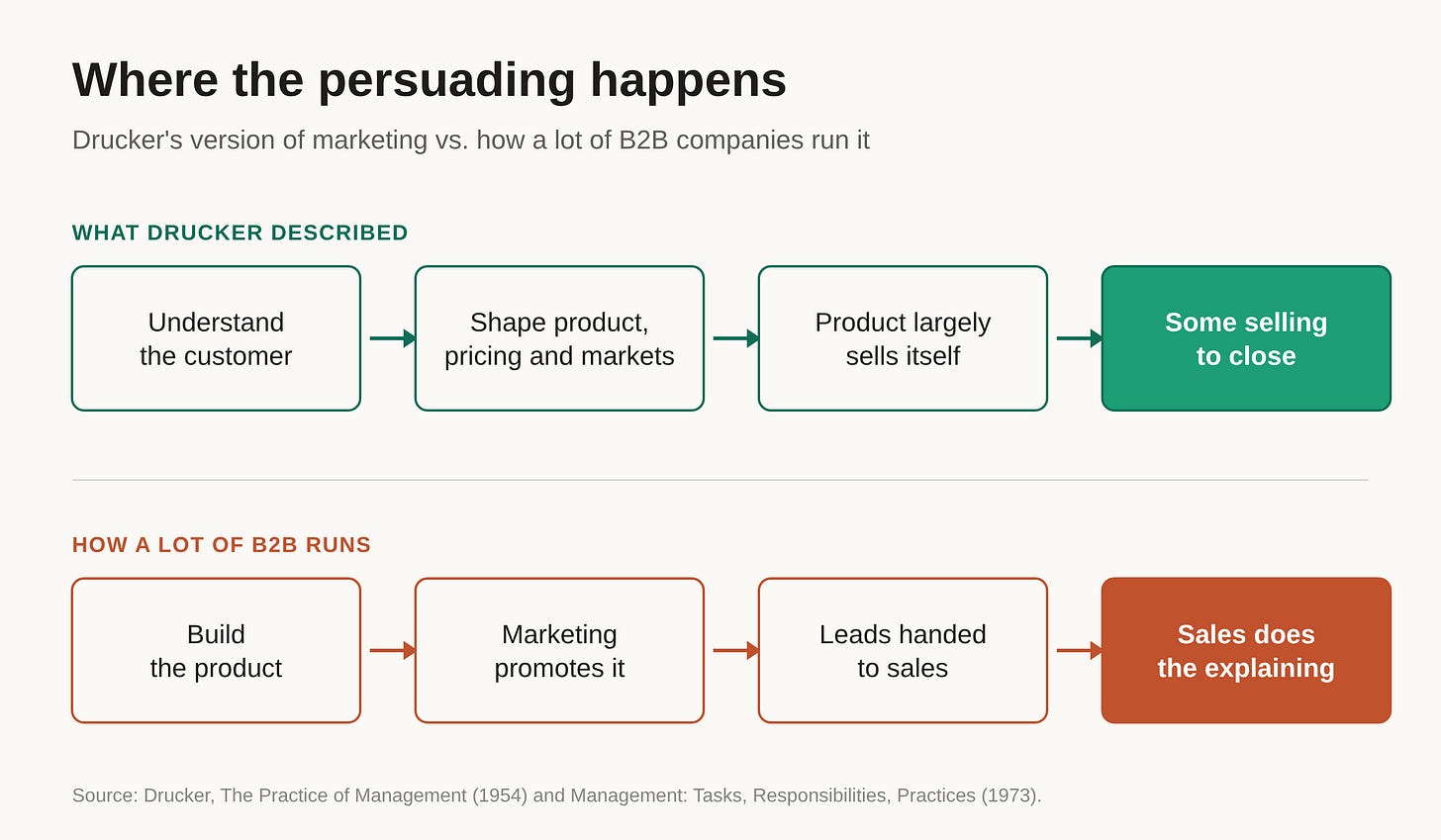
Two decades later, in his 1973 book, "Management: Tasks, Responsibilities, Practices," Drucker sharpened this assertion with the now-famous quote: "The aim of marketing is to make selling superfluous." This statement was not an indictment of sales teams but rather a testament to the power of effective marketing. It suggested that a profound understanding of the customer, coupled with the creation of a product or service that genuinely addresses their needs, would naturally lead to demand. In this ideal scenario, the product sells itself, requiring minimal persuasive effort from sales representatives. The role of sales, in Drucker’s view, was to facilitate transactions for those few instances where the product’s value proposition might not be immediately apparent or for complex, high-value purchases requiring personalized guidance.
The Disconnect: Current B2B Marketing Structures
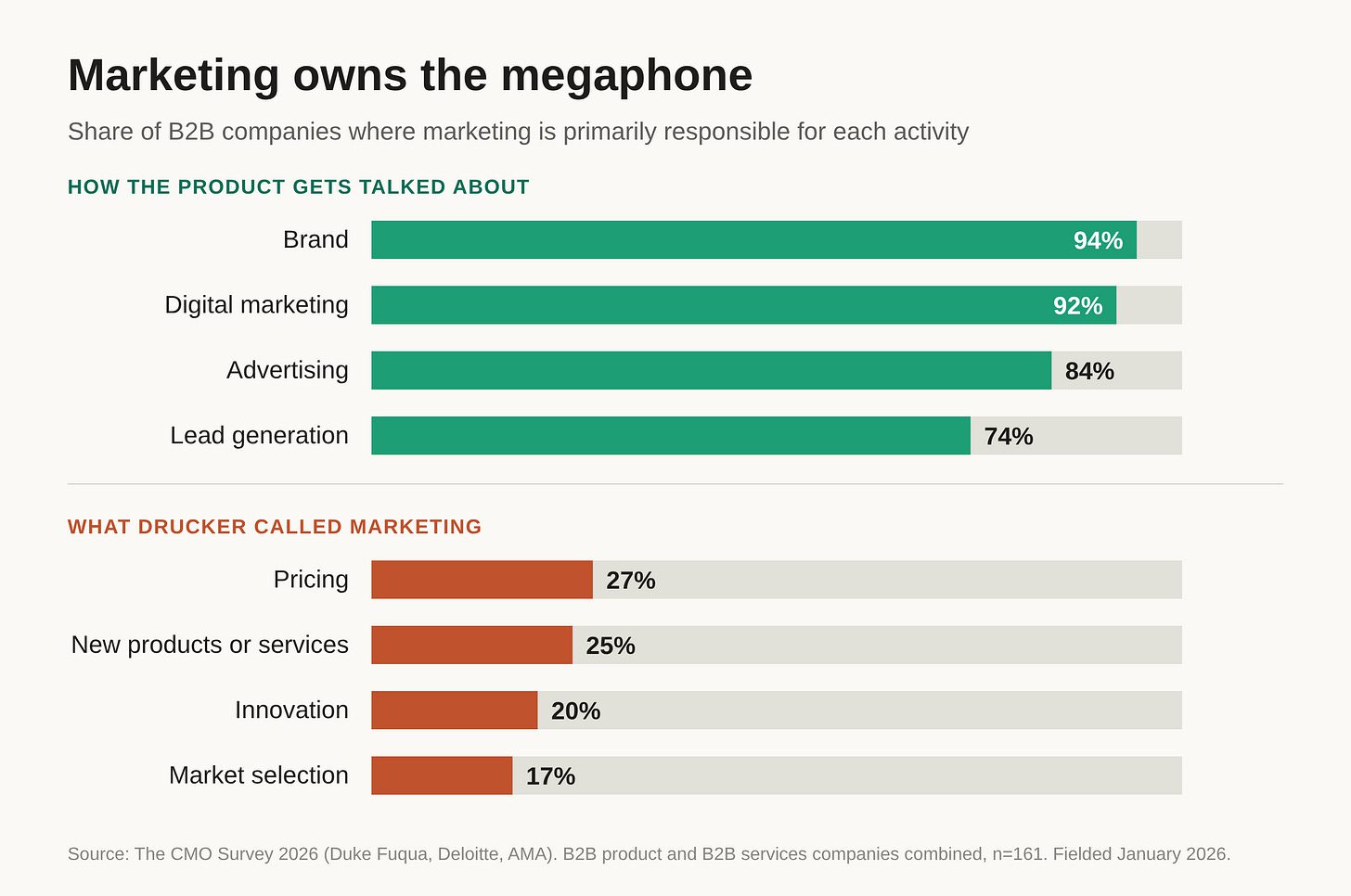
A stark contrast to Drucker’s vision emerges from recent industry surveys, particularly The CMO Survey, a long-standing initiative conducted by Duke University’s Fuqua School of Business in partnership with Deloitte and the American Marketing Association (AMA). This survey annually canvasses marketing leaders on their departmental responsibilities. Analysis of data from 161 B2B companies in the latest edition reveals a prevailing structure where marketing departments are primarily tasked with communication and promotional activities.
According to The CMO Survey, the top responsibilities assigned to B2B marketing departments often resemble those of a communications or public relations function. These typically include developing messaging, managing public relations, and overseeing advertising and content creation. These are crucial activities, but they represent the "how" the product is presented, rather than the "what" and "why" of its existence.

Conversely, the core elements Drucker would classify as marketing – pricing, packaging, and product development aligned with market needs – are frequently siloed within other departments. In roughly three out of four B2B companies surveyed, marketing holds primary responsibility for how the product is communicated but not for its fundamental attributes such as cost, feature set, or target market. Sales departments, in this model, often carry a smaller direct responsibility, with only about 14 percent of marketing leaders reporting it as a primary focus.
This division of labor creates a scenario where marketing departments, often equipped with the "megaphone" of communication, are not fundamentally shaping the product or its value proposition from the customer’s perspective. This misalignment is further underscored by a separate Gartner survey of 125 CEOs and CFOs. In this study, a mere 14 percent of these executives deemed their Chief Marketing Officers (CMOs) highly effective at "market shaping" – a concept Gartner defines as identifying and fulfilling unmet customer needs. This definition closely mirrors Drucker’s original intent for marketing. The stark reality is that a significant majority of budget approvers do not perceive marketing as fulfilling its core, customer-centric mandate.
The Pressure to Perform: Pipeline Over Understanding
The current operational model of many B2B marketing departments is often driven by performance metrics, particularly pipeline generation. With marketing teams frequently measured on the volume of leads passed to sales, there is an inherent incentive to prioritize activities that directly contribute to this pipeline. Lead volume is a quantifiable metric, making it easier to track and report on a quarterly basis than the more ambiguous, long-term goal of deep customer understanding and market shaping. This focus on immediate, measurable outcomes often leads to a strategic triage, where activities that build pipeline take precedence over those that might fundamentally improve the product or its pricing strategy based on customer insights.
The consequence of this prioritization is a marketing function that primarily serves as a conduit for sales. The product, therefore, may not evolve to effectively communicate its own value, leaving sales representatives to bridge the gap and explain its merits. This approach, while understandable from a short-term performance perspective, deviates significantly from Drucker’s ideal where the product itself, through its inherent value and market fit, would necessitate less explicit selling.
The Rise of the AI-Assisted Buyer
The landscape of B2B purchasing is undergoing a rapid transformation, significantly influenced by the proliferation of Artificial Intelligence (AI). Buyers are increasingly leveraging AI tools to conduct their own research, evaluate options, and even generate shortlists without direct engagement with sales representatives. This shift has profound implications for how businesses must present themselves to the market.
Gartner research highlights this evolving buyer behavior. A survey found that 73 percent of B2B buyers actively avoid suppliers who engage in irrelevant outreach. Furthermore, a substantial 67 percent of buyers express a preference for a rep-free buying experience, indicating a desire for self-service information and evaluation. Compounding this, 45 percent of buyers have already incorporated AI into their recent purchasing journeys, and a significant 69 percent reported inconsistencies between the information presented on a supplier’s website and what sales representatives communicated.
When buyers, or their AI assistants, can construct a preliminary list of potential vendors without initial human interaction, the publicly available information becomes paramount. This includes product positioning, pricing structures, comparative analyses, and detailed documentation. In essence, buyers are now independently running Drucker’s "test" – evaluating whether a solution meets their needs and offers compelling value based on the information they can readily access. This process bypasses the traditional sales funnel, forcing companies to ensure their foundational marketing elements are robust and self-explanatory.
The critical point is that the very aspects buyers are scrutinizing – pricing, packaging, and product fit for specific market segments – are precisely the areas where many marketing departments have limited direct responsibility. The traditional model assumed that sales representatives would fill in the informational gaps during later stages of the buying process. However, with buyers increasingly empowered by AI and preferring self-service, this handoff is becoming less effective. Buyers are less inclined to wait for a salesperson to clarify ambiguities; instead, they may simply ask their AI assistant for alternative options, potentially leading them to a competitor’s offering.
The Implications for Sales and Marketing Alignment
The shift towards AI-driven purchasing does not negate the need for sales expertise, but it fundamentally redefines its role. Complex, high-consideration purchases will likely continue to require skilled sales professionals to guide decision-making, facilitate negotiations, and address intricate customer-specific challenges. Gartner’s own research indicates that buyers still value seller input for assessing solution fit within their unique contexts, and confident buyers are more likely to report successful deal outcomes.
The crucial argument, therefore, centers on optimizing the allocation of sales and marketing resources. Sales teams should ideally focus their efforts on the high-value, human-centric aspects of the buying process that AI cannot replicate. This includes building relationships, providing strategic advice, and navigating complex organizational dynamics. Concurrently, marketing departments must assume a greater responsibility for the foundational elements that precede direct sales engagement.
Three Critical Questions for Modern Marketing
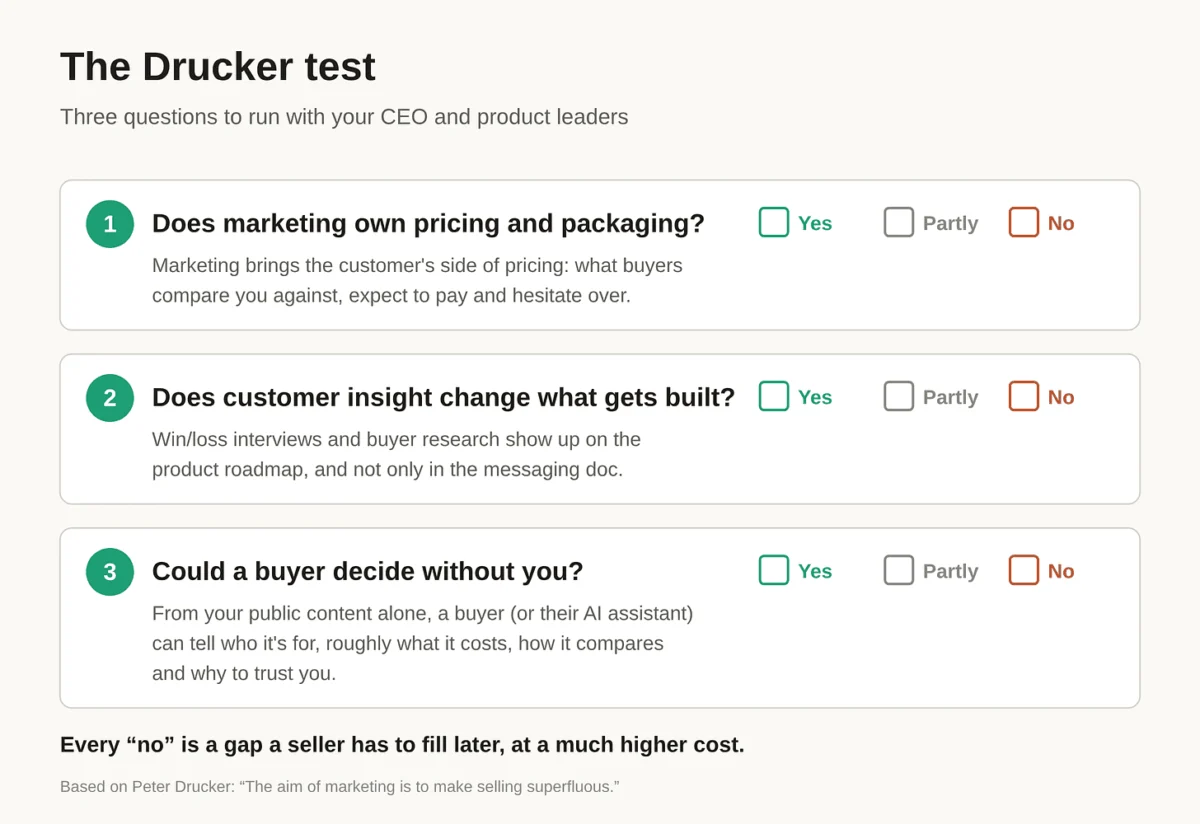
To bridge the gap between Drucker’s timeless principles and the realities of today’s market, marketing departments and their leadership must critically evaluate their current functions and responsibilities. This requires a strategic reorientation, often involving close collaboration with executive leadership and product teams. Three key questions, directly derived from Drucker’s philosophy and amplified by the current market dynamics, can serve as a framework for this self-assessment:
-
Does Marketing Own Pricing and Packaging? If marketing departments are excluded from pricing and packaging decisions, they are tasked with marketing a value proposition they did not help to shape. To truly embody Drucker’s vision, marketing must own the customer’s perspective on pricing, understanding what buyers compare against, their expectations for cost, and the factors that might cause hesitation. This requires a deep dive into market intelligence, competitive analysis, and customer willingness-to-pay. Without this involvement, marketing’s value story risks being disconnected from the economic realities faced by potential customers.
-
Does Customer Insight Inform Product Development? Drucker emphasized that marketing is intrinsically linked to innovation. If marketing departments are collecting valuable insights from win/loss interviews, buyer research, and feedback from sales and customer success teams, but this information does not influence product roadmaps, then marketing is functioning merely as a communications department. True marketing leadership means ensuring that customer needs and market intelligence directly translate into product enhancements, new features, or even entirely new offerings. This integration ensures that the product itself is a powerful marketing tool.
-
Could a Buyer Decide Without Direct Sales Engagement? In the age of AI, this question is more pertinent than ever. Companies must rigorously assess their public-facing information through the lens of a skeptical, independent buyer. This can be achieved by systematically reviewing website content, documentation, and publicly available pricing information, or by tasking an AI assistant to research the category and evaluate the company’s offerings. The ability of a buyer to clearly understand who the product is for, its approximate cost, how it compares to alternatives, and why they should trust the vendor is a direct measure of marketing’s effectiveness in making selling superfluous. Any gaps in this information represent an opportunity for a seller to intervene, often at a higher cost and with less efficiency.
Conclusion: Embracing the Drucker Standard in the AI Era
Peter Drucker’s assertion that the aim of marketing is to make selling superfluous remains a potent benchmark for business success. While the nature of selling and buying has evolved dramatically, the fundamental principle of understanding and meeting customer needs remains constant. The increasing sophistication of AI in the B2B purchasing process is not a threat to this principle, but rather an accelerator, forcing companies to confront the disconnect between their current marketing structures and Drucker’s ideal.
The trend of B2B buyers leveraging AI for research and evaluation means that product positioning, pricing, and packaging must be compelling and transparent from the outset. If marketing departments are not actively involved in shaping these critical elements, they risk being outmaneuvered by an increasingly informed and self-sufficient buyer. The challenge for B2B companies is to realign their marketing functions to embrace the full spectrum of Drucker’s definition – from deep customer insight and product innovation to clear and compelling value communication. The question is whether marketing departments can proactively adapt to enforce this standard, or if it will be the AI-powered buyers who ultimately compel this necessary evolution. The future of effective B2B engagement hinges on marketing teams embracing their role as the architects of customer value, ensuring that the product itself becomes the most persuasive salesperson.


 Suro Senen