Suro Senen

The realm of business-to-business (B2B) marketing is undergoing a significant transformation, with influencer marketing and creator-driven content moving from nascent experiments to strategic imperatives. A comprehensive analysis of industry trends and proprietary research by TopRank Marketing, spanning back to 2020, reveals a maturation of the discipline, indicating a shift from simply proving its efficacy to optimizing its impact and integration across the entire marketing funnel. The insights, drawn from extensive client engagements, benchmark reports such as the "2027 B2B Influencer & Creator Marketing Report," and consultations with industry leaders, highlight six key trends poised to redefine B2B influence in the coming years.
Influence: From Table Stakes to Strategic Tiebreaker
Since its inception as a recognized marketing strategy in the B2B space around 2020, influencer marketing has steadily climbed the ladder of importance. Initially viewed as a supplementary tactic, it has evolved into a critical component of the B2B marketing mix, earning the trust of sophisticated buying committees. Current data indicates a widespread adoption, with an overwhelming 83% of B2B marketers either actively running influencer programs or planning to launch them. This widespread implementation signifies that the competitive advantage will no longer stem from simply participating in influencer marketing, but rather from achieving excellence through innovation, differentiation, and expert execution.
The trajectory of B2B influence over the past several years has been marked by a growing recognition of its ability to build credibility and drive engagement in a crowded marketplace. Early adopters often experimented with limited budgets and scope, focusing on brand awareness. However, as more data emerged demonstrating tangible ROI, including lead generation and sales enablement, investment and strategic focus increased. The transition from a "nice-to-have" to a "must-have" is evident in the increasing budgets allocated and the integration of influencer strategies into broader marketing plans. Success in this evolving landscape will hinge on the ability of brands to leverage unique voices and authentic connections to cut through the noise and resonate with their target audiences.
Unconventional Creator Partnerships Become the Norm
The traditional archetypes of B2B influencers – industry analysts, prominent keynote speakers, and dedicated "brandividuals" – remain valuable assets for many marketing programs. However, the definition of a B2B influencer is expanding significantly to encompass a broader spectrum of "creators." This evolution is characterized by the increasing embrace of unconventional partnerships.
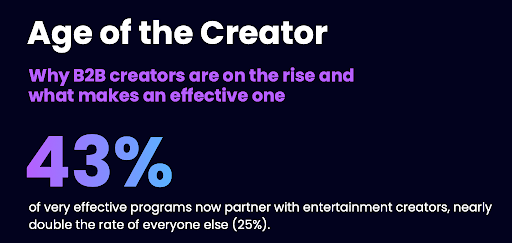
A notable development highlighted in recent analyses is the emergence of "entertainment creators" as viable partners for B2B brands. This category can include satirists, social media personalities, or even individuals with a strong comedic or storytelling flair who can translate complex B2B concepts into engaging and accessible content. Data indicates that highly effective B2B influencer programs are nearly twice as likely (43%) to partner with these unconventional creator profiles compared to less effective programs (25%). This suggests a growing recognition of the power of personality and relatable content to capture attention and convey brand messages, even in a professional context.
The integration of entertainment creators signifies a departure from purely didactic or academic approaches to influencer marketing. Brands are increasingly looking for creators who can connect with audiences on a more emotional or relatable level, fostering a deeper level of engagement. This shift is particularly relevant in an era where attention spans are short and content saturation is high. By collaborating with creators who possess unique storytelling abilities or a knack for humor, B2B companies can differentiate their messaging and build stronger connections with potential customers. This trend is supported by the growing popularity of platforms like TikTok and Instagram Reels, where short-form, entertaining content thrives, demonstrating the potential for these formats to be adapted for B2B audiences.

Focus Shifts Deeper into the Funnel
Historically, B2B influencer marketing has predominantly been positioned as an upper-funnel strategy, primarily utilized for brand awareness and reaching new, relevant audiences through trusted voices. This approach made intuitive sense, especially in an era of evolving search methodologies where AI is playing an increasingly significant role in content discovery.
However, a deeper analysis reveals that this upper-funnel focus significantly underutilizes the potential of influencer marketing. The same trust and credibility that creators build are equally, if not more, impactful in later stages of the buyer’s journey, including critical decision-making processes and even post-sale engagement. Research indicates that highly effective B2B influencer programs are considerably more likely than their less effective counterparts to leverage influencer marketing to support the evaluation stage (62% vs. 44%), the decision stage (63% vs. 48%), and the post-sale stage (46% vs. 25%).
This strategic expansion into the mid and lower funnel signifies a more mature understanding of influencer marketing’s capabilities. It recognizes that trusted voices can provide valuable validation during complex purchasing decisions, offer unbiased reviews, and even assist with customer onboarding and advocacy. As Desireé Porcaro, Senior Director of Social Media at UKG, aptly notes, "In 2027, B2B influencer marketing will increasingly influence the full funnel, combining trusted relationships, original insight, and human connection to shape decisions and AI discovery." This holistic approach maximizes the return on investment by ensuring that influencer collaborations contribute to tangible business outcomes across the entire customer lifecycle.
AI Search Visibility Becomes a Primary Objective
The burgeoning influence of Artificial Intelligence (AI) in search and content consumption presents a critical new frontier for B2B marketers. While the impact is not yet fully realized, the industry is acutely aware of the imperative to optimize for AI-driven discovery. A significant majority of B2B marketers (86%) acknowledge that improving visibility in generative AI tools will be at least moderately important for their influencer programs in the current year, with over half (53%) deeming it very important.
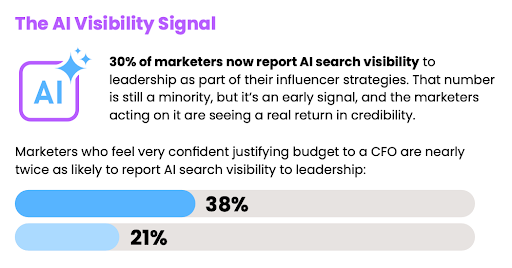
Despite this awareness, a notable gap exists between recognition and action. Only 21% of marketers have established AI/LLM (Large Language Model) visibility as a primary program goal, and a mere 37% have integrated influencer marketing with AI search optimization (AEO/GEO) strategies. This disconnect is further reflected in leadership reporting, with only 30% of marketers currently including AI search visibility as part of their influencer strategy when reporting to senior management.
However, a correlation emerges between reporting AI search visibility and stronger budgetary influence. Marketers who express high confidence in justifying influencer program budgets to their Chief Financial Officers (CFOs) are nearly twice as likely to report AI visibility to leadership (38% vs. 21%). This suggests that demonstrating a forward-thinking approach to AI integration can bolster budget allocation. Georgina Whalen, Director of Influencer, Affiliate & Social at TrueLearn, underscores the evolving vetting process: "Expertise will be a vital vetting metric in 2027 due to AI search now reading and ranking creators. As AI answers become more impactful, brands will vet creators on a second metric: whether large language models cite them." This indicates a future where a creator’s authority will be measured not only by human perception but also by their recognition within AI-powered knowledge systems.
The implications of this trend are profound. As AI models become increasingly sophisticated in synthesizing information and generating answers, the creators and content that are frequently cited and recognized by these models will gain significant prominence. B2B brands that proactively engage with influencers who possess deep expertise and are already established as authoritative sources in their respective fields will be better positioned to capture attention within AI-driven search results. This necessitates a strategic shift in content creation and influencer selection, prioritizing thought leadership and verifiable expertise that resonates with both human audiences and AI algorithms.
Influencer-Driven Content Formats Become More Durable and Diverse
The days of viewing a single social media post or a guest blog as the sole output of an influencer collaboration are rapidly receding. While social posts remain the most common co-created format (60%), they no longer serve as a differentiator between leading and lagging programs. Instead, the focus is shifting towards content formats that possess greater durability and longevity.
Highly effective B2B influencer programs are demonstrating a stronger propensity to co-create more enduring content formats with their partners. These include:
- Research Reports: Deep dives into industry trends, data analysis, and expert insights that can serve as foundational resources.
- Webinars and Virtual Events: Interactive sessions that allow for real-time engagement and Q&A with experts and audiences.
- Podcasts: Audio content that offers a more intimate and in-depth exploration of topics, often consumed during commutes or downtime.
- Ebooks and Guides: Comprehensive resources that provide valuable knowledge and practical advice.
- Online Courses and Workshops: Educational content that offers structured learning experiences.
These formats require a greater investment of time and resources but yield significantly longer-lasting impact. A podcast episode, for instance, can be repurposed into numerous short clips for social media, transcribed for blog posts, and continue to attract new listeners over time. Similarly, a well-researched report can be cited across various platforms, establishing the brand and its influencer partners as thought leaders.
Looking ahead, the trend towards more creative and immersive content activations is expected to accelerate. This includes:
- In-Person Experiences: Conferences, roundtables, and exclusive events that foster deep connections and networking.
- Interactive Tools and Calculators: Practical resources that provide immediate value to users.
- Video Series and Documentaries: Engaging visual storytelling that can explore complex subjects in a compelling manner.
- Co-Authored Books and Publications: Collaborative works that leverage the combined expertise of brands and influencers.
In an environment where a significant portion of content is becoming increasingly commoditized, potentially through AI generation, formats that emphasize human connection and collaborative creation are becoming invaluable. Joe Pulizzi, Founder of The Tilt, emphasizes this point: "The future of content creators and marketers is about human connection and relationships that live outside an algorithm. As marketers head into budget season, I would put in-person experiences near the top of the list." This highlights a strategic pivot towards experiences that foster genuine relationships and offer a tangible, human touchpoint in a digital world.
Compensation Becomes More Structured and Standardized
The financial framework for compensating B2B influencers has undergone a significant evolution. Gone are the days when exposure or mere association with a reputable brand was sufficient motivation for collaboration. Today, a substantial majority of B2B marketers (78%) provide some form of compensation to their influencer partners.
The prevalent compensation models are pay-per-deliverable, utilized by 51% of marketers, and performance-based models, favored by 48%. These structured approaches offer greater clarity and accountability for both parties involved. Notably, the complexity and structure of compensation tend to increase with the scale of the organization. Credibility-based compensation, for instance, rises from 23% at small companies to 48% at enterprise-level organizations, suggesting that larger entities are more inclined to invest in long-term relationships and consistent brand ambassadorship.
This increasing structure, while beneficial for clarity, also introduces a greater need for sophisticated management. Processes such as program scoping, rate negotiation, contract finalization, and ensuring compliance with disclosure regulations become paramount. Successfully navigating these complexities requires specialized expertise and robust internal processes. The shift towards more standardized and performance-driven compensation models reflects the growing maturity of the B2B influencer marketing industry, where measurable outcomes and clear contractual agreements are becoming the norm, mirroring practices in other established marketing channels.
The Broader Impact and Implications
The trends identified by TopRank Marketing paint a picture of a B2B influencer marketing landscape that is rapidly maturing and becoming deeply integrated into core business strategies. The shift from "campaign to system, from reach to citation, from tactic to infrastructure" signifies a fundamental change in how brands perceive and leverage influence.
For B2B brands, this evolution presents both opportunities and challenges. The opportunity lies in harnessing the power of authentic voices to build trust, drive engagement, and influence purchasing decisions across the entire customer journey. By embracing unconventional creators, focusing on deeper funnel impact, and strategically optimizing for AI search, brands can achieve greater differentiation and achieve more measurable business results.
However, the increased complexity and sophistication require a commensurate investment in expertise, technology, and strategic planning. Brands that fail to adapt to these evolving trends risk falling behind competitors who are effectively leveraging influencer marketing as a strategic growth engine. The growing emphasis on measurable ROI and integration with AI necessitates a data-driven approach, continuous learning, and a willingness to experiment with new formats and compensation models.
As the B2B influencer marketing discipline continues its trajectory, the organizations that will thrive will be those that view influencer relationships not as transactional campaigns, but as integral components of their broader marketing infrastructure, built on trust, expertise, and authentic human connection. The "2027 B2B Influencer & Creator Marketing Report" provides a valuable resource for marketers looking to assess their current standing and develop a roadmap for future success, offering benchmark data from over 400 senior B2B marketers and practical action plans to guide their strategies.


 Dwi Wanna
 Reynand Wu