

Shopify and ThriveCart both offer pathways to online sales, but their fundamental differences are paramount for any business owner considering an investment. Shopify operates as a comprehensive e-commerce platform, providing the infrastructure for a complete online storefront, including product catalogs, inventory management, shipping logistics, and a seamless checkout experience. In contrast, ThriveCart functions primarily as a sophisticated checkout and sales funnel tool, designed to be integrated with existing online presences. Understanding this core distinction is the single most crucial step before committing financial resources to either solution.
This analysis scrutinizes both platforms across eight critical areas for online sellers, with all pricing figures meticulously verified against current public rates from each vendor to ensure accuracy, eschewing outdated review data. For the vast majority of businesses aiming to establish a robust online retail presence, Shopify emerges as the superior choice. However, for a more specialized segment, particularly creators of digital products, online course facilitators, and business coaches, ThriveCart’s unique one-time payment model presents a compelling value proposition that is difficult to overlook.
Shopify vs. ThriveCart: The Essential Distinction
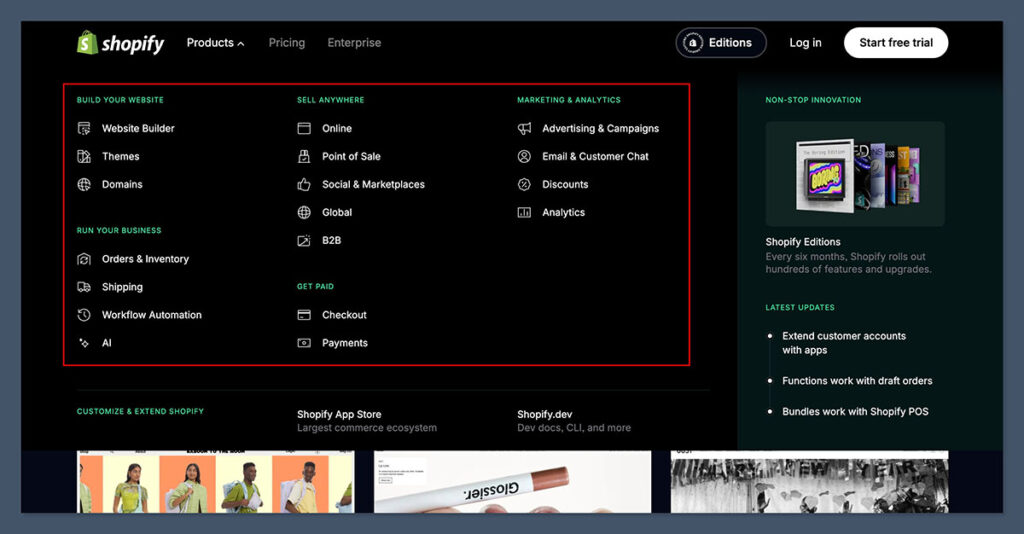
At its heart, Shopify is an all-in-one e-commerce solution, meticulously crafted to empower businesses to build, manage, and scale their online stores from the ground up. It encompasses everything from the visual appeal of a website and the organization of product listings to the intricate details of inventory tracking, shipping calculations, and secure payment processing. It is a digital retail ecosystem designed for comprehensiveness.
ThriveCart, on the other hand, is a specialist in conversion optimization, focusing intensely on the point of sale. It is engineered to maximize revenue through advanced checkout features, including order bumps, one-click upsells, and split testing, thereby enhancing the average order value for a given transaction. It is not designed to host an entire website or manage a large product catalog. Instead, it acts as a high-performance engine for closing sales, requiring an existing platform to direct traffic towards.
A Practical Synergy: Using Both Platforms
The reality for many online entrepreneurs is not an "either/or" decision, but rather a "both/and" strategy. A significant number of businesses leverage Shopify as their primary storefront and inventory management system, while simultaneously employing ThriveCart to manage specific high-converting sales funnels or to offer specialized digital products. In this integrated approach, ThriveCart often takes the lead in handling the checkout process and managing affiliate programs, while Shopify continues to be the bedrock for the broader e-commerce operations. This dual-platform strategy allows businesses to capitalize on the strengths of each tool, creating a more robust and efficient online sales infrastructure.
Quick Comparison: Shopify vs. ThriveCart at a Glance
To provide a clear overview, here’s a comparative table highlighting key features and pricing structures:
| Category | Shopify | ThriveCart |
|---|---|---|
| Core Functionality | Full hosted e-commerce platform | Checkout, cart, and funnel optimization tool |
| Entry Price | $39/month (or $29/month billed annually) | $495 one-time payment, no recurring fees |
| Higher Tiers | Grow ($105/month), Advanced ($399/month), Plus (from $2,300/month) | Pro+ ($295/year), Ultimate Bundle ($985 one-time) |
| Platform Transaction Fees | None with Shopify Payments; 0.6% to 2% with third-party gateways | None on any plan |
| Card Processing Fees | 2.9% + 30c (Basic) to 2.5% + 30c (Advanced) | Your processor’s rate (Stripe, PayPal, etc.) |
| Storefront & Themes | Yes, extensive free and paid themes, full site builder | No storefront; checkout pages only |
| Inventory Management | Yes, native, multi-location support | Minimal; not designed for complex inventory |
| Order Bumps & Upsells | Via third-party apps | Native, unlimited |
| Affiliate Program | Via third-party apps | Native affiliate center (Pro+) |
| Course Selling | Via third-party apps | Built-in (Learn / Learn+) |
| SEO & Blogging | Yes, native | No |
| Free Trial | Yes, plus $1/month promo for 3 months | No free trial; money-back guarantee only |
| Ideal For | Physical products, growing brands, multichannel sellers | Digital products, courses, coaching, single-offer funnels |
Key Takeaways for Decision Makers
- Core Purpose: Shopify is a complete e-commerce store builder; ThriveCart is a powerful sales conversion tool.
- Pricing Model: Shopify operates on a monthly subscription, while ThriveCart offers a significant one-time payment for its standard features.
- Feature Focus: Shopify excels in providing a full retail experience (storefront, inventory, shipping). ThriveCart shines in checkout optimization (bumps, upsells, affiliate management).
- Scalability: Shopify is built for scaling a broad e-commerce business. ThriveCart is optimized for scaling sales of specific offers.
1. The Pricing Landscape: ThriveCart’s Appeal and Caveats
ThriveCart’s marketing prominently features its one-time payment model as a major differentiator, contrasting it with Shopify’s recurring monthly fees. On the surface, this comparison suggests a clear financial advantage for ThriveCart, promising perpetual access for a single outlay. However, a deeper dive into the actual costs, especially when considering additional features, reveals a more nuanced picture.
Shopify’s Pricing Structure
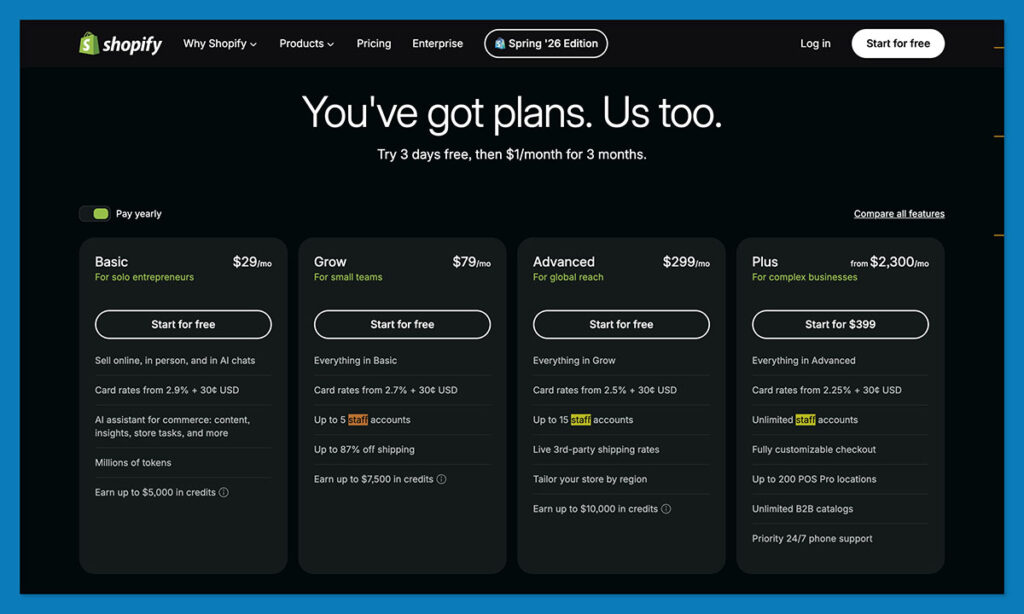
Shopify offers several tiered plans, each catering to different business needs and scales. For businesses prioritizing cost-efficiency, annual billing provides a significant discount.
- Basic Plan: Starts at $39 per month, or approximately $29 per month when billed annually. This plan is suitable for new businesses or those with lower sales volumes.
- Shopify Grow: Priced at $105 per month, offering enhanced reporting and more staff accounts.
- Shopify Advanced: At $399 per month, this tier provides more sophisticated reporting and lower transaction fees.
- Shopify Plus: For large enterprises, pricing begins at $2,300 per month, offering advanced customization and dedicated support.
A notable advantage for new users is Shopify’s introductory offer: a free trial followed by a promotional rate of $1 per month for the first three months. This significantly reduces the initial financial risk, a benefit that ThriveCart does not directly match.
A crucial point to understand with Shopify pricing is the platform transaction fee. While using Shopify Payments incurs no additional platform fee, opting for a third-party payment gateway introduces a surcharge ranging from 0.6% to 2%, depending on the Shopify plan. This highlights the incentive to utilize Shopify’s native payment solution.
ThriveCart’s Pricing Model
ThriveCart’s pricing is structured around a one-time payment for its core functionality, with optional annual subscriptions for advanced features.
- Standard Plan: A one-time payment of $495 provides access to core checkout and funnel-building features, including unlimited products, unlimited order bumps and upsells, and a 1-click upsell functionality. This plan does not include advanced features like affiliate management or course hosting.
- Pro+ Plan: This tier, which includes the affiliate center and course hosting capabilities, is now priced at $295 per year. This marks a significant shift from previous models where Pro features might have been a one-time upgrade.
- Ultimate Bundle: A one-time payment of $985 includes all current and future features, offering a comprehensive package for those seeking maximum value and future-proofing.
A key selling point for ThriveCart is its complete absence of platform transaction fees. Users are solely responsible for their payment processor’s standard rates (e.g., Stripe, PayPal). This direct relationship with payment processors ensures that businesses retain full control over their revenue streams, a significant benefit if platform migration becomes a consideration.
It is important to note that ThriveCart does not offer a free trial. Instead, it relies on a money-back guarantee. However, the precise duration and terms of this guarantee can be inconsistently reported across various sources, necessitating verification directly on ThriveCart’s checkout page before purchase.
The True Cost Calculation
When comparing long-term costs, the initial perception of ThriveCart’s affordability can shift. Shopify Basic, billed annually, amounts to approximately $348 per year. ThriveCart Standard, at $495, breaks even with Shopify Basic in roughly 17 months, after which it becomes pure profit.
However, the calculation changes when factoring in advanced features. If an affiliate program is essential, users must upgrade to ThriveCart’s Pro+ plan, which costs $295 per year. In this scenario, the upfront $495 payment, plus the annual $295 fee, results in a three-year cost of approximately $1,085. This figure closely approaches Shopify Basic’s estimated three-year cost of $1,044. The allure of a "pay once" model diminishes significantly when recurring annual fees for essential features are introduced.
The Verdict on Pricing: ThriveCart’s Standard plan at $495 offers exceptional value as a standalone checkout tool with no recurring fees and zero transaction charges. However, once the need for Pro+ features like the affiliate center arises, the long-term cost advantage of the one-time payment model is substantially eroded. Shopify’s free trial and $1 per month introductory offer also provide a more accessible entry point for evaluation.
2. The Core of E-commerce: Shopify’s Comprehensive Solution
The fundamental difference between Shopify and ThriveCart becomes most apparent when examining their capabilities for building and operating a full-fledged online store. This is where Shopify’s design as an integrated e-commerce platform truly distinguishes itself.
What Shopify Offers: The Complete E-commerce Ecosystem
Shopify is more than just a website builder; it is a robust commerce operating system. It provides:
- A Fully Realized Storefront: Users gain a browsable website complete with collections, product pages, and customizable themes.
- Native Inventory Management: Sophisticated tools for tracking inventory across multiple locations are built-in.
- Shipping and Logistics: Integrated shipping solutions, including carrier-calculated rates on higher plans, streamline fulfillment.
- Point-of-Sale (POS) System: For businesses with a physical retail presence, Shopify offers a POS system that syncs online and in-store sales.
- Multichannel Selling: Seamless integration with platforms like Amazon, Etsy, Instagram, TikTok, and Google allows businesses to expand their reach.
Every Shopify plan includes unlimited products, unlimited bandwidth, and built-in abandoned cart recovery. Advanced features like fraud analysis, tax calculation, gift card issuance, discount code management, and customer account creation are all handled natively. For businesses dealing with physical goods, these functionalities are not optional extras but essential components of an operational e-commerce business.
The Shopify App Store further extends the platform’s capabilities, offering thousands of applications for nearly any conceivable business need. However, this extensibility often comes at a cost, with many advanced features like specialized reviews, loyalty programs, or subscription management requiring additional monthly subscriptions, thereby increasing the overall operational expenditure.
What ThriveCart Offers: A Specialized Conversion Engine
ThriveCart’s design philosophy is distinctly different. It does not provide a product catalog, collections, or a general website builder. Instead, its focus is on the checkout experience itself. Users are directed to optimized checkout pages, which can be single-page, two-page, or embedded on an existing sales page, email, or advertisement.
Within its defined scope, ThriveCart is exceptionally powerful. It supports various pricing models, including one-time payments, subscriptions, split payments, and "pay-what-you-want" options. While it can handle physical products by allowing the input of shipping weights and dimensions and integrating with fulfillment providers, this is more of an add-on rather than a core fulfillment system. It is not suitable for managing a diverse inventory of hundreds of SKUs, such as in an apparel store.
ThriveCart’s strength lies in its extensive integration capabilities with popular marketing and educational platforms, including Kajabi, Teachable, Thinkific, MemberPress, ActiveCampaign, ConvertKit, Mailchimp, and Drip, with Zapier providing connectivity to a vast array of other services.
The Verdict on Selling Online: For any business that requires a comprehensive storefront, inventory management, and robust shipping solutions, Shopify is the undisputed leader. ThriveCart is not a competitor in this domain; it is a specialized tool that complements an existing online presence rather than replacing it.
3. Mastering the Checkout: ThriveCart’s Native Advantages
While Shopify offers a complete e-commerce solution, ThriveCart takes a commanding lead in optimizing the crucial checkout and sales funnel process. This is where its specialized design truly shines, offering features that often come at a premium or require additional app subscriptions on Shopify.
What ThriveCart Includes Natively
ThriveCart is engineered to maximize conversion rates and average order value directly at the point of sale. Key native features include:
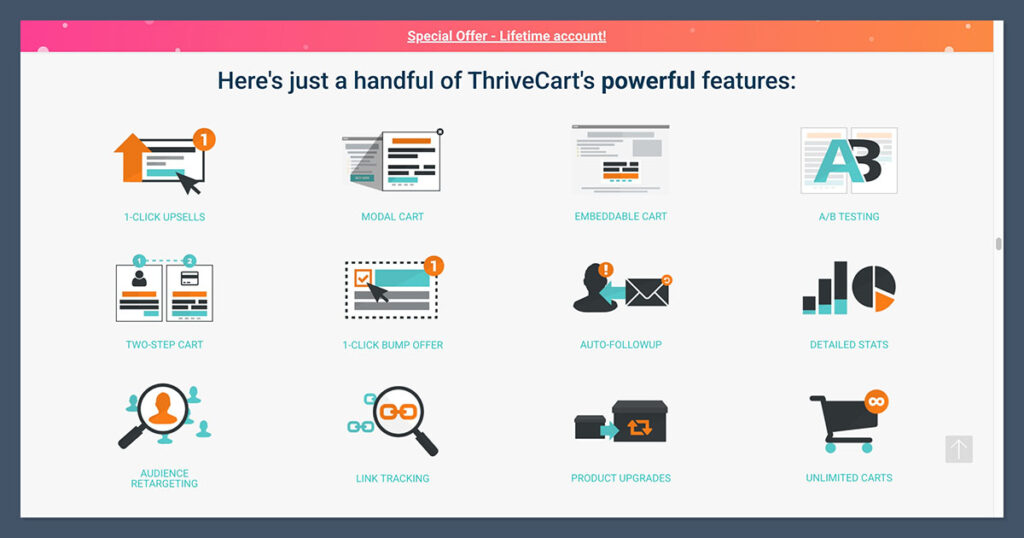
- Unlimited Order Bumps: Offer additional products or services directly on the checkout page.
- Unlimited One-Click Upsells: Present higher-value offers immediately after a purchase without requiring a second payment entry.
- Unlimited Downsells: Provide alternative, lower-priced offers if a customer declines an upsell.
- Split Testing: A/B test different checkout page elements to optimize conversion rates.
- Subscription and Payment Plan Management: Effortlessly configure recurring billing and payment installments.
- Affiliate Management (Pro+): A robust built-in system for managing affiliate partners.
- Course Hosting (Learn / Learn+): Integrated tools for delivering online courses.
- No Transaction Fees: A significant cost advantage for high-volume sellers.
How Shopify Compares
Shopify’s native checkout is known for its speed, reliability, and strong conversion rates, further enhanced by features like Shop Pay for expedited one-tap checkouts for returning customers. Shopify also claims higher average conversion rates compared to many competing platforms.
However, essential conversion-boosting tools like order bumps and one-click post-purchase upsells are not native to Shopify. They typically require integration with third-party apps, which can add $10 to $100 or more per month to the operational costs. Customization of the checkout page is also limited on standard plans, with advanced extensibility reserved for Shopify Plus merchants. For businesses focused on optimizing a single sales funnel, these app-driven costs and limitations can represent a significant friction point.
The Verdict on Checkout Optimization: ThriveCart unequivocally owns the checkout experience. Features like order bumps, one-click upsells, downsells, and split testing are integrated natively, whereas on Shopify, they often necessitate costly app subscriptions. For businesses whose model revolves around driving traffic to a single, high-margin offer and maximizing average order value, ThriveCart is purpose-built for this objective.
4. Driving Growth: Shopify’s Superior Marketing and Acquisition Engine
A critical aspect of any online business is its ability to attract and retain customers. This is where Shopify’s comprehensive approach to marketing and growth significantly outpaces ThriveCart’s specialized focus.
SEO and Content Creation
Shopify provides a solid foundation for organic search engine optimization (SEO). Its platform includes native blogging capabilities, editable meta titles and descriptions, image alt text optimization, automatic sitemap generation, and clean URL structures. This allows businesses to build organic traffic over time. Furthermore, Shopify’s product catalog can now syndicate into AI-driven shopping surfaces, emerging as a potent new acquisition channel.
In stark contrast, ThriveCart has no inherent SEO capabilities. Its checkout pages are transactional and not designed for organic search ranking. Consequently, if organic search is a key component of a business’s customer acquisition strategy, ThriveCart cannot serve as a standalone solution; it requires integration with a platform that can provide SEO-friendly content.
Expanded Sales Channels
Shopify’s strength lies in its ability to connect with a wide array of sales channels. Businesses can seamlessly integrate their stores with Instagram, TikTok, Facebook, Google Shopping, Amazon, Etsy, and eBay, synchronizing inventory and sales data across all platforms. This multichannel approach is essential for maximizing market penetration and reaching diverse customer segments.
ThriveCart, by its very nature, does not offer multichannel selling. It does not maintain a product catalog that can be synced across different marketplaces. Its function is to convert traffic directed to its checkout pages, not to distribute products across various online venues.
Email Marketing and Automation
While Shopify offers Shopify Email for basic campaign management and automation, its native capabilities are somewhat limited compared to dedicated email marketing platforms. However, the platform integrates with a vast ecosystem of email marketing services.
ThriveCart, while not an email marketing platform itself, offers powerful behavior-based rules. These rules allow businesses to tag customers and trigger automations in their connected email service provider based on specific actions, such as the payment option chosen, whether an order bump was accepted, or if a subscription payment failed. This granular control over customer segmentation can be highly effective for targeted marketing efforts.
The Verdict on Marketing and Growth: Shopify possesses a superior acquisition engine. It facilitates customer acquisition through SEO, social commerce integrations, and marketplace listings. ThriveCart, conversely, is designed to convert traffic that has already been generated by other means. This fundamental difference underscores their distinct roles in the online business landscape.
5. User Experience: It Depends on the Task
The ease of use for both Shopify and ThriveCart is subjective and heavily dependent on the user’s specific objectives. Neither platform is inherently difficult to navigate, but they demand different skill sets and focus from the user.
Shopify’s Learning Curve
Shopify’s onboarding process is designed to be intuitive. New users are guided through a setup checklist that covers essential steps like adding products, selecting a theme, and configuring payment settings. The platform utilizes a section-based site editor, which ensures design consistency and prevents layout breakages but offers less freedom for highly custom designs without direct code manipulation. The complexity in Shopify often arises not from its interface but from the sheer breadth of its features and the potential proliferation of apps, each with its own settings and billing. Managing a large number of installed apps can quickly lead to a cluttered administrative dashboard.

ThriveCart’s Focused Simplicity
ThriveCart’s interface is intentionally narrower, leading to a faster learning curve for its core functions. Building a checkout page—selecting a template, customizing elements, adding upsells and bumps, and connecting a payment processor—can often be accomplished in under an hour. The platform’s strength lies in its streamlined process for creating high-converting sales pages.
However, the "ease" of ThriveCart’s checkout setup is counterbalanced by the complexity of assembling the surrounding ecosystem. ThriveCart assumes the user already has a sales page, a website, an email marketing platform, and a method for delivering products or services. Integrating these disparate tools, and troubleshooting potential issues like broken Zapier connections, falls on the user, introducing a different kind of complexity.
The Verdict on Ease of Use: ThriveCart offers a faster path to a live, functional checkout because it performs fewer tasks. Shopify requires a more involved initial setup but consolidates multiple functionalities into a single platform. The choice hinges on whether a user prefers a streamlined tool for a specific function or a comprehensive platform that replaces several individual services.
6. Aesthetic Appeal: Shopify’s Design Advantage
When it comes to the visual presentation of an online business, Shopify offers a more robust and comprehensive solution.
Shopify’s Design and Template Ecosystem
Shopify boasts an extensive library of themes, catering to a wide array of retail categories. Many of these themes, including free options, are highly professional and sufficient for launching a business. Premium themes are typically a one-time purchase, ranging from $100 to $400, and are designed to be fully responsive and customizable through the intuitive section editor. This ensures that businesses can establish a strong and visually appealing brand identity.
ThriveCart’s Functional Templates
ThriveCart’s templates are specifically designed for conversion-optimized checkout pages, not for overall website aesthetics. While these templates are clean, professional, and mobile-friendly, they serve a singular purpose: to facilitate transactions. The actual brand identity and visual design of a business using ThriveCart reside on the external sales page or website that directs traffic to the checkout.
The Verdict on Design: Shopify is the clear winner in terms of design and template offerings because it provides a complete storefront design system. ThriveCart offers well-designed checkout pages, but it is not in the business of designing entire brand experiences.
7. Affiliate Programs: ThriveCart’s Native Strength
ThriveCart offers a distinct advantage for businesses that rely on affiliate marketing to drive sales. Its Pro+ tier includes a native affiliate center, a feature that is often a costly add-on for Shopify users.
ThriveCart’s Integrated Affiliate Solution
The Pro+ plan provides affiliates with their own dedicated portal, automatic link tracking, and commission calculations that encompass upsells and bumps. Payouts can be automated through PayPal. Furthermore, ThriveCart includes a joint-venture platform for revenue sharing with partners. This integrated approach is invaluable for creators launching products and seeking to leverage an affiliate network.
Shopify’s App-Dependent Approach
On Shopify, affiliate management is typically handled through third-party applications. While these apps can be effective, they represent an additional monthly expense, often ranging from $50 to $200, and operate as separate entities from the core checkout process.
It is important to note that ThriveCart’s affiliate center is part of the Pro+ tier, which has an annual fee of $295. While this is generally more cost-effective than comparable Shopify apps, it deviates from the pure "one-time payment" narrative associated with the Standard plan.
The Verdict on Affiliate Programs: ThriveCart is the superior choice for businesses prioritizing an integrated affiliate program. Its native affiliate center, with automated payouts and built-in revenue sharing tools, offers significant value at $295 per year, outperforming most Shopify app equivalents.
8. Support and Stability: Shopify’s Established Infrastructure
When it comes to ongoing support and platform reliability, Shopify’s mature infrastructure and extensive resources provide a significant advantage.
Shopify’s Robust Support Network
Shopify offers 24/7 customer support via live chat, with options for escalation to human advisors. Its comprehensive Help Center, active community forums, and a vast network of agencies and freelancers specializing in the platform ensure that users can find assistance readily. While Shopify has discontinued email support, its other channels are generally highly regarded. Priority support is reserved for Shopify Plus merchants.
ThriveCart’s Support Evolution
ThriveCart’s support is primarily handled through a helpdesk ticketing system, complemented by documentation and a user community. While adequate, it does not operate at the same 24/7 scale as Shopify’s support.
A more significant consideration for ThriveCart is its platform stability and ownership history. The platform has undergone ownership changes, and some long-term users have reported periods of downtime and connectivity issues. While ThriveCart has reportedly stabilized and is under active development, the history of a one-time payment model is inherently tied to the longevity and stability of the company behind it. This structural risk is a crucial factor for any business making a long-term commitment to a lifetime license.
The Verdict on Support and Stability: Shopify holds the edge in both support and platform risk mitigation. Its round-the-clock support, extensive partner ecosystem, and established track record offer greater peace of mind. While ThriveCart’s support is reasonable, its ownership history warrants caution for those considering a substantial upfront investment for lifetime access.
How the Comparison Was Conducted
This analysis was performed by evaluating both Shopify and ThriveCart across eight weighted categories. Feature and pricing data were meticulously gathered from each vendor’s current public documentation and cross-referenced with multiple independent sources. All pricing figures were verified against live pricing pages, ensuring that the data reflects current offerings rather than outdated information. This rigorous verification process is particularly important given that ThriveCart has updated its Pro tier pricing and features, a change that may not be reflected in older reviews.
| Criterion | Weighting | Assessment Focus |
|---|---|---|
| Sales & Checkout Features | 30% | Checkout capabilities, upsells, bumps, subscriptions, split testing, cart recovery |
| Store & Catalog Features | 20% | Storefront, product catalog, inventory, shipping, multichannel selling |
| Value for Money | 15% | Total cost of ownership over 1, 3, and 5 years, including add-ons and fees |
| Marketing & SEO | 12% | Organic search capability, email tools, sales channels, affiliate management |
| Ease of Use | 10% | Onboarding, editor usability, time to a live, sellable page |
| Design & Templates | 5% | Template quality, customization depth, mobile responsiveness |
| Support | 5% | Channels, availability, documentation, partner ecosystem |
| Platform Stability | 3% | Ownership history, uptime record, development activity |
Shopify vs. ThriveCart: The Definitive Verdict
For any business aiming to establish a comprehensive e-commerce operation, Shopify stands out as the superior choice. It provides an integrated solution encompassing storefronts, product catalogs, inventory management, shipping logistics, SEO capabilities, and multichannel selling, all backed by industry-leading 24/7 support and the largest partner ecosystem. ThriveCart, while powerful in its niche, does not attempt to replicate these core e-commerce functionalities.
However, for a specific segment of online entrepreneurs—particularly those focused on digital products, online courses, or coaching services—ThriveCart warrants serious consideration. Its out-of-the-box checkout experience surpasses Shopify’s in terms of conversion optimization features, and its native affiliate center is a significant asset. For businesses that do not require a traditional storefront and can operate effectively with a single offer or a streamlined funnel, ThriveCart’s $495 Standard license, with its one-time payment and absence of recurring fees, presents a compelling cost advantage.
Two critical caveats temper ThriveCart’s attractive pricing model. Firstly, the "lifetime" promise is most accurately applied to the Standard plan. The Pro+ tier, essential for advanced features like the affiliate center, renews annually at $295. Secondly, the absence of a free trial means that potential users must commit financially upfront, relying on the money-back guarantee for evaluation.
Given these considerations, the most practical recommendation for those uncertain about their needs is to begin with Shopify’s free trial and its introductory $1 per month promotional period. This allows for the validation of whether a full storefront is indeed necessary for the business model, with minimal initial financial outlay. If, after building out a Shopify presence, it becomes clear that the business model is centered on a singular offer, a dedicated funnel, and a robust affiliate program, ThriveCart remains a viable and powerful option, and the user will have a clear understanding of why it is the right choice.
Frequently Asked Questions
Can ThriveCart replace Shopify entirely?
ThriveCart can only replace Shopify entirely for businesses selling a very limited number of digital products who do not require a browsable storefront, extensive inventory management, or SEO capabilities. ThriveCart is a checkout and funnel tool, not a full e-commerce platform. If customers need to browse multiple products, add them to a cart, and manage inventory, Shopify is necessary.
Can I use Shopify and ThriveCart together?
Yes, many sellers successfully integrate both platforms. A common strategy involves using Shopify for the primary online store and inventory management while employing ThriveCart for high-margin digital product sales, courses, or affiliate-driven funnels. While deep integration is limited, leading to manual data reconciliation, running them in parallel is entirely feasible.
Is ThriveCart’s lifetime deal actually lifetime?
The $495 Standard plan is a genuine one-time payment with no recurring fees. However, the Pro+ tier, which includes features like the affiliate center, renews annually at $295. ThriveCart previously offered a one-time upgrade for Pro features, but this has been replaced by the annual subscription model, making older reviews quoting a one-time Pro price outdated.
Does ThriveCart charge transaction fees?
No, ThriveCart does not charge any transaction fees on any of its plans. Users are only responsible for the standard rates of their chosen payment processor (Stripe, PayPal, Authorize.net). Shopify also avoids platform transaction fees when using Shopify Payments but imposes a surcharge of 0.6% to 2% on transactions processed through third-party gateways.
Which is cheaper over three years?
Shopify Basic, billed annually, costs approximately $1,044 over three years. ThriveCart Standard alone costs $495, making it significantly cheaper. However, if the Pro+ tier is required for affiliate management, the three-year cost rises to around $1,085, slightly exceeding Shopify Basic. The cost comparison is highly dependent on whether a business can operate solely on ThriveCart’s Standard plan.
Does ThriveCart have a free trial?
No, ThriveCart does not offer a free trial or a free tier. Evaluation requires an initial purchase, with reliance on the money-back guarantee period. It is crucial to verify the specific terms of the refund policy on ThriveCart’s checkout page before purchasing, as third-party sites may provide inconsistent information. Shopify, in contrast, provides a no-credit-card-required free trial and a $1 per month promotional rate for the initial three months.
Can I sell physical products with ThriveCart?
Technically, yes, ThriveCart allows for the addition of shipping weights, prices, and dimensions for physical products and integrates with some fulfillment providers. However, it lacks robust inventory management, a product catalog, and advanced shipping rate calculations. It is suitable for selling a single physical product through a funnel but not for managing a diverse range of physical products in a traditional store setting.
Which one is better for selling online courses?
In most scenarios, ThriveCart is the preferred option for selling online courses. It includes a built-in course builder and consolidates checkout, upsell, and affiliate management within a single tool. While Shopify can facilitate course sales via third-party apps, this often involves stacking multiple subscription services. For businesses whose primary focus is course hosting, a dedicated course platform might offer a superior user experience.








