SearchEngineWatch, a venerable institution in the SEO landscape, has commenced a renewed commitment to in-depth SEO tool evaluations, with a comprehensive review of Serpstat marking the inaugural analysis. Drawing on over two decades of experience in SEO, publishing, and content strategy, the platform’s editor undertook this extensive assessment, providing a nuanced perspective for both seasoned professionals and average users. This initiative, launching in 2026, aims to solidify SearchEngineWatch’s role as a trusted arbiter in the evolving world of search engine optimization software.
The decision to spotlight Serpstat first was rooted in its frequent use by the reviewer, allowing for an informed and practical examination of its capabilities. The review approaches Serpstat as a "multi-product" platform, dissecting each standalone feature based on internal tests and comparing its performance against industry benchmarks, particularly in the context of its pricing structure. The methodology deliberately targets an "average user" understanding, acknowledging that advanced SEO skills are not universally present among its readership. The analysis, conducted on Serpstat.com to avoid exposing proprietary data, relied exclusively on publicly available information and the platform’s outputs, with traffic figures noted as third-party estimates.

Serpstat’s Evolution and Interface in 2026
Serpstat has undergone significant evolution, transitioning from a more specialized tool to a robust, multi-faceted SEO suite, aligning with the industry trend towards all-in-one solutions. The platform offers a 7-day trial, providing full access to core features such as rank tracking, site auditing, and keyword research, albeit with daily search and project limits that vary by assigned trial tier. This accessibility stands out in a market where many tools offer limited or no free trials of their full functionality.
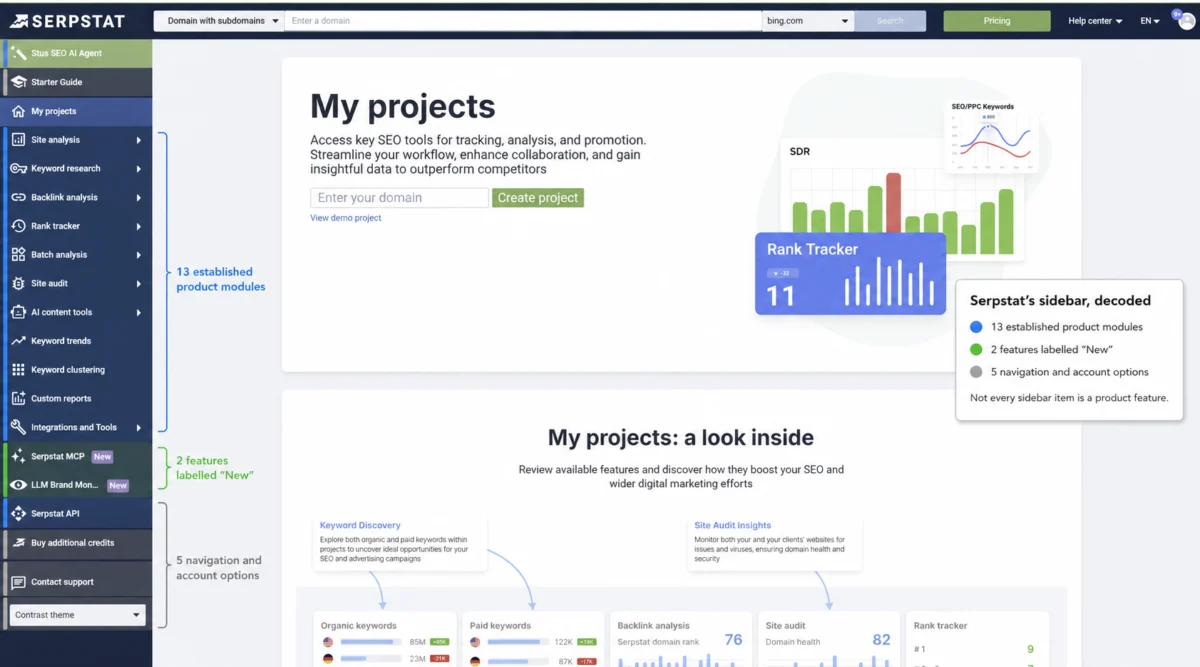
Upon entry, users are greeted by a distinctive dashboard. While functional, the user interface (UI) has been described as "unique" and somewhat "stuck in time," suggesting a design that prioritizes utility over modern aesthetics. The left-sidebar acts as the primary navigation hub, categorizing features into "Newest features" and "Legacy features." The explicit labeling of "New" entries signifies Serpstat’s ongoing efforts to integrate contemporary SEO functionalities, ensuring its relevance in a rapidly changing digital environment. Navigation also includes a Starter Guide for onboarding and "My projects" for streamlined workflow management, alongside options for theme customization.

Comprehensive Site and Backlink Analysis
The foundational entry point for Serpstat remains its direct domain search box, enabling users to initiate both Domain Analysis and Backlink Analysis. A notable differentiator is the ability to select the target search engine – Google or Bing – a feature particularly valued by those managing properties with significant Bing traffic. For this review, the focus was primarily on Google US traffic.
The initial public-data snapshot provides a quick overview of any domain, serving as a research and comparison page rather than a technical audit. Key metrics presented include:

- Search Scope: The flexibility to analyze an entire domain with subdomains, or narrow the research to a specific domain, folder, or individual URL.
- Search Market: Selection of the Google database and country for localized analysis.
- Market Position: An overall country rank and Serpstat’s assigned industry category rank.
- Visibility: An estimated 0-100 score reflecting the domain’s prominence within Serpstat’s tracked top-20 results, factoring in rankings and keyword popularity.
- AI Overview Visibility: A newer metric indicating the domain’s appearance frequency within Google AI Overviews, including triggering keywords and mentions.
- Authority: Serpstat Domain Rank, alongside total backlinks and referring domains.
- Traffic Estimates: Comparison between Serpstat’s conventional search-traffic estimate and its machine-learning-driven estimate.
- Search Footprint: Quantification of organic, paid, and AI Overview-related keywords associated with the domain.
- Insights: Highlighting notable changes in traffic, visibility, and rankings, categorized by priority (critical, medium, opportunity).
- Export/API: Options to export summaries or retrieve underlying data via Serpstat’s API and AI/MCP workflows.
These insights provide a robust starting point for competitive analysis and strategic planning, though the emphasis on third-party estimates necessitates cross-referencing with proprietary analytics data for definitive conclusions.
In-Depth Keyword Analysis: A Core Strength
Serpstat’s keyword analysis capabilities are extensive and represent a central pillar of its multi-product approach. The current layout is praised for its density and versatility, offering significant improvements over previous iterations while retaining an option for the legacy view. This feature effectively functions as a standalone keyword analysis product, encompassing a wide array of functionalities for any domain, subdomain, folder, or URL.

The keyword report details:
- Keyword List: A comprehensive list of keywords a site ranks for.
- Position: The current ranking position for each keyword.
- Search Volume: Estimated monthly search queries.
- Keyword Difficulty (KD): A proprietary metric indicating the challenge of ranking.
- Cost Per Click (CPC): Average cost for paid advertising on the keyword.
- Traffic Estimate: Estimated traffic driven by the keyword to the analyzed entity.
- SERP Features: Identification of special Google search results (e.g., featured snippets, local packs).
Users can filter results by organic or paid keywords and access AI Overview data. The platform offers readily available filters like "low-hanging fruits" (keywords with high potential and relatively low difficulty), "Low KD keywords," "Increased positions," and "Decreased positions." The reviewer notes that Serpstat’s origins as a keyword research tool are evident in the robustness and centrality of this feature.
Delving deeper, selecting a specific keyword transitions the user to a dedicated "Keyword research" section. This page transforms the chosen keyword into a starting point for expanded research, offering related searches, search volume, keyword difficulty, intent classification, language, and detected SERP features. From here, users can:

- Analyze SERP: View the actual search engine results page.
- Discover Related Keywords: Explore semantic variations and long-tail opportunities.
- Investigate Competitors: Identify who else ranks for the keyword.
- Find Content Ideas: Brainstorm new topics based on related searches.
- Add to Rank Tracker: Monitor the keyword’s performance over time.
A notable practical drawback identified is the tool’s occasional inability to detect semantically duplicate phrases, leading to redundant research efforts – a common frustration across many SEO platforms. However, the "Top Pages" feature, which mirrors SERP results to reveal organic keywords and estimated traffic for ranking pages, is highlighted as particularly useful. Clicking on a top-ranking page leads to an "exact URL analysis," which provides a granular view of keywords a specific URL ranks for, along with traffic estimates, backlinks, and social shares. This is invaluable for reverse-engineering successful competitor content strategies, identifying keyword clusters Google associates with a single page, and preventing the creation of redundant content.
Competitive Intelligence and Content Gap Analysis
Serpstat offers distinct competitive analysis features. Within keyword research, a "Competitors tab" identifies websites competing for specific queries, comparing them by common keywords, relevance, traffic, and visibility. It’s crucial to distinguish these "search competitors" (which might include forums like Reddit) from direct commercial rivals.

The "Site Analysis" section features a dedicated "Competitors" report, identifying domains that overlap in organic results with the analyzed site. This report leverages metrics like Common and missing keywords, Relevance, Traffic, and Visibility, allowing users to uncover content gaps and switch between SEO and PPC competitors. This helps pinpoint actual search adversaries and their successful content strategies.
Further enhancing competitive analysis is the "Keyword Gap" tool. This feature allows comparison of up to three domains or URLs, illustrating overlapping and unique Google rankings via a Venn diagram. It categorizes keywords into those common to all, unique to each, or shared between two. The accompanying table provides position data, search volume, difficulty, CPC, and paid competition. While highly effective for identifying opportunities, the review strongly cautions against blindly replicating competitor strategies, emphasizing the need for critical analysis of relevance. The comparison can also be toggled between SEO and PPC data.
Robust Backlink Analysis and Monitoring

The Backlink Analysis dashboard provides a holistic view of a website’s link profile. Key data points include Serpstat Domain Rank, total backlinks, referring domains, follow-versus-nofollow ratios, and identification of potentially malicious linking sites. Visual charts simplify the process of tracking link acquisition trends, identifying sudden shifts, and assessing the authority of linking domains. For Serpstat.com itself, the analysis revealed approximately 239,600 backlinks from 5,300 referring domains, with an even split between follow and nofollow links.
Within this section, users can investigate:
- Referring Domains: A list of unique domains linking to the site.
- New/Lost Backlinks: Tracking changes in the backlink profile over time.
- Anchor Text: Analysis of the text used in backlinks.
- Most Linked Pages: Identification of top-performing content in terms of link acquisition.
- Competitor Backlinks: Comparison of backlink profiles with rivals.
It is reiterated that these figures originate from Serpstat’s proprietary database and should be used for research and comparison, rather than as an exhaustive count of all links on the web.

For ongoing performance tracking, the "Rank Tracker" module allows users to create projects for monitoring specific keywords across chosen locations and devices. Unlike the broader "Organic Keywords" report, Rank Tracker offers frequent updates (e.g., daily or weekly) and is ideal for measuring the impact of SEO campaigns or content updates. Additionally, "Batch Analysis" streamlines the process of analyzing large lists of websites or keywords, converting repetitive research into comparative tables, although it consumes credits.
Site Audit: Uncovering Technical Imperfections
Serpstat’s Site Audit tool performs a comprehensive crawl of a website, flagging a range of technical SEO issues. These include broken links, missing or duplicate meta tags, indexing errors, incorrect canonicals, page-speed problems, and faulty schema markup. Users define the domain, project name, and can schedule weekly audits, optionally enabling rank tracking concurrently.

Post-crawl, the audit provides:
- A prioritised list of issues: Categorized by severity (critical, warning, notice).
- Detailed explanations and recommendations: For each identified problem.
- SDO health score: Serpstat’s proprietary technical SEO benchmark.
- Page-level analysis: To drill down into specific URL issues.
This feature transforms complex technical problems into actionable to-do lists, crucial for maintaining website health and search performance.
Emerging AI Capabilities and Their Current State

Serpstat has ventured into AI-powered tools, though the review indicates these features are still in nascent stages. The "AI Content Tools" suite, encompassing a Text Editor for article generation, rewriting, plagiarism checking, and AI-content detection, is described as less convincing. The editor is basic, lacking visible search-results analysis, competitor research, content scoring, keyword recommendations, or factual citations, suggesting it functions more as a generic AI writer rather than a deeply integrated SEO content tool. The "beta" and "alpha" labels for these features, particularly for AI content detection (which is inherently unreliable in definitively identifying AI-generated text), underscore their developmental status.
"Keyword Trends" identifies searches gaining attention in selected markets, offering a discovery feed for timely content ideas for publishers and content teams. However, it lacks crucial data points like search volume, growth rate, or trend duration, requiring further investigation through other tools. The cost in credits for running these reports also necessitates careful consideration.
"Keyword Clustering" addresses a common content strategy challenge by grouping large keyword lists into themes that can realistically be targeted on a single page. By analyzing which URLs appear for various queries, Serpstat helps prevent keyword cannibalization and supports efficient content planning. While valuable for creating cohesive content clusters, it comes at a significant credit cost (five credits per keyword).

Integrations, API, and Specialized AI Products
Serpstat’s commitment to integration is evident in its API and various tools designed to extend its data beyond the platform. Users can integrate Serpstat metrics into popular reporting tools like Google Data Studio, Power BI, Google Sheets, Looker Studio, and Microsoft Excel. Additional utilities include an HTTP status checker, robots.txt generator, and a SERP analysis tool. These features are particularly beneficial for agencies and technical teams requiring robust reporting and automation capabilities.
The newly introduced "Serpstat MCP" (Machine-Assisted Content Platform) connects the platform’s data with leading AI assistants such as ChatGPT, Claude, and Gemini. This allows users to query Serpstat data using natural language (e.g., "Find the keywords my competitor ranks for but I don’t"), with the AI interpreting the request and returning results. While powerful, each request consumes Serpstat API credits.

"LLM Brand Monitor," presented as a separate Serpstat-built product, assesses brand visibility within large language models (LLMs). Users configure prompts and run them across various AI models. However, the definition of "Brand Visibility" is narrow, representing only the percentage of successful prompt-and-model checks where the brand was detected. This score is heavily dependent on the chosen prompts and does not reflect universal brand visibility across the entire AI ecosystem. The pricing structure, with limited free checks and a restrictive Pro plan, further limits its utility for comprehensive, real-time insights.
Pricing Structure and Comparative Market Value
Serpstat’s API is positioned competitively against Ahrefs and Semrush, though not necessarily the cheapest API-only option, with DataForSEO and SE Ranking offering more flexible alternatives for certain workloads. API access is exclusive to the Team plan and above.

| Plan | Advertised price* | API credits | Speed | Effective cost per 1,000 rows |
|---|---|---|---|---|
| Team | $100/month | 200,000/month | 1 request/sec | $0.50 |
| Team x2 | $169/month | 400,000/month | 1 request/sec | $0.42 |
| Agency | $410/month | 2,000,000/month | 10 requests/sec | $0.21 |
*Annual billing rates.
The credit model is straightforward: one credit typically equates to one row of data, one site audit page, or one position check. Keyword Clustering and Keyword Trends, however, consume credits at higher rates.
Serpstat is frequently marketed as a more affordable alternative to industry leaders like Ahrefs and Semrush. While generally true, the review highlights a crucial distinction: Serpstat doesn’t necessarily outperform market leaders in their core strengths (e.g., Ahrefs for backlinks, Semrush for a broader marketing ecosystem). Instead, its value lies in making a remarkably wide array of SEO, PPC, tracking, auditing, and automation tools accessible to smaller teams at a comparatively lower price point.

Serpstat’s advertised annual-billing prices are:
| Plan | Price | Best suited to | Important limits |
|---|---|---|---|
| Individual | $50/month | Freelancers and individual site owners | Five projects, 100 searches per day, 10,000 monthly position checks, 30,000 audit pages |
| Team | $100/month | Small agencies and in-house teams | Three users, unlimited projects, 50,000 position checks, 150,000 audit pages and 200,000 API credits |
| Team x2 | $169/month | Busier agencies | Six users, 100,000 position checks, 300,000 audit pages and 400,000 API credits |
| Agency | $410/month | Large agencies and data-heavy operations | 30 users, 500,000 position checks, 1.5 million audit pages and two million API credits |
Month-to-month pricing is higher, starting at $69 for Individual and $129 for Team. The $50 Individual plan, while seemingly a bargain, excludes key differentiating features such as Batch Analysis, Keyword Clustering, Keyword Trends, LLM Brand Monitor, MCP, and API access. The Team plan ($100/month annually or $129 month-to-month) is identified as the honest basis for comparing Serpstat with other complete SEO platforms, offering nearly the full product with three user accounts and unlimited projects.
Comparing similar monthly budgets across competitors reveals Serpstat’s competitive edge in feature breadth for the price:

| Tool and plan | Month-to-month price | What the plan primarily buys |
|---|---|---|
| Serpstat Team | $129 | Three users, unlimited projects, daily rank tracking, audit, PPC research, batch tools, MCP and API |
| Ahrefs Lite | $129 | One user, five unverified projects, 750 weekly tracked keywords and 100,000 monthly crawl credits |
| Semrush Starter | $199 | Five monitored websites, 500 daily tracked keywords, fuller SEO research, MCP and 50 daily AI prompts |
| SE Ranking Core | $129 | One manager seat, ten projects, 2,000 daily tracked keywords, 100 daily AI prompts and 250,000 audit pages |
Strengths, Weaknesses, and Overall Assessment
Serpstat consistently delivered useful starting points for investigation during testing, uncovering rankings, content gaps, competing pages, backlinks, and keyword opportunities. However, the review noted several instances where results required verification, including unusual traffic estimates, discrepancies in keyword volume data, and questionable language classifications. These observations underscore that Serpstat, like any competitor research platform, relies on models and should be treated as an intelligence source rather than an unquestionable measurement. Site analysis databases update every one to two weeks in major markets, necessitating Rank Tracker for current position monitoring.
Our Comparative Ratings

| Platform | Overall rating | Best reason to choose it |
|---|---|---|
| Semrush | 8.8/10 | The broadest SEO, PPC, content and AI-search ecosystem |
| Ahrefs | 8.7/10 | The strongest choice for organic and backlink research |
| SE Ranking | 8.5/10 | Excellent tracking, auditing and AI-search value |
| Serpstat | 8.0/10 | Affordable team access, PPC intelligence, API and MCP automation |
Serpstat Score Breakdown
| Category | Rating |
|---|---|
| Keyword and competitor research | 7.8/10 |
| Backlink analysis | 7.0/10 |
| Rank tracking | 8.5/10 |
| Site auditing | 7.8/10 |
| PPC research | 8.3/10 |
| API, MCP and integrations | 9.0/10 |
| AI and content tools | 6.0/10 |
| Usability and data confidence | 7.0/10 |
| Pricing and overall value | 9.2/10 |
Final Verdict
Serpstat earns a commendable 8.0 out of 10, or 4.0 out of 5. It is not positioned as a direct, low-cost replacement for Ahrefs in backlink-centric workflows, nor is it a complete alternative to Semrush’s expansive marketing ecosystem, particularly in its current AI content capabilities.

Serpstat’s most compelling proposition is its ability to equip a small team with a comprehensive suite of SEO, PPC, rank-tracking, audit, and automation tools at a significantly lower cost than comparable offerings from market leaders. The $50 Individual plan serves solo users needing foundational tools, but the $100-per-month Team plan stands out as the true value proposition, unlocking Serpstat’s most distinctive features and providing multi-user access without project limits.
Ultimately, Serpstat is recommended for teams where breadth of tools, collaborative access, and automation capabilities are prioritized over having the most polished dataset or cutting-edge AI content generation. For unparalleled link and organic research, Ahrefs remains the top choice. For the widest marketing platform integration, Semrush is dominant. And for daily monitoring, auditing, and integrated AI visibility, SE Ranking presents a strong alternative. Serpstat shines for its rational pricing and extensive feature set, provided users understand the need to verify data and manage expectations around its less mature AI offerings.
Insights from Extensive Use

The most accurate characterization of Serpstat is not as a budget Ahrefs or a scaled-down Semrush. Its strength lies in providing a broad, functional SEO and PPC operating environment for small teams, circumventing the often-prohibitive pricing structures of larger platforms. While not the primary choice for AI writing or best-in-class backlink research, its combination of competitor research, valuable Bing data, robust rank tracking, team accessibility, API economics, and MCP integration offers a distinct advantage. Crucially, Serpstat proves highly effective in guiding users on where to focus their efforts next, rather than offering unquestionable definitive data. This distinction is pivotal to its 8.0/10 rating, making it a highly valuable, rationally priced SEO platform for teams capable of validating and strategically applying the data it generates.