


The practice of forecasting how specific digital experiments will influence future revenue remains one of the most debated topics within the Conversion Rate Optimization (CRO) and growth engineering sectors. While data-driven decision-making is the cornerstone of modern e-commerce and SaaS management, a persistent friction point exists between the statistical "lift" reported in a testing tool and the actual realized gains in a company’s profit and loss statement. The core of this controversy lies in the inherent uncertainty of whether a 10% conversion lift observed during a two-week experiment will consistently translate into a 10% increase in monthly recurring revenue once the change is permanently deployed.

The complexity of the modern digital ecosystem means that even a perfectly executed experiment is subject to a multitude of external variables. From shifting macroeconomic conditions and seasonal consumer behavior to aggressive competitor pricing and fluctuations in advertising spend, the environment in which an experiment is conducted is never static. Consequently, the transition from experimental results to financial forecasting requires a sophisticated blend of statistical rigor, conservative modeling, and strategic communication.
The Foundation of Causality in Digital Experimentation
In the realm of business analytics, the ability to prove causality is the "holy grail." Without a clear causal link, stakeholders are left with correlation, which is often misleading. This is why the industry has largely moved away from "pre/post" comparisons—where performance is measured before a change and then again after—in favor of controlled, randomized A/B testing.

A/B testing remains the gold standard for proving causality because it isolates the variable being tested. In a pre/post scenario, if a website’s performance drops by 10% due to an external factor, such as a new competitor entering the market, a change that actually improved performance by 10% would appear to have a net-neutral result. By running a simultaneous control and variant, practitioners can account for these external "noise" factors. If both the control and the variant are subjected to the same market downturn, the delta between them remains a valid indicator of the change’s impact.
However, for these statistics to be robust enough for executive-level revenue forecasting, they must meet specific criteria. This includes ensuring the experiment is adequately powered to detect the expected effect and that the sample size is large enough to reach statistical significance. Without these foundations, any revenue forecast built upon the data is essentially speculative.
The Reality Gap: Why Test Results Often Overstate Impact
One of the primary pitfalls in CRO reporting is the "naive multiplication" error. This occurs when a practitioner takes a percentage uplift from a localized test and applies it to the organization’s total annual revenue. For example, if an e-commerce store generating $50 million annually sees a 10% lift in a checkout page test, a naive forecast would suggest a $5 million increase in yearly revenue.
In practice, this rarely happens for three distinct reasons. First, the "novelty effect" often causes an initial spike in engagement that tapers off as returning users become accustomed to the new layout. Second, the experiment may only have been exposed to a specific segment of traffic, meaning the global impact is diluted. Third, technical implementation delays can mean that the "winning" version isn’t live for the entire fiscal period being forecasted.
Beyond technicalities, there are significant political and professional risks associated with aggressive forecasting. If a CRO team promises a multi-million dollar return based on a single test and the company’s bank account does not reflect that growth at the end of the quarter, the credibility of the entire experimentation program is called into question. This leads to a breakdown in trust between the data science team and the C-suite, often resulting in reduced budgets for testing tools and personnel.
Implementing a Conservative Forecasting Model
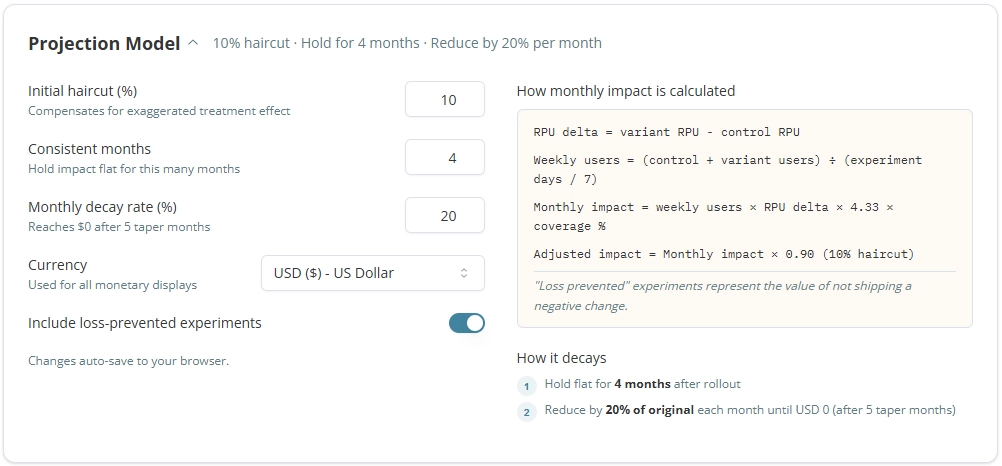
To combat over-projection, seasoned growth analysts employ "haircuts" and "decay rates" in their models. A conservative approach is not a sign of lack of confidence; rather, it is a sign of statistical maturity. By building a model that assumes a certain level of regression to the mean, practitioners can provide "safe" numbers that are more likely to be met or exceeded.
A standard conservative model typically involves three key adjustments:
- The Initial Haircut: Reducing the observed lift by a set percentage (e.g., 10%) to account for the difference between the testing environment and the live production environment.
- Exposure Correction: Calculating the exact percentage of total site traffic that will actually interact with the modified element. If a test was run on a sub-category page that only receives 15% of total traffic, the revenue impact must be scaled accordingly.
- The Decay Factor: Recognizing that the impact of a design or functional change often diminishes over time. A robust model might hold the full impact steady for three to four months and then apply a monthly reduction (e.g., 20%) to account for market saturation or changing user preferences.
For instance, if a test shows a $1,000 monthly lift, a conservative forecast would apply a 10% haircut, bringing the projected gain to $900. If the change is only implemented on a section of the site reaching 50% of the audience, the monthly gain becomes $450. Over a year, this number would be further adjusted downward in the later months to account for the decay of the effect.

The Role of Cumulative Impact and Stacking
Revenue forecasting becomes even more complex when multiple experiments are running throughout the year. The impact of these tests is not merely additive; it is cumulative. A winning test in January changes the baseline for a test in March.
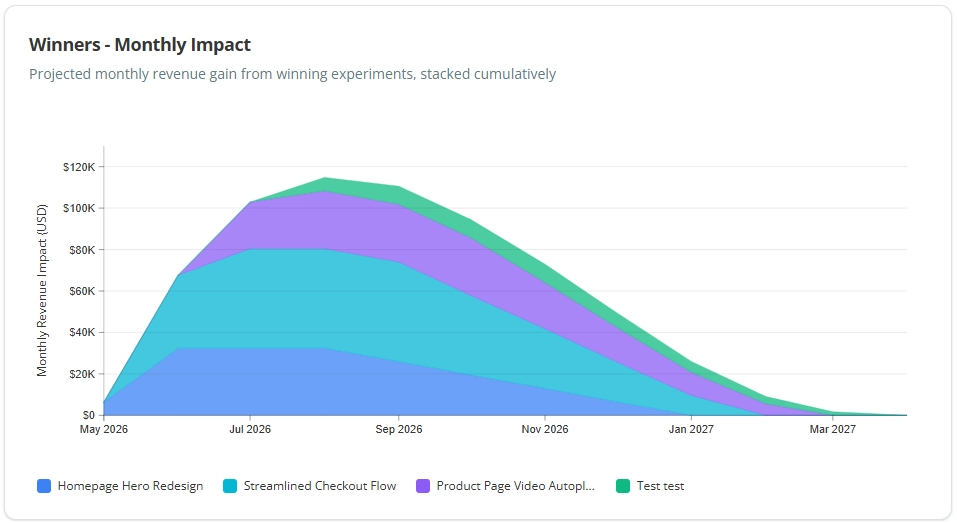
Visualizing this cumulative impact is essential for stakeholder reporting. Most executives prefer to see a "stacked" chart that shows the layers of revenue contributed by different "winning" experiments over time. This visualization helps demonstrate the long-term value of an experimentation program, showing that while a single test might provide a small bump, the aggregate effect of twelve months of successful testing creates a significant upward trajectory in the revenue baseline.
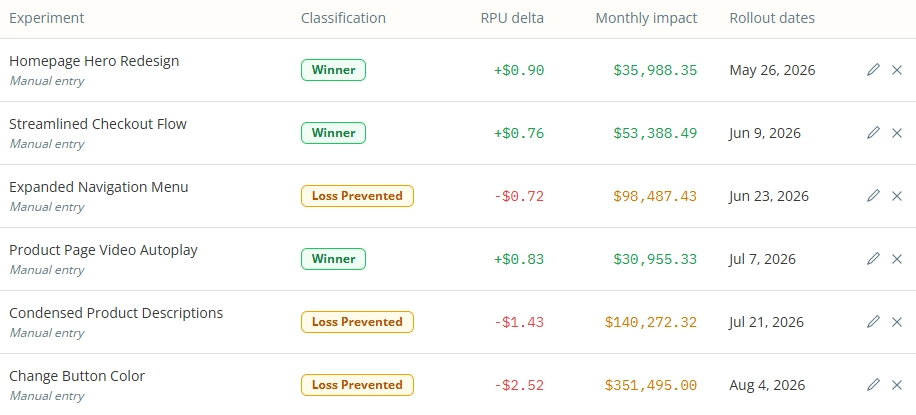
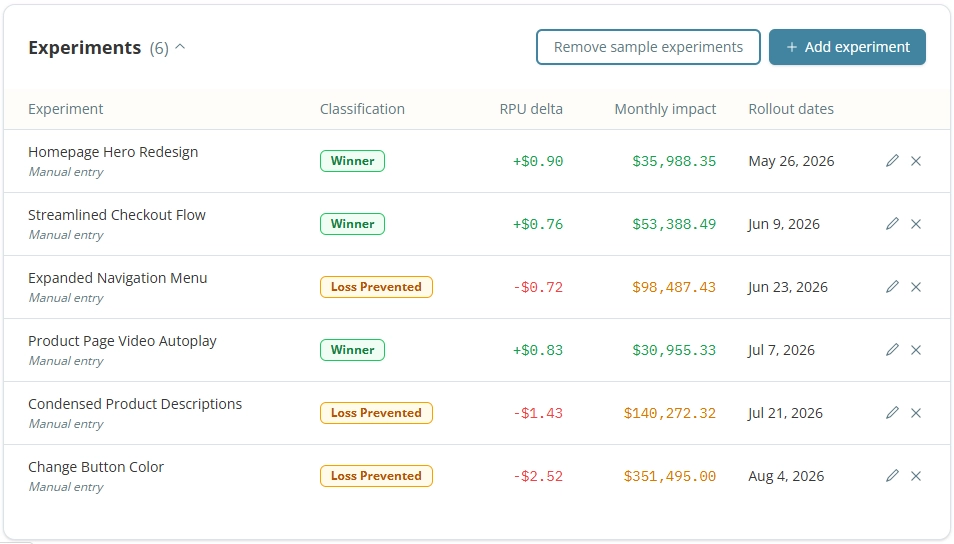
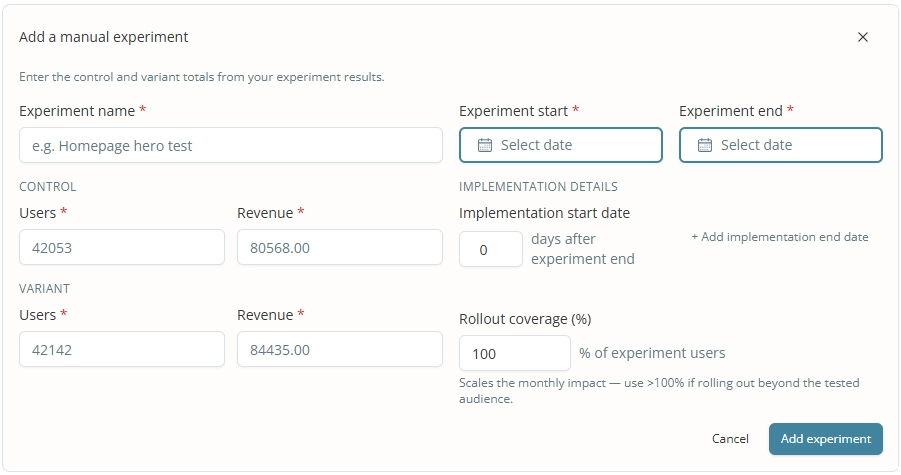
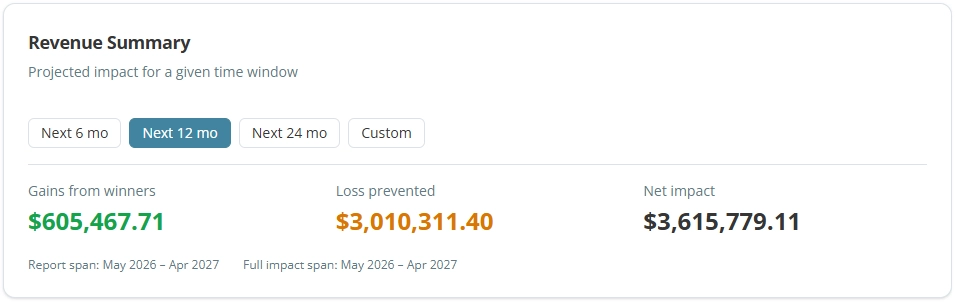
Tools such as Katsed have emerged to automate this specific type of analytics. These platforms allow teams to input raw experiment data—users, revenue, and dates—and automatically apply projection models. By classifying tests as either "Winners" or "Loss Prevented" (tests that stopped a declining trend), these tools provide a more nuanced view of the CRO team’s contribution to the bottom line.
Factoring in the Return on Investment (ROI)
A revenue forecast is only one side of the ledger; a complete journalistic analysis of a testing program must also consider the investment side. Proving the ROI of an A/B testing program requires subtracting the operational costs from the projected revenue gains.
These costs typically include:
- Personnel: The salaries of CRO managers, data analysts, and UX designers.
- Engineering Overhead: The cost of developer time used to build test variants and, more importantly, to permanently implement the winners into the site’s codebase.
- Software Fees: The monthly or annual costs of testing platforms, heatmapping tools, and analytics suites.
By comparing the "stacked" revenue gains against these fixed and variable costs, organizations can determine the true efficiency of their experimentation engine. In many high-performing organizations, the ROI of a mature CRO program can exceed 500%, far outperforming traditional paid acquisition channels where costs-per-click are constantly rising.
Conclusion: Embracing the Model Over the Crystal Ball
Ultimately, revenue forecasting in the world of conversion optimization should be viewed as a model rather than a prophecy. The goal is not to predict the future with 100% accuracy—an impossible task given the volatility of the internet—but to provide a logical, data-backed framework for business planning.
By making assumptions explicit, remaining conservative with lift estimates, and accounting for the reality of implementation delays and effect decay, CRO practitioners can move from being perceived as "growth hackers" to being seen as essential financial contributors. In an era where data privacy changes are making traditional ad tracking more difficult, the ability to internalize growth through rigorous experimentation and accurate forecasting is becoming the primary competitive advantage for digital-first enterprises. The transition from "guessing" to "modeling" marks the professionalization of the CRO industry, ensuring that experimentation remains a permanent fixture in the corporate budget.







