The marketing landscape has undergone a seismic shift over the past three years, largely driven by the explosive growth and perceived potential of generative artificial intelligence. Initially heralded as a revolutionary force, promising unprecedented efficiency gains and creative breakthroughs, AI quickly became a cornerstone of strategic discussions across boardrooms and marketing departments. Early adopters, eager to capitalize on the nascent technology, invested heavily in tools and talent, fueled by a blend of genuine optimism and the pervasive fear of missing out (FOMO). This initial phase was characterized by widespread experimentation, with teams exploring a myriad of applications from content generation to data analysis and personalized customer engagement.
However, as the dust settles on this intense period of innovation, a stark reality has emerged: while some marketing teams have indeed unlocked genuine efficiency gains and transformative capabilities, a significant number find themselves grappling with mounting frustration. This frustration often stems from an accumulation of tool subscriptions that haven’t translated into tangible improvements, leaving teams feeling overwhelmed rather than empowered. The optimistic vision of "AI best practices" often touted by early evangelists has proven elusive, with many marketers struggling to trace these recommendations back to concrete, measurable outcomes. This disconnect is particularly concerning given the broader industry context, where critical metrics such as organic traffic and clicks are reportedly in freefall, signaling a challenging environment for digital visibility and engagement.
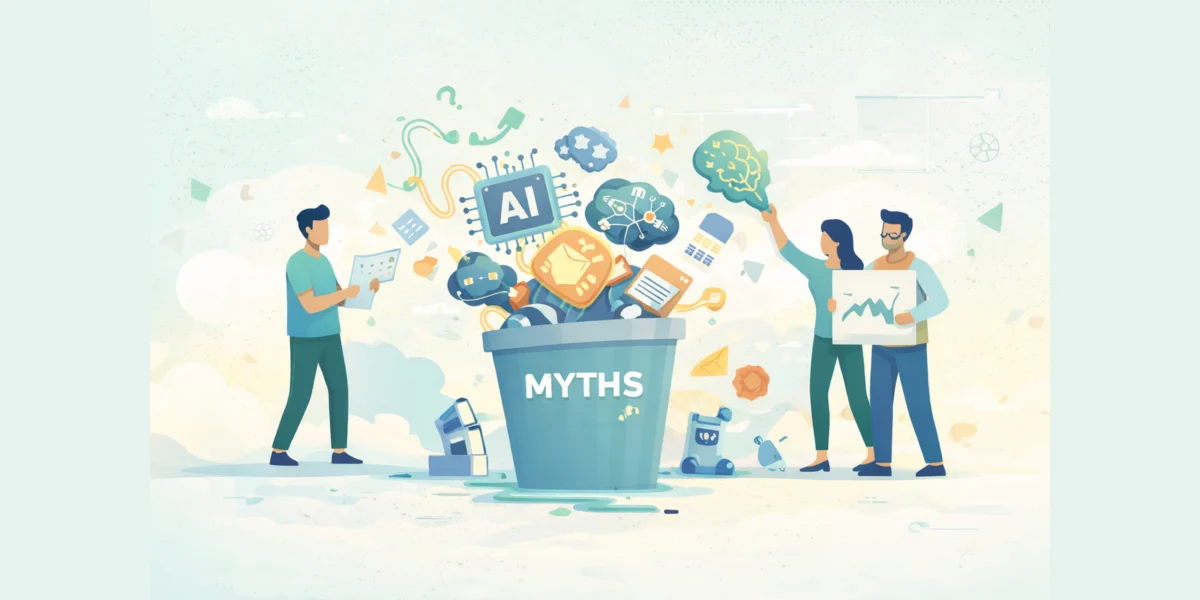
The disparity between AI’s ambitious promise and its practical value has necessitated a critical re-evaluation of its role in content strategy and marketing operations. Organizations like Contently, while firmly advocating for AI’s potential as a force multiplier for high-performing teams, recognize that a more disciplined and nuanced approach is required. Thoughtfully integrated, AI can streamline research, optimize workflows, and accelerate the delivery of higher-quality content. Yet, its effective deployment is frequently hampered by persistent "marketing myths" — misconceptions about AI’s true capabilities and how it can be most effectively leveraged within content programs. These myths tend to take root in an environment where AI marketing advice oscillates wildly between extremes: the unbridled promises of "hype merchants" on one side, and the wholesale dismissals of "skeptics" on the other. Neither extreme provides the practical clarity that marketing directors desperately need to make informed decisions for their teams on a day-to-day basis. As the industry looks towards 2026, the imperative is clear: discard these limiting myths and cultivate a more grounded, outcome-oriented understanding of AI.
The Dawn of Generative AI in Marketing: A Brief Chronology
The journey of generative AI in marketing can be traced back to its early conceptualization in academic research, but its mainstream adoption accelerated dramatically around 2022-2023 with the public release of powerful large language models (LLMs). Initially, marketing departments were quick to identify applications such as automated copywriting, idea generation, and basic content summarization. The sheer speed at which AI could produce text, images, and even video drafts captivated the industry, promising to alleviate bottlenecks in content production and personalization at scale. Investments poured into AI-powered writing assistants, image generators, and data analysis platforms. Conferences and webinars became saturated with discussions on prompt engineering and the future of "AI-first" marketing. This period, roughly spanning late 2022 through mid-2024, was largely one of enthusiastic experimentation, characterized by a "throw everything at the wall and see what sticks" mentality. Marketers were encouraged to integrate AI into every conceivable workflow, leading to a proliferation of tools and a steep learning curve for many teams. The focus was predominantly on quantity and novelty, often overshadowing considerations of quality, brand voice, and strategic alignment.
The Unfulfilled Promise: A Reality Check
Despite the initial fervor, the widespread implementation of generative AI has revealed significant challenges. A recent industry report indicated that while 70% of marketing teams have adopted some form of AI tool, only 35% report a significant improvement in return on investment (ROI) directly attributable to AI. This "gap between promise and practical value" is a critical pain point. Many teams invested in AI with the expectation of seamless integration and immediate, substantial gains, only to find themselves navigating complex interfaces, inconsistent outputs, and the sheer volume of data required to train and refine AI models for specific brand voices.
Moreover, the digital landscape itself has become increasingly complex. Data from analytics firms suggests a continuous decline in organic search clicks, with some reports indicating a reduction of 15-20% across various industries in the past year alone. This downturn is attributed to several factors, including Google’s evolving search results pages that increasingly feature rich snippets, "AI Overviews," and direct answers, often reducing the need for users to click through to original sources. For marketers, this means that even if AI helps them produce more content, the traditional pathways for that content to reach an audience are diminishing, further exacerbating the frustration with tools that promise visibility but deliver little impact. The need for a more strategic, less tool-centric approach has become undeniably urgent.
Navigating the Hype Cycle: Debunking Key Misconceptions
To effectively harness AI’s potential, marketers must move beyond superficial understandings and address several ingrained myths. These misconceptions, born from early hype and a lack of practical experience, hinder genuine progress and lead to misallocated resources.
Myth 1: The Illusion of More AI Tools Automatically Equaling More Efficiency
The intuitive appeal of this myth is undeniable: logic suggests that adding more advanced tools should invariably lead to increased productivity and efficiency. In practice, however, many organizations have found the opposite to be true. Instead of replacing cumbersome manual steps, new AI tools are often layered on top of existing processes, creating additional complexity and fragmented workflows. A survey of marketing operations professionals revealed that companies utilizing more than five distinct AI tools for content generation reported a 20% increase in integration challenges and a 15% rise in internal communication breakdowns compared to those with fewer, more integrated solutions.
The issue isn’t merely the quantity of tools, but their integration and strategic deployment. True efficiency gains manifest when AI is seamlessly embedded within existing operational hubs—be it content management systems (CMS), project management platforms, or editorial calendars. When AI functionality lives where the work naturally occurs, such as aiding in brief creation directly within a project brief template or suggesting content improvements within the CMS, the benefits become apparent. Conversely, relying on a multitude of disparate tools that require constant data transfers, reformatting, or context-switching introduces friction that negates any potential gains.
Beyond integration, the human element remains paramount. Investing in robust training programs for teams on how to effectively utilize existing AI tools, coupled with clear guidelines for their application, often yields greater productivity dividends than perpetually chasing the latest feature set. Without proper guidance, teams may experiment in various directions, leading to inconsistent output and wasted effort.
What Works: A prerequisite for any new AI adoption should be a comprehensive mapping of current content workflows. This end-to-end analysis helps identify genuine bottlenecks that AI can realistically address, rather than simply automating an inefficient process. Prioritizing consolidation of existing tools where possible and investing in ongoing team education and confidence-building are more impactful than a simple expansion of the AI tech stack. Establishing basic "guardrails" for AI usage can also prevent fragmented experimentation and ensure a more unified approach.
Myth 2: The Pitfalls of Autonomous AI Content: Why Human Touch Remains Irreplaceable
In an era of unprecedented content generation capabilities, the industry is no longer constrained by volume. AI tools can churn out articles, social media posts, and product descriptions at a scale previously unimaginable. The true challenge, however, lies in creating content that resonates authentically, distinctively, and persuasively with an audience already inundated with information. Generic AI text, often defaulting to the safest or most common interpretation of an idea, struggles to convey the unique brand voice, lived experience, and nuanced perspective that fosters trust and drives conversions.
Search engines and sophisticated readers alike are increasingly adept at discerning generic, undifferentiated content. Google’s algorithm updates, for instance, have consistently emphasized expertise, authoritativeness, and trustworthiness (E-A-T) as critical ranking factors. Content that lacks a genuine human touch—evidenced by unique insights, personal anecdotes, or direct experience—often fails to meet these criteria. A study by a leading SEO platform indicated that AI-generated content without substantial human editing and augmentation ranked 30% lower on average for competitive keywords compared to human-curated content of similar length and topical relevance. While grammatically correct, such content rarely constitutes a compelling narrative or a memorable brand interaction.
The most successful teams view AI content creation as a collaborative process. They leverage AI for its speed in drafting outlines, conducting initial research, and generating first passes. The critical subsequent step involves extensive human intervention: layering in real customer examples, refining claims, sharpening arguments, rigorous fact-checking, and ensuring every piece aligns with a clear business objective. This hybrid approach ensures that the content not only meets volume requirements but also maintains quality, accuracy, and brand integrity.
What Works: Employ AI to accelerate the foundational stages of content creation—research, outlining, and initial drafts. Subsequently, integrate comprehensive human editing to infuse accuracy, distinct brand voice, compelling storytelling, and strategic differentiation. This collaboration elevates content beyond mere information delivery to persuasive communication.
Myth 3: AI as a Panacea for Poor Strategy: Speed Amplifies Direction, Not Rectifies It
One of the most dangerous myths is the belief that AI can somehow compensate for a flawed or absent marketing strategy. AI excels at optimizing execution; it can make processes faster, more efficient, and more scalable. However, it cannot rectify fuzzy positioning, unclear messaging, or ill-defined business goals. In fact, scaling content production with AI when the underlying strategy is weak merely amplifies the wrong direction, leading to a faster expenditure of resources with minimal impact on critical metrics.
This phenomenon is frequently observed in practice. Teams deploy AI to publish more content at an accelerated pace, yet key performance indicators (KPIs) such as conversions, lead generation, or customer retention remain stagnant. While traffic might see a superficial increase due to higher content volume, this visibility often evaporates before it translates into tangible business value. Content might rank for relevant keywords but fails to address genuine buyer pain points or guide users towards a clear conversion path. Without a robust content strategy that defines target audiences, outlines key messages, and maps out the customer journey, even the most prolific AI-powered content output will struggle to move the needle on pipeline generation.
What Works: Prioritize developing a crystal-clear messaging strategy and well-defined conversion paths before scaling content production with AI. Once the strategic foundation is solid and pointed in the right direction, then leverage AI to execute and amplify that strategy efficiently and effectively.
Myth 4: The Pressure for Immediate, Universal AI Adoption: Deliberation Over FOMO
The pervasive "fear of missing out" (FOMO) often drives suboptimal technology decisions. Marketers might adopt AI tools simply because competitors are using them, rather than because they address a specific, identified problem within their own operations. This reactive approach frequently leads to the integration of "wrong-fit" tools that introduce unnecessary costs, create confusion among teams, and foster cynicism, making future, more strategic AI adoption even harder.
Successful AI implementation is rarely about moving the fastest; it’s about moving deliberately and strategically. The most effective teams begin by identifying a specific, high-impact problem that AI can genuinely solve. They then define clear success metrics for that solution before evaluating and selecting the appropriate technology. This problem-first, solution-second approach ensures that AI investments are targeted and yield measurable results.
Furthermore, organizational readiness plays a crucial role. A team still struggling with basic content workflows, lacking standardized processes, or operating without clear brand guidelines will derive minimal benefit from advanced AI optimization features. In fact, premature AI scaling without adequate governance can inadvertently multiply risks related to brand consistency, legal compliance, and data privacy. For instance, an AI tool generating content at scale without proper oversight could easily produce off-brand messaging or inadvertently use copyrighted material, leading to significant repercussions.
What Works: Identify a single, high-impact use case where AI can demonstrably reduce friction or cost. Conduct a contained pilot program to test its effectiveness, meticulously documenting improvements and any unforeseen challenges. Based on concrete results and learnings, expand AI adoption incrementally and strategically.
Myth 5: AI Search Is Basically the Same as SEO: A Divergent Landscape
Marketers have historically understood visibility through the lens of search engine rankings, leading to the assumption that AI-powered search (like Google’s "AI Overviews" or other generative AI answers) is merely an extension of traditional SEO algorithms. This assumption is fundamentally flawed. While foundational SEO principles—such as site structure, technical performance, and content quality—remain crucial, AI Search operates on a distinct paradigm.
Traditional SEO focuses on ranking entire web pages based on relevance, authority, and user experience. AI Search, by contrast, leverages large language models to compress and synthesize information from multiple sources, presenting direct answers or summaries rather than merely a list of links. According to Ahrefs’ 2025 research, the introduction of AI Overviews has demonstrably reduced clicks to top-ranking pages by an average of 34.5%. This signifies a critical shift: ranking well no longer guarantees the same level of visibility or traffic as it once did. Users may receive their answer directly within the search interface, obviating the need to visit an external website.
Visibility in the AI Search era depends heavily on how content is structured, its clarity, and the richness of its credible context. Two articles might rank identically on Google’s traditional search results page. However, the one featuring clear structural elements, schema markup, and direct, concise answers is far more likely to be cited repeatedly by AI assistants and integrated into AI-generated responses. Content that explicitly defines entities, provides structured data, and directly answers common questions is prioritized by language models seeking to synthesize information efficiently.
What Works: Maintain robust traditional SEO foundations, focusing on topical authority, technical excellence, and quality backlinks. Concurrently, integrate AI-specific optimization practices: meticulous entity definitions, comprehensive structured data markup (e.g., schema.org), and the creation of question-driven content formats designed for direct answers and clear summarization. This dual approach ensures both traditional search visibility and optimal integration into AI-powered information retrieval.
Strategic Imperatives for 2026 and Beyond
The preceding years were characterized by a necessary, albeit sometimes chaotic, period of experimentation with generative AI. The next phase, however, demands discipline, strategic clarity, and a rigorous focus on measurable outcomes. The shift from unbridled enthusiasm to pragmatic application is not a step backward but a crucial evolution for marketers aiming to leverage AI for sustainable growth.
Organizations must cultivate a culture that asks critical questions: Does this AI tool solve a real problem? Is it integrated seamlessly into our existing workflows? Are our teams adequately trained to use it effectively? Does it help us achieve our strategic objectives, or is it merely adding complexity? The answer to these questions should dictate AI adoption, rather than external pressures or fleeting trends.
The future of AI in marketing is not about replacing human ingenuity but augmenting it. It’s about empowering teams to work smarter, not just faster. It’s about using AI where it genuinely adds value—streamlining research, automating repetitive tasks, and providing data-driven insights—and knowing when to rely on human expertise for strategic direction, creative nuance, and authentic connection.
Frequently Asked Questions (FAQs):
How do I know if my team is truly ready for AI adoption beyond initial experimentation?
Assessing readiness involves a clear-eyed evaluation of your current content operations. Teams with well-documented workflows, established brand guidelines, and consistent publishing processes are well-positioned to pilot and scale AI tools effectively. If foundational operations still lack structure or clarity, prioritizing these improvements will yield greater benefits than prematurely adding AI complexity. A stable operational base provides the necessary framework for AI to be integrated efficiently and safely, minimizing potential disruptions and maximizing impact.
What is the minimum investment required to see tangible results from AI in marketing?
The "minimum investment" is less about financial outlay for new tools and more about time and training. Many existing content platforms now include integrated AI features, reducing the need for entirely new subscriptions. The critical investment lies in dedicating two to four weeks for comprehensive team training on effective AI prompting techniques, ethical usage guidelines, and refined editing workflows. Budgeting for these initial learning curves is essential, as consistent productivity gains will only materialize once the team is proficient and confident in their AI-assisted processes.
How should marketers balance traditional SEO strategies with the emerging demands of AI Search optimization?
These two approaches should be viewed as complementary, not mutually exclusive. Marketers must continue to invest in traditional SEO fundamentals: building topical authority, ensuring technical site performance, fostering a strong backlink profile, and optimizing for user experience. These elements remain crucial for overall web presence and credibility. On top of this foundation, layer AI-specific practices. This includes meticulous implementation of structured data markup (e.g., Schema.org), precise entity definitions within content, and crafting content formats that directly answer user questions, making it easier for AI models to synthesize and cite information. A holistic strategy ensures visibility across both traditional search results and AI-generated summaries.
As the marketing industry progresses into 2026, the call is for fewer breathless predictions and more verifiable proof that the work is, in fact, working. The intelligent application of AI, guided by strategic discipline and a clear understanding of its true capabilities, will be the hallmark of successful marketing teams.
Ready to build AI workflows that actually help your team accomplish real work? Contently’s AI-assisted content platform combines generative AI efficiency with editorial oversight — so your team accelerates without sacrificing quality or brand safety. Contently writers have the credentials your compliance team asks about. CFAs, MDs, JDs and FINRA-registered reviewers, with a managing editor on every piece. Tell us your vertical and we will show you what that looks like for your program. Book a Content Strategy Call.