Dwi Wanna
A successful e-commerce entrepreneur, who prefers to remain anonymous to discuss sensitive business strategies, recently revealed a transformative approach to business operations that has dramatically boosted his company’s profitability and reduced personal stress. This story, shared within a private business community, challenges the conventional wisdom that scaling a business necessitates a linear increase in employee headcount. Instead, it highlights the power of strategic outsourcing, lean operations, and proactive financial management as key drivers of sustained success in the competitive e-commerce landscape.
The entrepreneur, formerly managing a team of 35 employees, found himself in a common but often unspoken predicament. While his business generated solid revenue, its profitability consistently lagged behind expectations. The constant pressure of managing a large team, in addition to the core business responsibilities, led to chronic stress. This situation prompted him to make a series of significant operational shifts. He transitioned his business to a remote-first model, engaged a third-party logistics (3PL) provider for warehousing and fulfillment, and strategically replaced many full-time employees with a team of freelancers and independent contractors. Today, his operation runs with a lean core team of just one full-time employee and eight contractors. The result? Unprecedented profit margins and a significantly reduced burden of stress.
This anecdote serves as a powerful counterpoint to the pervasive narrative that equates business growth directly with increased personnel. The common assumption is that scaling requires a commensurate expansion of the workforce. However, this case study, and others like it, suggest a more nuanced reality. The driving force behind superior profitability in e-commerce may not be a larger team, but rather a more strategic and efficient allocation of resources.

The Data Behind Operational Leanness
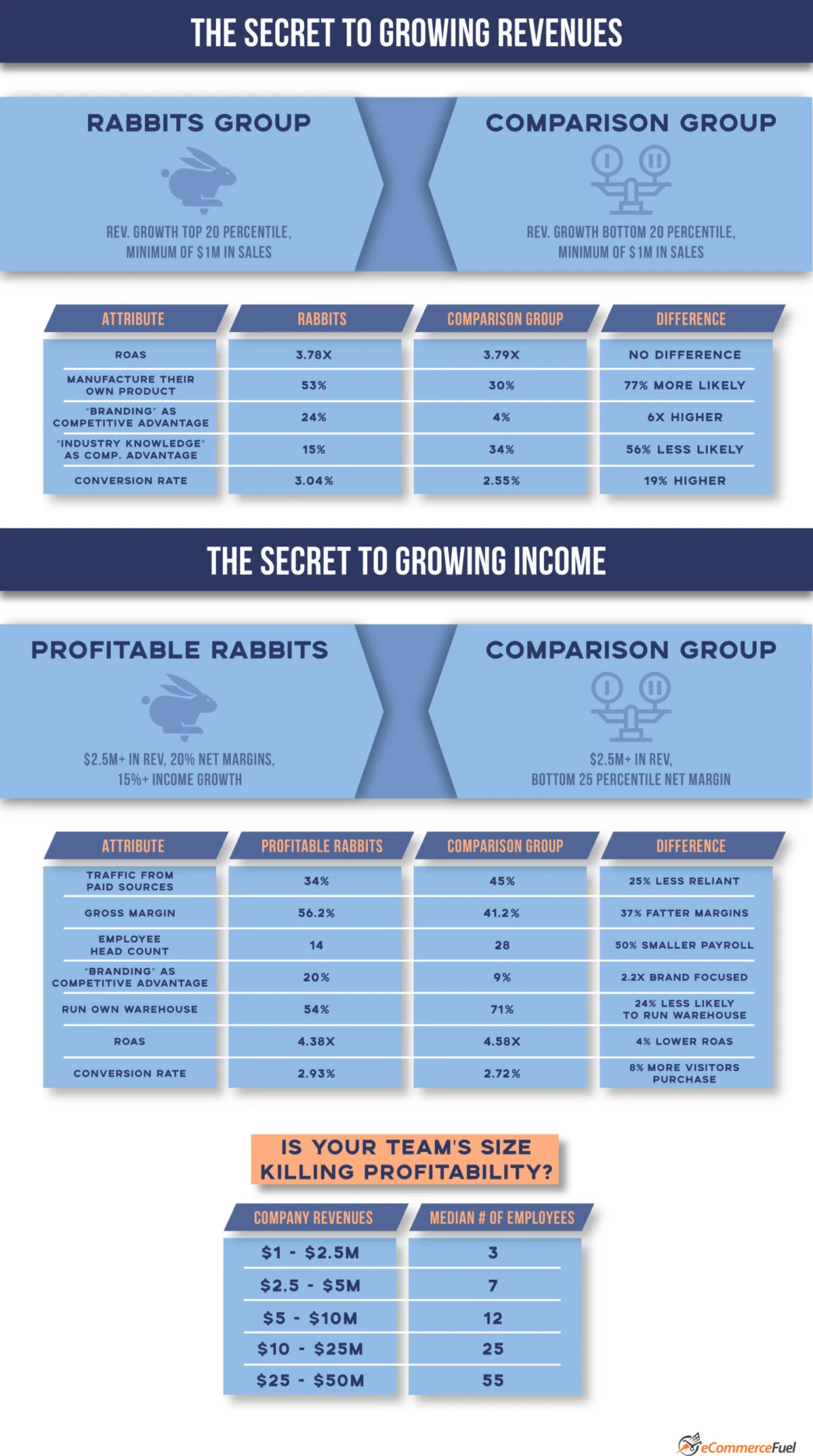
Research conducted across hundreds of e-commerce businesses consistently points towards operational efficiency as a stronger predictor of profitability than marketing prowess. A comprehensive analysis, which examined the financial metrics of successful and struggling online stores, revealed that top-performing businesses exhibited significantly lower payroll expenses. Specifically, these highly profitable entities had, on average, half the payroll of their less successful counterparts.
Furthermore, the data indicated a clear trend towards outsourcing non-core functions. Profitable stores were 25% more likely to outsource their warehouse operations, a critical component of the e-commerce supply chain. This suggests that specialized third-party providers can often handle fulfillment more efficiently and cost-effectively than in-house teams. Additionally, these businesses demonstrated a 25% lower reliance on paid traffic, implying that their operational efficiency allowed them to achieve better returns on their marketing investments or to rely more heavily on organic growth channels.
The overarching finding from this research is that operational leanness consistently outperforms marketing cleverness when it comes to driving profitability. This doesn’t diminish the importance of marketing, but it reframes the conversation around what truly moves the financial needle for an e-commerce business.
Beyond Headcount: Defining Operational Lean
The concept of "staying lean" is often narrowly interpreted as reducing employee numbers. However, true operational leanness extends far beyond headcount and encompasses a holistic review of all business expenditures and resource allocations. Overhead costs can accumulate insidiously, often in areas that are not directly tied to core value creation.

Examples of such overhead include maintaining large, underutilized office spaces that were deemed necessary in previous economic climates but are now a drain on resources. Similarly, investing in proprietary warehouse infrastructure when a 3PL can provide superior service at a lower cost represents a significant overhead burden. Even seemingly minor expenses, such as recurring SaaS subscriptions that auto-renew without active oversight, can amount to substantial costs over time. The key is to critically assess every expenditure against its contribution to the brand’s core value proposition.
A useful framework for evaluating these costs is to ask: "What is truly core to our brand’s unique selling proposition?" If a company’s competitive advantage lies in its innovative product design, then retaining in-house design talent is justifiable. However, if the primary function of a particular operation, such as packing and shipping, is not a direct differentiator, then exploring external solutions like 3PLs becomes a strategic imperative. The most profitable businesses are not cutting costs indiscriminately; they are making deliberate decisions about which resources are essential for their unique brand identity and which can be more effectively managed by external partners.
The Imperative of Proactive, Difficult Conversations
A widely cited principle for personal and professional success is the willingness to engage in difficult conversations. In the business world, avoiding these crucial discussions can lead to delayed decision-making and the erosion of financial health. Many entrepreneurs find themselves forced into these conversations only when faced with an impending crisis, such as an economic downturn, a cash flow shortage, or a critical decline in profitability that threatens the very existence of the business.
In contrast, the most successful and profitable entrepreneurs proactively initiate these dialogues. They regularly assess the necessity of each role within their organization, questioning whether positions were created out of genuine need or simply because the business was growing and felt busy. They scrutinize expenditures on tools and services, differentiating between essential investments and habitual or forgotten subscriptions. A critical exercise for these leaders involves contemplating what would be cut if a 25% reduction in expenses were required overnight.

By engaging in these forward-thinking assessments, these entrepreneurs are able to make intentional adjustments to their operational structure. These are not reactive cuts made out of desperation, but rather strategic decisions designed to optimize resource allocation and maintain peak financial performance. This proactive approach to cost management and organizational structure is a hallmark of resilient and highly profitable businesses.
The Underrated Lever: Tax Efficiency
While marketing and operational efficiency are frequently discussed levers for business growth, the impact of tax planning on net profitability is often overlooked. Many business owners view taxes as a fixed cost, a percentage of income that must be paid regardless of strategic choices. However, this perspective fails to account for the significant opportunities available for tax optimization.
Savvy entrepreneurs are not engaging in illicit activities or complex offshore schemes to reduce their tax burden. Instead, they are being deliberate about their financial strategies, employing legitimate methods to minimize their tax liabilities. This intentionality can lead to substantial differences in after-tax income, even for businesses with identical revenues and pre-tax profits.
A Tale of Two Entrepreneurs: Quantifying Tax Savings
Consider two hypothetical e-commerce owners, both generating $2.5 million in annual revenue with $250,000 in profit, and both with similar personal financial situations—married with three children. Assuming a marginal tax rate of approximately 30%, their annual tax obligations could differ dramatically based on their strategic financial planning.

Owner A, following a conventional approach, might pay around $75,000 in taxes annually. Owner B, however, who actively implements tax-efficient strategies, could reduce their tax bill to as little as $21,000, saving a remarkable $54,000 per year. This significant difference is achieved through a variety of well-established and legal tax planning techniques:
- Profit Sharing Contributions: Owner B contributes $45,000 to retirement accounts through profit-sharing plans, exceeding standard 401(k) limits. This strategy can yield tax savings of approximately $13,500 annually, assuming a 30% marginal tax rate.
- Donating Appreciated Stock: Instead of donating cash to charities, Owner B donates stock that has increased in value. This allows them to avoid capital gains tax on the appreciation while still receiving a full tax deduction for the stock’s fair market value. This strategy can result in savings of around $3,500.
- Maximizing Health Savings Accounts (HSAs): Owner B contributes the maximum allowable amount ($8,500 for a family) to their HSA. HSAs offer triple tax advantages: contributions are tax-deductible, growth is tax-free, and withdrawals for qualified medical expenses are also tax-free. This contributes to annual savings of approximately $2,550.
- Employing Children: Owner B strategically employs their three children for legitimate work performed within the business, paying each $7,000 annually. These payments are deductible for the business, and the children can invest this income in Roth IRAs, allowing it to grow tax-free for decades. This strategy can save approximately $6,300 in taxes.
- Inventory Donations: Owner B identifies $60,000 worth of slow-moving inventory. Instead of liquidating it at a loss, they donate it to a qualified charity, receiving a tax deduction at its fair market value. This is a significantly underutilized strategy in e-commerce and can provide substantial tax savings, estimated at $18,000 in this scenario.
The cumulative effect of these deliberate actions leads to an annual tax saving of approximately $54,000 for Owner B. This difference highlights the profound impact of proactive tax planning on an e-commerce business’s bottom line.
The Hidden Nature of Tax Opportunities
The reason these tax-saving opportunities often go unnoticed is the fragmented nature of financial information. Tax liabilities are spread across personal tax returns, business filings, brokerage statements, and payroll tax reports. Without a consolidated view, business owners rarely see their total tax expenditure in a clear, actionable format. This lack of visibility prevents them from identifying areas where they could potentially pay less.
Owner A in the example is not necessarily lacking in intelligence or competence. They likely have a competent accountant who ensures accurate filing of tax returns. However, "competent" accountants often operate reactively, processing information provided to them rather than proactively offering strategic tax-saving ideas. This passive approach can result in significant missed opportunities for substantial financial gains.

Evaluating Your Tax Professional’s Proactivity
A simple yet effective way to assess the value of your tax advisor is to consider their proactivity. Ask yourself: When was the last time your CPA or tax advisor proactively reached out with a strategic suggestion tailored to your specific business situation? If you cannot recall such an instance, it suggests that while your advisor may be competent in handling routine matters, they might not be actively identifying opportunities to optimize your tax liabilities.
The $54,000 difference between Owner A and Owner B is not the result of complex, arcane financial maneuvers. It is the product of intentionality and a proactive approach to financial management. If your tax professional is not regularly bringing forward innovative ideas, it may be time to seek out an advisor who is committed to helping you maximize your after-tax profitability.
The Two Overlooked Levers of Profitability
Marketing metrics like Return on Ad Spend (ROAS), Customer Acquisition Cost (CAC), and Lifetime Value (LTV) dominate industry discussions and are often the focus of improvement efforts. These metrics are undoubtedly important for driving revenue. However, the entrepreneurs who achieve exceptional profitability are often focusing on two less glamorous but profoundly impactful levers: reducing their operational costs and minimizing their tax liabilities.
By cultivating a lean operational structure, engaging in strategic outsourcing, and proactively optimizing their tax strategies, these businesses are able to retain a significantly larger portion of the revenue they generate. While pursuing better marketing is always beneficial, the ability to keep more of the money already earned is frequently the more potent and immediate path to enhanced profitability and long-term financial health.

For e-commerce business owners seeking to build more resilient and profitable enterprises, a shift in focus from solely revenue generation to comprehensive cost management and tax efficiency may offer the most significant returns. This strategic reorientation allows businesses to not only grow but to grow profitably, securing a stronger financial future.


 Laily UPN

 Basiran