The landscape of digital content discovery is undergoing a seismic shift, prompting a crucial question for businesses and marketers alike: are blogs still a viable and valuable channel for investment? In an era increasingly dominated by artificial intelligence, where content can feel commoditized and traditional search engine traffic is experiencing a noticeable decline, the role of blogs as content hubs warrants a rigorous re-evaluation. While some may perceive a waning ROI, a deeper dive into recent data and evolving search behaviors reveals that blogs, when approached strategically, continue to offer significant advantages in building brand authority, driving high-value conversions, and establishing a foundational presence in the AI-driven future of information retrieval.
The Initial Concern: Declining Traffic and the AI Disruption
The emergence of AI-powered search has undeniably altered the way users find information. Gartner, a leading research and advisory company, projected in February 2024 that traditional search engine volume would drop by 25% by 2026, a consequence of users migrating towards AI chatbots and virtual agents for answers. This prediction has begun to manifest, with many businesses observing a dip in organic traffic, a key metric for many blog strategies. The traditional model of ranking for a broad range of keywords and attracting clicks through a list of blue links is being challenged as AI synthesizes answers, potentially bypassing direct website visits for many queries. This has understandably led to scrutiny regarding the return on investment for blog content, prompting some to consider redirecting resources to other marketing avenues.
However, this narrative of decline is incomplete. While raw traffic volume may be a concern for some, the quality and conversion potential of the traffic that does arrive via AI-driven discovery channels present a compelling counterpoint. Semrush’s research indicates that visitors originating from Large Language Models (LLMs) are significantly more valuable, converting at a rate 4.4 times higher than those from traditional organic search. Further data from Similarweb, published in May, highlights that referral traffic from ChatGPT converts at 7.1%, trailing only paid search. This suggests that while fewer clicks may occur, those that do are from users who are further along the decision-making process and more receptive to a brand’s offerings.
The underlying reason for this higher conversion rate is the transfer of trust signals. A high search ranking, traditionally indicative of authority and relevance, translates into user confidence. AI systems, which are increasingly sophisticated in evaluating authority, extend this principle to the content they surface. When an AI synthesizes information and points to a specific source, the inherent credibility of that source is often transferred to the user, leading to a more engaged and conversion-ready visitor.
AI Citation Patterns: What the Machines Actually Value

A critical aspect for understanding the current value of blogs lies in what AI systems actually cite when generating responses. While brand-owned content is crucial, the raw citation volume across major AI platforms reveals a nuanced picture. Analysis of AI responses indicates that not all owned content formats are equally favored. However, this does not diminish the potential for blogs; rather, it underscores the importance of their inherent structure and informational nature.
Wix’s AI Search Lab, in a comprehensive analysis of 75,000 AI answers, discovered a significant preference for certain content types. Their research found that articles are cited 2.7 times more often for informational queries. When combined with listicles, these formats accounted for an impressive 67% of all informational citations. This finding is echoed by Otterly’s study, which consistently shows that editorial and informational content outperforms purely commercial pages. The structured, informative, and non-transactional nature of blog content aligns precisely with the requirements of LLMs seeking to synthesize accurate and comprehensive answers.
Therefore, even if a brand’s blog is not the most cited source globally, it often represents the most direct and accessible owned channel for producing content in a format that AI systems actively seek. This positions blogs as a unique asset in the AI-driven content ecosystem, providing a direct pathway for brands to be recognized and referenced.
The Power of Topical Breadth and Query Fan-Out
Counterintuitively, AI search engines do not simply match a single query to a single result. Instead, they deconstruct queries into multiple parallel sub-queries, retrieve content for each, and then synthesize a comprehensive answer. This phenomenon, known as "query fan-out," has profound implications for content strategy. Research indicates that a significant percentage of pages cited in AI Overviews do not rank within the top 10 organic search results. Approximately 90% of citations by platforms like ChatGPT originate from beyond the first or second page of traditional search results.
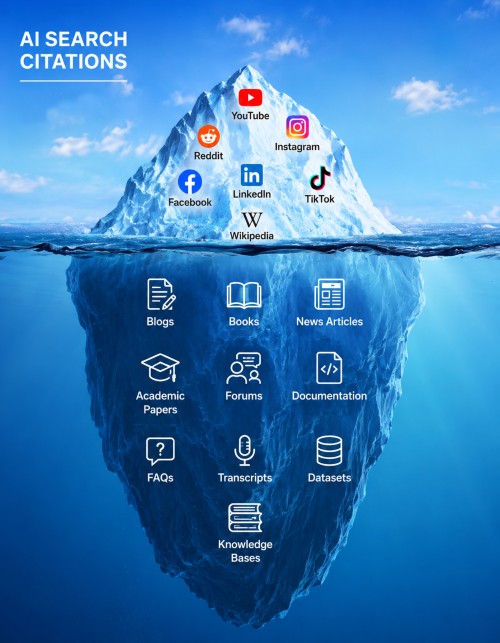
This means that a brand’s meticulously optimized cornerstone content may not be the primary driver for AI citations. Instead, niche posts addressing highly specific questions, perhaps published years ago, might be precisely what aligns with these parallel sub-queries. For enterprises with extensive legacy blog libraries, this presents an opportunity. The vast, often underutilized, archive of a blog can serve as a deep well of information that AI systems can draw upon. As Lee Odden, CEO of TopRank Marketing, aptly puts it, "Blogs are now the iceberg beneath the water." The visible tip of search results may be changing, but the foundational content driving those results is often found in the extensive archives of a well-maintained blog.
What No Longer Works in B2B Content Creation

The shift in AI-driven search necessitates a re-evaluation of traditional content creation strategies. The emphasis on sheer volume and keyword stuffing is becoming increasingly ineffective. Recent research underscores that simply producing massive quantities of mediocre content is no longer a winning formula. Instead, AI visibility is correlating strongly with content that demonstrates originality, proprietary data, demonstrated expertise, a distinct point of view, and a clear, structured format.
AI systems are not merely ranking pages; they are evaluating specific passages of text. A concise, well-structured blog post of around 800 words, containing a specific claim supported by data, is likely to outperform a sprawling, generic overview. This highlights the importance of depth and specificity in content creation, moving away from broad, superficial coverage towards focused, authoritative pieces that can be easily extracted and understood by AI.
The Importance of Content Freshness and Strategic Refreshing
In the dynamic world of AI-driven search, recency and relevance are paramount. ZipTie reports that AI-cited content is, on average, 25.7% fresher than traditionally ranked content. Furthermore, a substantial 76.4% of ChatGPT’s top-cited pages were updated within the last 30 days. This trend has significant implications for blog strategies. A regular cadence of content updates is becoming as crucial as publishing entirely new pieces.
Refreshing a high-performing blog post with current statistics, recent references, and updated insights is not merely good housekeeping; it acts as a powerful citation signal. According to ZipTie, a structured content refresh strategy can boost citation rates by an impressive 292%. This approach is also more cost-efficient than constantly producing new content and URLs, making it a smart investment for maintaining and enhancing a blog’s visibility in AI-driven search results.
The Brand Entity: Building Authority Over Time
Beyond direct citations, blogs play a vital role in building a brand’s entity – the sum of its online presence and reputation – which AI systems learn from over time. Ahrefs has found a strong correlation (0.66-0.71) between branded web mentions and AI visibility across various AI search interfaces. The more frequently a brand appears across the web, whether through third-party coverage, user-generated content, or citations of its original research, the more likely it is to be surfaced in AI-generated responses.
Blogs serve as a foundational source for these mentions. When a brand publishes original data, a well-articulated perspective, or in-depth analysis, it creates the raw material that other websites cite, practitioners share in forums, and ultimately, AI systems associate with that brand. As Otterly.AI suggests, businesses should "treat your blog like a source, not a sales brochure." This approach transforms the blog from a transactional marketing tool into a valuable repository of expertise that bolsters brand authority and drives organic discovery.
Conclusion: The Strategic Imperative of Blogs in the AI Era
The question of whether blogs are still worth investing in for B2B marketing has a nuanced answer: it depends entirely on the strategy and purpose behind them. If a blog’s sole objective is to churn out keyword-targeted posts to capture mid-funnel clicks, the return on investment is indeed becoming more challenging to justify, a trend that predates the acceleration brought by AI search.
However, if a blog functions as an authoritative reference point – publishing original research, delving deeply into specific use cases, maintaining a consistent refresh cadence, and genuinely building topical authority – then the data strongly supports continued investment. While blogs may no longer drive the sheer volume of traffic they once did, they remain as influential as any other channel in shaping AI citations and discovery. Furthermore, they often require a relatively lower publishing lift compared to other complex content initiatives. In essence, the blog has evolved from a simple content factory to a critical pillar of brand authority and AI discoverability, making it an indispensable component of a forward-thinking B2B marketing strategy.