The rapid evolution of artificial intelligence presents B2B marketers with an unprecedented opportunity to redefine operational efficiency and strategic effectiveness. However, amidst the burgeoning landscape of AI applications, discerning which use cases offer the most significant value and are most feasible for implementation can be a complex undertaking. Tom Swanson, Senior Engagement Manager at Heinz Marketing, proposes a robust three-part framework—leverage, risk, and chainability—as a systematic approach to evaluate and prioritize AI initiatives within B2B marketing workflows. This framework aims to inject objectivity into the decision-making process, guiding organizations toward strategic AI adoption that maximizes return on investment.
The Foundation: Identifying and Evaluating AI Opportunities
Swanson’s previous work explored the use of SWOT analyses to identify potential AI marketing use cases. This subsequent article delves into the critical next step: evaluating and prioritizing those identified opportunities. For teams focused on optimizing their marketing orchestration, the integration of AI has become a paramount concern over the past eighteen months. The fundamental challenge lies not only in pinpointing meaningful use cases but also in establishing a clear hierarchy for their implementation.
The "leverage, risk, chainability" framework offers a structured method for teams of all sizes to concentrate on executing a select few initiatives exceptionally well. This approach fosters a focused and iterative development process, crucial for navigating the complexities of AI integration.
Defining the Core Components of the Framework
At its heart, the framework breaks down the evaluation process into three distinct, yet interconnected, dimensions:

- Leverage: How often is the task repeated? This metric quantifies the potential time savings and efficiency gains achievable by automating a particular task. Tasks that are performed with high frequency offer the greatest opportunity for AI to deliver substantial benefits.
- Risk: What happens if things go wrong? This component assesses the potential negative consequences of an AI system failing or producing erroneous outputs. The severity of these consequences can vary dramatically depending on the task, industry, and organizational risk tolerance.
- Chainability: How does this fit into a workflow? This factor examines the extent to which a task’s output can seamlessly serve as an input for another subsequent task within a broader workflow. High chainability indicates a potential for creating automated, end-to-end processes, further amplifying efficiency.
The interplay of these three elements provides a comprehensive lens through which to view AI use cases. A task that is highly repetitive, carries minimal risk if it encounters an error, and naturally feeds into another automated process is an ideal candidate for AI implementation. Conversely, tasks with low leverage, high risk, or poor integration potential may require a more cautious or deferred approach.
Visualizing the Framework: A Cartesian Approach
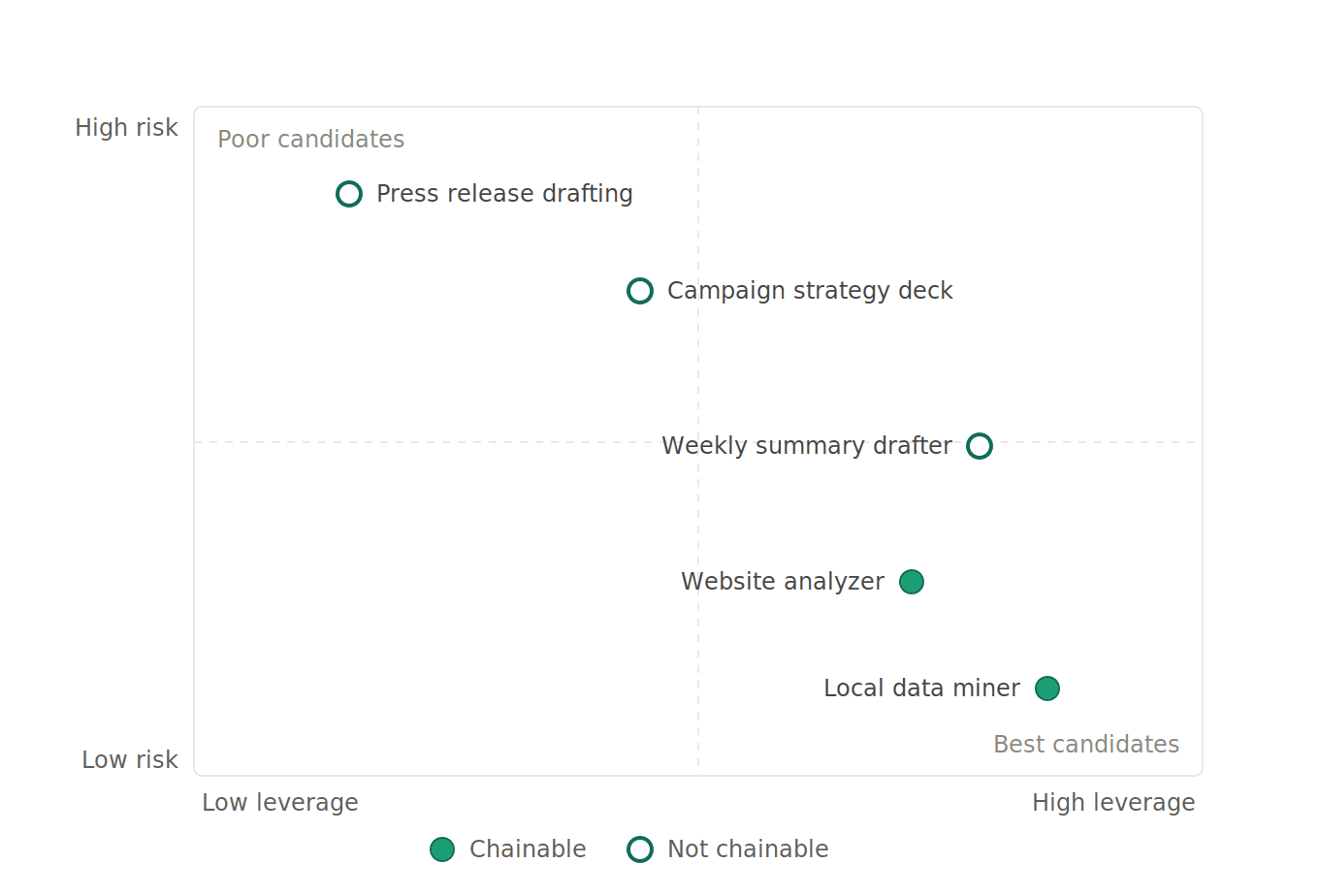
For those who benefit from visual aids, the "leverage, risk, chainability" framework can be effectively mapped onto a Cartesian plane. Leverage and risk can be plotted on the X and Y axes, respectively, offering a visual representation of a use case’s position within the evaluation spectrum. Chainability, while more qualitative, can function as a critical Boolean gate or a significant weighting factor in this assessment. It’s important to acknowledge that these dimensions are not absolute but rather exist on a continuum, allowing for nuanced evaluation.
The inherent subjectivity of risk assessment is a crucial consideration. The potential ramifications of an error in AI output can be vastly different across organizations and industries. For instance, a minor inaccuracy in marketing copy might have negligible impact for one company, while for another operating in a highly regulated sector, such an error could lead to significant financial penalties or reputational damage. Therefore, a thorough understanding of the specific context is paramount in assigning risk levels.
Deep Dive: Understanding Each Evaluation Metric
Leverage: The Engine of Efficiency
The frequency with which a task is performed is a primary indicator of its suitability for AI automation, particularly in the initial stages of adoption. As organizations gain experience with AI, they can progressively tackle more complex tasks by breaking them down into manageable components.
When assessing leverage, several key questions should be addressed:

- Frequency of Repetition: How often is this specific task executed within the marketing department or across related functions?
- Cost of Execution: What is the tangible cost associated with performing this task, primarily in terms of human hours and associated resource allocation?
- Workflow Uniformity: To what extent does the underlying workflow for this task vary from one instance to another? Highly standardized workflows are generally easier to automate.
- Output Consistency: How consistent is the output of this task across different executions? Tasks that consistently produce similar results are prime candidates for AI.
Case Study: Local Data Miner
A practical example illustrating high leverage comes from a regional sales team that needed to identify new local businesses as potential prospects.
- Situation: Regional representatives required a system to stay abreast of emerging local businesses.
- Frequency: The task was performed weekly.
- Cost: It consumed approximately half a day of a representative’s time each week.
- Workflow: The workflow was uniform and repeatable, involving a consistent process of data aggregation and analysis.
- Output Structure: The output was also uniform, consistently structured and formatted.
This scenario presented a compelling use case for AI. The regular frequency allowed for scheduled automation, and the significant time savings freed up valuable selling hours for the representatives. The uniformity of the workflow and output meant that the AI solution would require minimal ongoing maintenance and adjustments, with changes expected to be infrequent and additive. The inherent low risk and high chainability of this particular application further solidified its status as an ideal AI candidate.
Risk: Navigating Potential Pitfalls
The assessment of risk is inherently task-specific and can vary significantly between different use cases, organizations, and even individual team members. Factors such as an organization’s AI automation mandates and its leadership’s stance on AI adoption can influence its risk tolerance.
Swanson categorizes risks into types and then assigns a low, mid, or high rating to define the inherent risk of a task. This approach helps to standardize the risk assessment process.
Case Study: Automated Campaign Strategy with Human Review
Consider a client aiming to automate the drafting of campaign strategies by employing AI agents that could aggregate CRM data, conduct web research, and analyze customer data. The objective was to accelerate time-to-market for strategic campaign plans. Crucially, this process was designed to produce a strategic deck for leadership review, not to directly launch campaigns into the market.
- Financial Risk: Assessed as low, primarily limited to token costs associated with AI processing.
- Rework Risk: Rated as high, acknowledging the potential for strategic drift or misinterpretations by the AI.
- Total Cost of Ownership (TCO) Risk: Categorized as medium, recognizing the need for up-to-date documentation and system maintenance.
- Brand Risk: Considered low, as the strategic outputs were subject to human oversight and review by leadership, mitigating direct brand exposure to AI errors.
- Adoption Risk: Evaluated as medium, anticipating the need for team training and encouragement to adopt the new AI-assisted process.
- Accountability Risk: Rated as low, again due to the leadership review process that established clear lines of accountability.
While Swanson has not yet codified a definitive list of risks for every task, he identifies financial, brand, and TCO as broadly significant. However, the risk profile for different AI applications, such as content generation bots versus win/loss analysis bots, will naturally diverge.
Chainability: Building Integrated Workflows
For enthusiasts of workflow optimization, chainability represents a particularly compelling aspect of AI integration. It describes how effectively an AI task can seamlessly connect with other tasks in a sequence, forming automated pipelines.
The core question in evaluating chainability revolves around the desired level of human intervention. In a maximally chained workflow, the output of one bot directly serves as the input for the next, operating with minimal human oversight. This approach offers significant advantages but also presents certain trade-offs.
Advantages of High Chainability:
- Accelerated Throughput: Automated sequences can process tasks much faster than manual human intervention.
- Reduced Human Error: Minimizing manual handoffs reduces the likelihood of human-induced errors.
- Enhanced Scalability: Automated workflows can be scaled up or down more readily to meet fluctuating demands.
- Deeper Insights: The continuous flow of data through chained agents can facilitate more comprehensive and timely analysis.
Disadvantages of High Chainability:
- Complexity in Troubleshooting: Identifying the source of an error in a long chain can be challenging.
- Systemic Impact of Changes: A modification at one point in the chain can have cascading effects throughout the entire workflow.
- Potential for Stagnation: Over-reliance on fully automated chains might hinder the introduction of new strategies or creative input.
- Reduced Human Oversight: In certain sensitive areas, the complete absence of human review may be undesirable.
Case Study: Website Analyzer Agent
At Heinz Marketing, an example of effective chainability is demonstrated by their "Website Analyzer Agent."

- Use Case Context: The need to analyze client websites and integrate this information with other strategic inputs during the discovery process.
- Inputs: Client website URL and key pages.
- Input Sources: Derived from a "Client Info Analyzer" agent.
- Trigger: Receipt of input data.
- Output: A comprehensive website analysis.
- Output Destination: The analysis serves as input for the "Content Analyzer," "Messaging Developer," and "Campaign Strategist" agents.
This agent receives a URL, either automatically from a preceding analyst agent or manually triggered. Its output is then fed into multiple downstream agents, illustrating strong chainability. While not all subsequent agents may activate immediately (e.g., the campaign strategist might require additional inputs), the agent is firmly embedded within a larger, interconnected workflow. The greater the chainability, the more potent the AI use case becomes.
Broader Implications and Strategic Considerations
The "leverage, risk, chainability" framework is not a rigid dogma but a guiding principle designed to foster objectivity in the prioritization of AI initiatives. As organizations mature in their AI adoption, the perceived daunting nature of certain risks may diminish with a deeper understanding of the tools and their capabilities. Similarly, specific organizational structures or strategic imperatives might necessitate a greater degree of human intervention, thereby adjusting the weighting of chainability.
The success of this framework hinges on a foundational understanding of the organization’s internal dynamics and existing workflows. As Swanson emphasizes, starting with an assessment of the team’s capabilities and needs, perhaps through a SWOT analysis, is the crucial first step towards developing a comprehensive AI roadmap.
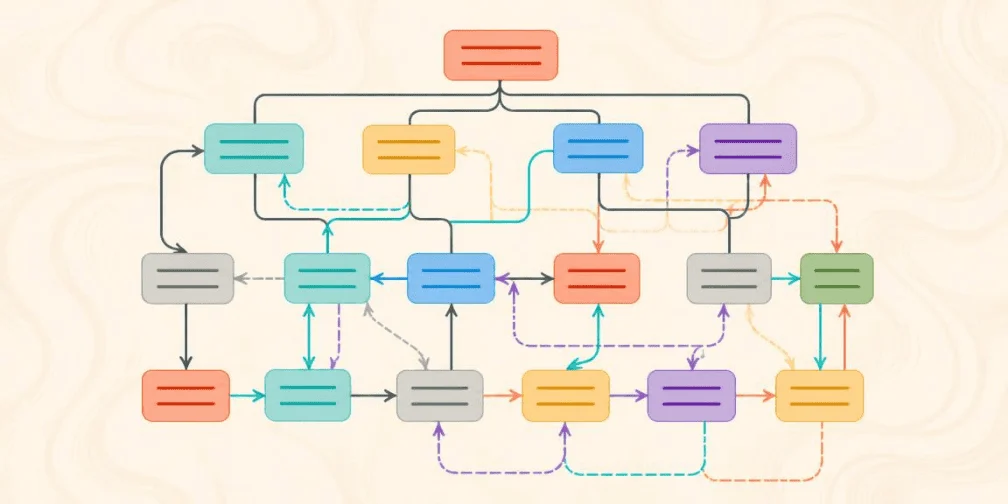
Marketing, in particular, stands to gain substantially from AI-driven solutions that can demonstrably generate a positive return on investment. However, realizing this potential requires a strategic and well-executed approach. Organizations should aim to implement one AI initiative at a time, especially when building interconnected chains of agents. This iterative process allows for learning, adjustment, and modular addition of parallelism. Maintaining a visual representation of the workflow is essential for understanding how different components fit together and for managing the flow of information.
Ultimately, the judicious application of AI in B2B marketing, guided by a framework that considers leverage, risk, and chainability, can unlock significant operational efficiencies and drive measurable business outcomes. The journey requires careful planning, a willingness to experiment, and a clear vision of how AI can be integrated to augment human capabilities and achieve strategic marketing objectives.