The rapidly evolving digital marketing landscape has introduced a critical new dimension: Answer Engine Optimization (AEO). As artificial intelligence (AI) models increasingly shape how users consume information, providing direct, concise answers rather than mere links, businesses face a pivotal decision in their visibility strategies. This choice often boils down to selecting between a dedicated AEO specialist like Scrunch or an established, full-service SEO suite such as Semrush, which has augmented its capabilities with AI visibility tools. The fundamental question for marketers is whether to integrate AI monitoring into an existing, comprehensive SEO framework or to adopt a specialized solution exclusively focused on AI-generated answers. This distinction drives every practical difference between the two platforms, influencing their pricing structures, the breadth of AI engines they monitor, their respective optimization workflows, and the inherent content delivery risks. This analysis delves into a detailed comparison of Scrunch and Semrush, examining their features, strategic approaches, and suitability for various organizational needs, while also providing broader context on the implications of AEO for modern marketing.
The Dawn of Answer Engine Optimization and Its Imperative
The digital realm is experiencing a profound shift, with AI-powered search experiences like Google AI Overviews, ChatGPT, Perplexity, and Microsoft Copilot becoming central to how users find information. Unlike traditional search engine results pages (SERPs) that primarily display lists of links, these answer engines aim to provide immediate, synthesized answers directly within the interface. This paradigm shift has given rise to Answer Engine Optimization (AEO), a discipline focused on ensuring a brand’s presence, accuracy, and positive sentiment within these AI-generated responses.
For decades, Search Engine Optimization (SEO) has been the cornerstone of online visibility, emphasizing keyword rankings, backlinks, and site authority. However, as AI models increasingly summarize content and answer queries directly, the traditional click-through model is being challenged. Data from various industry reports indicates a steady increase in zero-click searches, where users find their answers directly on the search results page without visiting a website. While specific statistics on AI answer adoption are still emerging, the rapid user growth of platforms like ChatGPT (reaching 100 million users within two months of launch) underscores the accelerating trend. This necessitates that brands not only rank in traditional search but also optimize for direct answers, making AEO an indispensable component of a holistic digital strategy. Companies that fail to adapt risk losing significant brand exposure and authority in this new information economy.
Scrunch: The Dedicated AEO Specialist
Scrunch positions itself as "The AI Customer Experience Platform," a specialist tool explicitly designed for AEO. Its core mission is to monitor and manage how a brand appears in AI-generated answers, focusing on elements such as brand presence, citation accuracy, sentiment analysis (positive, mixed, negative), and overall share of voice across various AI engines.
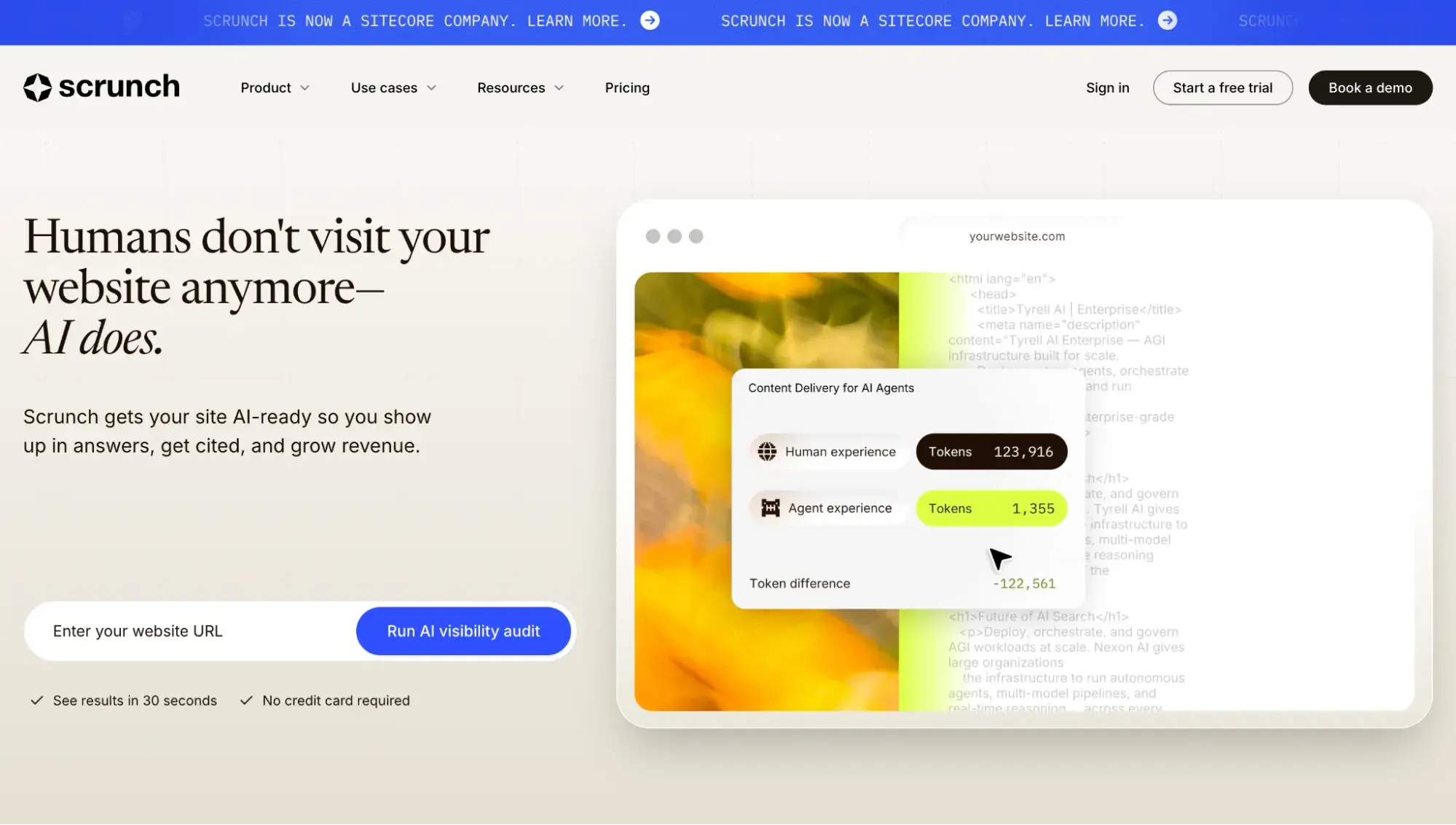
At its self-serve Core and Agency Core tiers, Scrunch monitors four key AI engines: ChatGPT, Perplexity, Google AI Overviews, and Copilot. For its Enterprise clients, this coverage expands significantly to nine engines, including Claude, Gemini, Meta AI, Google AI Mode, and Grok, in addition to the initial four. A notable distinction is Scrunch’s exclusive tracking of Meta AI across all tiers, an engine not covered by Semrush. Scrunch’s monitoring is prompt-native, estimating topic-level volume by clustering related prompts. It offers daily refresh rates for new prompts over a 14-day period, then every 72 hours, with the option for on-demand data pulls.
From a workflow perspective, Scrunch adopts a "human-in-the-loop" model. Its "Content Gaps" feature identifies prompts where a brand is absent or underrepresented, generating content briefs that teams can then use to create or update content. Scrunch supports data export through a Data API, Looker Studio, GA4, and Adobe Analytics, facilitating integration into existing analytics stacks. The platform’s re-measurement strategy suggests checking back after 30 to 60 days to confirm the closure of citation gaps.
A distinctive and somewhat contentious feature of Scrunch’s Enterprise plan is its Agent Experience Platform (AXP). AXP is a content-delivery layer designed to serve a simplified, bot-friendly version of a webpage to AI crawlers, while human visitors see the standard website content. Scrunch explicitly states that AXP does not use llms.txt (analogous to robots.txt for LLMs) and, crucially, does not serve the bot-friendly version to Google crawlers, aiming to avoid traditional SEO penalties for cloaking. Scrunch defends AXP by arguing that the AI version "reflects the same intent" as the human-facing page, thus not being deceptive.
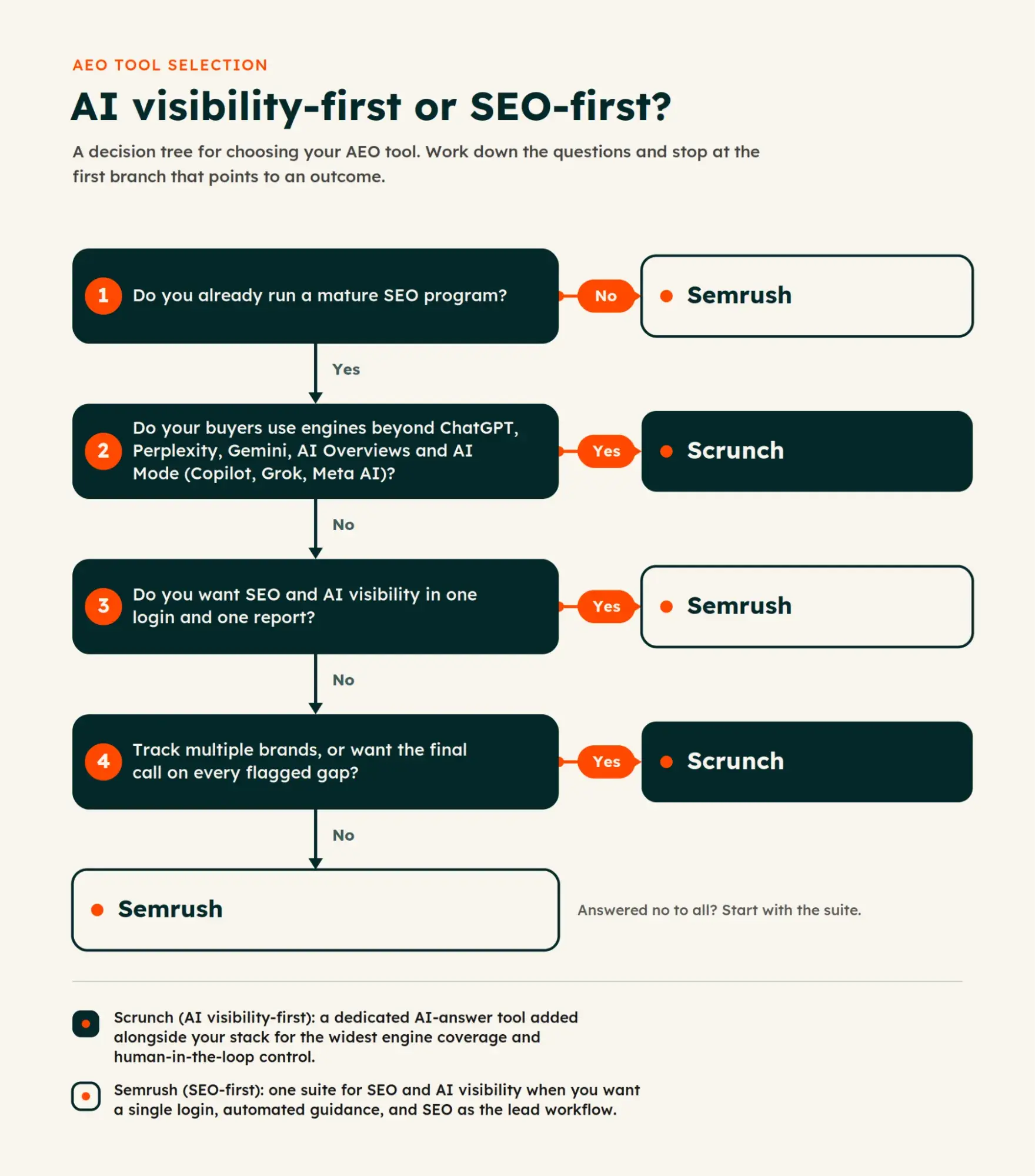
Scrunch is best suited for organizations that already have a mature SEO program and wish to add a dedicated AI-answer monitoring layer without overhauling their existing toolkit. It appeals to agencies needing to manage multiple brand workspaces and teams that prefer a manual review process before acting on AI insights. Its direct connection to GA4 for AI-referred sessions and revenue tracking also makes it attractive for teams focused on direct ROI measurement from AEO.
Semrush: The Integrated SEO and AI Visibility Powerhouse
Semrush, long established as a "brand visibility management platform," offers a comprehensive suite encompassing traditional SEO, content marketing, paid media, and now, AI search optimization. Its approach to AEO is to integrate it as a dedicated "AI Visibility Toolkit" within its broader ecosystem, available either as an add-on or bundled within its "Semrush One" plans.
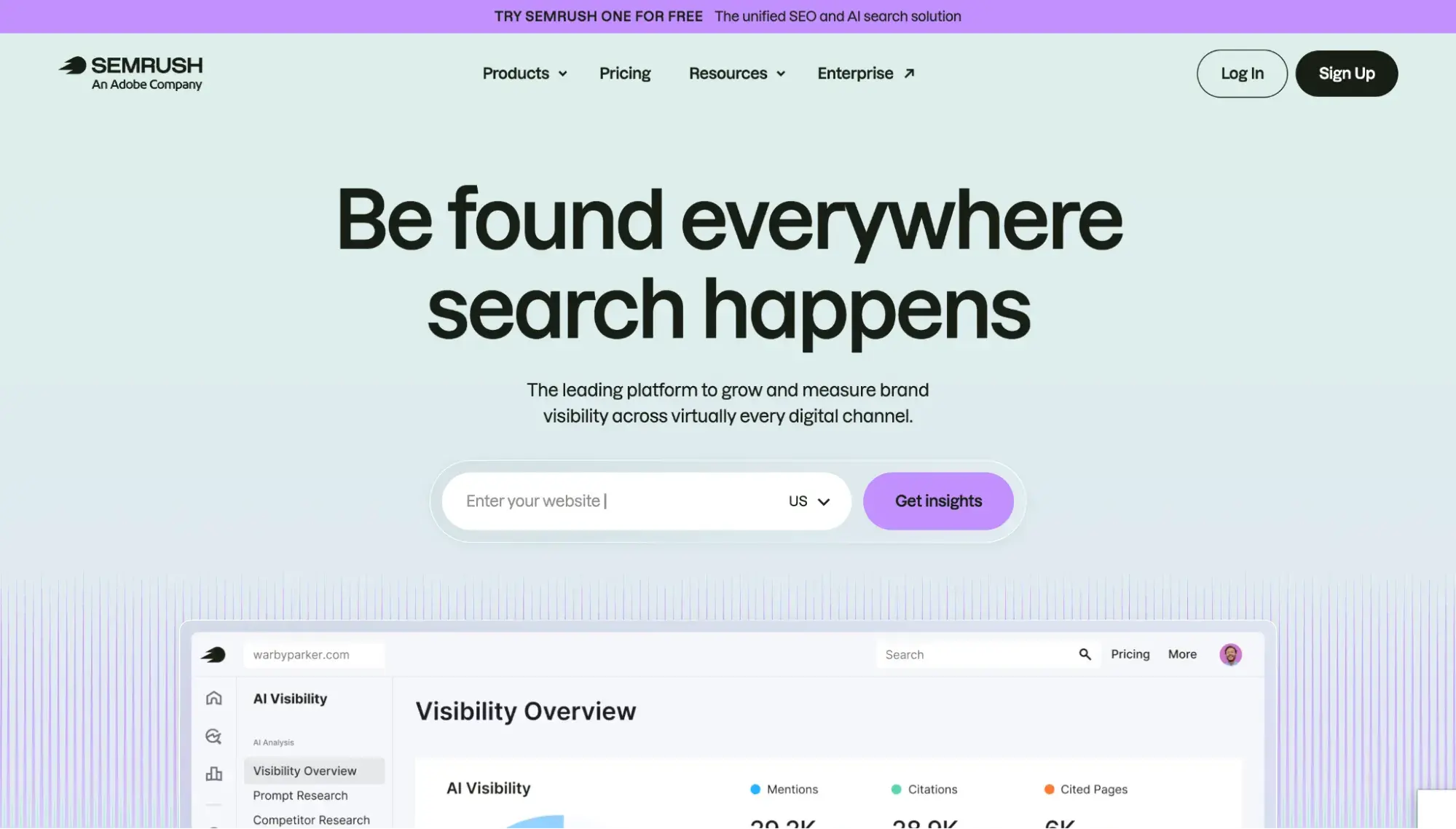
Semrush’s AI Visibility Toolkit tracks five key engines on its self-serve plans: Google AI Mode, AI Overviews, ChatGPT, Perplexity, and Gemini. Its custom Enterprise tier expands this coverage to nine engines, adding Claude, Microsoft Copilot, Grok, and DeepSeek, alongside the initial five. Semrush uniquely includes DeepSeek at its Enterprise tier, which Scrunch does not. The platform updates its core reports daily and Brand Performance weekly, performing prompt and topic research from a database of over 289 million AI queries. Sentiment analysis is labeled as favorable versus neutral.

Regarding pricing, Semrush offers the AI Visibility Toolkit as a $99 add-on to its SEO Classic plans (starting from $139.95), or it can be accessed through its bundled Semrush One plans (e.g., Starter at $199/month). The cost is influenced by the number of users, tracked domains, and prompts.
Semrush’s workflow leans towards automated recommendations. Its "Brand Performance" reports identify "AI Strategic Opportunities" and generate suggested action plans. The "Prompt Research" report allows for one-click transfer of a topic into the "Content Toolkit" to initiate a draft. Furthermore, Semrush incorporates an "AI Search Site Audit," bringing SEO-style crawl checks into the AI optimization process. For re-measurement, its "Prompt Tracking" logs daily visibility changes, enabling direct correlation between content updates and AI answer movements.
Semrush’s content delivery approach is straightforward: it optimizes one page for all audiences – human and AI. This avoids the complexities and potential risks associated with serving different content versions, thereby adhering to Google’s long-standing guidelines against cloaking and minimizing duplicate content exposure.
Semrush is an ideal choice for leaner teams or those already deeply invested in its ecosystem. It allows for managing SEO and AI visibility from a single login, making it efficient for marketers who prioritize a unified platform for rank tracking, site audits, backlinks, and AI insights. Its automated recommendations suit teams that prefer quicker action plans over extensive manual review. For SMBs and mid-market teams, Semrush positions AI visibility as an integrated report within an existing SEO workflow rather than a separate discipline.
A Detailed Comparative Analysis: Strategic Approaches and Operational Impact
The choice between Scrunch and Semrush transcends mere feature lists, delving into strategic alignment, operational efficiency, and risk tolerance.
Pricing and Total Cost of Ownership: Scrunch’s standalone AEO subscription model (starting at $250/month for Core) offers a clear cost for dedicated AI visibility. Semrush’s model, with a $99 add-on to existing SEO plans (e.g., $139.95 for SEO Classic), means its AI visibility starts at a higher total cost if a full SEO suite is also required. However, for existing Semrush users, it’s a more cost-effective integration. The true cost of ownership for both platforms depends heavily on specific needs regarding the number of seats, monitored domains or brand workspaces, and the volume of prompts tracked. For comprehensive coverage across nine engines, both platforms require an Enterprise-level subscription, which is custom-priced. This suggests that for larger organizations with complex needs, direct negotiation will determine the final investment.
Monitoring Breadth and Depth: While both platforms offer extensive monitoring at their Enterprise tiers (nine engines each), their entry-level offerings differ. Semrush provides coverage for five engines (Google AI Mode, AI Overviews, ChatGPT, Perplexity, Gemini) at its self-serve tiers, narrowly surpassing Scrunch’s four (ChatGPT, Perplexity, Google AI Overviews, Copilot). Scrunch’s unique offering of Meta AI tracking at all tiers provides a specific advantage for brands prioritizing visibility on that particular platform. Conversely, Semrush’s Enterprise AIO includes DeepSeek, which Scrunch does not. The volume of prompts tracked and refresh rates also vary, with Semrush’s Enterprise tier offering up to 15,000 daily prompt tracking, reflecting a robust data acquisition capability.
Optimization Workflow and Actionability: The philosophical difference in workflow is significant. Scrunch’s "human-in-the-loop" approach, where content briefs are generated for manual review and execution, empowers marketers to maintain granular control over every piece of content. This suits teams with robust content creation processes and a desire for meticulous oversight. In contrast, Semrush’s "automated recommendations" and one-click drafting into its Content Toolkit offer a streamlined, faster path from insight to content creation. This can be highly beneficial for teams with limited resources or those prioritizing speed and efficiency. The ability to directly push topics into a content drafting tool within the same platform minimizes context-switching, a common bottleneck in marketing operations.
Content Delivery and Risk Management: This is perhaps the most significant divergence. Semrush’s strategy of optimizing a single webpage for both human readers and AI systems is inherently lower risk. It aligns with traditional SEO best practices and avoids any potential accusations of "cloaking" by search engines like Google, which strictly penalizes sites that serve different content to crawlers versus users. While Scrunch explicitly states its AXP does not serve bot-friendly versions to Googlebot, the concept of a dual content layer introduces a novel complexity. The industry is still nascent in defining best practices for AI-specific content delivery, and any deviation from established norms, however well-intentioned, carries a degree of uncertainty. Marketers must weigh the potential benefits of hyper-optimized AI content against the possible long-term risks or ethical considerations of maintaining two distinct versions of their web presence. The lower-risk path, emphasized by both HubSpot and Semrush, involves structuring content to be universally legible and extractable, regardless of the audience.
Strategic Considerations for Marketers
The emergence of AEO necessitates a re-evaluation of marketing strategies.
- Resource Allocation: Businesses must decide whether to allocate budget to a dedicated AEO tool or to invest in an integrated suite that combines SEO and AEO. This impacts not only financial outlay but also the training and skill sets required within the marketing team.
- Workflow Integration: The choice influences operational efficiency. A single, integrated platform like Semrush can streamline workflows, reducing the need for data transfers and context-switching. Conversely, Scrunch, with its open integrations, allows teams to pipe AEO data into existing analytics and content management systems, catering to "best-of-breed" preferences.
- Future-Proofing: Both tools aim to position brands for the future of AI search. However, their different approaches to content delivery and integration with traditional SEO reflect varying philosophies on how this future will unfold.
- Measuring ROI: Connecting AI visibility gains to tangible business outcomes is paramount. Scrunch’s AI Referrals tab, linking to GA4 for revenue and conversion tracking, offers a direct pathway. Semrush also enables GA4 data integration within its "My Reports" for similar analysis. However, a more robust connection to pipeline and CRM data, as offered by platforms like HubSpot Marketing Hub, provides a holistic view of how AI visibility translates into leads and deals.
Beyond Scrunch and Semrush: The Broader AEO Ecosystem
While Scrunch and Semrush represent two prominent approaches, the AEO landscape is diverse. Alternatives include other dedicated AEO startups (e.g., Profound, AthenaHQ, Peec AI, Otterly AI), general SEO tools that are increasingly adding AI-related features, and specialized AI content generation tools that can assist with creating AEO-friendly content. The market is dynamic, with new solutions continually emerging, each offering unique strengths tailored to specific needs, budgets, and technical capabilities. The overarching principle remains: the effectiveness of any tool is ultimately tied to how well the generated insights are translated into actionable, high-quality content.
Best Practices for AI-Optimized Content without Risk
Regardless of the chosen tool, a fundamental strategy for low-risk AI visibility involves optimizing a single page for both human readers and AI answer engines. This approach avoids the complexities and potential penalties associated with serving different content versions. Key elements of this strategy include:
- Direct Answers: Lead each page with a concise, direct answer to the primary query it addresses.
- Question-Matching Headers: Utilize clear, question-based headings (H1, H2, H3) that align with user queries and AI processing.
- Factual Specificity: Provide accurate, detailed, and verifiable information to enhance AI’s ability to extract reliable answers.
- Structured Data: Implement schema markup (e.g., FAQ schema, HowTo schema) to explicitly tell AI models what your content is about and how it should be interpreted.
- Scannable Formatting: Use bullet points, numbered lists, short paragraphs, and bold text to improve readability for humans and parseability for AI.
- Authoritative External Links: Include credible outbound links to reinforce expertise and trustworthiness, a factor often considered by AI models.
By structuring content in this manner, a page becomes inherently legible to human readers and readily extractable by AI, without requiring a separate bot-only version. This strategy mitigates the risk of duplicate content exposure and aligns with established principles of good web governance. The iterative process of auditing AI answers, identifying content gaps, updating or creating content, and then re-measuring its impact after a refresh cycle remains crucial for sustained AEO success. Integrating content creation and publishing within a unified platform, such as HubSpot’s content operations platform, can further accelerate this cycle, allowing marketers to move from insight to live content more efficiently.
Conclusion: Making an Informed Choice
The decision between Scrunch and Semrush hinges on a brand’s existing infrastructure, strategic priorities, and risk appetite. For mature organizations with a robust SEO stack already in place, Scrunch offers a dedicated, specialized layer for AI answer monitoring, allowing them to complement their current operations without disruption. Its "human-in-the-loop" model and specific Meta AI tracking might be decisive factors. Conversely, Semrush provides an integrated solution, making it ideal for teams seeking to manage both traditional SEO and emerging AEO within a single, unified platform. Its automated recommendations and lower-risk content delivery approach appeal to those prioritizing efficiency and adherence to established web standards.
Ultimately, the choice reflects a broader strategic direction: whether to pursue a "best-of-breed" approach with specialized tools for each facet of digital marketing or to consolidate efforts within a comprehensive, integrated suite. As AI continues to reshape the digital landscape, the agility to adapt and optimize for new visibility channels will be a defining characteristic of successful marketing endeavors.