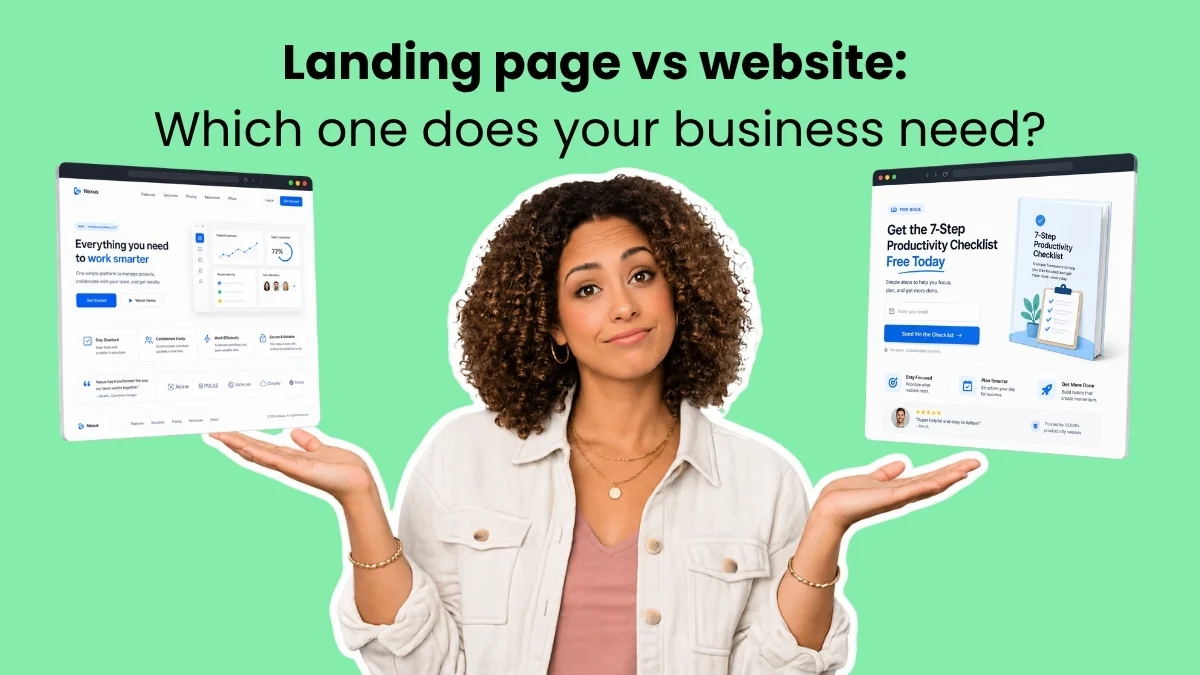
The digital realm presents a myriad of opportunities for businesses to establish their presence, engage with audiences, and drive conversions. However, for many entrepreneurs and small business owners, the initial steps into this online world are often fraught with fundamental questions: "Do I need a website? What exactly is a landing page for? And critically, do I need both?" These inquiries reflect a common dilemma in an increasingly complex digital marketing ecosystem, where understanding the distinct functions and strategic advantages of each tool is paramount for setting a business up for immediate and long-term success.
The fundamental objective for any online venture is to carve out a visible and effective space on the internet, thereby building an audience and fostering growth. Yet, the path to achieving this is multifaceted, offering various digital avenues, each with unique characteristics and optimal use cases. This article aims to demystify the core similarities and differences between landing pages and websites, providing a comprehensive guide to selecting the right tool for specific business objectives, and outlining how to strategically integrate them into a cohesive digital marketing strategy.
The Evolution of Online Presence: A Brief Chronology
The journey of digital presence began with rudimentary, static websites in the early 1990s, primarily serving as online brochures. As internet accessibility expanded and technology advanced, websites evolved into dynamic, interactive platforms capable of hosting vast amounts of information, facilitating e-commerce, and fostering community engagement. This era saw the rise of Content Management Systems (CMS) like WordPress, making website creation more accessible to non-developers.
Parallel to this evolution, the demands of performance-driven marketing led to the emergence and refinement of specialized tools. With the advent of paid advertising, email marketing, and social media campaigns, marketers needed dedicated pages designed for singular, measurable actions. This necessity gave birth to the modern landing page – a highly focused, conversion-oriented digital asset. The mid-2000s onwards witnessed a rapid acceleration in digital marketing sophistication, where the distinction between a broad informational website and a targeted conversion landing page became increasingly critical for optimizing campaign performance and maximizing return on investment. This chronological progression highlights a continuous drive towards greater efficiency and specificity in online communication and marketing efforts.
Defining the Pillars of Digital Presence: Websites vs. Landing Pages
To effectively deploy either tool, a clear understanding of their inherent definitions and intended purposes is essential. While both are web pages accessible via a browser, their architectural and functional philosophies diverge significantly.
The Website: Your Digital Headquarters
A website typically serves as a comprehensive digital headquarters for a business. It is a collection of interconnected web pages, usually comprising five or more distinct sections, meticulously designed to offer a holistic view of the entity it represents. Common components of a robust website include:
- Homepage: The primary entry point, providing an overview and navigation to other sections.
- About Us/Company Page: Detailing the organization’s mission, values, history, and team.
- Services/Products Page(s): Showcasing offerings with detailed descriptions, features, and benefits.
- Blog/Resources Section: Providing valuable content, establishing thought leadership, and aiding SEO.
- Contact Us Page: Offering various methods for visitors to get in touch.
- Portfolio/Gallery: Displaying past work or visual assets.
- E-commerce Store: For businesses selling products directly online.
The overarching goal of a website is exploration and education. Visitors are invited to browse freely, delve into various aspects of the business, find answers to their queries, and gradually build familiarity and trust over time. It functions as a one-stop shop for everything a potential customer might need to know about a business, its offerings, and its brand identity.
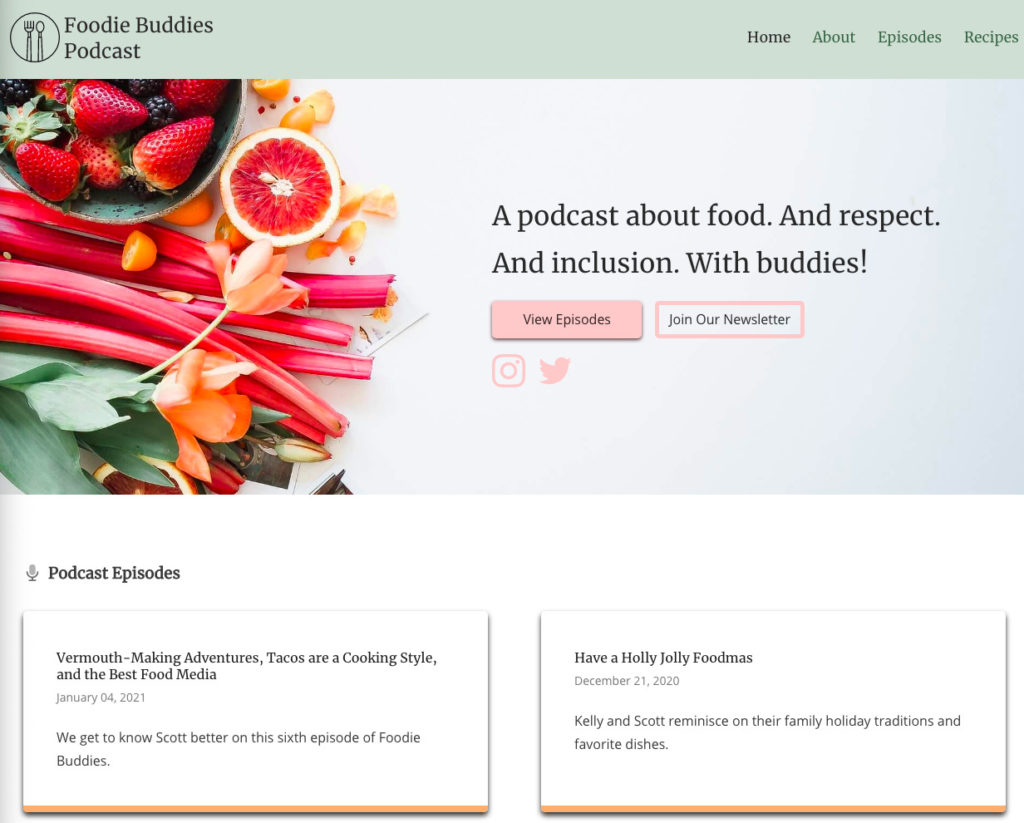
This comprehensiveness, however, comes with inherent requirements. Websites demand more significant investments in terms of time, financial resources, and ongoing upkeep. Developing a professional website often involves designers, developers, content creators, and requires continuous maintenance for security, updates, and content freshness. According to industry data, the initial cost of developing a custom business website can range from a few thousand dollars to tens of thousands, depending on complexity and features, with ongoing hosting and maintenance fees adding to the operational budget. Despite these costs, a well-structured website is indispensable for long-term brand building, establishing online authority, and serving as the central hub for all digital marketing activities. For instance, the website for the "Foodie Buddies" podcast, as observed in various online examples, allows visitors to navigate seamlessly between learning about the podcast, accessing past episodes, and discovering related recipes, exemplifying the exploratory nature of a website.
The Landing Page: Your Targeted Conversion Machine
In stark contrast, a landing page is a standalone web page with a singular, laser-focused objective and a single, clear call to action (CTA). It is characterized by limited navigation, meaning visitors cannot easily click away to other pages within a broader site. The design philosophy behind a landing page is to eliminate distractions, guiding the visitor towards one specific action. A visitor "lands" on the page, consumes the focused information, and then has a clear choice: take the intended action or leave.
Common goals for which landing pages are optimally deployed include:
- Lead Generation: Collecting email addresses for newsletters, free resources (e.g., e-books, whitepapers), or webinar registrations.
- Product/Service Promotion: Driving sales for a specific product, service, or limited-time offer.
- Event Registration: Encouraging sign-ups for conferences, workshops, or online events.
- Survey/Feedback Collection: Gathering user insights or opinions.
- Click-Through: Directing visitors to another page, such as an e-commerce product page, after presenting a compelling offer.
- Link Directory (e.g., Link-in-Bio): Consolidating multiple important links for social media profiles.
The effectiveness of landing pages stems from their highly focused design, which minimizes cognitive load and decision fatigue for the visitor. By presenting a clear value proposition and a single path forward, landing pages typically achieve significantly higher conversion rates compared to general website pages. Industry benchmarks often indicate that dedicated landing pages can convert visitors at rates 2-3 times higher than homepages or other general website pages, with some specialized campaigns seeing even greater differences. This efficiency makes them invaluable for paid advertising campaigns, email marketing promotions, and social media calls to action. The "Foodie Buddies" podcast, for example, might utilize a landing page specifically designed as a link directory for its social media bios, streamlining the process for followers to access various content pieces without navigating a full website.
Side-by-Side Analysis: Key Differences and Strategic Implications
Understanding the fundamental distinctions between websites and landing pages is crucial for strategic deployment. Imagine a website as a continent, with diverse landscapes and interconnected cities for exploration. A landing page, in this analogy, is a precisely targeted island off the coast, designed for a singular purpose upon arrival.
| Feature | Landing Page | Website |
|---|---|---|
| Number of Pages | One | Five or more, interconnected |
| Navigation | None or minimal (e.g., privacy policy link) | Full menu facilitating extensive browsing |
| Primary Goal | One specific action (e.g., signup, purchase) | Exploration, education, brand building, information repository |
| Calls to Action | One primary, prominent CTA | Multiple, varied CTAs spread across pages |
| Time to Launch | Minutes to hours | Days to weeks (or months for complex sites) |
| Cost | Low, often included with marketing tools | Higher: design, development, hosting, maintenance |
| Best For | Specific campaigns, lead generation, product launches, A/B testing, list growth | Established businesses, comprehensive brand presence, content marketing, e-commerce, long-term SEO |
| SEO Focus | Generally less (campaign-specific) | High (long-term organic traffic generation) |
| Analytics Focus | Conversion rate, cost per conversion | Traffic, bounce rate, time on site, page views, SEO rankings |
The structural and functional differences translate directly into behavioral implications. A landing page explicitly directs a visitor towards a single objective, minimizing choices to maximize the likelihood of conversion. A website, conversely, invites broad engagement, allowing visitors to self-direct their journey based on their interests and informational needs.
When to Deploy Each: Strategic Considerations
The decision to use a landing page, a website, or both, is not merely technical but deeply strategic, aligning with specific business objectives, available resources, and the stage of the business.
Optimal Scenarios for Landing Pages:
Landing pages are the tool of choice when focus and immediate action are paramount. They excel in scenarios such as:
- Campaign-Specific Marketing: When running paid advertising (Google Ads, social media ads) or email marketing campaigns, a landing page ensures that ad spend is directed to a highly optimized conversion point, maximizing ROI.
- Lead Magnet Distribution: Offering free e-books, webinars, templates, or courses to capture email addresses and build a subscriber list.
- Product/Service Launches: Generating excitement and collecting pre-orders or sales for a new offering.
- Market Validation: Testing the viability of a new idea, product, or service before committing significant resources to a full website or extensive development. A landing page can be built in an afternoon to gauge interest.
- Social Media Bio Links: Providing a single, actionable link in social media profiles that directs followers to multiple important destinations (e.g., latest blog post, product page, signup form).
- Budget and Time Constraints: For startups or solopreneurs just beginning their online journey, a landing page offers a rapid, cost-effective way to establish an initial online presence and start generating leads or sales without the overhead of a full website.
Optimal Scenarios for Websites:
A website becomes indispensable when a business requires depth, broad information dissemination, and a sustained online presence. Use a website when:
- Comprehensive Brand Building: To establish a complete brand identity, articulate values, and build long-term trust and authority.
- Multiple Products or Services: When a business offers a diverse range of offerings that require dedicated pages for explanation and presentation.
- Extensive Content Marketing: To host a blog, resource library, case studies, or whitepapers, positioning the business as a thought leader and attracting organic traffic through SEO.
- E-commerce Operations: For businesses selling multiple products online, requiring a robust catalog, shopping cart, and checkout system.
- Customer Support and FAQs: Providing a central hub for customer inquiries, support documentation, and frequently asked questions.
- Long-Term Search Visibility: A well-optimized website with consistent, valuable content is foundational for improving organic search engine rankings and attracting a steady stream of passive visitors over time.
It is crucial to understand that these tools are not mutually exclusive; rather, they are often complementary. Even businesses with robust, multi-page websites leverage landing pages for specific conversion goals. For example, while a business’s website may showcase its full product line, a specific ad campaign for a new product should ideally direct traffic to a dedicated landing page for that product, designed to convert immediately, rather than the busy homepage.
Expert Insights and Industry Trends
Digital marketing strategists consistently emphasize that the choice between a website and a landing page hinges entirely on the specific objective. "The most effective digital strategies are built on clarity of purpose," notes a prominent marketing consultant. "If your goal is to inform and explore, a website is your canvas. If your goal is to convert a specific action, a landing page is your precision tool."
Current industry trends further highlight the importance of both. The rise of personalized marketing and micro-experiences means that highly targeted landing pages are more critical than ever for delivering relevant content to specific audience segments. Furthermore, the increasing integration of artificial intelligence (AI) in content creation tools, as seen in platforms like AWeber’s AI-powered content creator, is making it faster and easier to generate compelling copy for both websites and landing pages, democratizing sophisticated marketing techniques for businesses of all sizes. The "mobile-first" imperative also applies equally to both, as a significant portion of internet traffic now originates from mobile devices, demanding responsive design and fast loading times for optimal user experience and conversion rates.
Can a Business Thrive on Landing Pages Alone?
For a growing number of creators, coaches, solopreneurs, and lean startups, the answer is a resounding yes. It is entirely feasible to operate a successful business primarily or even exclusively using landing pages. This model typically involves:
- One Landing Page for Email Sign-ups: Serving as the primary mechanism for audience building.
- Another for Selling a Digital Product: Such as an online course, e-book, or membership.
- A "Link-in-Bio" Page: Consolidating important links for social media.
In this "landing pages only" ecosystem, email marketing becomes the foundational backbone of the business. Once a subscriber is captured via a landing page, a carefully crafted email sequence takes over many functions traditionally handled by a website: education about the brand, building trust, nurturing leads, and promoting offers. The email list effectively becomes the core asset, and the landing page serves as the initial "front door."
This approach offers significant advantages in agility and cost-effectiveness. Businesses can launch new offers quickly, validate market demand, and iterate rapidly without the overhead of maintaining a complex website. Platforms like AWeber provide integrated solutions, allowing users to build and publish landing pages with drag-and-drop editors, built-in hosting, secure connections (SSL), and direct payment collection capabilities, ensuring that every signup flows seamlessly into an email list for immediate engagement.
However, operating solely on landing pages also has limitations. It may result in less organic search visibility compared to a content-rich website, and some audiences might perceive a business without a comprehensive website as less established or authoritative. Therefore, while viable, this model is often best suited for businesses with a very focused offering and a strong reliance on direct marketing channels.
Conclusion: A Strategic Choice for Digital Success
The decision between a website and a landing page is not a matter of one being inherently superior to the other; rather, it is a strategic choice dictated by specific business goals, available resources, and the desired customer journey. A website acts as the comprehensive digital headquarters, essential for long-term brand building, extensive information sharing, and establishing authority through content marketing and SEO. A landing page, conversely, is a highly specialized, agile tool engineered for singular conversion objectives, making it invaluable for targeted campaigns, lead generation, and rapid market validation.
For many businesses, the most potent strategy involves a symbiotic relationship between both. A robust website provides the overarching brand narrative and informational depth, while strategically deployed landing pages act as precision instruments, guiding specific segments of the audience towards immediate action. The evolution of digital marketing tools and the increasing sophistication of user behavior underscore the importance of this nuanced approach. By understanding the distinct strengths of websites and landing pages, businesses can craft a digital presence that is both expansive and effective, ensuring they not only attract visitors but also convert them into loyal customers and advocates. The ultimate goal remains consistent: to communicate value effectively and drive desired outcomes, leveraging the right digital asset for the right purpose.


 Ammar Sabilarrohman
 Asro
Asro