
 rifanmuazin
In the competitive landscape of digital product development, the transition from intuition-based decision-making to a data-driven experimentation culture is often fraught with a paradoxical failure known as the big test trap. This phenomenon, characterized by an initial over-ambition that leads to long-term stagnation, has become a primary hurdle for Conversion Rate Optimization (CRO) initiatives globally. Lucia van den Brink, the founder of the specialized consultancy The Initial, recently detailed a comprehensive framework for avoiding these pitfalls during an appearance on the VWO Podcast. Her insights provide a roadmap for organizations to move beyond the paralyzing desire for “transformative” first tests and toward a sustainable, high-velocity experimentation engine.
The Lifecycle of a Stalled Experimentation Program
The narrative of a failing experimentation program often begins with internal advocacy. A dedicated team, led by figures like the hypothetical “Alex,” spends months pitching the merits of A/B testing to executive leadership. When approval is finally granted, the pressure to prove immediate, massive ROI leads to a critical error: the selection of a high-stakes, high-complexity project as the debut experiment.
Chronologically, these projects follow a predictable and destructive path. Within the first three months, the “big test” is typically mired in design reviews and stakeholder alignment meetings. By the six-month mark, the project remains in the development queue, competing for engineering resources against core product features. A year after the program’s inception, the initial momentum has evaporated, leadership has lost interest due to a lack of tangible results, and the experimentation culture is declared a failure before it truly began. Van den Brink notes that this cycle is not an anomaly but a recurring pattern across various industries, from B2B SaaS to global e-commerce.
Understanding the Mechanics of the Big Test Trap
The inclination toward large-scale experiments stems from a fundamental misunderstanding of how organizational buy-in is maintained. Leadership naturally gravitates toward projects that promise significant shifts in core metrics—such as a total homepage redesign or the implementation of a complex fraud detection system. There is an implicit, though often flawed, assumption that the magnitude of the change is directly proportional to the magnitude of the impact.
In reality, large-scale tests introduce excessive variables, making it nearly impossible to isolate which specific change influenced the user’s behavior. Furthermore, these tests require extensive cross-departmental coordination, which increases the likelihood of “bottlenecking.” When a test takes six months to launch, the cost of learning becomes prohibitively high. If the test fails, the organization has lost half a year of potential insights; if it succeeds, the team has still missed the opportunity to run dozens of smaller, faster experiments that could have yielded cumulative gains.

Step 1: Identifying the Psychological Drivers of Over-Ambition
The first stage of Van den Brink’s framework involves recognizing why organizations fall into this trap. Often, the “big test” is used as a shield against skepticism. Teams feel that unless they change something fundamental, the results will be too “noisy” to convince critics. However, this creates a high-risk environment where the entire future of the experimentation program rests on a single roll of the dice.
Van den Brink cites examples where product owners attempted to test foundational systems, such as entire new user onboarding flows, as their first initiative. While these areas certainly need optimization, they are poor candidates for a program’s infancy. The complexity of the technical implementation and the number of stakeholders involved create a “friction-heavy” environment that stifles the agility required for a successful testing culture.
Step 2: The Strategic Value of Incrementalism
To counter the allure of the big swing, Van den Brink advocates for a focus on small tests that can drive significant impact. The objective in the early stages of a CRO program should not be to “move the needle” in a single jump, but to build the operational muscle required to test frequently. Small tests—such as modifying call-to-action (CTA) language, adjusting visual hierarchy, or refining value propositions—offer several strategic advantages.
First, they are low-risk. A minor copy change is unlikely to break a site’s functionality or alienate a core user base. Second, they are fast to deploy, often requiring minimal developer intervention. This speed allows teams to generate a steady stream of data points, which serves to educate the organization on user preferences. Third, these small wins provide the “evidence for the case of experimentation” that Van den Brink considers essential for long-term survival. When a team can show three small wins in a month, they build more credibility than a team that spends six months preparing for one large experiment.
Step 3: Implementing a Balanced Portfolio Approach
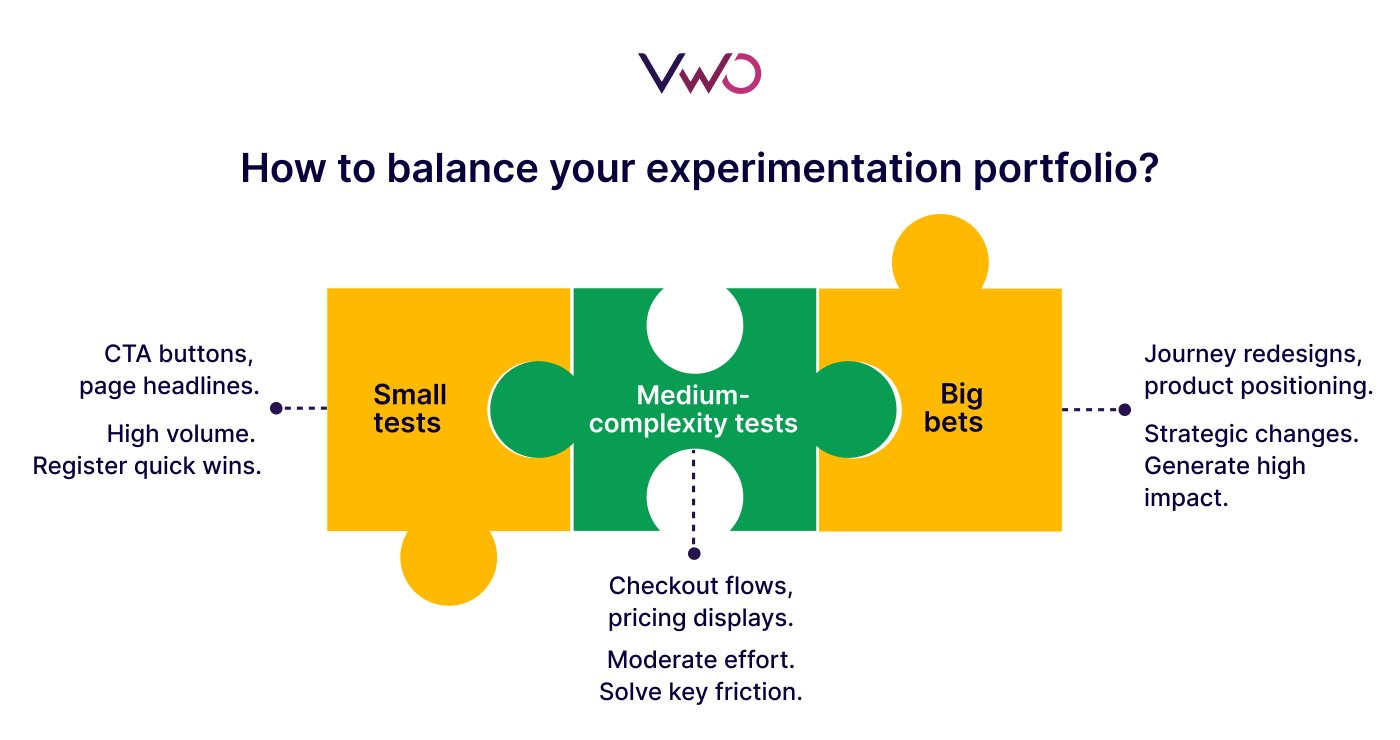
Once the “habit” of testing is established, the focus shifts to portfolio management. A mature experimentation program should mirror a financial investment portfolio, diversifying risk across different types of initiatives. Van den Brink suggests that decisions about which tests to run should be intentional rather than reactive.

A balanced portfolio typically includes:
- Operational Tests: Small, “low-hanging fruit” changes that keep the testing engine running and provide quick insights.
- Strategic Tests: Medium-sized experiments that explore specific hypotheses about user behavior or feature adoption.
- Innovative Tests: Large-scale, high-risk “swings” that could fundamentally change the business trajectory.
By maintaining this balance, an organization ensures that it is constantly learning through small experiments while still making progress on larger strategic goals. This prevents the program from becoming either a “copy-change only” shop or a “one-test-per-year” department.
Step 4: Using High-Complexity Tests for Validation, Not Exploration
One of the most profound shifts in Van den Brink’s framework is the redefined role of the “big test.” In unsuccessful programs, big tests are used for exploration—throwing a massive change at the wall to see if it sticks. In successful programs, big tests are used for validation.
Before committing to a full-scale redesign, a high-performing team will have run a series of smaller tests to identify which elements resonate with users. For instance, if a series of small tests reveals that users respond better to “benefit-driven” messaging (e.g., “Save more money”) than “feature-driven” messaging (e.g., “Automated expense tracking”), that insight becomes the foundation for the eventual large-scale redesign. In this context, the big test is not a gamble; it is the culmination of a series of proven hypotheses. This approach significantly reduces the risk of a “flat” or negative result on a high-investment project.
The Role of Infrastructure and Culture in Sustainability
Building a sustainable program requires more than just a framework for choosing tests; it requires a supporting infrastructure. Van den Brink points out that the most successful teams prioritize documentation and communication. This includes maintaining a centralized repository of insights, where both winning and losing experiments are recorded.
In a B2B SaaS context, for example, a team might spend the first three months of their program building this infrastructure. They establish a “test request” workflow, integrate their experimentation platform (such as VWO) with their analytics stack, and create a recurring “learning share” meeting. After six months of this disciplined approach, the team might have run 20 tests. Even if only five were “winners,” the organization has gained 20 distinct insights into user behavior, and the habit of asking “should we test this?” becomes ingrained in the product development lifecycle.
Furthermore, the integration of modern technology, such as AI-powered assistants like VWO Copilot, has drastically lowered the barrier to entry for small-scale testing. These tools can assist in generating variations, setting up tracking metrics, and defining target audiences in minutes, allowing teams to focus on strategy rather than technical setup.
Broader Industry Implications and Analysis
The shift toward the “start small, scale fast” methodology reflects a broader trend in digital transformation. As market volatility increases, the cost of being wrong on a “big bet” has risen. Organizations that can iterate quickly and pivot based on real-time user data are outperforming those that rely on long-cycle, high-investment projects.
From a journalistic perspective, the data supports this incremental approach. Industry benchmarks often show that only 10% to 20% of A/B tests result in a statistically significant positive outcome. In such an environment, the only way to ensure success is through volume. If a company runs only two “big” tests a year, their chances of failure are high. If they run 50 “small” tests, they are virtually guaranteed to find several significant wins that, when compounded, lead to transformative growth.
Conclusion: The Path Forward for CRO Leaders
Lucia van den Brink’s framework serves as a critical correction for organizations that have struggled to move past the initial excitement of experimentation. By recognizing the big test trap, focusing on high-impact small tests, balancing the experimentation portfolio, and using large-scale projects for validation rather than exploration, companies can build a culture that values learning over “being right.”
The ultimate goal of an experimentation program is not to find a single “silver bullet” that doubles conversion rates overnight. Instead, it is to create a system where data-driven insights are generated continuously, reducing uncertainty and fostering a more agile, responsive, and ultimately more profitable business. For leaders looking to implement this change, the message is clear: the most successful big things almost always start small.








