

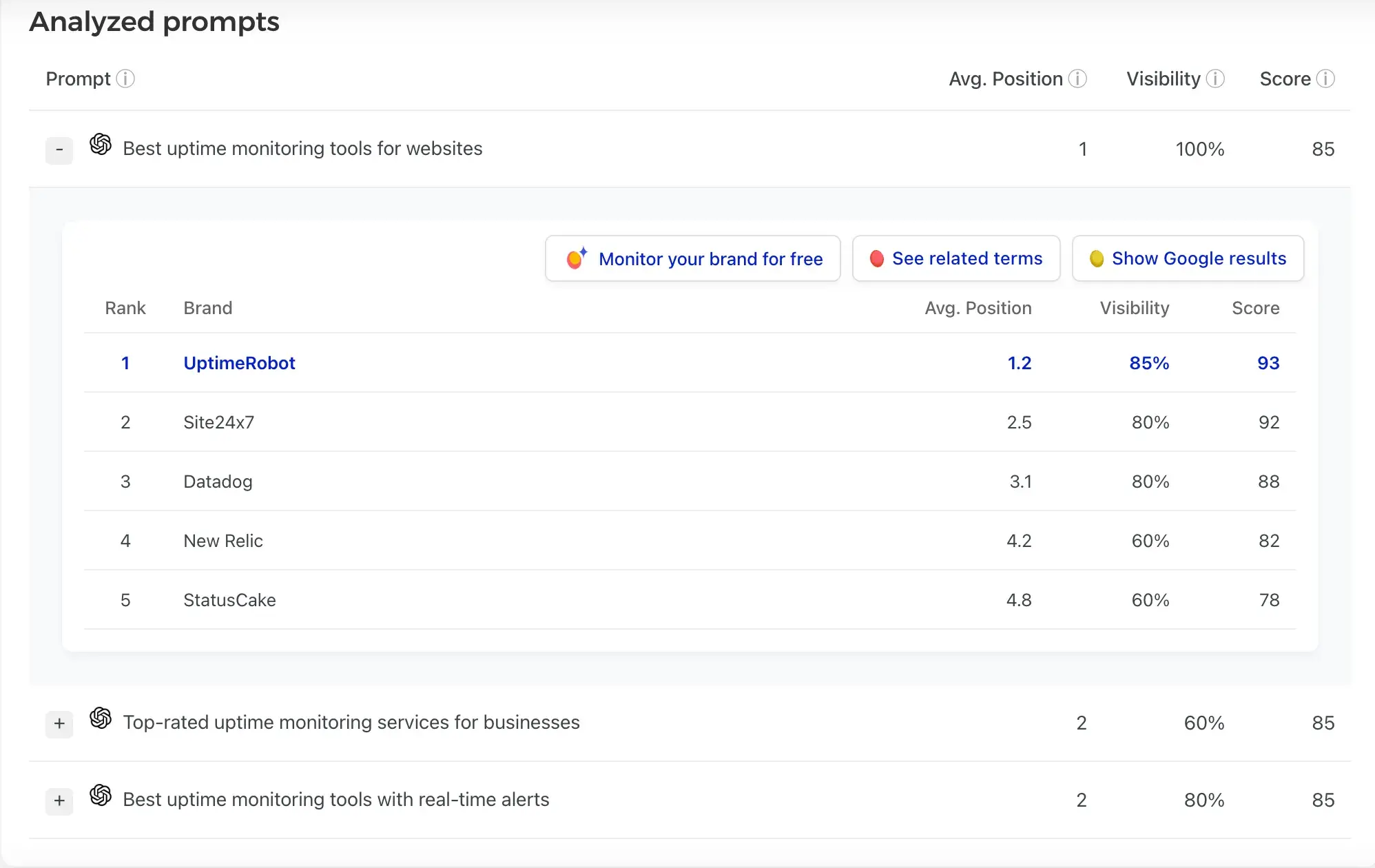
The landscape of B2B software research is undergoing a profound transformation, with a recent G2 2026 Answer Economy research report revealing that a significant 51% of B2B software buyers now initiate their product investigations using AI chatbots, often bypassing traditional search engines like Google. This pivotal shift necessitates a strategic re-evaluation for marketing teams, moving beyond conventional search engine optimization (SEO) to encompass Answer Engine Optimization (AEO) – specifically, tracking how AI assistants mention, cite, and recommend brands. While Ahrefs Brand Radar emerged as an early contender in this burgeoning field, a growing number of businesses are exploring alternative solutions to meet their evolving needs for granularity, integration, and actionable insights.
The Genesis of the Answer Economy and Its Impact on Marketing
The rapid ascent of generative AI tools, spearheaded by platforms like ChatGPT, Perplexity, and Gemini, has fundamentally altered how users seek information. This phenomenon, dubbed the "Answer Economy," moves beyond lists of links to deliver direct, synthesized answers, often citing specific sources. For B2B marketers, this paradigm shift is particularly impactful. The G2 report underscored that not only are buyers utilizing AI chatbots, but 71% rely on them at various stages of their research process. This means a brand’s visibility is no longer solely defined by its ranking on a search engine results page (SERP), but by its presence, sentiment, and citation within AI-generated responses. Consequently, marketing teams must now monitor and optimize for this new dimension of discoverability, understanding that an AI assistant’s recommendation can carry significant weight in a buyer’s decision-making journey.
Ahrefs Brand Radar: An Evolving Solution
Ahrefs, a long-standing leader in the SEO toolkit market, responded to this shift with its Brand Radar feature. Initially designed to track brand mentions and citations across major AI answer engines, Brand Radar has steadily evolved to incorporate capabilities like custom prompt monitoring. This allows marketing teams to specify queries relevant to their industry or product, then observe how AI models respond. For many, Ahrefs Brand Radar provided a crucial initial step into AI visibility tracking, leveraging their existing familiarity with the Ahrefs ecosystem for backlink analysis, keyword research, and site auditing. However, the dynamic nature of AI search and varied organizational requirements have led several companies to explore tools offering a different mix of AI model coverage, evidence preservation, CRM integrations, pricing structures, and reporting workflows.
The Imperative for Alternatives: Granularity, Customization, and Business Alignment
The demand for Ahrefs Brand Radar alternatives is not a critique of the platform itself, but rather a reflection of the diverse and rapidly maturing needs of marketing teams navigating the Answer Economy. Several key factors are driving this exploration:

1. The Pursuit of Granular Data: Large marketplaces, in particular, often require a level of prompt-level context and reporting flexibility that transcends a broad visibility score. Alexandra Novikava, a marketer at Truck1, shared her team’s experience: "At first, we used Ahrefs Brand Radar to observe what sorts of references were being made to us by AI engines but have now transitioned toward custom API tracking and alternative SEO intelligence tools." Truck1’s need for more detailed insights into competitor visibility for specific queries, combined with greater flexibility in data collection, highlighted the market’s appetite for deeper analytical capabilities. While Ahrefs has since enhanced its custom prompt tracking, the early experiences of companies like Truck1 underscored a critical need for more detailed competitive intelligence.
2. Demand for Prompt-Specific and High-Intent Tracking: In specialized B2B sectors, the impact of a single, high-intent prompt can far outweigh a multitude of generic brand mentions. Colleen Barry, Head of Marketing at Ketch, articulated this precisely: "In B2B, one mention in the right context matters more than ten generic mentions." Ketch initially used Ahrefs Brand Radar in early 2025 to establish a baseline for AI-search visibility. However, their subsequent desire for greater control over industry-specific prompt libraries – to analyze how conversational engines handled nuanced privacy and compliance queries, and whether thought-leadership content influenced responses – prompted a search for more tailored solutions. This experience, while predating some of Ahrefs’ custom prompt enhancements, illustrates the strategic importance of aligning AI visibility tracking with specific buyer journey stages and content strategies.
3. Cost-Effectiveness and Broader Coverage: Pricing remains a significant consideration for many teams. Ashot Nanayan, founder and CEO of B2BSEO, found that during Brand Radar’s open beta, the estimated monthly cost for Ahrefs subscription and AI-monitoring add-ons reached approximately $800. Coupled with a desire for localized prompt customization and broader model coverage, this led B2BSEO to seek dedicated AI visibility platforms offering a more comprehensive and cost-effective solution for their specific use case. While Ahrefs has since revised its packaging, with standalone Brand Radar starting at $199 per month and custom-prompt packages at $50 per month, the initial pricing structure prompted many to explore alternatives.
4. Connecting AI Visibility to Tangible Business Outcomes: Matthew Kinneman, founder of Bully Max, emphasized a critical lesson: "the biggest lesson for me was that AI visibility is only valuable if you can tie it back to actions customers take afterward. Otherwise, it’s easy to end up optimizing for a metric that looks good but doesn’t drive business growth." His team, while finding Ahrefs Brand Radar a useful starting point, recognized that visibility alone was insufficient. The goal became to integrate AI-driven discovery with traditional search performance and customer behavior data to understand its impact on traffic, engagement, and conversions. This highlights the crucial requirement for AI visibility tools to seamlessly integrate with CRM, attribution, pipeline, and revenue reporting systems, rather than existing as isolated measurement dashboards.
Key Features Defining Superior AI Visibility Tools
When evaluating Ahrefs Brand Radar alternatives, marketing teams should prioritize features that not only track brand mentions but also provide actionable insights and integrate with broader business objectives.
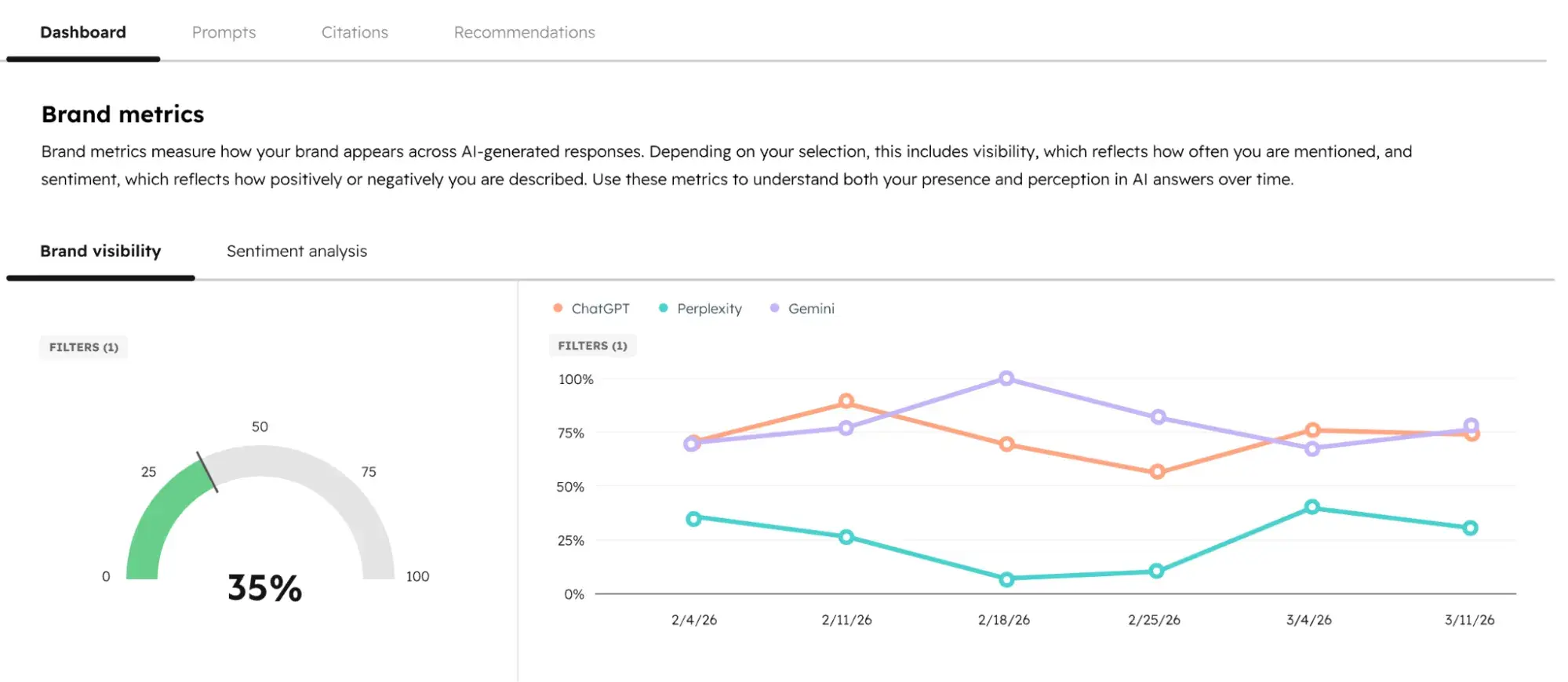
Comprehensive AI Model Coverage and Data Freshness: The diversity of AI assistants means buyers rarely rely on a single platform. A robust tool should monitor multiple key AI models, such as ChatGPT, Perplexity, and Gemini, to provide a holistic view of a brand’s presence. Equally important is data freshness. AI-generated answers are dynamic, changing frequently. Therefore, tools should rerun tracked prompts regularly (daily, weekly, or monthly) and preserve historical data to show trends over time, enabling active optimization and meaningful trend reporting.
Segmentation by Persona and Journey Stage: An aggregated visibility score can mask critical performance gaps. The ability to segment prompts by buyer persona or journey stage allows marketing teams to differentiate between general brand awareness and high-intent consideration or purchase queries. The G2 report’s finding that 71% of B2B software buyers use AI chatbots throughout their research process underscores the need to measure visibility across the entire buying journey, ensuring a strong presence at every crucial touchpoint. This granular segmentation prevents a strong overall score from obscuring a lack of visibility within a vital audience segment, such as developers versus marketing leaders.
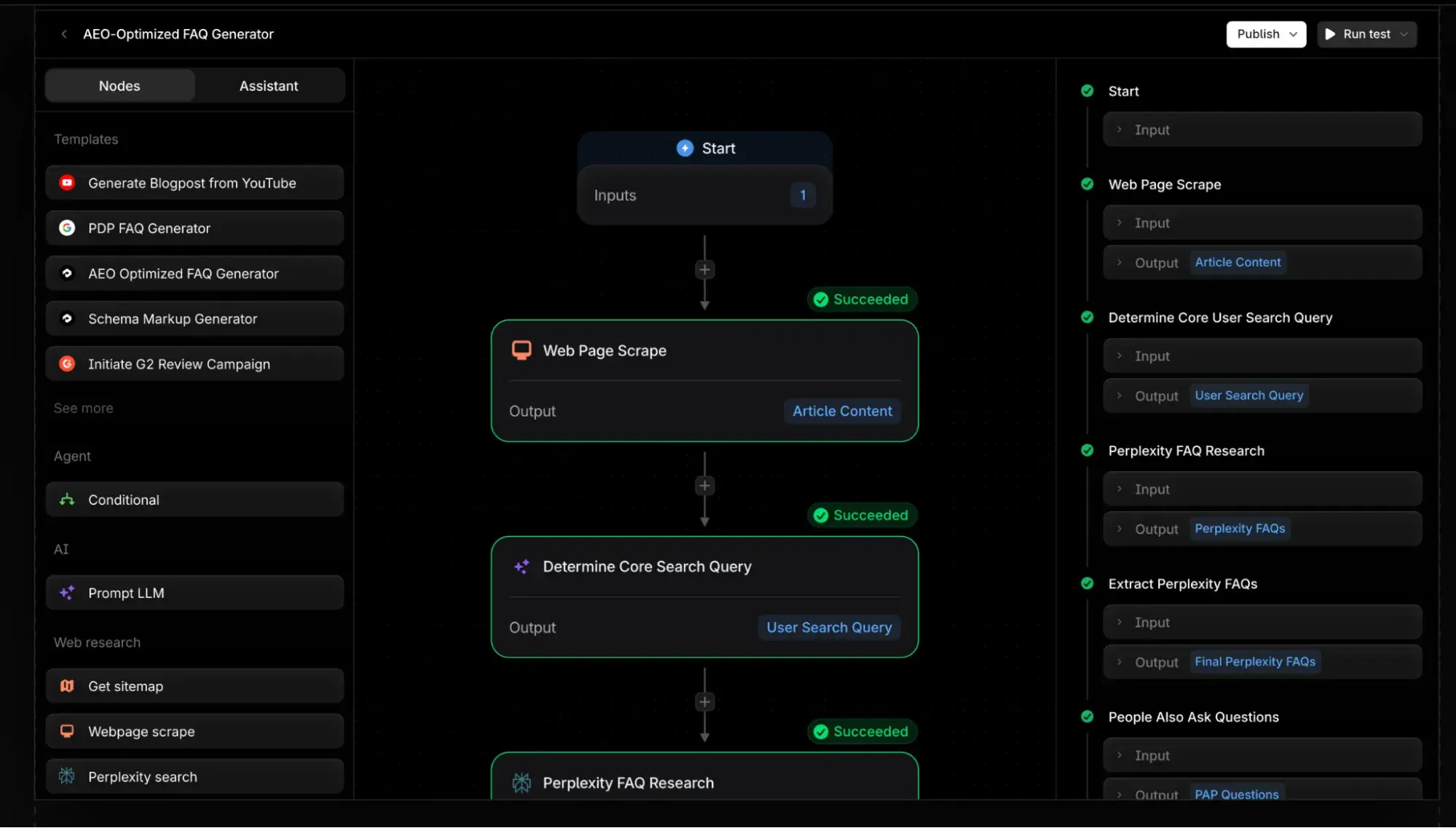
Robust Integrations and Reporting: The true value of AI search insights emerges when they are integrated into existing reporting workflows. Effective platforms should connect AI visibility data with CRM systems, business intelligence dashboards, web analytics, and marketing automation tools. This integration is vital for correlating AI visibility with traffic, leads, pipeline, and revenue. HubSpot’s 2026 State of Marketing report noted that 12.4% of marketers struggle with data sharing across their organization; a disconnected AI visibility tool would only exacerbate this challenge. Reporting quality, including historical trends, exportable evidence, custom dashboards, and stakeholder-friendly summaries, is equally important for understanding the interplay between AI search engine changes, content performance, and business outcomes.
Evidence Quality, Pricing, and Team Fit: A visibility score gains significant utility when accompanied by inspectable evidence. Tools should preserve the underlying AI response, cited sources, timestamps, and model information, making results auditable. This evidence also enhances competitive intelligence by revealing which sources drive competitor recommendations. Pricing models should be evaluated based on the realistic monitoring program a team will run, not just the lowest advertised plan. Finally, team fit considers the user interface, ease of collaboration, and how well the tool integrates into existing marketing operations, ensuring seamless adoption and maximizing return on investment.
Leading Alternatives to Ahrefs Brand Radar
The market for AI visibility tools is expanding rapidly, offering specialized solutions for various needs and budgets. Here’s a detailed look at some prominent alternatives:
1. HubSpot AEO:
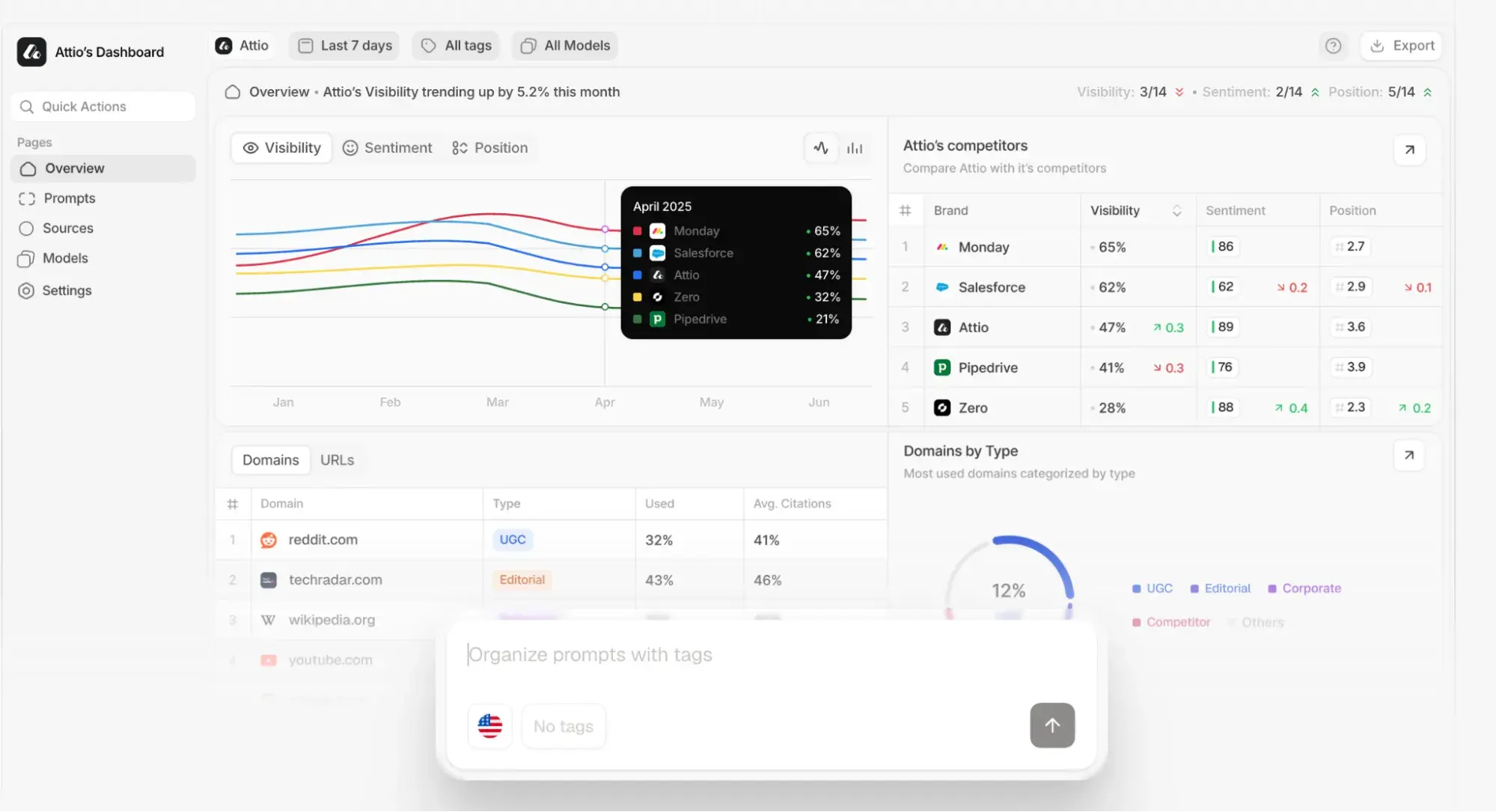
HubSpot AEO stands out as an AI visibility tool designed not just for measurement but for action. It tracks brand visibility and sentiment across ChatGPT, Perplexity, and Gemini, offering competitor share of voice and citation analysis. Critically, it turns visibility gaps into prioritized recommendations, integrating seamlessly with content and campaign actions. Standalone HubSpot AEO does not require a HubSpot subscription, but for Marketing Hub Professional and Enterprise users, AEO integrates with CRM data to inform prompt suggestions and connect AI visibility directly to pipeline and revenue metrics. This CRM-connected approach allows teams to leverage buyer data for more relevant prompt tracking.
- Key Features: Brand visibility and sentiment, competitor share of voice, citation analysis, prompt tracking with prioritized recommendations.
- Best For: Marketing teams seeking continuous AI visibility measurement combined with an actionable workflow for content and campaign optimization, especially those already using HubSpot CRM.
- Pricing: Starts at $50/month ($45/month with annual billing) for 25 prompts across supported models, with a 28-day free trial. Additional prompts can be purchased.
- Insights: Customers praise its ability to structure discoverability efforts and its citation analysis, which helps build actionable strategies.
2. Profound:
Profound offers an enterprise-grade AEO platform tailored for larger organizations. Its Answer Engine Insights track brand and competitor performance across AI platforms, complemented by Agents, Agent Analytics, and Prompt Volumes for content workflows, AI-sourced traffic analysis, and prompt research. Profound’s tiered plans, from ChatGPT-only monitoring to broader enterprise coverage, position it as a robust choice for companies committed to building a dedicated AEO program.
- Key Features: Detailed Answer Engine Insights, Agent Analytics, Prompt Volumes for content and traffic analysis.
- Best For: Larger enterprises and agencies establishing comprehensive AEO programs requiring detailed reporting, extensive model coverage, and advanced controls.
- Pricing: Starts at $99/month (billed yearly) for ChatGPT tracking and 50 prompts; Growth plan ($399/month yearly) includes three answer engines and 100 prompts; Enterprise offers custom pricing with up to nine answer engines.
- Insights: Valued for its comprehensive approach that extends beyond simple scores to offer deep analytical and workflow capabilities.
3. Peec AI:
Peec AI is an AI search analytics platform providing multi-model visibility tracking, citation analysis, and competitor benchmarking. It enables teams to organize prompts by project, monitor performance trends, and examine domains and URLs cited in AI-generated responses. Peec AI complements traditional AI SEO by focusing specifically on the answer-engine layer, offering daily tracking and collaborative access without per-user pricing constraints.
- Key Features: Multi-model visibility, citation and competitor analysis, prompt management, daily tracking.
- Best For: SEO and content teams needing broad AI model coverage, daily updates, and collaborative access for multiple stakeholders.
- Pricing: Starts at $95/month for Starter (50 prompts, one project); Pro ($245/month for 150 prompts, two projects); Advanced ($495/month for 350 prompts, five projects); Enterprise with custom pricing.
- Insights: Praised for its unlimited user access on public plans, scaling primarily by prompts, projects, and models, which fosters easier team collaboration.
4. Xofu:
Xofu specializes in tracking bottom-of-the-funnel and purchase-intent prompts, focusing on how buyers shortlist vendors, compare products, and evaluate solutions. This narrow focus distinguishes it from broader brand-monitoring tools, providing insights into competitive recommendations, supporting sources, and citation gaps directly relevant to buying decisions.
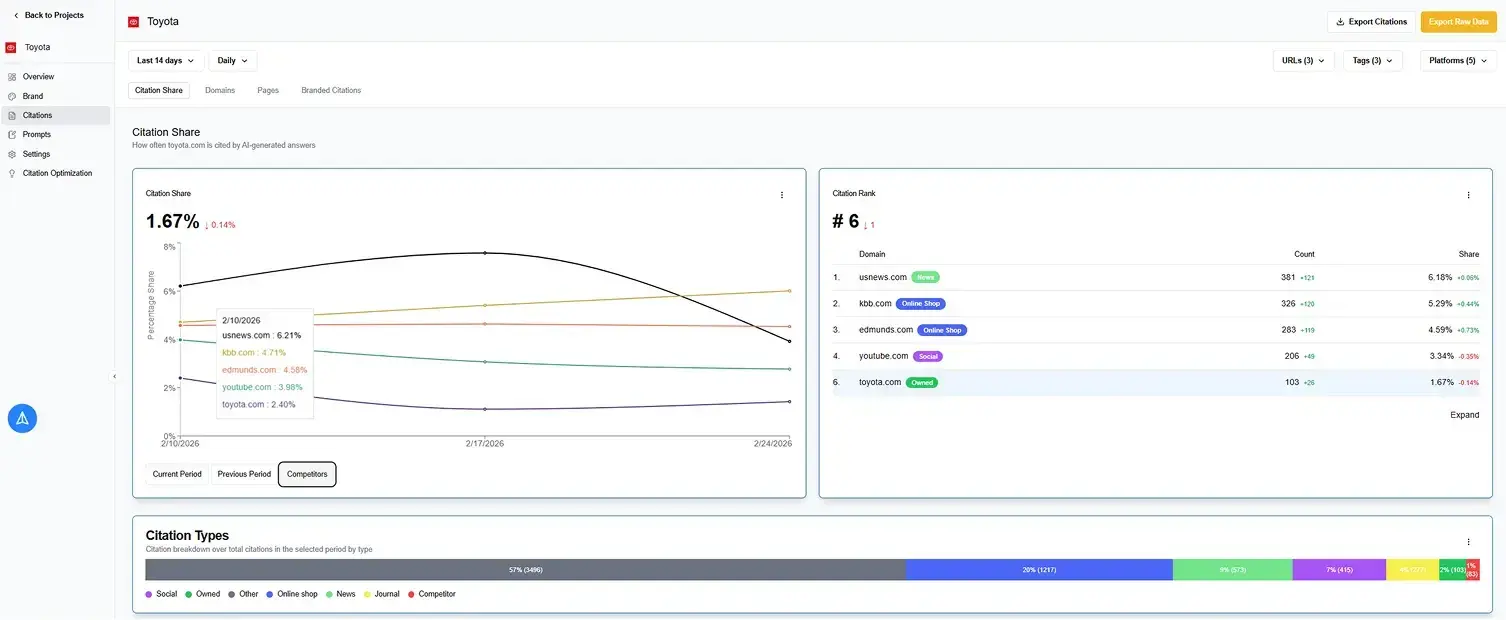
- Key Features: Bottom-of-funnel prompt tracking, competitive benchmarking, citation-gap analysis, weekly or daily reporting.
- Best For: SaaS companies, consultants, and agencies prioritizing AI visibility for commercial and purchase-intent queries.
- Pricing: Free plan (50 prompts per model, weekly reporting); Consultant ($99/month for 200 prompts per model, weekly); Agency Weekly ($499/month for 500 prompts per model); Agency Daily ($999/month for 200 prompts per model, daily).
- Insights: Its focus on vendor selection prompts makes reports directly applicable to competitive positioning and pipeline generation.
5. Mangools AI Search Grader:
Mangools AI Search Grader is a free diagnostic tool that provides a baseline assessment of a brand’s performance across AI-search models. It generates an "AI Search Score" based on visibility and ranking, comparing the brand against competitors for automatically generated prompts. It’s a valuable starting point for marketers and SEO teams before committing to continuous monitoring solutions.
- Key Features: AI Search Score, model-level visibility and ranking, competitor benchmarking, support for multiple models.
- Best For: Teams seeking a free, one-time baseline assessment of their AI visibility before investing in ongoing tracking.
- Pricing: Free. For continuous monitoring, Mangools offers the separate paid AI Search Watcher.
- Insights: Its easy-to-read AI Search Score and underlying model-level results provide an accessible entry point into AI visibility analysis.
6. Morningscore ChatGPT Rank Tracker:
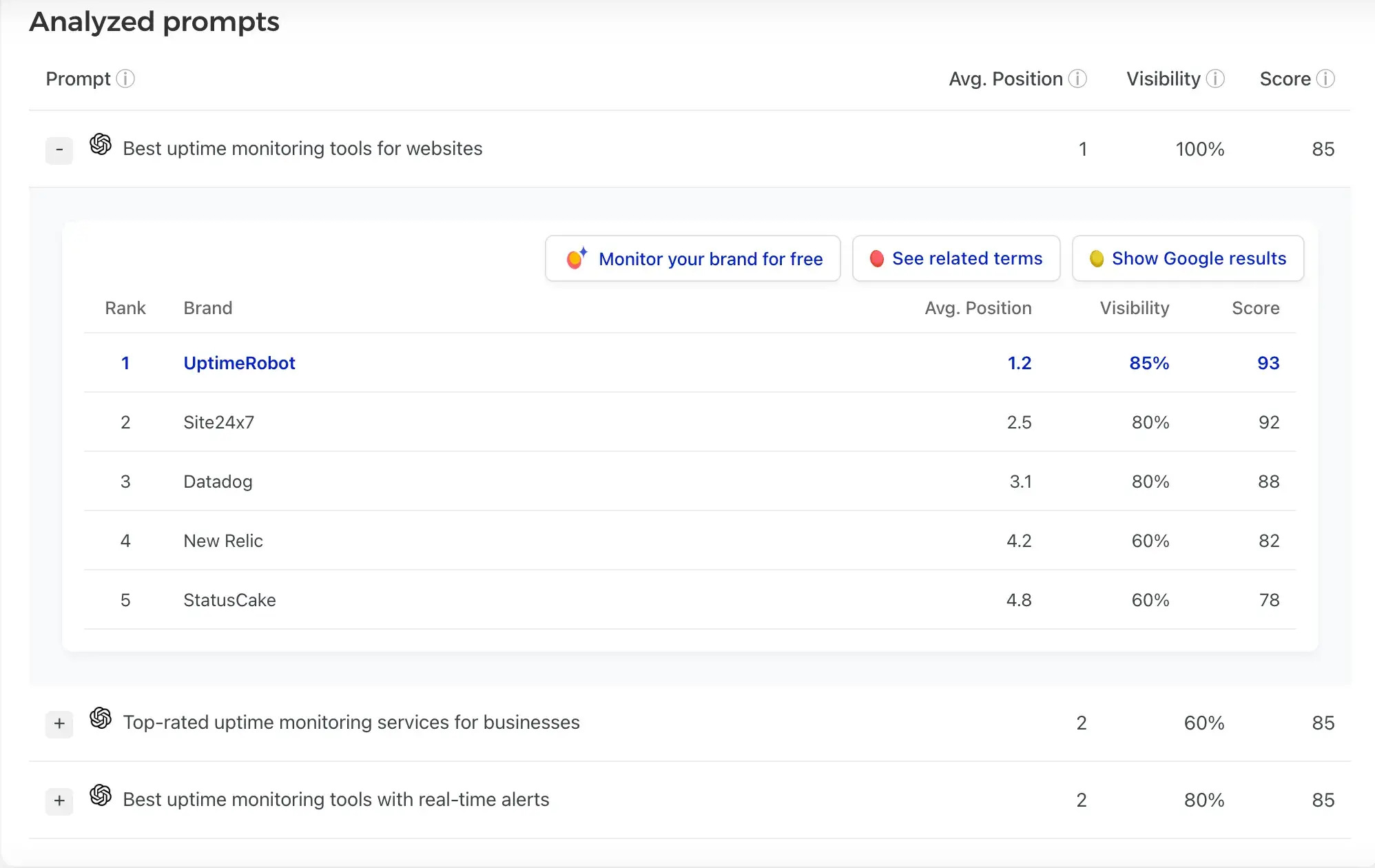
Morningscore ChatGPT Rank Tracker monitors brand mentions and recommendations within ChatGPT for selected prompts, providing the answer and source evidence. Integrated within Morningscore’s broader SEO platform, it offers a unified view of traditional SEO metrics and ChatGPT visibility. Its primary distinction is its focus on ChatGPT and weekly prompt lookups.
- Key Features: ChatGPT prompt tracking, brand mentions and citation evidence, competitor comparisons.
- Best For: Teams primarily concerned with ChatGPT visibility who prefer an integrated solution within their existing SEO platform.
- Pricing: Starts at $69/month for Lite (10 ChatGPT prompts); Business ($99/month for 100 prompts); Pro ($159/month for 500 prompts); Premium ($299/month for 2,000 prompts), with a 14-day free trial.
- Insights: Provides transparent reporting by showing the actual ChatGPT response and source evidence, aiding validation.
Bonus Diagnostic: HubSpot AI Search Grader
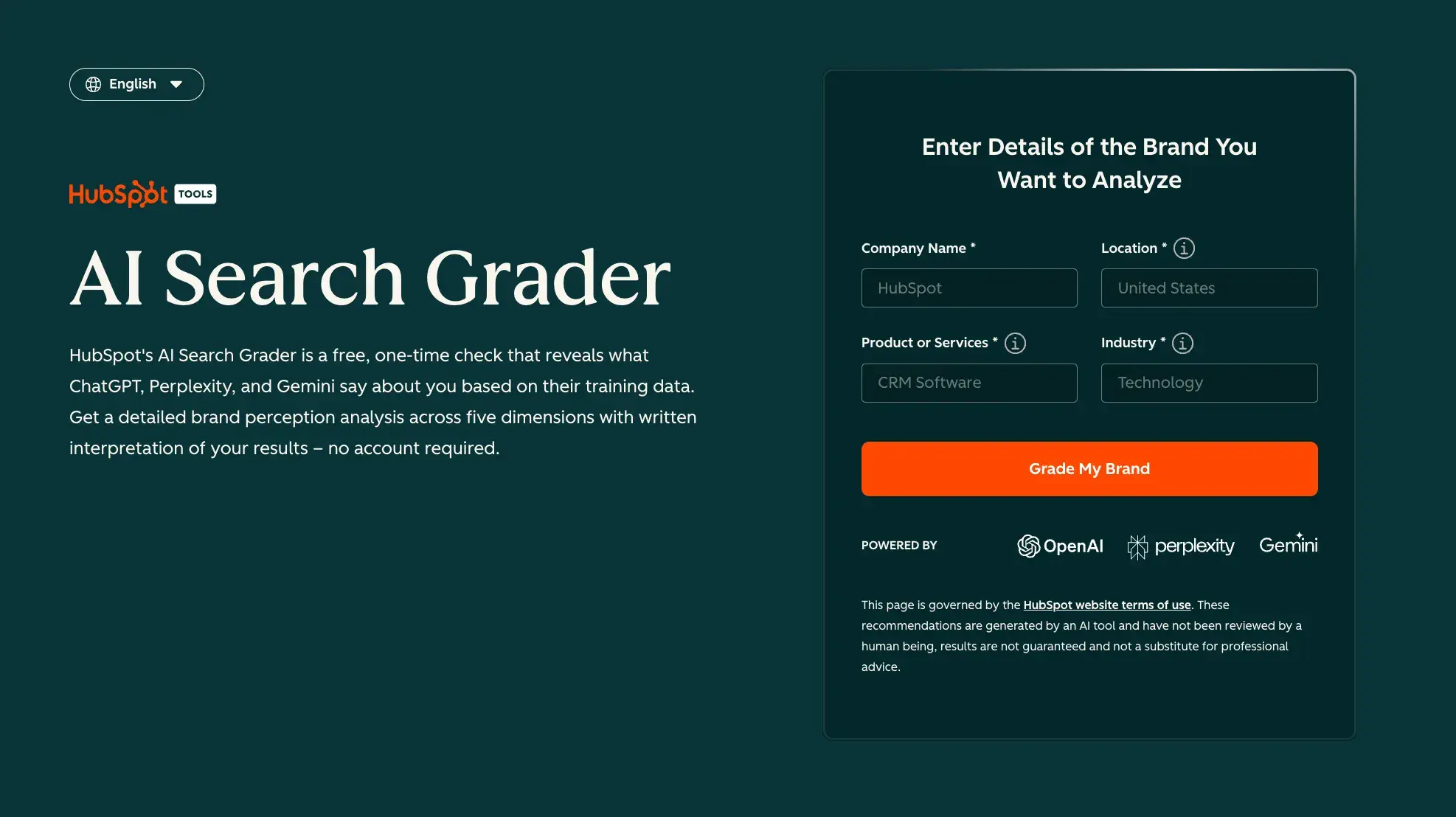
Complementing its full AEO product, HubSpot also offers a free, one-time AI Search Grader. This diagnostic tool assesses how ChatGPT, Perplexity, and Gemini represent a brand across five dimensions: sentiment, presence quality, brand recognition, share of voice, and market competition, providing a composite score and interpretation. It’s an excellent resource for marketing leaders, brand managers, and SEO professionals to get a quick, comprehensive snapshot without any commitment. The Answer Engine Report lauded its "pedagogically useful framework" for explaining AI visibility to non-specialists.
Strategic Implications: Bridging AI Visibility with Business Pipeline
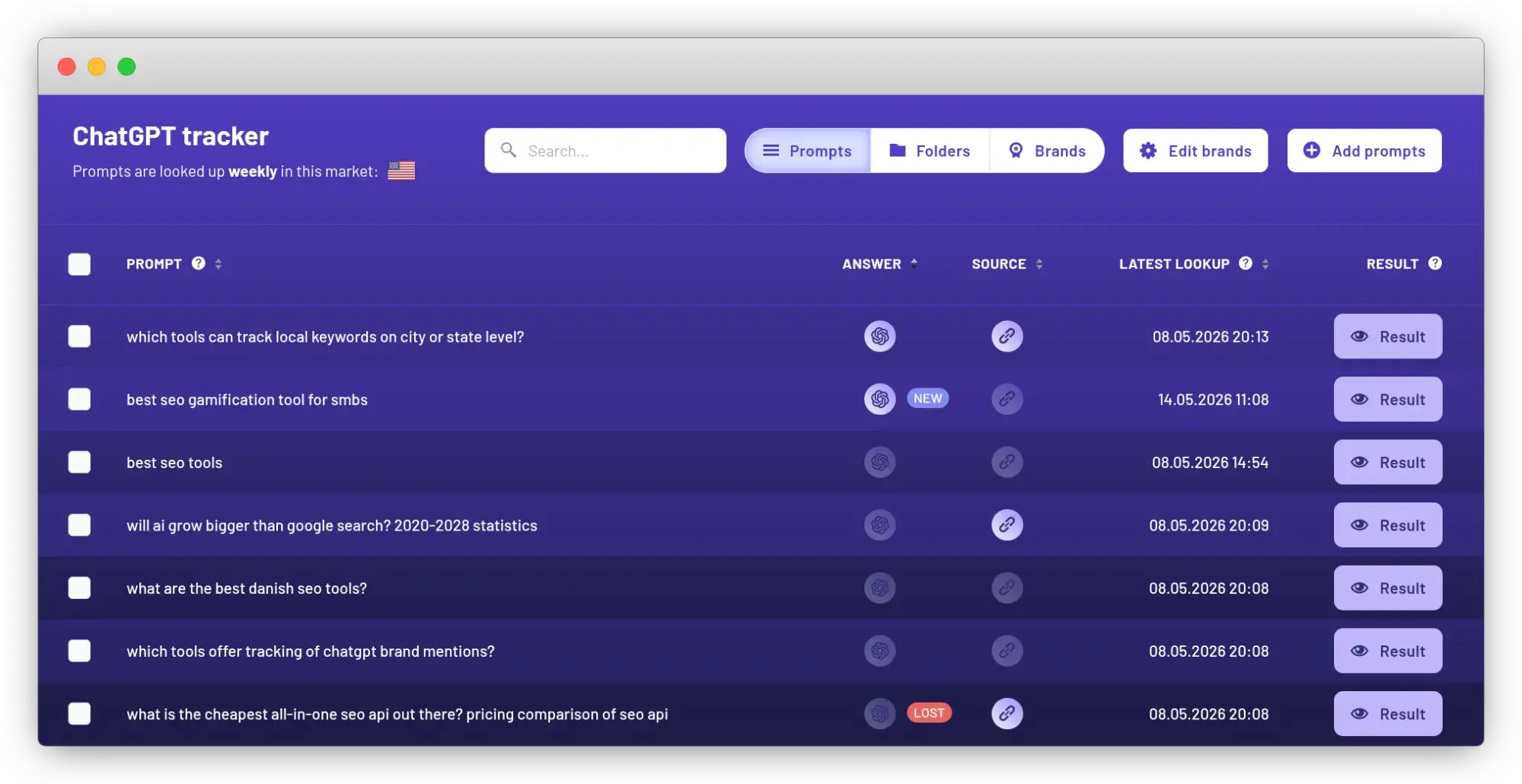
Ultimately, the effectiveness of any AI visibility tool is measured by its ability to connect insights to core business metrics. Merely tracking mentions is insufficient; the data must be comparable with traffic, leads, opportunities, pipeline, and revenue. An integrated approach, where AI visibility data informs and is informed by CRM systems, is crucial.
HubSpot’s integrated AEO experience within Marketing Hub Professional and Enterprise exemplifies this by using CRM data to surface prompts most relevant to actual buyers. This creates a direct link between AI visibility and pipeline generation, allowing teams to identify which pages, topics, and sources contribute to AI mentions and, subsequently, to business growth. HubSpot AEO, for instance, provides prioritized recommendations—suggesting content updates, new pages, or citation opportunities—based on identified visibility gaps. This transforms AI visibility data into actionable competitive intelligence, revealing what brands answer engines recommend, which sources drive those recommendations, and where a brand can improve its strategic positioning.
Implementing an AI Visibility Solution: A Phased Approach
Adopting an Ahrefs Brand Radar alternative should be a structured, phased rollout rather than an abrupt transition. The goal is to establish a repeatable AI visibility measurement layer that complements, rather than replaces, traditional SEO reporting.
Step 1: Set Up Integrations and Reporting Foundations. Begin by determining where AI visibility data will reside and how it will be integrated with existing marketing and revenue metrics. This includes connecting the tool to CRM, web analytics, and business intelligence platforms to ensure a unified view of performance.
Step 2: Establish Prompt Governance. Consistency in prompt usage is paramount for accurate trend analysis. Standardize prompts, segment them by buyer persona, journey stage, or product line, and maintain a clear repository of all tracked queries.
Step 3: Implement Multi-Run Quality Assurance. AI-generated answers can vary. To account for this, run priority prompts multiple times and compare outputs across different models, locations, and tracking frequencies. This iterative process helps ensure the reliability of reported visibility scores.
Step 4: Build an Evidence Repository. Preserve the underlying AI responses, cited sources, timestamps, and model information. This evidence is crucial for validating results, explaining visibility scores, and informing content and competitive strategies.
Step 5: Pilot, Compare, and Scale. Initiate the workflow with a limited set of prompts and audiences. Validate the results against business outcomes before expanding the program across all products, regions, or customer segments. This controlled rollout minimizes risks and optimizes resource allocation.
Conclusion
The shift to the Answer Economy represents a fundamental change in how brands are discovered and evaluated. While Ahrefs Brand Radar offers valuable AI visibility tracking, the diverse needs of marketing teams necessitate a comprehensive review of available alternatives. The choice of an AI visibility tool should hinge on factors such as AI model coverage, data freshness, evidence quality, segmentation capabilities, CRM integrations, pricing, and overall team fit. Ultimately, the most effective solution will be one that not only provides accurate visibility scores but also delivers actionable insights, seamlessly integrates with existing marketing and sales workflows, and clearly connects AI-driven discoverability to measurable business outcomes like pipeline and revenue. The era of optimizing for direct answers is here, and marketers must strategically equip themselves to thrive within it.








