

The Black Friday and Cyber Monday period, often extended into "Cyber Week," has evolved from a single-day shopping frenzy into a multi-day spectacle of discounts and promotions. Originating in the United States, Black Friday traditionally followed Thanksgiving, signaling the point when retailers’ balance sheets moved "into the black." Cyber Monday emerged later, specifically to boost online sales when consumers returned to work after the holiday weekend. Together, they form the most significant retail event of the year, driving billions in global sales and setting the stage for holiday spending.
This period is not merely about slashing prices; it’s an opportunity for brands to connect with customers, acquire new leads, and reinforce loyalty. The campaigns deployed during BFCM are diverse, ranging from aggressive discounting to purpose-driven initiatives, interactive experiences, and value-added offers. The top 10 Black Friday campaign examples covered below will show you how. Every campaign either uses strategic discount placement, offers bundles and gift-with-purchase, or leads with a gamified element. We’ll go through each one and detail what exactly makes each example work.
The Evolution of Black Friday and Cyber Monday: A Historical Perspective
The concept of Black Friday dates back to the 1950s in Philadelphia, where police used the term to describe the chaos that ensued on the day after Thanksgiving, as large crowds of shoppers and tourists flooded the city for the Army-Navy football game and holiday shopping. Retailers, however, rebranded it to signify the point where their accounts moved from "red" (losses) to "black" (profits). For decades, it remained largely an American phenomenon, characterized by early morning queues, doorbuster deals, and intense competition among brick-and-mortar stores.
The advent of the internet and e-commerce in the late 20th and early 21st centuries revolutionized the event. Cyber Monday was coined in 2005 by the National Retail Federation to encourage online shopping, recognizing the growing trend of consumers making purchases from their work computers on the Monday after Thanksgiving. This marked a significant shift, expanding the sales window and democratizing access to deals beyond physical store locations.
Today, BFCM has transcended national borders, becoming a global retail phenomenon embraced by consumers and brands worldwide. The proliferation of mobile shopping, social media marketing, and sophisticated data analytics has further transformed the landscape. Campaigns now often begin weeks in advance, extending into "Cyber Week" or even "Cyber Month," creating a prolonged period of promotional activity. This evolution underscores the need for brands to adopt dynamic, multi-channel strategies that resonate with a digitally savvy consumer base.
Anatomy of a Successful Black Friday Campaign: Key Pillars for E-commerce Success
What makes a Black Friday campaign work? The most successful Black Friday campaigns start preparing early and then turn the Black Friday hype into new customer acquisition and retention. According to Omnisend’s newest Black Friday research, the average order value rose from $164 to $215 during Cyber Week, which shows that the brands that earn the most revenue are the ones that focus on a single strong concept. This data underscores a critical insight: success isn’t just about offering discounts, but about strategically leveraging the heightened consumer demand to drive long-term value.
Here’s a brief rundown of the five main elements shared by the most successful Black Friday campaigns:
-
Early Preparation and Strategic Planning: Effective BFCM campaigns are meticulously planned months in advance. This includes inventory management, website optimization for high traffic, staffing for customer service, and, crucially, developing a cohesive marketing strategy. Early preparation allows brands to test campaigns, segment audiences, and build anticipation, avoiding last-minute rushes and potential operational bottlenecks. Industry data consistently shows that brands beginning their campaigns in early November or even late October capture a larger share of consumer spend, as shoppers start their research and purchasing earlier each year.
-
Customer Acquisition and List Growth: While BFCM is a sales event, it’s also a prime opportunity for customer acquisition. Successful campaigns often incorporate mechanisms to grow email and SMS lists, such as early-access sign-ups, contests, or exclusive subscriber-only deals. These new contacts can then be nurtured into loyal customers through post-BFCM engagement strategies. The focus extends beyond immediate sales to building a sustainable customer base.
-
Customer Retention and Loyalty Building: Beyond attracting new customers, BFCM campaigns are vital for reinforcing loyalty among existing ones. Offering exclusive deals, VIP access, or personalized recommendations to loyal customers can significantly boost retention rates. Brands that understand the lifetime value of a customer often prioritize these segments, ensuring that the BFCM experience strengthens, rather than erodes, their relationship.
-
Optimized Average Order Value (AOV): Increasing the average order value is a key metric for BFCM success. Strategies like bundles, gift-with-purchase offers, free shipping thresholds, and tiered discounts encourage customers to spend more per transaction. This approach moves beyond simple percentage-off sales, offering perceived greater value and enhancing profitability even amidst heavy discounting.
-
Unified Concept and Execution: The most impactful campaigns are built around a single, strong concept that resonates with the brand’s identity and target audience. This concept is then consistently communicated across all channels – email, SMS, social media, website, and in-store. A coherent message, whether it’s about value, sustainability, entertainment, or exclusivity, creates a memorable experience and cuts through the noise of competing promotions. This unified approach ensures brand integrity while maximizing campaign reach and effectiveness.
In other words, treat these five actions as a single Black Friday marketing plan rather than five separate tactics to get the best results. The synergy between these elements is what elevates a good campaign to an exceptional one, driving both short-term revenue and long-term brand equity.
Leading the Pack: Ten Exemplary Black Friday Campaigns and Their Strategic Insights
Understanding what other brands do well is a great starting point for creating your own Black Friday marketing campaigns. We’ve rounded up 10 examples below that offer a masterclass in BFCM content creation, packed with practical tips for ecommerce store owners:
- Campaign type: Purpose-led stand | Example: Patagonia, REI | Best for: Brands with values customers already recognize
- Campaign type: Circular or trade-in | Example: IKEA | Best for: Brands built on reuse or sustainability
- Campaign type: Humor or stunt | Example: Cards Against Humanity | Best for: Brands with a distinct voice
- Campaign type: Entertainment-led | Example: Walmart | Best for: Brands with reach or a shareable idea
- Campaign type: Gamified reward | Example: Macy’s | Best for: Brands growing a list or repeat visits
- Campaign type: Early or VIP access | Example: Rachel Riley | Best for: Brands with an email and SMS list
- Campaign type: Value over discount | Example: Amundsen | Best for: Premium brands protecting price
- Campaign type: Gift with purchase | Example: To’ak | Best for: Premium brands protecting margin
- Campaign type: Bold flash sale | Example: B*WEAR | Best for: Value brands with room to discount
1. Patagonia: The Anti-Consumerism Stand – A Brand-Defining Move
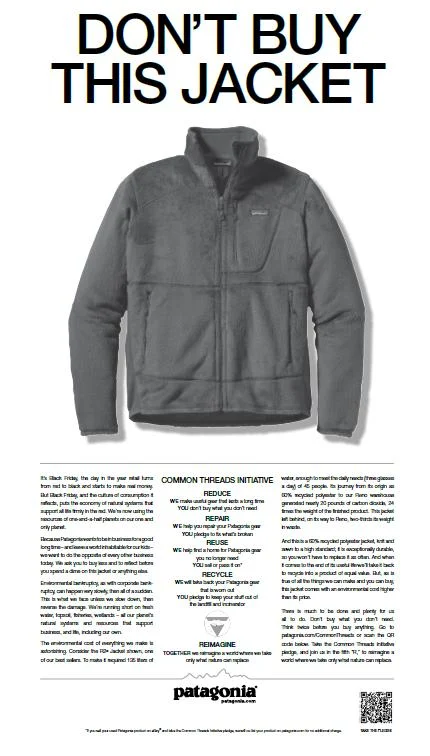
Over a decade ago, in 2011, Patagonia made headlines with a full-page advertisement in the New York Times telling people: "Don’t Buy This Jacket." The brand actively encouraged shoppers not to spend money in a protest against overconsumption. This radical approach, launched during the peak shopping season, was a bold statement that underscored Patagonia’s deep commitment to environmental sustainability and responsible consumption.
Patagonia’s strategy focused on the net effect. It sacrificed temporary profit for brand awareness and, in turn, became a pioneer of eco-conscious fashion. The message is simple: if you care about sustainability, buy from Patagonia. This campaign was not merely a marketing stunt but a reinforcement of their core values, which resonate deeply with their target demographic. By aligning their BFCM message with their overarching mission, Patagonia garnered significant media attention and strengthened its reputation as an authentic, purpose-driven brand. The long-term implication was an enhanced brand image that attracted a loyal customer base willing to pay a premium for ethically produced goods, demonstrating that values can translate into valuable market share.
2. REI: The #OptOutside Movement – Prioritizing Values Over Sales
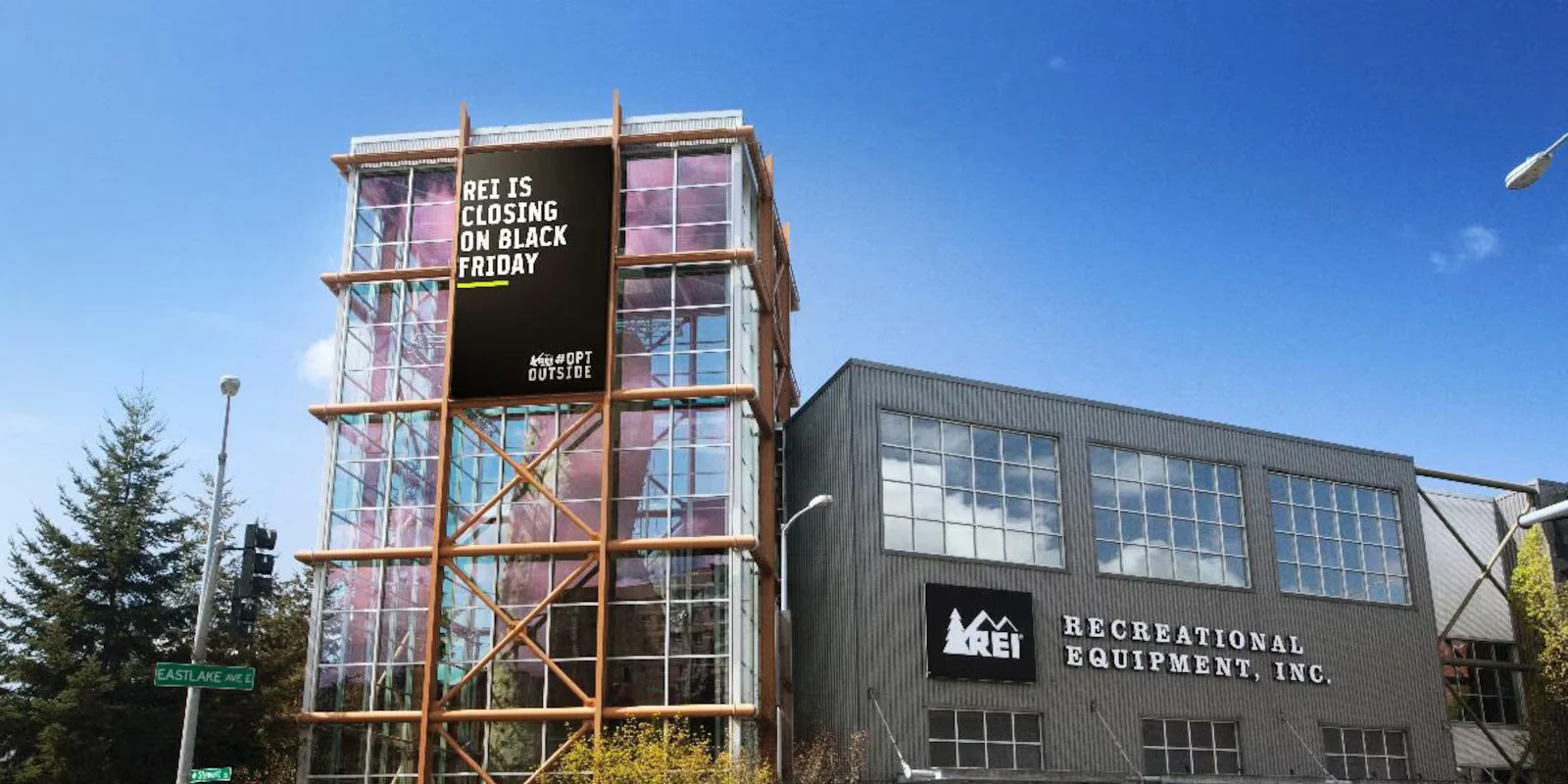
REI, a prominent outdoor gear retailer, took a similarly defiant stance by turning one of the most profitable events in ecommerce into a major statement. Instead of running a site-wide sale, REI launched #OptOutside and closed all its stores, paying its employees to spend the day outdoors. The entire campaign took a completely different turn, inviting customers to share their outdoor adventure moments. This initiative, first launched in 2015, immediately captured national attention and sparked a broader conversation about consumerism and the outdoors.
Now, not every business can afford to close down, much less during Black Friday. But the key lesson from REI’s example is to pick a single theme, topic, or value your audience can relate to. Then use an appropriate hashtag and encourage communication with a signup form to grow your lists while building goodwill. REI’s #OptOutside campaign successfully tapped into a desire among many consumers to escape the commercial frenzy and reconnect with nature. It solidified REI’s brand identity as an advocate for outdoor experiences rather than just a seller of gear. The initiative resonated with its core customer base, fostering immense loyalty and differentiating REI in a crowded retail landscape, proving that a strong ethical stance can be a powerful marketing tool.
3. Cards Against Humanity: The Satirical Prank – Leveraging Brand Voice
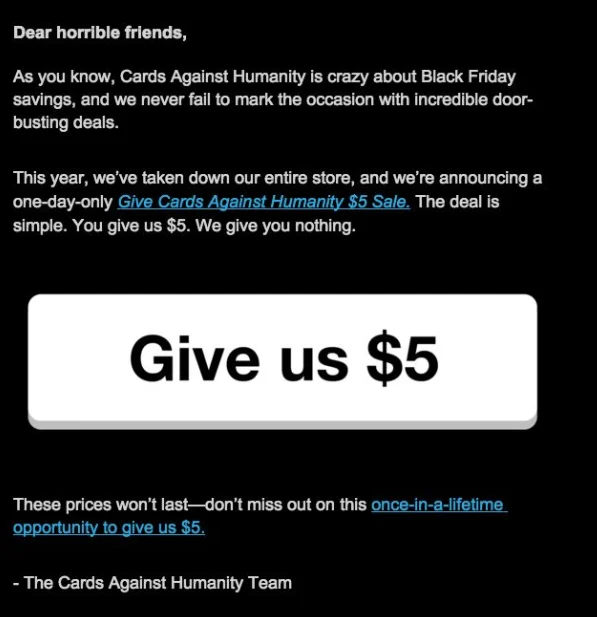
Cards Against Humanity, known for its irreverent and often offensive humor, consistently approaches Black Friday with a satirical twist that perfectly aligns with its brand identity. One year, the brand launched a promotion called "Give us $5." Fans of the brand followed through, only to receive absolutely nothing in return. A bold move for sure, but expected given Cards Against Humanity’s reputation.
Max Temkin, the Cards Against Humanity founder, is known for disliking Black Friday. So, it’s no wonder that this sentiment fits in perfectly with the brand’s anti-establishment values. Cards Against Humanity doesn’t care about trends or being offensive. The brand simply wants to spread fun. This campaign, while seemingly counter-intuitive, was a masterclass in brand voice and audience understanding. Their customers expect the unexpected and appreciate the brand’s subversive humor. By subverting traditional Black Friday expectations, Cards Against Humanity generated significant buzz and cemented its unique position in the market. The implication for other brands is clear: authentic brand voice, even if unconventional, can create powerful engagement and loyalty, especially when it challenges norms.
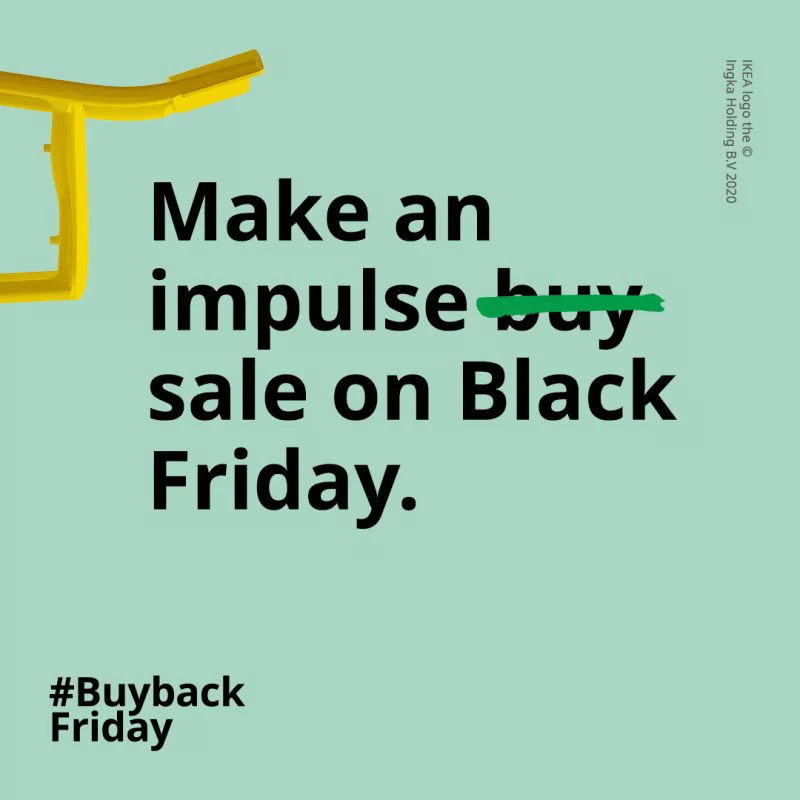
4. IKEA: The #Buyback Friday Scheme – Embracing the Circular Economy
Building on the sustainability focus seen in campaigns from REI and Patagonia, IKEA launched a genius marketing campaign called #Buyback Friday. The goal of this campaign was to increase sales and incentivize customers to return unused furniture in exchange for credits, which could be used to buy new items. This initiative perfectly aligned with IKEA’s broader commitment to sustainability and circular economy principles.
This campaign is great and can be used by many brands to take a more eco-conscious approach without losing valuable revenue opportunities. Plus, it can also work great as an early-bird offer for the people who act first. The #Buyback Friday campaign addressed the growing consumer concern about waste and environmental impact, offering a practical solution that also drove foot traffic and encouraged future purchases. It positioned IKEA not just as a seller of affordable furniture, but as a responsible partner in sustainable living. This strategy demonstrates how brands can integrate sustainability into their sales events, creating a win-win scenario for both the company and environmentally conscious consumers, while also potentially capturing market share from competitors focused solely on discounts.
5. Walmart: The Advertainment Series – Blending Commerce with Pop Culture
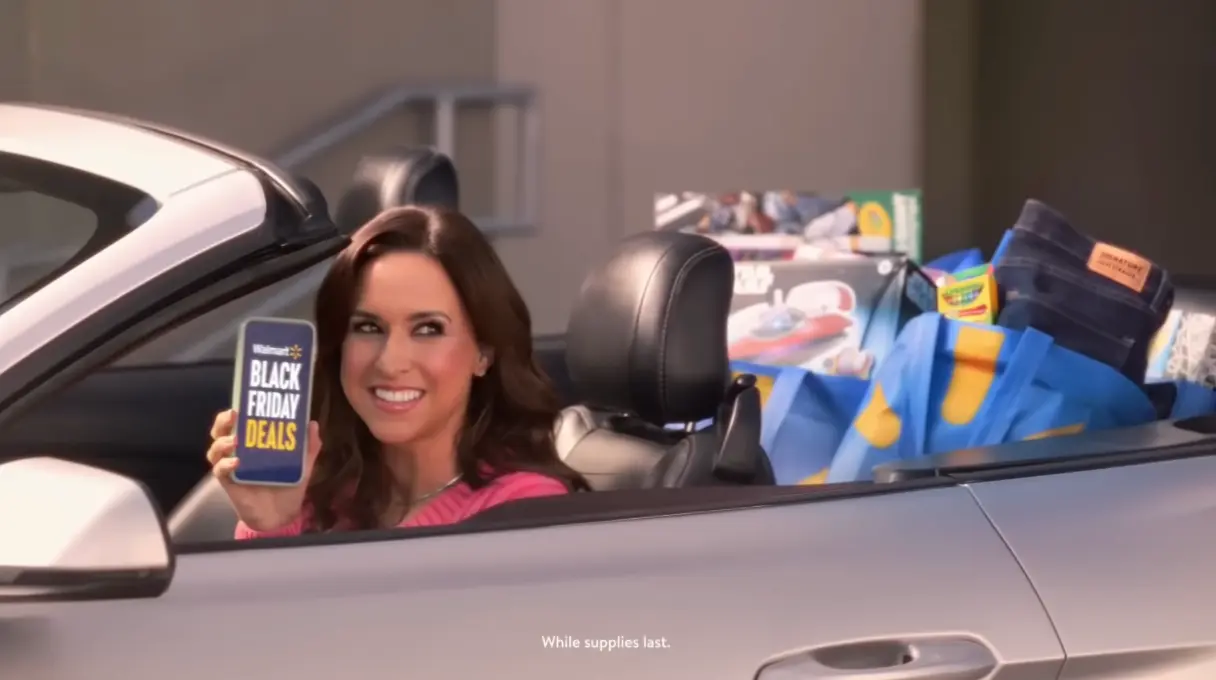
Walmart’s Black Friday campaign combined two elements – entertainment and seasonal deals. This allowed the company to create a comedy-driven scripted ad series with the cast of Mean Girls. As a result, this campaign performed well and created substantial buzz on social media platforms thanks to the popularity of the movie. Leveraging popular culture figures and narratives in advertising is a classic strategy, but Walmart’s execution during BFCM was particularly effective.
While this type of campaign can require a larger budget, smaller brands can use this example to combine a popular contemporary subject, like memes, to relate to and connect with the audience before introducing their Black Friday deals. The "Mean Girls" campaign tapped into nostalgia and humor, making the Black Friday message more engaging and shareable. It moved beyond transactional advertising to create a memorable brand experience. The implication is that integrating "advertainment" can significantly amplify reach and engagement, particularly on social media, by offering value beyond just product information. It shows that even large retailers benefit from infusing creativity and cultural relevance into their promotional efforts.
6. Macy’s: The Gamified In-Store Experience – Engaging Shoppers with Interactive Rewards
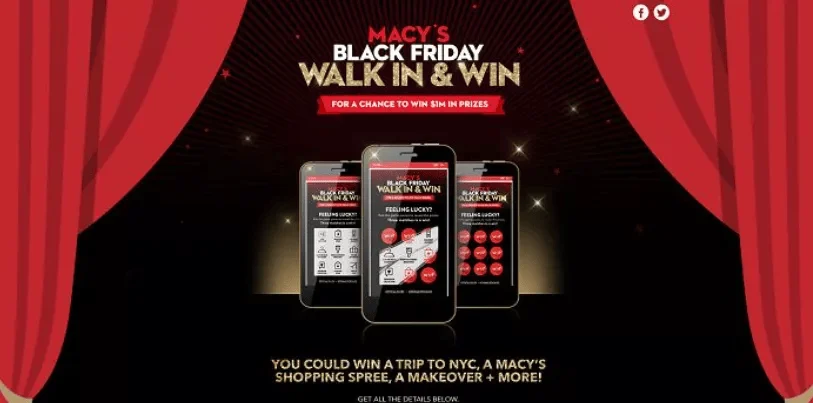
Macy’s, a historic department store, delivered tons of exciting early access BFCM content across channels to pique consumers’ interest. The brand’s "Walk in and Win" initiative involved a mobile giveaway game that targeted customers in stores prior to the big weekend. This gamified approach transformed the shopping experience into an interactive event, encouraging physical store visits during a time when online shopping increasingly dominates.
Adding gamified elements like a Wheel of Fortune popup with clear messaging revolving around benefits can incentivize customers to proceed. Macy’s leveraged the excitement of a game to drive foot traffic and engage shoppers directly in the retail environment. This strategy created a sense of fun and opportunity, rewarding early engagement and fostering a positive brand association. The lesson here is the power of gamification to enhance customer experience, boost engagement, and collect valuable customer data, whether in-store or online. It demonstrates how traditional retailers can innovate to remain relevant in a competitive, omnichannel landscape.
7. Rachel Riley: The Month-Long Campaign – Extending Engagement and Urgency
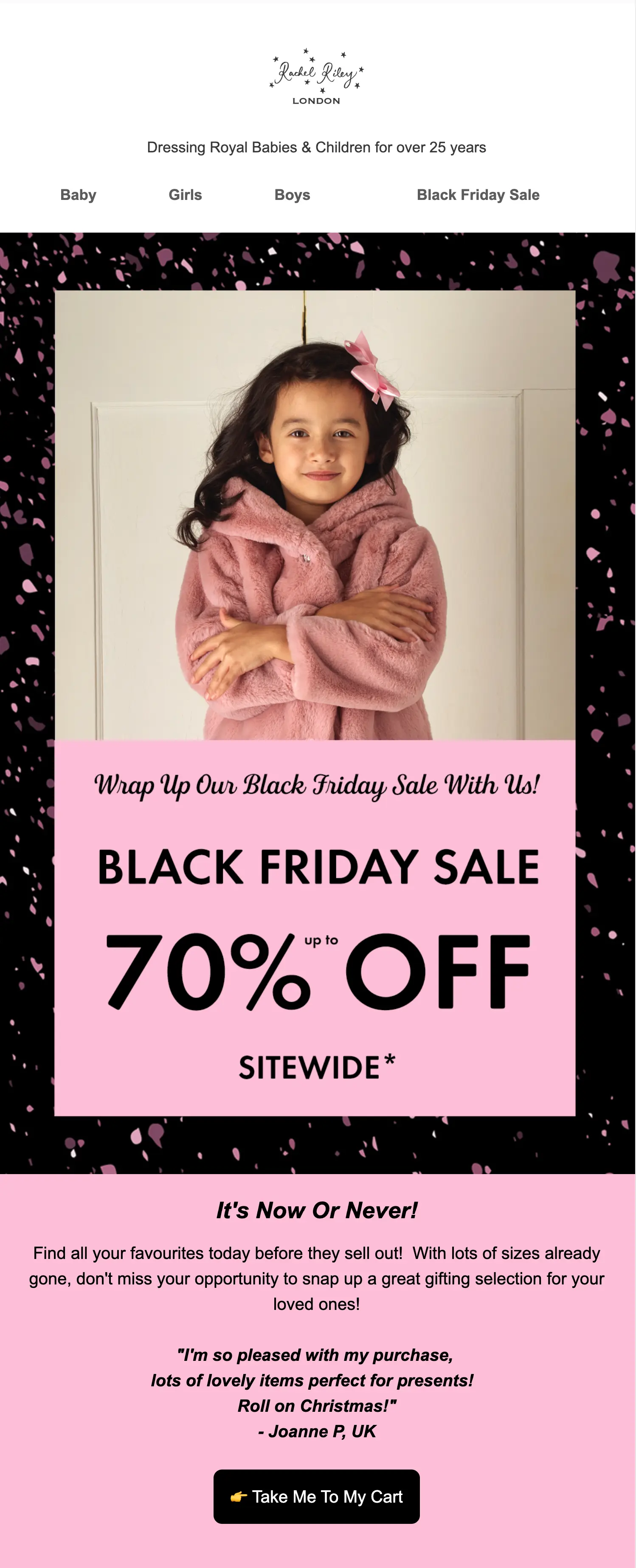
Rachel Riley, a children’s luxury clothing brand, turned the standard Black Friday sale into a month-long campaign. The brand opened the campaign by offering 24 hours of early access to active subscribers to build urgency through the weekend, followed by other relevant communications, and ending the campaign with a last-chance email attached below. This extended timeline allowed for sustained engagement and multiple touchpoints with customers.
If this sounds like something that could be applicable for your brand, focus on sending your lists an early access announcement before you launch the public sale. Include signup forms to enrich your lists or add an early-access BF popup, and end your Black Friday campaign with a last-chance SMS. Rachel Riley’s approach generated impressive results, growing BFCM revenue by 77% year over year. This success highlights the effectiveness of segmenting audiences for VIP access and building a multi-stage campaign that maintains urgency without resorting to a single, overwhelming discount blitz. It provides a blueprint for brands seeking to maximize their sales period by cultivating excitement and offering staggered opportunities.
8. Amundsen: Value Over Discount – Preserving Premium Brand Identity
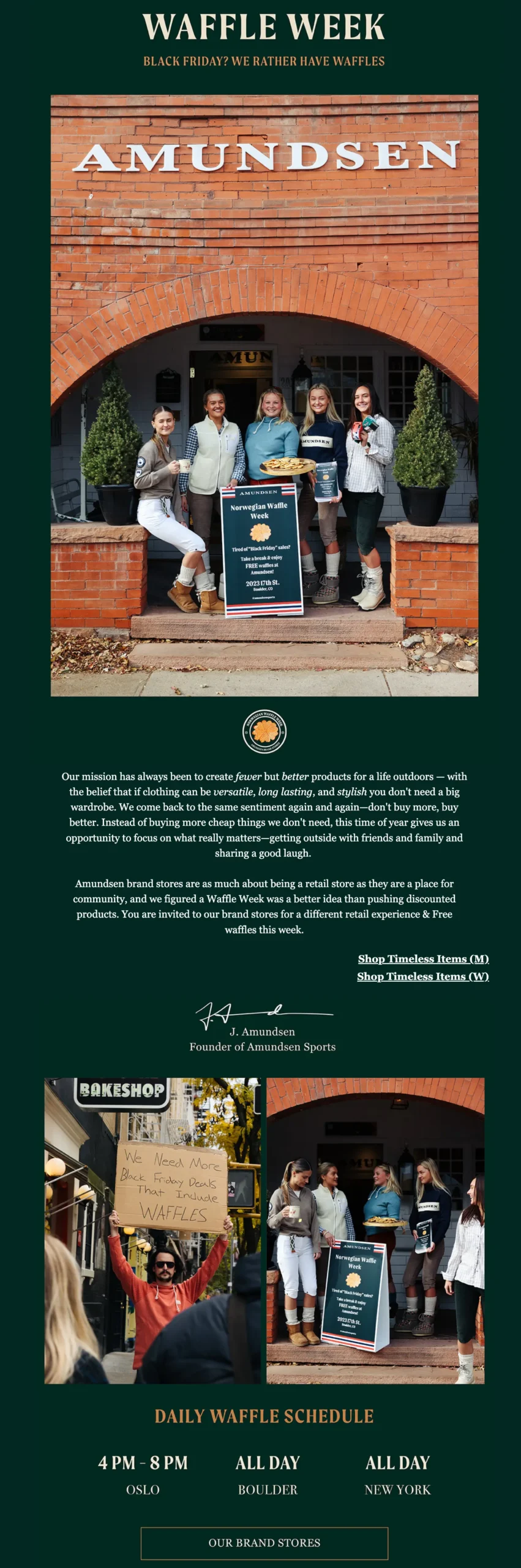
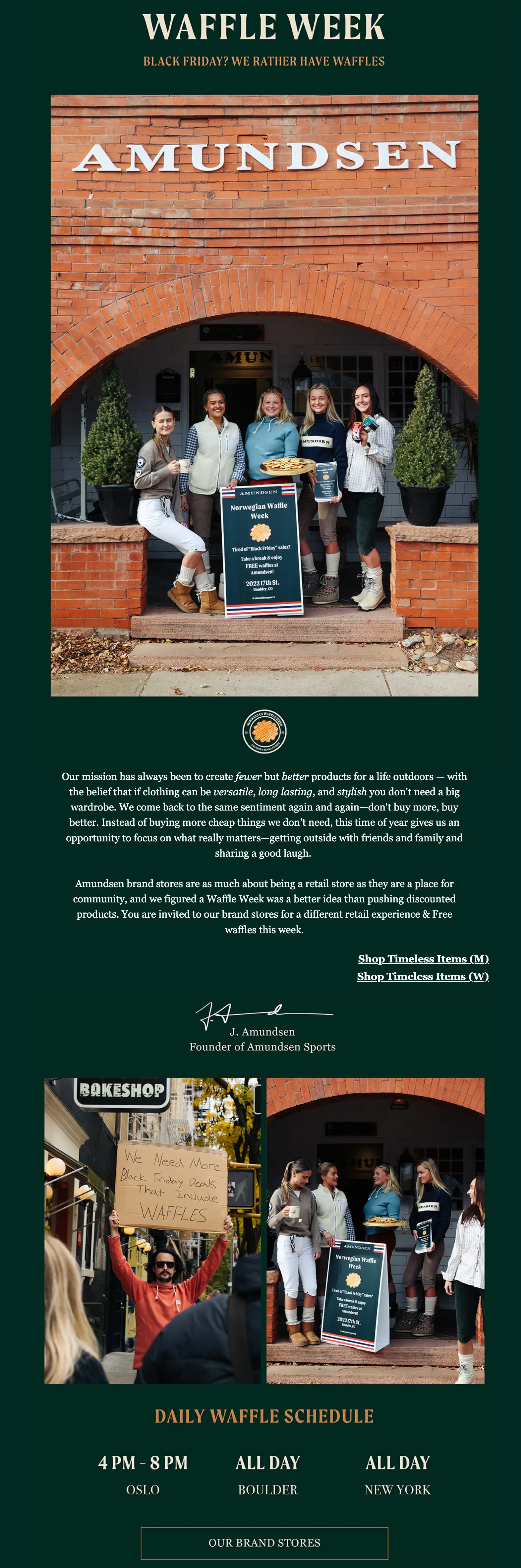
Black Friday sales typically follow a straightforward strategy where there’s a massive discount announcement. Amundsen, a premium outdoor apparel brand, chose a different path. Their campaign opened with an email about waffles, something that gives a nod to the brand’s familiar outdoors concept. And while the email does have a CTA button, it simply says "Shop Amundsen", actively choosing not to follow discount pricing strategies.
Amundsen shows that brands built on a genuine story can approach Black Friday and other campaigns from a brand-story perspective. It’s particularly useful for luxury brands who want to retain their premium status. By focusing on brand narrative and experiential value rather than steep discounts, Amundsen preserved its premium image and avoided diluting its perceived worth. This strategy is crucial for brands where price sensitivity is not the primary driver for purchase. Amundsen’s approach resulted in a remarkable 1,010% higher revenue-per-email (RPE) from automations, demonstrating that an authentic brand story can be far more powerful than a simple price cut for the right audience. It’s a testament to the idea that value, not just price, drives purchase decisions for discerning consumers.
9. To’ak Chocolate: The Gift with Purchase – Enhancing Perceived Value and Margin Protection
To’ak is a premium chocolate brand that uses the hype around Black Friday to engage with its subscribers. But instead of announcing discounts, the brand offers complimentary tasting kits to chocolate collections to add value, maintain a premium brand status, and protect margins. This strategy is particularly effective for high-end products where deep discounting could undermine brand perception.
Ecommerce brands with a similar profile can use this strategy and set a low-cost but high-value gift together with already favored products. You could also take it a step further by automating these offers to be sent after a customer makes a purchase. To’ak’s gift-with-purchase strategy enhances the perceived value of its already luxurious products without resorting to price reductions. It encourages larger purchases and offers an exclusive experience, reinforcing the brand’s premium positioning. To’ak Chocolate earns almost 40% of its email revenue from automation, indicating the power of strategically deployed, value-added incentives. This approach is a masterclass in protecting profitability while still participating in the BFCM buzz, appealing to customers who seek quality and exclusivity.
*10. BWEAR: The Bold Flash Sale – Clear Communication for Value-Driven Brands**
B*WEAR’s Black Friday email is one of the best examples of a brand running a sale announcement using minimal copy with fixed price points. The strategy builds on an already existing brand reputation, so the email’s bold discounting strategy communicates exactly what customers are expecting. This direct and no-frills approach cuts through the noise and delivers immediate value.
If you decide to follow a similar email layout, emphasize creating a clean, mobile-friendly email that focuses on price points without relying on text to carry the messaging. Pair this with SMS marketing and frame it as a real limited-time offer. BWEAR’s campaign demonstrates the effectiveness of clear, concise communication when the brand’s identity is synonymous with value and straightforward deals. By highlighting specific price points and bold discounts, they cater directly to price-sensitive customers looking for immediate bargains. BWEAR drives up to 40% of its online sales through email, proving that a well-executed flash sale, presented clearly and urgently, can be incredibly effective for brands that have room to discount and a customer base that appreciates direct offers.
Beyond the Weekend: Emerging Trends and the Future of BFCM Strategies
The landscape of Black Friday and Cyber Monday campaigns is continuously evolving. As consumer preferences shift towards greater sustainability and ethical consumption, more brands are expected to follow the lead of Patagonia and REI, integrating purpose-driven initiatives into their sales events. Personalization, driven by advanced data analytics and AI, will become even more sophisticated, allowing brands to deliver hyper-targeted offers and experiences to individual customers.
The rise of social commerce and live shopping events also presents new avenues for BFCM engagement, transforming passive browsing into interactive purchasing experiences. Furthermore, the emphasis on omnichannel integration will only grow, ensuring a seamless customer journey across all touchpoints, from social media ads to email campaigns, in-app experiences, and physical stores. Brands will need to invest in robust marketing automation platforms that can orchestrate these complex, multi-channel strategies efficiently. The future of BFCM will likely see a blend of aggressive discounting for certain segments, alongside value-driven, experiential, and purpose-led campaigns designed to build deeper, more enduring customer relationships.
Conclusion: Crafting a Resilient Black Friday Strategy for Enduring Success
The brands that see the highest ROI on their Black Friday campaigns and generate the most revenue build strategies around creativity, authenticity, and email segmentation. In practice, this looks like running a campaign based on a single, clear idea communicated throughout the Black Friday period and supporting it with timely and fitting offers, not generic one-size-fits-all discounts. The examples highlighted above illustrate that while discounts remain a cornerstone of BFCM, true success lies in strategic differentiation and a deep understanding of customer values.
Whether a brand chooses to make an anti-consumerism statement, offer a gamified experience, extend its sales period, or prioritize value over steep discounts, the underlying principle is the same: a well-conceived, coherent strategy that resonates with its audience. Pick the approach that matches your brand and margins, then run it from one place. Omnisend handles the email, SMS, popups, and automations behind every example above. Ultimately, a resilient Black Friday strategy is not just about maximizing short-term sales, but about strengthening brand identity, fostering customer loyalty, and laying the groundwork for sustained growth in the competitive e-commerce landscape.








