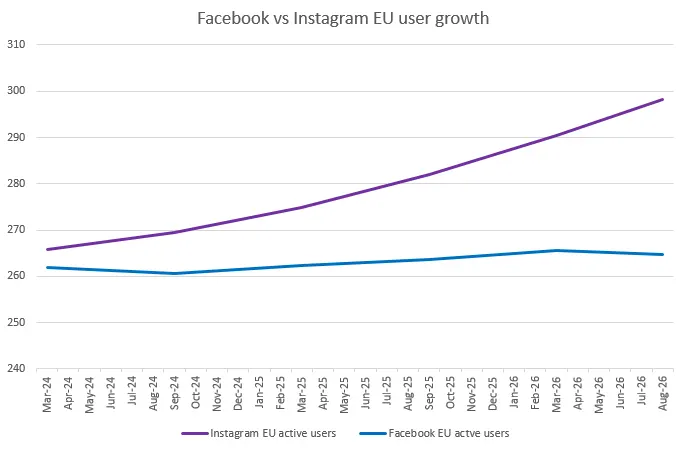
Meta Platforms Inc. has released its latest biannual transparency report under the European Union’s Digital Services Act (DSA), shedding light on the evolving landscape of its major platforms within the EU. The data, covering the first half of 2026, reveals a significant divergence in user growth trajectories between Instagram and Facebook, with the former demonstrating robust expansion while the latter continues to experience stagnation, and in some cases, decline. This report also details shifts in Meta’s content moderation efforts, notably a reduction in human moderation staff in the EU, coupled with an increasing reliance on artificial intelligence-powered tools, and mixed trends in the reporting of illicit content.
The Digital Services Act: A New Era of Accountability for Tech Giants
The European Union’s Digital Services Act (DSA), which became fully applicable for Very Large Online Platforms (VLOPs) and Very Large Online Search Engines (VLOSEs) in August 2023, represents a landmark piece of legislation aimed at creating a safer, more transparent, and accountable online environment. Enacted as part of the EU’s broader digital strategy, the DSA imposes stringent obligations on major digital service providers, including Meta, to protect users’ fundamental rights, combat illegal content, and enhance algorithmic transparency.
Key provisions of the DSA relevant to Meta’s recent report include the requirement for VLOPs to publish biannual reports detailing their average monthly active users in the EU. This metric is crucial, as platforms exceeding 45 million active users are designated as VLOPs, triggering a host of enhanced obligations. These obligations extend beyond user reporting to encompass comprehensive content moderation efforts, risk assessments, crisis response protocols, and mechanisms for user redress. The DSA’s overarching goal is to ensure that what is illegal offline is also illegal online, placing unprecedented responsibility on tech companies to proactively manage their platforms. For Meta, a company with multiple VLOP-designated services, compliance necessitates granular reporting across its ecosystem, offering an invaluable window into its operational dynamics within one of the world’s most significant regulatory blocs.
Meta’s EU User Landscape: A Shifting Tide
The newly published DSA report for the first half of 2026 underscores a pivotal shift in Meta’s user demographics across the EU. Instagram, the photo and video-sharing platform, has emerged as Meta’s primary growth engine in the region, registering 297 million active users. This figure marks a substantial increase compared to previous reporting periods and positions Instagram well on its trajectory to surpass 300 million users in the EU within the coming year. This consistent upward trend highlights Instagram’s enduring appeal, particularly among younger demographics and content creators, solidifying its role as a vibrant hub for visual communication and digital engagement.
In stark contrast, Facebook, Meta’s flagship social network, reported 264 million active users in the EU during the same period. This number not only places Facebook behind Instagram in terms of user count but also reflects a broader pattern of stagnation. Over several reporting cycles, Facebook’s EU user base has remained relatively flat, and in some instances, has even experienced slight declines. This trend suggests a maturation of the platform in the region, with limited new user acquisition and a potential exodus of existing users to alternative, more dynamic platforms. The data collectively indicates a clear generational and behavioral shift, where Instagram’s content-centric, visually driven experience resonates more powerfully with contemporary internet usage habits than Facebook’s traditional social networking model.
Instagram’s Ascendancy and Facebook’s Stagnation: A Deeper Dive
Instagram’s sustained growth in the EU is not an isolated phenomenon but rather a reflection of broader global trends and strategic pivots within Meta. The platform has successfully adapted to evolving user preferences, heavily investing in features such as Reels (short-form video content, directly competing with TikTok), Stories, and enhanced e-commerce capabilities. These innovations have broadened its appeal beyond its original photo-sharing roots, transforming it into a multifaceted platform for entertainment, community building, and brand engagement. Its intuitive interface and emphasis on visual storytelling continue to attract a diverse user base, including a significant segment of Generation Z and millennials who prioritize authentic, visually rich interactions.
Conversely, Facebook’s struggles in the EU are indicative of a mature platform facing intense competition and evolving user expectations. While still a colossal platform globally, its relevance in the EU appears to be diminishing, particularly among younger cohorts. Factors contributing to this stagnation include increasing competition from newer platforms like TikTok, the persistent challenge of misinformation and content moderation, and a general fatigue with its traditional newsfeed-centric experience. Users, particularly in developed markets like the EU, are increasingly seeking more niche communities, immersive visual experiences, and platforms that offer greater privacy or perceived authenticity. Facebook’s attempt to pivot towards a "metaverse company" also signals an acknowledgment of the platform’s limitations in its current form, as it seeks new avenues for long-term growth beyond its core social network. The platform’s persistent struggle to shed its "older demographic" image further complicates its efforts to attract and retain younger users in competitive markets.
Threads’ Entry into the EU Market
Meta’s text-based social platform, Threads, launched in the EU in December 2023, following a delayed rollout due to regulatory concerns, primarily related to data sharing between Instagram and Threads under the DSA and GDPR. The latest report indicates that Threads has garnered 41 million active users in the EU in the first half of 2026. While a significant figure for a relatively new platform, this represents a fraction of its global user base, which now exceeds 500 million monthly actives.
Threads’ performance in the EU, though modest compared to Instagram and Facebook, reflects a gradual but steady integration into the region’s social media landscape. Its initial launch outside the EU was met with rapid adoption, but its European debut faced the additional hurdle of navigating complex regulatory frameworks. The platform’s direct integration with Instagram’s user base has been a key driver of its growth, allowing users to seamlessly transition and leverage existing networks. However, Threads faces stiff competition from established microblogging platforms, most notably X (formerly Twitter), and must differentiate itself through unique features, enhanced content moderation, and a clear value proposition to accelerate its growth trajectory in the highly competitive European market. Its future success in the EU will depend on its ability to build a distinct community, address user feedback, and comply rigorously with the region’s stringent digital regulations.
Content Moderation Under Scrutiny: AI Integration and Staff Reductions
The DSA report also provides crucial insights into Meta’s content moderation practices, a cornerstone of its compliance obligations. A notable development is the reported reduction in Meta’s EU moderation staff. The company reported approximately 5,900 moderation staff as of the latest report, down from around 7,700 EU moderators in March of the reporting year. This significant reduction of nearly 24% in human moderation capacity within the EU is consistent with Meta’s previously stated strategy to increasingly leverage artificial intelligence (AI) for content moderation.
Meta has publicly outlined plans to replace human moderation staff with AI-powered systems, citing efficiency gains, scalability, and the ability to detect and act on harmful content more rapidly. The company asserts that AI can proactively identify a broader spectrum of illicit content, including hate speech, spam, and child sexual exploitation material (CSEM), often before it is reported by users. This strategic pivot, while promising in terms of technological advancement, raises questions about the nuances of content review, the accuracy of AI systems in diverse linguistic and cultural contexts, and the potential for algorithmic bias. Critics often point out that human moderators possess a contextual understanding that AI currently lacks, especially in areas like satire, sarcasm, and highly complex political discourse. The DSA itself emphasizes the importance of human oversight and effective redress mechanisms, putting Meta’s AI-centric approach under increased regulatory and public scrutiny.
Trends in Reported Content
The report also details specific trends in reported content categories across Facebook and Instagram:
- Instagram: Showed a concerning increase in certain severe categories. Reports of terror-related content on Instagram rose by almost 38% compared to the second half of 2025. Additionally, reports of child sexual exploitation content on the platform increased by approximately 22% during the same period. These increases are particularly alarming, suggesting that despite growth in user numbers, the platform faces significant challenges in preventing the proliferation of highly sensitive and harmful material. It also raises questions about whether the reduction in human moderators and the increased reliance on AI are effectively tackling these severe content types or if the reported increases are merely a reflection of more users encountering and reporting such content.
- Facebook: Presented a more favorable picture in terms of content reduction across several categories. Meta reported double-digit reductions from H2 2025 to H1 2026 in reports of hate speech (down about 19%), spam (down about 27%), bullying and harassment (down about 30%), and child exploitation material (down about 17%). While these declines could be interpreted as a success in moderation efforts, they must be considered in conjunction with the platform’s overall user stagnation and potential decline in the EU. A shrinking or less active user base might naturally lead to fewer instances of reported content, making it difficult to ascertain whether the reductions are due to more effective moderation, less problematic user behavior, or simply less overall engagement on the platform. The report acknowledges this ambiguity, suggesting these declines "could also be further indicators of the platform’s overall usage drops in the region."
The overall disclosure data confirms that Facebook has lost footing in terms of how much time users spend on the platform, with other platforms including Instagram and TikTok now superseding it. This broader shift in user engagement patterns is critical for understanding the context of content moderation statistics. If users are spending less time on Facebook, they are inherently less likely to encounter or report harmful content there, regardless of the effectiveness of moderation systems.
Implications for Brands and Digital Marketing in the EU
The findings of Meta’s latest DSA report carry significant implications for brands, advertisers, and digital marketers operating within the European Union. The clear ascendancy of Instagram over Facebook in terms of active users and growth trajectory necessitates a strategic re-evaluation of digital marketing approaches.
For brands aiming to maximize reach and resonance in the EU, Instagram is increasingly positioned as the more popular and dynamic platform. Its consistent growth suggests a fertile ground for engaging new audiences, particularly those within younger demographics who are more active on the platform. This implies a need for increased investment in Instagram-specific content strategies, including visually compelling campaigns, influencer marketing, short-form video content (Reels), and interactive features like Stories and shopping tools. Advertisers should prioritize authentic, creative content that aligns with Instagram’s aesthetic and community-driven ethos.
While Facebook still commands a significant user base of 264 million, its flat usage and declining relevance, especially among younger cohorts, indicate that it may no longer be the primary growth channel for many businesses in the EU. For brands targeting older demographics or leveraging established communities, Facebook retains value. However, a diversified approach is crucial, perhaps shifting ad spend and content creation efforts towards Instagram for broader brand awareness and new customer acquisition, while utilizing Facebook for community management, customer service, and targeted niche campaigns. The data suggests that a "one-size-fits-all" Meta strategy is no longer viable in the EU; instead, a nuanced approach tailored to each platform’s unique audience and engagement patterns is imperative. The rise of Threads, albeit nascent, also presents an opportunity for early adopters to establish a presence on a potentially influential text-based platform, especially for brands focused on real-time communication and community building.
Regulatory Oversight and Future Outlook
The transparency reports mandated by the DSA serve as a critical mechanism for regulatory oversight, allowing the European Commission and national authorities to monitor the compliance of VLOPs like Meta. The reported user numbers are not merely statistics; they are a direct measure of a platform’s market power and its corresponding obligations under the law. Any discrepancies or failures in reporting could lead to investigations and substantial penalties, underscoring the gravity with which Meta and other tech giants approach these disclosures.
The ongoing evolution of Meta’s content moderation strategy, particularly the increased reliance on AI, will remain a focal point of regulatory scrutiny. The DSA places a strong emphasis on effective and transparent content moderation, including robust appeals mechanisms and human oversight where necessary. The simultaneous rise in reports of terror and child sexual exploitation content on Instagram, coupled with a reduction in human moderators, will undoubtedly prompt questions from regulators regarding the efficacy and safety implications of an AI-first approach. Meta will need to demonstrate unequivocally that its AI systems are robust, accurate, and do not compromise user safety or fundamental rights, especially in critical areas of illegal content.
Looking ahead, the trends revealed in this report are indicative of a broader transformation within the digital ecosystem. The shift in user preferences from traditional social networking to more dynamic, visual, and ephemeral content formats will continue to shape platform development and advertising strategies. Meta’s strategic investments in the metaverse, while not directly reflected in these DSA numbers, represent a long-term bet on the next generation of digital interaction, acknowledging the limitations and challenges faced by its current core platforms. The interplay between technological innovation, evolving user behavior, and increasingly stringent regulatory frameworks like the DSA will define the future landscape of digital platforms in the EU and globally. These biannual reports offer invaluable data points in navigating this complex and ever-changing environment, providing a factual basis for understanding the trajectory of major digital players and their impact on society.