
 rifanmuazin
The discipline of Conversion Rate Optimization (CRO) has undergone a fundamental transformation over the last decade, shifting from a niche technical requirement to a central pillar of digital business strategy. At the heart of this evolution is the integration of artificial intelligence and the refinement of conversion research methodologies. Simbar Dube, a Conversion Research Specialist at Enavi and a veteran of the industry, recently shared insights into how the intersection of human psychology, data-driven experimentation, and generative technology is shaping the future of user experience and revenue growth. Dube, who transitioned into the field from a background in journalism, emphasizes that while the tools have become more sophisticated, the core objective remains constant: understanding why human intent collapses during the digital journey.
The Professional Evolution of Conversion Research
Simbar Dube’s entry into the CRO space in 2019 marked a significant career pivot from journalism. Joining Invesp as a Content Editor, he eventually ascended to the role of Head of Marketing before specializing in research at Enavi. This trajectory highlights a growing trend in the marketing sector where investigative skills—traditionally associated with reporting—are increasingly applied to data analysis. According to Dube, the transition was logical; both journalism and CRO require an obsession with understanding people, asking the right questions, and following a trail of evidence to a logical conclusion.

In the current digital landscape, the "Conversion Research Specialist" role has become critical. As businesses move away from relying on generic "best practices," which often fail to account for unique brand contexts, the demand for primary research has surged. Dube’s work focuses on identifying friction points in the user journey—the moments where a potential customer hesitates or abandons a purchase—and translating those findings into experiments that produce measurable financial results.
The Role of Artificial Intelligence in Modern Experimentation
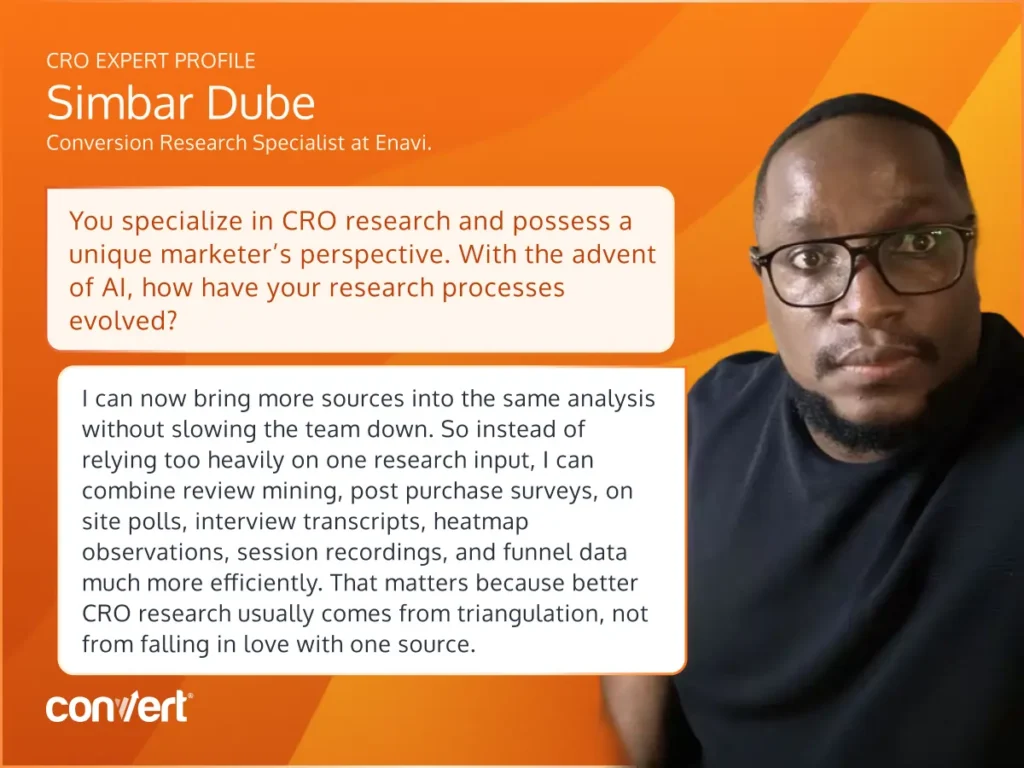
The advent of generative AI has introduced a paradigm shift in how research is conducted. For years, the bottleneck in CRO was the manual labor required to synthesize qualitative data. Researching customer sentiment often involved reading hundreds of product reviews, manually categorizing survey responses, and watching hours of session recordings.
Dube notes that AI has significantly altered the speed and breadth of this process. "Before AI, a lot of strong research work was limited by time," Dube explained. "You could go deep, but it was harder to go wide at the same time." With modern AI tools, researchers can now process vast volumes of customer feedback, cluster recurring objections, and identify language patterns in a fraction of the time. This allows for a "triangulation" of data—combining insights from post-purchase surveys, heatmaps, interview transcripts, and funnel data to create a more comprehensive view of the customer.

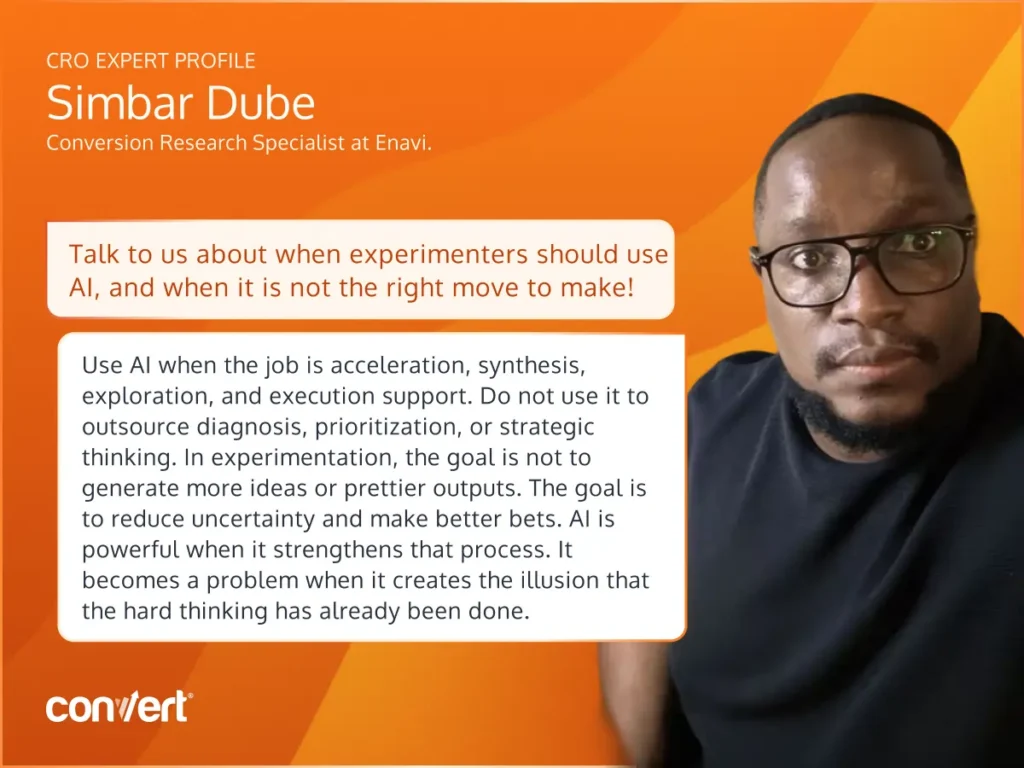
However, the integration of AI is not without its risks. Dube maintains a strict distinction between AI as a tool for acceleration and AI as a tool for judgment. While a model can surface signals—such as a recurring complaint about shipping costs—it cannot determine whether that complaint is the primary bottleneck for the most valuable user segment. This requires business judgment, funnel context, and an understanding of commercial reality that algorithms currently lack.
Chronology of an Experiment: Bridging the Digital and Physical Divide
To illustrate the practical application of CRO research, Dube points to a case study involving a retail client that recently opened a new physical storefront. This experiment highlights how CRO thinking can be applied beyond the confines of a website to influence real-world consumer behavior.
The Challenge (Baseline Period):
The client observed that while online traffic was steady, the Average Order Value (AOV) was significantly higher in physical stores. Customers expressed anxiety regarding the "fit and feel" of products, leading to hesitation in completing online purchases.
The Intervention (The Experiment):
The team formulated a hypothesis based on "Buy Online, Pick Up In-Store" (BOPIS) dynamics. They redesigned the website to make the pickup option prominent for shoppers in the geographic vicinity of the new store. The messaging was shifted to position the physical store as the fastest and most reassuring path to purchase, directly addressing the customer’s fear of incorrect fit.
The Results and Analysis:
By measuring pickup orders, foot traffic increases, and the order value of the local cohort, the team was able to validate the intervention. This was not a traditional A/B test of a button color, but a strategic experiment aimed at shifting demand into a more valuable and confident purchasing channel. It demonstrated that conversion research is as much about psychological reassurance as it is about technical optimization.
Supporting Data: The Growing Influence of AI in Marketing
Dube’s observations align with broader industry trends. According to a 2023 report by McKinsey & Company, generative AI could add between $2.6 trillion and $4.4 trillion annually to the global economy, with marketing and sales being one of the four functional areas that will realize 75% of that value. The report highlights that AI’s ability to synthesize data and generate personalized content is a primary driver of this growth.
Furthermore, data from Gartner suggests that by 2025, 80% of customer service organizations will be using generative AI to improve agent productivity and customer experience. In the realm of CRO, this manifests as "idea expansion" and "QA support," where AI helps teams pressure-test their implementation plans and explore a wider variety of copy variations than would be possible manually.
Strategic Sales Motion and Pipeline Recovery
Beyond traditional e-commerce, Dube has applied experimentation frameworks to B2B sales cycles, specifically targeting "stalled pipelines." In professional services and agency environments, a deal that stops moving is often treated as a "follow-up" problem. Dube suggests treating it as an experimentation problem.
By testing different re-entry approaches—ranging from broad nurture sequences to highly specific "diagnostic" outreach—Dube found that specific interventions outperform general marketing. Diagnostic outreach involves presenting a prospect with a pointed analysis of what is likely constraining their growth. This approach provides value and a "reason to think," which often restarts conversations that had previously gone cold. The metric for success here is not the "open rate" of an email, but the re-engagement of the account and the progression of the deal.

Official Responses and Industry Outlook
The rapid adoption of AI tools by major platforms further validates Dube’s approach. Shopify, for instance, has integrated AI-driven applications such as SimGym and Rollouts to assist merchants in simulating and deploying experiments. This signifies that AI is no longer a peripheral tool but a core component of the experimentation environment.
Industry experts have reacted to this shift with a mix of optimism and caution. While the speed of synthesis is widely praised, there is a consensus that "outsourcing diagnosis" to AI is a dangerous path. The role of the human experimenter is evolving from a data-gatherer to a strategic interpreter. The goal of the modern CRO professional is to reduce uncertainty and make better "bets" for the business, using AI to clear the path of manual hurdles.
Broader Impact and Implications
The insights provided by Simbar Dube suggest that the future of conversion research lies in the synergy between human intuition and machine efficiency. As AI continues to handle the "breadth" of research—processing thousands of data points instantly—humans must double down on the "depth" of research, focusing on empathy, strategy, and complex problem-solving.

For businesses, the implication is clear: those who use AI to simply generate more "stuff" (more ideas, more copy, more tests) will likely see diminishing returns. Conversely, those who use AI to strengthen their diagnostic processes and accelerate their path to proven insights will gain a significant competitive advantage.
In conclusion, the discipline of optimization is best summarized by Dube’s own five-word philosophy: "Curiosity. Tested. Proven. Repeat." In an era of technological upheaval, the most successful experimenters will be those who remain curious about the human behind the data and use every tool at their disposal—AI or otherwise—to prove what truly works in the pursuit of growth.








