
The landscape of enterprise e-commerce has undergone a seismic shift since Adobe’s $1.68 billion acquisition of Magento in 2018, transforming a popular open-source platform into Adobe Commerce, a cornerstone of the Adobe Experience Cloud. While most optimization guides assume a linear path for A/B testing, the sophisticated architecture of Adobe Commerce—defined by its multi-storefront capabilities, complex session handling, and aggressive caching layers—requires a specialized approach to experimentation. For global brands, the stakes are high; a poorly configured test can lead to inconsistent user experiences, data corruption, and significant revenue leakage. Understanding the technical nuances of this platform is no longer optional for digital marketers and developers aiming to drive conversion rate optimization (CRO) at scale.
The Evolution of Magento to Adobe Commerce
To understand the current complexities of A/B testing on the platform, one must look at the chronology of its development. Originally released in 2008, Magento quickly became the dominant force in e-commerce due to its flexibility. However, as the "Enterprise Edition" matured, it integrated features designed for high-volume retailers, such as the Full-Page Cache (FPC) and support for Varnish. Following the 2018 acquisition, Adobe rebranded the enterprise version as Adobe Commerce, layering in advanced AI-driven features like Product Recommendations powered by Adobe Sensei and deeper integrations with the Adobe Experience Manager (AEM).
Today, Adobe Commerce powers a significant portion of the world’s top 1,000 e-commerce sites. These businesses typically operate under a "multi-store" architecture, where a single Magento instance manages dozens of localized storefronts across different regions, languages, and currencies. This architectural complexity is precisely what makes standard A/B testing tools struggle; without deep integration, a test intended for a UK audience might accidentally trigger on a US storefront, or worse, serve conflicting variants to the same user across different sessions.
Technical Hurdles: The Caching and Varnish Layer
The primary challenge in Magento experimentation lies in its performance-first architecture. To handle thousands of concurrent users, Adobe Commerce utilizes a Varnish layer—a reverse proxy cache that sits in front of the web server. Varnish intercepts incoming requests and delivers pre-rendered HTML without ever reaching the PHP application layer. While this results in lightning-fast page loads, it creates a "blind spot" for A/B testing tools.
Because Varnish operates independently of the application, it has no inherent knowledge of a visitor’s "bucket" or variant assignment. If a testing tool’s JavaScript runs only on the client side, it must modify the DOM after the cached page has already rendered. This leads to the "Flash of Original Content" (FOOC), or flicker, where a user sees the original version of a page for a fraction of a second before the test variant appears. Industry data suggests that even a 100-millisecond delay in page rendering can decrease conversion rates by 7%, making the elimination of flicker a technical priority for enterprise developers.
Furthermore, if the cache is not configured to respect "variant cookies," the server may serve a cached version of Variant A to a user who was supposed to see Variant B. This results in "polluted" data, rendering the entire experiment statistically invalid.
Strategic Testing Zones: Where to Optimize
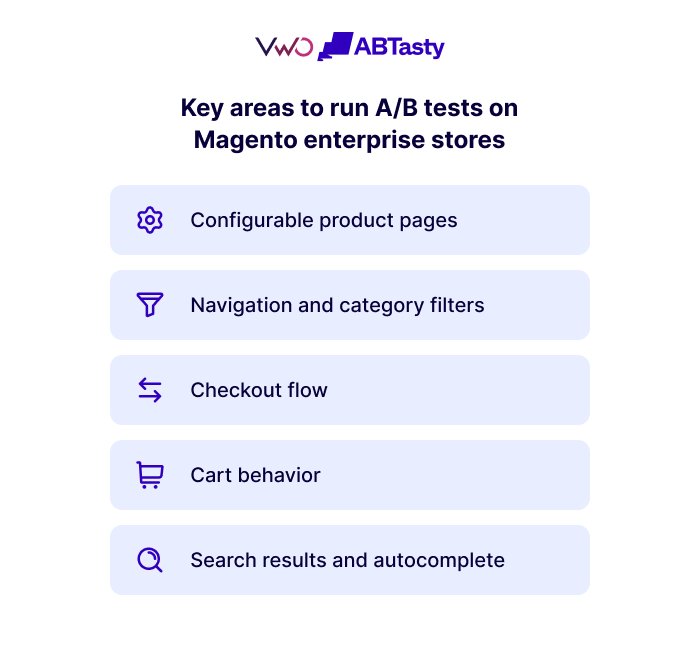
In the template-driven environment of Adobe Commerce, the most impactful experiments are those that target high-traffic global templates. According to industry benchmarks, the following areas offer the highest return on investment for testing:

1. Configurable Product Pages
Unlike simple products, Magento’s configurable products allow for complex attribute selections (size, color, material). Testing how these options are presented—whether via dropdowns, visual swatches, or tiled buttons—can significantly influence the "Add to Cart" rate. Data from consumer behavior studies indicates that visual swatches often outperform dropdown menus by providing a more intuitive and faster shopping experience.
2. Navigation and Layered Filtering
The "Layered Navigation" feature is a core strength of Magento, but it is often the most under-tested. For stores with massive catalogs, the order of filters (e.g., price vs. brand vs. rating) and the default state of those filters (expanded vs. collapsed) can determine whether a user finds a product or bounces. Optimizing the search bar and autocomplete functionality is also critical; searchers are typically 2.4 times more likely to buy than browse-only visitors, making search result relevance a high-leverage testing area.
3. The Multi-Step Checkout Flow
Magento’s checkout is a structured process involving shipping selection, address entry, and payment. Enterprise brands often test the "guest checkout" versus "account creation" prompts. With the global average shopping cart abandonment rate hovering at 70.22%, even a 1% improvement in checkout completion can translate into millions of dollars in annual revenue for enterprise-tier retailers.
4. B2B Buying Workflows
For Adobe Commerce B2B users, the quote request process and requisition lists are vital. Experimenting with the "Quick Order" form layout or the visibility of shared catalog pricing can streamline the procurement process for corporate buyers, who prioritize efficiency over aesthetic appeal.
Best Practices for Reliable Experimentation
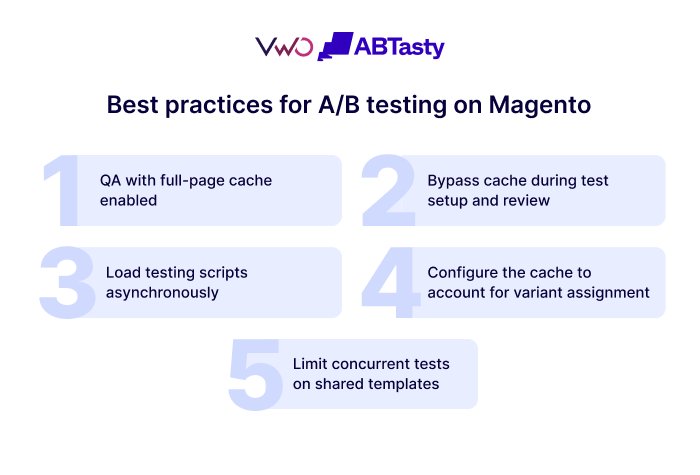
To overcome the architectural barriers of Magento, technical teams must adhere to a rigorous set of implementation standards.
- Asynchronous Loading with Pre-hiding: To mitigate flicker, testing scripts should be loaded asynchronously to prevent render-blocking, but they must be paired with a "pre-hiding snippet" placed high in the
<head>tag. This snippet suppresses the page content until the variant is ready to be displayed, ensuring a seamless user experience. - Cache-Aware QA: Quality assurance (QA) must be conducted with the Full-Page Cache enabled. Testing on an uncached staging environment is a common mistake that fails to replicate the production behavior of Varnish.
- Persistent First-Party Cookies: To maintain session integrity, variant assignments should be stored in persistent first-party cookies. The Varnish configuration must then be updated to "vary" its cache based on these cookies, ensuring the correct HTML is served to the correct user bucket.
- Scoping to Store Views: Given Magento’s multi-storefront nature, every test must be explicitly scoped to a specific store view. This prevents "cross-pollination," where promotional tests for one brand or region unintentionally appear on another.
The Tooling Landscape: Selecting an Enterprise Partner
Not all A/B testing tools are equipped to handle the demands of Adobe Commerce. The market is currently led by three major players, each offering different strengths for Magento users:

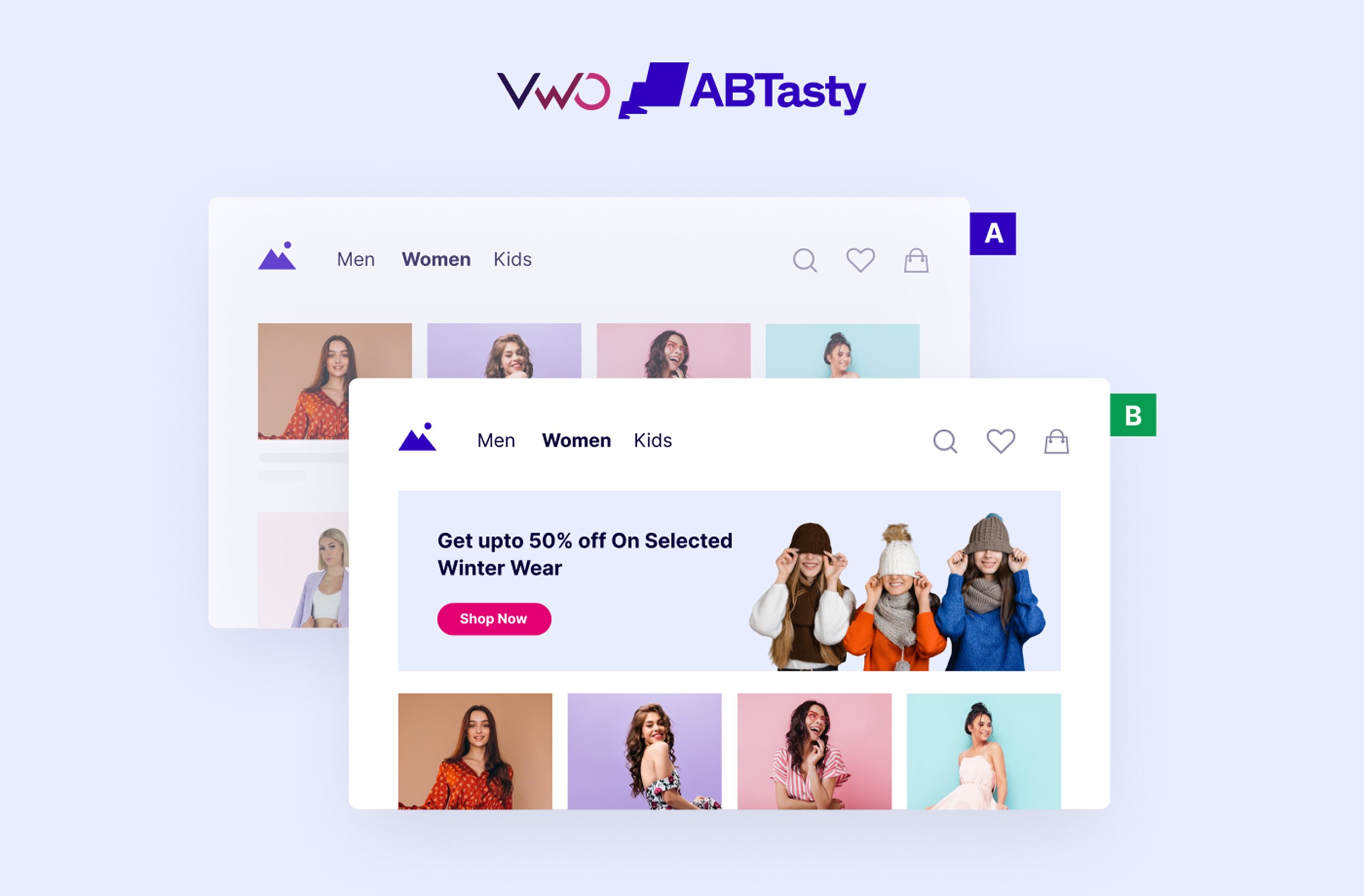
- VWO AB Tasty: Known for its deep integration capabilities, VWO’s SmartCode can be configured per store view directly within the Magento admin. It offers a suite of qualitative tools, including heatmaps and session recordings, which allow teams to build hypotheses based on actual user friction.
- Kameleoon: This platform is favored by high-traffic stores that require server-side testing capabilities. By handling variant assignment earlier in the request cycle, Kameleoon can bypass many of the client-side flicker issues associated with heavily cached templates.
- Optimizely: As a staple of the enterprise market, Optimizely provides a comprehensive platform that combines experimentation with content management. It is often the choice for organizations that have already invested heavily in the wider Adobe or Microsoft ecosystems and require robust multi-team collaboration features.
Official Responses and Expert Analysis
Garret Cunningham, Director of Global Optimization at Columbus Global, emphasized during a recent industry podcast that "testing velocity" is the true differentiator for enterprise success. According to Cunningham, organizations that dedicate specific design and development resources to experimentation consistently outperform those that rely on shared or "borrowed" teams. This sentiment is echoed by Ilan Hurwitz, a veteran in the e-commerce space, who notes that the primary challenge for enterprise businesses is often not a lack of data, but a lack of cross-departmental alignment.
The implication for the broader e-commerce market is clear: as consumer acquisition costs (CAC) continue to rise, the ability to squeeze more value out of existing traffic through scientific testing is becoming a core competitive advantage. Adobe Commerce provides the robust foundation needed for this, but it requires a sophisticated layer of experimentation logic to truly unlock its potential.

Broader Impact and Future Outlook
Looking forward, the integration of AI and machine learning into the Adobe Commerce ecosystem is set to change the nature of A/B testing. We are moving away from simple "A vs. B" tests toward "multi-armed bandit" experiments and hyper-personalization, where the platform automatically directs traffic to the winning variant in real-time.
For the enterprise Magento store owner, the roadmap to success involves moving beyond basic front-end changes. The future lies in testing deep-stack logic—such as pricing algorithms, shipping calculations, and AI-driven product sorting. By mastering the technical complexities of caching and session handling today, brands are positioning themselves to leverage the next generation of automated optimization tools. In the high-stakes world of enterprise e-commerce, the winners will be those who treat their website not as a static storefront, but as a living laboratory for continuous improvement.

 Siti Muinah
 Nana
Nana