LinkedIn, the world’s leading professional networking platform, reported a notable increase in its active user base within the European Union during the first half of 2026, reaching 56.5 million users. This growth of 1.4 million active users, compared to the second half of 2025, was disclosed as part of the platform’s obligations under the European Union’s Digital Services Act (DSA). Simultaneously, the company announced a substantial 46% jump in its enforcement actions against inauthentic activity, signaling a concerted effort to combat automated content, artificial intelligence-generated comments, and fraudulent profiles that threaten the integrity of its professional ecosystem. This dual revelation underscores LinkedIn’s ongoing efforts to expand its reach while grappling with the pervasive challenge of maintaining content authenticity and user trust in an increasingly digital and AI-driven landscape.
The Digital Services Act: A Mandate for Transparency
The disclosure of LinkedIn’s active user metrics is a direct consequence of the EU’s landmark Digital Services Act, a comprehensive legislative framework designed to create a safer, more predictable, and trustworthy online environment. Enacted with significant provisions coming into effect in late 2023 and early 2024, the DSA places stringent obligations on online platforms, particularly those designated as Very Large Online Platforms (VLOPs) and Very Large Online Search Engines (VLOSEs), which reach a significant portion of the EU population. LinkedIn, with its extensive user base, falls under this classification, necessitating greater transparency regarding its operations, content moderation practices, and user engagement figures within the EU.
The DSA’s primary objectives include combating illegal content, protecting users’ fundamental rights online, and holding platforms accountable for their impact on society. For VLOPs like LinkedIn, this translates into requirements for publishing detailed reports on active users, content moderation, risk assessments, and measures taken to mitigate systemic risks. The mandate for active user reporting is particularly crucial as it moves beyond vanity metrics like total registered members, offering a more accurate picture of a platform’s actual engagement and reach—a critical distinction for regulators, researchers, and the public alike. By compelling platforms to report monthly active users (MAU) in the EU, the DSA aims to provide a clearer understanding of their market power and societal influence, fostering greater accountability. This regulatory pressure has brought to light specific data points that LinkedIn, like many other platforms, typically does not make public, offering a rare glimpse into the true dynamics of its user base.
Deciphering LinkedIn’s User Metrics: Members vs. Active Users
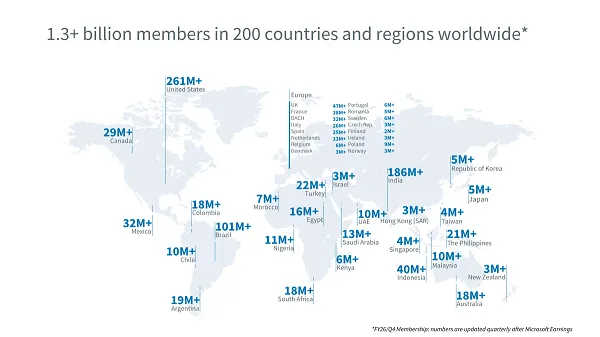
The latest DSA report highlights a persistent disparity between LinkedIn’s widely reported "total members" and its actual "active users." While the platform proudly announces a global member base exceeding 1.3 billion, the EU data provides a more granular insight into real-world engagement. The 56.5 million active EU users represent a significant portion of the total EU member base, yet the ratio reveals a consistent pattern. Based on LinkedIn’s own reported EU membership statistics, only approximately 30% of its registered members in the European Union are actively utilizing the application. This implies that a substantial majority of registered accounts, roughly 70%, are either dormant, infrequently accessed, or created for a one-time purpose and then abandoned.
Extrapolating this 30% active user trend across LinkedIn’s global member base of 1.3 billion suggests an approximate worldwide monthly active user count of around 433 million. While still a formidable figure, this starkly contrasts with the headline-grabbing "1.3 billion members" often cited by the company. This distinction is paramount for stakeholders, particularly advertisers, recruiters, and businesses leveraging the platform for professional outreach. An active user base signifies genuine engagement, content consumption, and potential for interaction, whereas a large member count can be misleading if a significant portion remains inactive. The DSA’s insistence on reporting active users therefore provides a vital corrective to potentially inflated perceptions of platform reach.
A Closer Look at Engagement Trends: The Paradox of Growth
Despite LinkedIn’s recent announcements of solid growth, the underlying active user data suggests a more nuanced reality. In its Q2 2026 update, parent company Microsoft reported that LinkedIn CEO Daniel Shapero highlighted "double-digit member growth" and a 10% year-over-year increase in content consumption. These figures, taken in isolation, paint a picture of robust expansion and heightened user engagement. However, when juxtaposed with the stable percentage of active users, a different narrative emerges.
Historical DSA reports from LinkedIn further underscore this consistency. In March 2025, an analysis based on the DSA data showed that 28% of LinkedIn’s EU member base was actively using the app. Similarly, in October 2024, the ratio of members to active users also stood at 28%. The current figure of approximately 30% for H1 2026, while a slight uptick, demonstrates a remarkable stability over time. This suggests that while LinkedIn continues to attract new registrations (contributing to "member growth") and existing active users are consuming more content, the platform is not significantly converting its vast pool of inactive members into regular, engaged users.
This phenomenon implies that the increased content consumption and overall engagement metrics are largely driven by the platform’s existing core active user base. These are the "power users" and consistent contributors who generate and interact with the bulk of the content. While their increased activity is valuable, the challenge for LinkedIn lies in broadening this active base and activating the millions of registered members who are currently on the sidelines. The consistent active user percentage, despite overall member growth, indicates that the platform’s strategies for re-engaging dormant accounts or attracting new, consistently active users have not yet yielded a significant shift in this fundamental ratio. This presents a strategic challenge for LinkedIn as it seeks to maximize its network effect and expand its influence beyond its committed user cohort.
The Battle Against Inauthenticity: AI Slop and Engagement Pods
Perhaps the most striking revelation from LinkedIn’s latest report is the 46% surge in detected instances of inauthentic activity during the first half of 2026 compared to the latter half of 2025. This significant increase underscores the escalating battle platforms face against sophisticated forms of manipulation and content pollution, particularly with the proliferation of artificial intelligence tools. LinkedIn has explicitly stated its focus on combating "engagement pods," external automated posting services, and what it terms "AI slop."
Engagement pods are groups, often formed outside the platform, where users agree to artificially inflate each other’s post metrics (likes, comments, shares) to boost visibility within the algorithm. While seemingly innocuous to some, these pods distort the true reach and relevance of content, creating an uneven playing field and undermining the platform’s meritocratic principles. Automated posting services, on the other hand, allow users to schedule and publish content without direct manual intervention, often leading to a flood of generic or low-quality posts designed solely for visibility rather than genuine value. These services can also be exploited for spamming or disseminating misleading information at scale.
"AI slop" represents a newer, more insidious challenge. As generative AI technologies become more accessible and sophisticated, there has been a rise in automatically generated comments, messages, and even profiles that lack genuine human insight or professional value. These AI-generated contributions often appear superficially plausible but are devoid of substance, designed to mimic engagement or propagate specific narratives. Such content clutters feeds, dilutes the quality of discussions, and erodes user trust by making it difficult to discern authentic interactions from algorithmic mimicry. The 46% increase in detected inauthentic activity suggests either a dramatic rise in such malicious endeavors or a significant improvement in LinkedIn’s detection capabilities, or likely a combination of both. This proactive stance is critical for maintaining the platform’s reputation as a reliable and professional environment, free from the noise and deception that can plague other online spaces.
LinkedIn’s Proactive Stance and Technological Countermeasures
The substantial rise in enforcement actions reflects LinkedIn’s commitment to preserving the integrity of its platform. While specific technologies are often proprietary, it can be logically inferred that LinkedIn is deploying advanced machine learning models and AI-powered detection systems to identify patterns indicative of inauthentic behavior. These systems likely analyze comment velocity, repetitive phrasing, account creation patterns, network connections, and deviations from typical user behavior. Furthermore, LinkedIn likely employs a combination of automated flagging, human review, and user reporting mechanisms to identify and address violations.
Combating engagement pods, for instance, involves identifying coordinated activity among accounts that might not otherwise interact naturally. For automated posting, systems can detect unusual posting frequencies or content generation methods. The challenge of "AI slop" is particularly complex, as generative AI can produce text that is difficult for even humans to distinguish from genuine contributions. This requires AI detection tools capable of identifying subtle stylistic markers, semantic inconsistencies, or patterns associated with specific large language models. LinkedIn’s previous statements, such as outlining measures to combat engagement pods and acknowledging the reporting of "AI slop" by over a million users, indicate an ongoing, iterative process of developing and refining these countermeasures. This increased enforcement is not merely a reactive measure but part of a broader, sustained strategy to cultivate a high-quality, trustworthy professional network in the face of evolving digital threats.
Chronology of Transparency: DSA Reporting Evolution
The EU DSA has provided a unique chronological insight into LinkedIn’s active user dynamics, revealing a consistent trend. The initial DSA disclosure reports, mandated for Very Large Online Platforms, first became public in late 2023 and early 2024.
- October 2024: LinkedIn’s first round of DSA reporting revealed a specific active user count for the EU, with analysis indicating that approximately 28% of its EU member base was actively using the app. This was the first concrete public data point on active usage within a defined geographic region.
- March 2025: Subsequent reporting by LinkedIn, covering the second half of 2024, showed a similar trend. The active user percentage relative to the total EU member base remained consistent at around 28%. This indicated a stable ratio, even as the overall member count might have continued to grow.
- First Half of 2026: The latest report, covering H1 2026, shows a slight increase in the active user percentage to approximately 30%. While a positive sign, this shift is modest, reinforcing the observation that the core active user base is growing in absolute terms (1.4 million new active users) but maintaining a relatively consistent proportion of the total member population.
This chronology demonstrates that while LinkedIn has achieved consistent, albeit modest, growth in its absolute number of active users in the EU, the fundamental challenge of converting a larger proportion of its vast registered member base into active participants persists. The DSA reporting has thus become a crucial benchmark for evaluating the platform’s true engagement health over time, offering a level of transparency previously unavailable.
Broader Implications for the Professional Network
The insights gleaned from LinkedIn’s DSA disclosures carry significant implications across various facets of the professional networking ecosystem.
-
For Advertisers and Marketers: The distinction between total members and active users is critical for campaign effectiveness. Advertisers pay for reach and engagement, and if a substantial portion of the "member" audience is inactive, their return on investment (ROI) could be diluted. The stable active user percentage suggests that while the audience of engaged professionals is growing, its growth is not proportional to the overall member acquisition. This necessitates more targeted strategies to reach the truly active segment and a greater focus on content quality to capture their attention amidst increasing noise. The fight against inauthentic activity is also vital; a clean, engaged audience is far more valuable than one inflated by bots or fake interactions.
-
For Recruiters and Talent Acquisition: LinkedIn’s primary value proposition for many organizations lies in its robust talent pool. If a significant portion of members are inactive, recruiters might encounter profiles that are outdated or unresponsive. While the platform remains an invaluable tool, understanding the active vs. inactive user ratio helps refine recruitment strategies, perhaps emphasizing direct outreach to genuinely engaged candidates or focusing on active communities within the platform. The removal of inauthentic profiles also ensures that recruiters are connecting with real professionals, reducing wasted effort on fraudulent or misleading accounts.
-
For the User Experience: The platform’s concerted effort to combat "AI slop" and engagement pods is paramount for maintaining a high-quality user experience. A feed inundated with generic, AI-generated comments or artificially boosted content can quickly become frustrating and erode trust. Users rely on LinkedIn for authentic professional interactions, credible information, and meaningful networking. By proactively addressing inauthenticity, LinkedIn aims to ensure that discussions remain relevant, connections are genuine, and the overall value proposition for its users is preserved. This commitment to quality is essential for user retention and satisfaction.
-
For LinkedIn’s Strategic Growth: The challenge for LinkedIn is to not only grow its total member count but also to deepen engagement across its entire user base. Converting inactive members into active participants represents a significant growth opportunity. This could involve enhanced personalization, more compelling content formats, improved community features, or even targeted re-engagement campaigns. The ongoing battle against inauthentic activity is also a strategic imperative; failure to maintain content quality and trust could deter users and advertisers, impacting long-term revenue and market position. The platform’s ability to balance scale with integrity will define its future trajectory in the competitive landscape of professional online communities.
Official Statements and Future Outlook
While LinkedIn does not typically issue specific press releases detailing these DSA-mandated figures beyond the reports themselves, the consistent messaging from Microsoft and LinkedIn CEO Daniel Shapero emphasizes a commitment to fostering a vibrant and authentic professional community. The reported double-digit member growth and increased content consumption, alongside the rigorous enforcement actions, suggest a strategy focused on both expansion and quality control. The implicit message is that LinkedIn is actively investing in the tools and policies necessary to combat emerging threats to its platform’s integrity, even as it continues to expand its global footprint.
The future outlook for LinkedIn will likely involve a continuous refinement of its AI detection capabilities to stay ahead of increasingly sophisticated inauthentic activity. Furthermore, efforts to convert its vast "member" base into a more actively engaged "user" base will remain a key strategic priority. As the professional world increasingly relies on digital networks, LinkedIn’s ability to maintain a trustworthy, high-quality, and genuinely active environment will be crucial for its continued relevance and success in a dynamic digital economy. The transparency mandated by the EU DSA offers valuable, ongoing insights into how effectively the platform is navigating these complex challenges.