

The strategic application of ChatGPT prompts for Shopify is rapidly becoming an indispensable tool for merchants aiming to optimize operations, enhance customer engagement, and drive sales. By understanding how to effectively communicate with generative AI, businesses can reclaim countless hours weekly, transforming time-consuming tasks into streamlined processes. The more granular the input provided to ChatGPT regarding product specifics, target audience, and desired outcomes, the more precise and actionable the generated content will be, significantly reducing the need for extensive post-generation revisions.
This transformative capability extends across nearly every facet of e-commerce operations that traditionally demand significant time and resources. From crafting compelling product descriptions and designing intricate email marketing campaigns to optimizing for search engine visibility (SEO) and developing engaging ad copy, ChatGPT offers a versatile solution. The availability of structured prompts allows merchants to quickly adapt and reuse templates, ensuring consistency and efficiency across diverse marketing and operational needs.
The importance of precise and relevant copy has surged dramatically in recent years, particularly with the proliferation of AI in consumer interactions. As shoppers increasingly turn to AI assistants like ChatGPT for product recommendations, the quality and detail of a store’s product data directly influence its discoverability. This data, encompassing well-articulated product descriptions and optimized content, forms the foundation upon which AI draws to present options to potential buyers. Shopify itself has observed this profound shift, reporting an astonishing eightfold year-over-year growth in AI-driven traffic to its stores by early 2026, underscoring the critical link between AI-ready content and market presence.
The Dawn of Agentic Commerce: Shopify’s Vision with OpenAI
A significant development underpinning this shift was the strategic partnership between Shopify and OpenAI in 2025. This collaboration marked the advent of what Shopify terms "agentic commerce," a paradigm where AI acts as an intelligent agent, facilitating product discovery and purchase decisions for consumers. Through this partnership, ChatGPT gained the ability to recommend products directly from Shopify stores, seamlessly guiding shoppers toward purchase. This forward-thinking move by Shopify aligns perfectly with broader industry trends and recent research, which indicates that over half of online shoppers are now utilizing generative AI in their purchasing journeys. This statistic highlights a fundamental change in consumer behavior, where AI is no longer just a backend tool but an active participant in the front-end shopping experience.
Understanding ChatGPT Prompts for E-commerce Tasks
At its core, a ChatGPT prompt for Shopify is a specific instruction provided to the AI to execute an e-commerce task. These tasks range from generating a new product description or refining existing page SEO to drafting a targeted email, creating persuasive ad copy, or assisting with customer support inquiries. The efficacy of these prompts hinges entirely on the context provided. The richer and more detailed the input, the higher the quality and relevance of ChatGPT’s output.
Effective Shopify prompts typically incorporate several key components:
- Clear Role Assignment: Directing ChatGPT to "Act as an ecommerce copywriter" or "ecommerce SEO specialist."
- Specific Task Definition: Clearly stating the desired outcome, e.g., "Write a Shopify product description" or "Create an Instagram carousel."
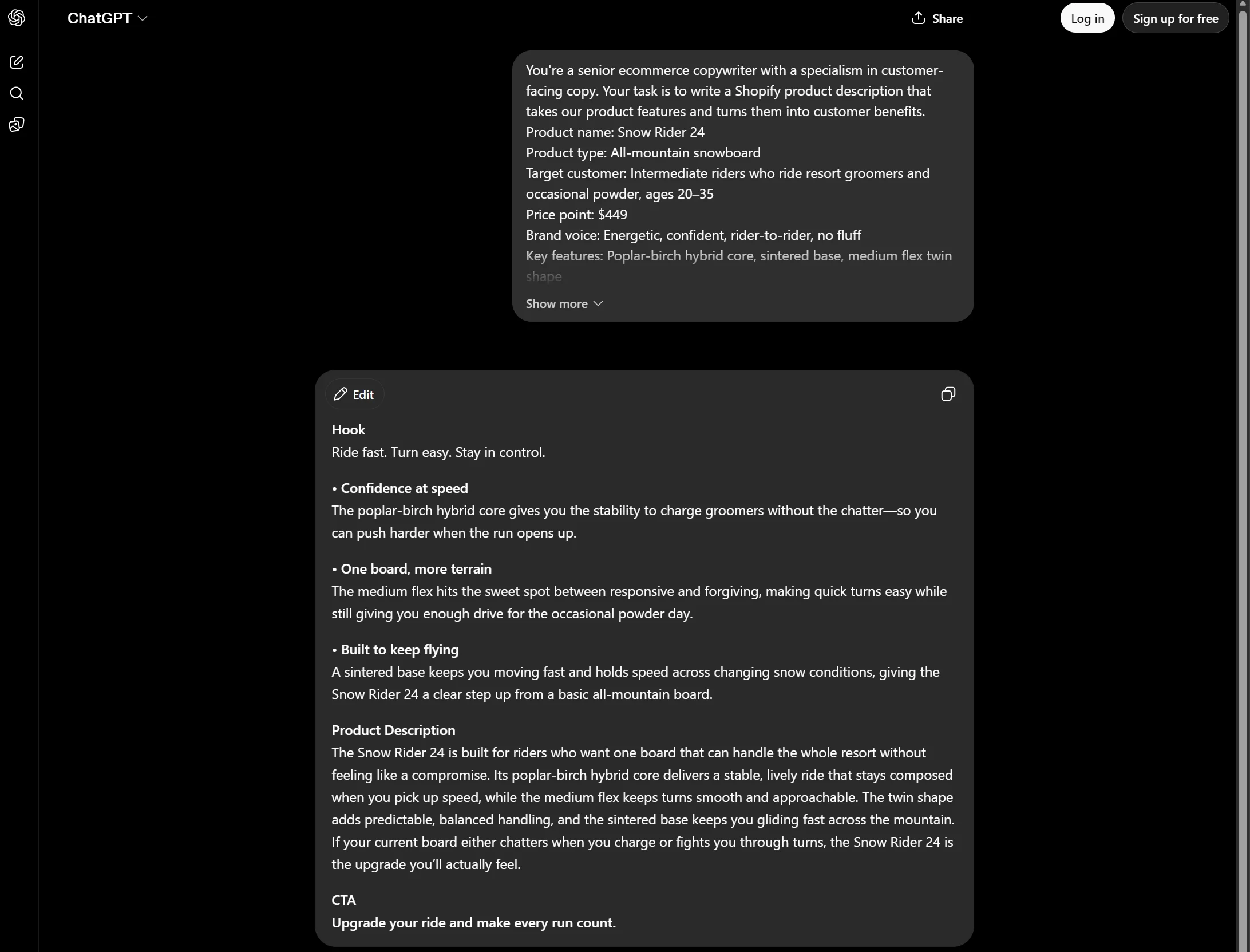
- Product and Audience Details: Providing comprehensive information about the product, its features, benefits, and the target customer’s demographics, pain points, and objections.
- Brand Voice and Tone: Specifying the desired brand personality (e.g., professional, friendly, witty, empathetic) to ensure brand consistency.
- Output Format: Defining the structure of the desired response, such as bullet points, paragraphs, subject lines, or character limits.
- Goals and Constraints: Outlining the objective of the content (e.g., increase conversions, build awareness) and any limitations (e.g., avoiding discounts, specific word counts).
Diverse Applications: How ChatGPT Empowers Shopify Stores
ChatGPT functions as an on-demand content generator and analytical assistant for Shopify stores. Its capabilities span content creation, marketing optimization, and customer interaction, offering significant efficiency gains. However, it’s crucial to remember that AI outputs require a human editorial pass to verify accuracy, brand alignment, and factual correctness before deployment.
Here’s a breakdown of key areas where ChatGPT can be deployed:
1. Product Page Optimization
Compelling product pages are critical for converting browsers into buyers. ChatGPT excels at transforming raw product data into persuasive sales copy.
- Feature-to-Benefit Descriptions: A common pitfall in e-commerce is listing features without translating them into customer benefits. Prompts can guide ChatGPT to articulate what the product does for the customer, addressing their pain points and highlighting solutions. For example, a prompt could turn "waterproof material" into "enjoy worry-free adventures, knowing your gear is protected."
- Competitive Positioning: Merchants can use prompts to generate copy that subtly positions their product advantageously against competitors, emphasizing unique selling propositions without directly criticizing alternatives.
- Audience-Specific Rewrites: Repurposing existing product copy for different customer segments (e.g., beginners vs. experts, budget-conscious vs. luxury buyers) while maintaining brand voice is made simple.
- Technical Feature Simplification: For products with complex functionalities, ChatGPT can distill technical jargon into easily understandable language, ensuring all potential customers grasp the value proposition.
- Urgency for Limited Editions: Crafting engaging copy that creates a sense of urgency for seasonal or limited-edition products, encouraging immediate purchases without resorting to aggressive sales tactics.
2. Email and SMS Marketing Campaigns
Email and SMS marketing are vital for customer retention and engagement. ChatGPT provides initial drafts that can be tailored for various segments and campaign types.
- Abandoned Cart Recovery: Generating empathetic yet persuasive emails that remind customers about items left in their cart, potentially addressing common objections without immediately resorting to discounts, thereby protecting margins.
- Post-Purchase Upsells: Crafting follow-up emails that nurture customer relationships post-purchase, offering relevant product recommendations to encourage repeat business.
- Personalized Re-engagement: Developing win-back campaigns for inactive customers, leveraging their past purchase history to suggest new products or offers that reignite interest.
- VIP Early Access: Designing exclusive email and SMS campaigns that make VIP customers feel valued, offering early access to new products or promotions, fostering loyalty without relying solely on discounts.
- Welcome Series Automation: Creating a multi-part welcome sequence for new subscribers, introducing the brand story, showcasing popular products, and gently guiding them towards their first purchase.
3. SEO and AI Discovery Enhancement
Optimizing a Shopify store for both traditional search engines and emerging AI discovery channels is paramount for visibility. ChatGPT can assist with various SEO tasks.
- Product Title and Meta Description Optimization: Generating compelling, keyword-rich titles and meta descriptions that improve click-through rates from search results and align with character limits.
- Blog Topic Generation: Using keyword research and customer pain points to brainstorm blog post ideas that address pre-purchase queries, driving organic traffic and positioning the store as a thought leader.
- Product Page SEO Rewrites: Enhancing existing product page copy for clarity, search relevance, and conversion potential, ensuring natural keyword integration and improved readability.
- Structured FAQs for AI Search: Creating detailed FAQ sections that not only answer common customer questions but also provide structured data for AI assistants, improving product discoverability through conversational search.
- Image Alt Text: Generating descriptive and keyword-inclusive alt text for product images, improving accessibility for screen readers and enhancing search engine understanding of visual content.
4. Ad Copy and Social Media Content
Effective advertising and social media engagement are crucial for brand awareness and customer acquisition. ChatGPT can generate platform-specific content that resonates with target audiences.
- Facebook Ad Variations: Producing multiple versions of ad copy, headlines, and CTAs, each testing a different angle (e.g., benefit-focused, urgency, social proof, problem-solution) to optimize campaign performance.
- Instagram Carousel Content: Outlining slide-by-slide content for Instagram carousels, complete with captions, hashtags, and CTAs, designed for visual appeal and quick comprehension.
- TikTok Video Concepts: Brainstorming simple, low-budget TikTok video ideas that address customer pain points and highlight product benefits, optimized for the platform’s dynamic format.
- Customer Review Social Posts: Transforming authentic customer testimonials into engaging social media posts, leveraging social proof across platforms like Instagram, Facebook, and TikTok.
- Seasonal Campaign Angles: Generating fresh, unique angles for seasonal promotions (e.g., Black Friday, holidays), helping stores stand out from the competition and avoid clichéd messaging.
5. Streamlined Customer Support
Responsive and empathetic customer support is vital for customer satisfaction and brand reputation. ChatGPT can draft initial responses to common inquiries, reducing the workload on support teams.
- Damaged Product Responses: Crafting prompt and empathetic replies to customers whose products arrived damaged, clearly outlining next steps and resolution options in line with store policy.
- Lost Package Replies: De-escalating situations involving lost packages by acknowledging the issue, explaining the investigation process, and offering clear next steps and timelines without shifting blame.
- Shipping Delay Notifications: Proactively informing customers about shipping delays due to unforeseen circumstances, providing new estimated delivery dates and any compensation, maintaining transparency and trust.
- Final Sale Return Requests: Politely responding to requests for returns on final sale items, clearly explaining the policy while offering alternative resolutions where appropriate (e.g., store credit, exchange).
- Negative Review Management: Generating professional and empathetic public responses to negative reviews, acknowledging customer concerns, suggesting next steps for resolution, and maintaining a positive brand image.
Crafting Superior Prompts for Optimal AI Output
The secret to unlocking ChatGPT’s full potential for your Shopify store lies in the art of prompt engineering. Detail and structure are paramount, providing the AI with the necessary context to generate high-quality, actionable outputs. To minimize revisions and maximize efficiency, consider these best practices:
- Be Explicit with Role and Task: Start by assigning ChatGPT a clear persona (e.g., "Act as an expert SEO specialist") and state the task unequivocally.
- Provide Comprehensive Context: Furnish all relevant background information about your product, target audience, brand values, current challenges, and campaign objectives.
- Define Your Brand Voice: Explicitly describe your brand’s tone (e.g., "friendly and informative," "luxury and sophisticated," "quirky and humorous") to ensure consistency.
- Specify Output Format: Clearly outline the desired structure, length, and specific elements of the output (e.g., "three bullet points," "a 100-word paragraph," "a catchy subject line and preview text").
- Include Examples (Few-Shot Prompting): If you have examples of content that aligns with your brand, providing one or two as part of your prompt can significantly guide the AI’s generation style.
- Iterate and Refine: Don’t expect perfection on the first try. Review the output, identify areas for improvement, and provide follow-up prompts to refine the content.
- Test Different Angles: For marketing content, ask ChatGPT to generate variations with different angles (e.g., focusing on price, convenience, emotion) to facilitate A/B testing.
- Set Constraints and Exclusions: Instruct ChatGPT on what to avoid (e.g., "do not use discounts," "avoid clichés," "keep under 160 characters") to steer the output more effectively.
The Broader Impact and Future Implications
The integration of ChatGPT prompts into Shopify operations signifies a pivotal moment for e-commerce. For small and medium-sized businesses, it democratizes access to sophisticated marketing and content creation capabilities that were once the exclusive domain of larger enterprises with extensive budgets. This levels the playing field, allowing smaller merchants to compete more effectively on quality of content, personalization, and customer service.
Moreover, as "agentic commerce" continues to evolve, the ability to feed AI systems with well-structured, high-quality product data becomes a fundamental competitive advantage. Stores that excel at prompting and refining AI-generated content will be better positioned for discovery in an increasingly AI-driven shopping landscape. The ongoing development of tools like Omnisend, which automates email and SMS marketing and integrates ChatGPT via its Marketing Cloud Platform (MCP) to build campaigns and segments, further exemplifies this trend, illustrating how AI is becoming deeply embedded in the e-commerce ecosystem.
Conclusion
ChatGPT prompts for Shopify represent a powerful toolkit for generating workable first drafts across a multitude of content tasks, delivering substantial time savings and efficiency gains. From optimizing product pages and crafting targeted email campaigns to enhancing SEO, developing compelling ad copy, and streamlining customer support, ChatGPT’s utility for Shopify merchants is undeniable.
The key to harnessing this power lies in providing ChatGPT with detailed context—including product specifics, audience insights, desired brand voice, and clear output formats. While AI offers unprecedented capabilities, a thorough human review of all generated content remains an indispensable step before publication. Proofreading for accuracy, fact-checking, and ensuring alignment with brand guidelines are critical safeguards, as ChatGPT, while highly capable, is not infallible. Embracing this AI-powered approach, coupled with diligent human oversight, positions Shopify merchants for enhanced productivity, improved customer experiences, and sustained growth in the dynamic world of e-commerce.








