In an increasingly complex and rapidly evolving digital landscape, safeguarding a brand’s reputation has become an existential imperative, demanding robust internal policies that extend far beyond traditional marketing guidelines. The dynamic interplay of high-speed programmatic advertising, the proliferation of user-generated content, and the accelerating advancements in artificial intelligence (AI) necessitates a proactive, multi-layered approach to brand safety. As digital channels become the primary touchpoints for consumer interaction, the potential for reputational damage from harmful adjacencies, misinformation, or unvetted partnerships has never been greater, pushing enterprises to formalize and operationalize their defense mechanisms.
Understanding Brand Safety in a Dynamic Era
Brand safety refers to the comprehensive set of practices designed to prevent a brand’s advertisements, content, and public conversations from appearing alongside or being associated with harmful, offensive, or misleading environments. This principle applies across all digital domains, from paid media placements where an ad might inadvertently appear next to violent or extremist content, to organic social media interactions where a poorly crafted post or an unmoderated comment thread can inflict significant reputational damage. The core objective is to shield the brand from contexts that could erode trust, alienate audiences, or contradict its core values.

The journey toward formalized brand safety began in earnest with the rise of widespread digital advertising and social media in the late 2000s and early 2010s. Early incidents of ads appearing next to illicit content or hate speech sparked advertiser boycotts and brought the issue to the forefront. This led to a concerted industry effort to establish common standards. A significant milestone was the formation of the Global Alliance for Responsible Media (GARM) in 2019, a voluntary cross-industry initiative spearheaded by the World Federation of Advertisers (WFA). GARM’s primary contribution was the Brand Safety Floor, which established universally agreed-upon content categories that advertisers unequivocally sought to avoid, such as hate speech, explicit content, and terrorism. Although the WFA formally discontinued the GARM initiative on August 9, 2024, citing the successful embedding of its principles within the industry, its Brand Safety Floor and Adjacency Standards Framework remain widely referenced as foundational benchmarks. Independent verification vendors, accredited by bodies like the Interactive Advertising Bureau (IAB), continue to measure adherence to these standards, underscoring that brand safety is not a singular tool or a one-time audit, but a continuous system of standards, workflows, and monitoring spanning every team involved with a brand’s public presence.
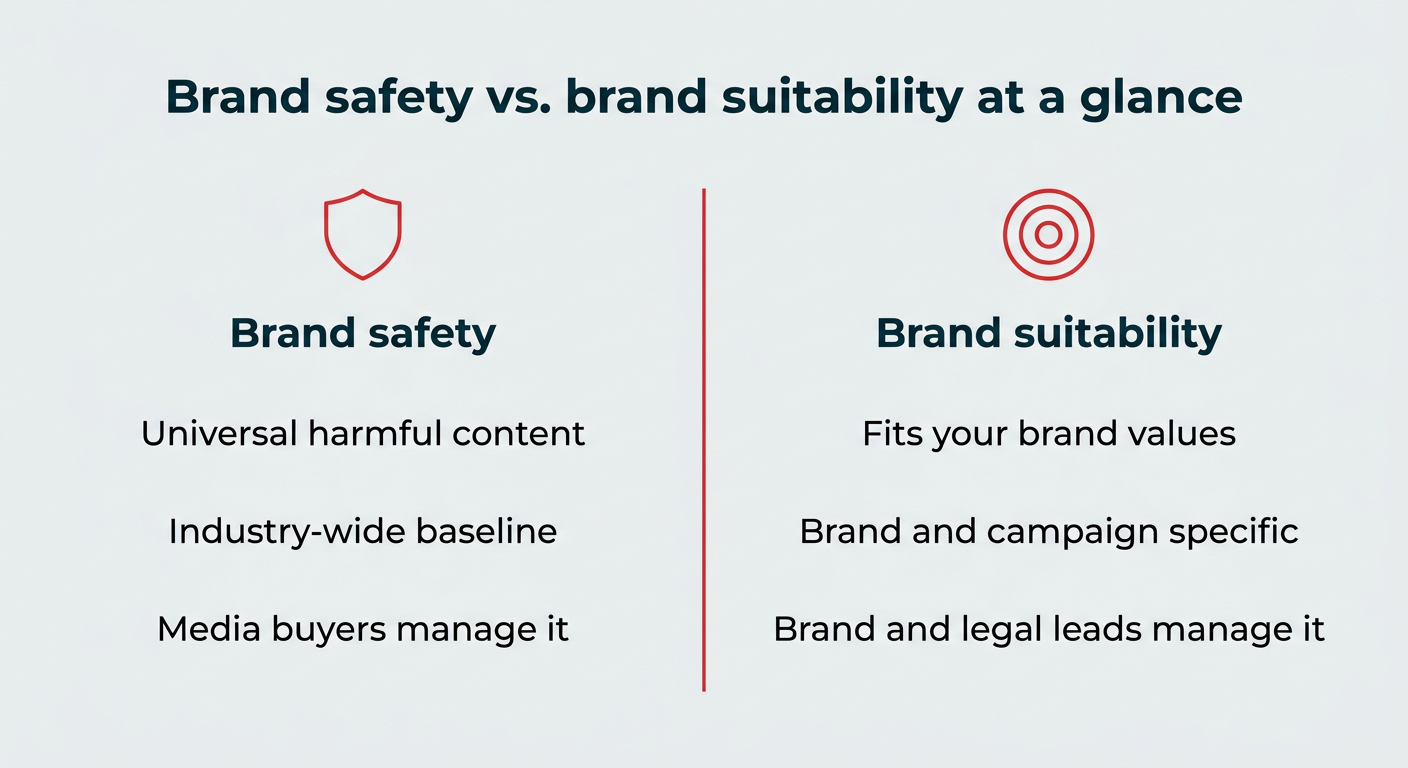
It is crucial to differentiate brand safety from brand suitability. While brand safety establishes a universal baseline, aiming to avoid content that no advertiser would wish to be associated with, brand suitability delves into what is specifically appropriate for a particular brand, its target audience, and the context of a given campaign. Brand safety is the non-negotiable floor; suitability is where a brand’s unique values, industry category, and risk tolerance come into play. For instance, a news report on a natural disaster would typically clear the Brand Safety Floor, as it is not inherently harmful or illegal content. However, it might be deemed unsuitable for a travel brand promoting beach vacations, given the incongruence of messaging. Brand safety decisions are often managed by media buyers and platform policy teams, while brand suitability requires input from brand, marketing, and legal leads, tailored to specific campaigns and market nuances.
| Aspect | Brand Safety | Brand Suitability |
|---|---|---|
| Definition | Avoiding universally harmful or illegal content | Choosing content contexts that align with brand values and audience |
| Scope | Industry-wide baseline (e.g., legacy GARM standards) | Brand-specific, campaign-specific, and often market-specific |
| Who Manages It | Media buyers, verification vendors, platform policy teams | Brand, marketing, and regional leads with legal input |
| Example | Blocking ads from appearing alongside violent or extremist content | A family-oriented brand opting out of political debate content adjacency |
In essence, brand safety keeps brands out of trouble, while brand suitability ensures they remain authentically on-brand.
The Escalating Digital Risk Landscape

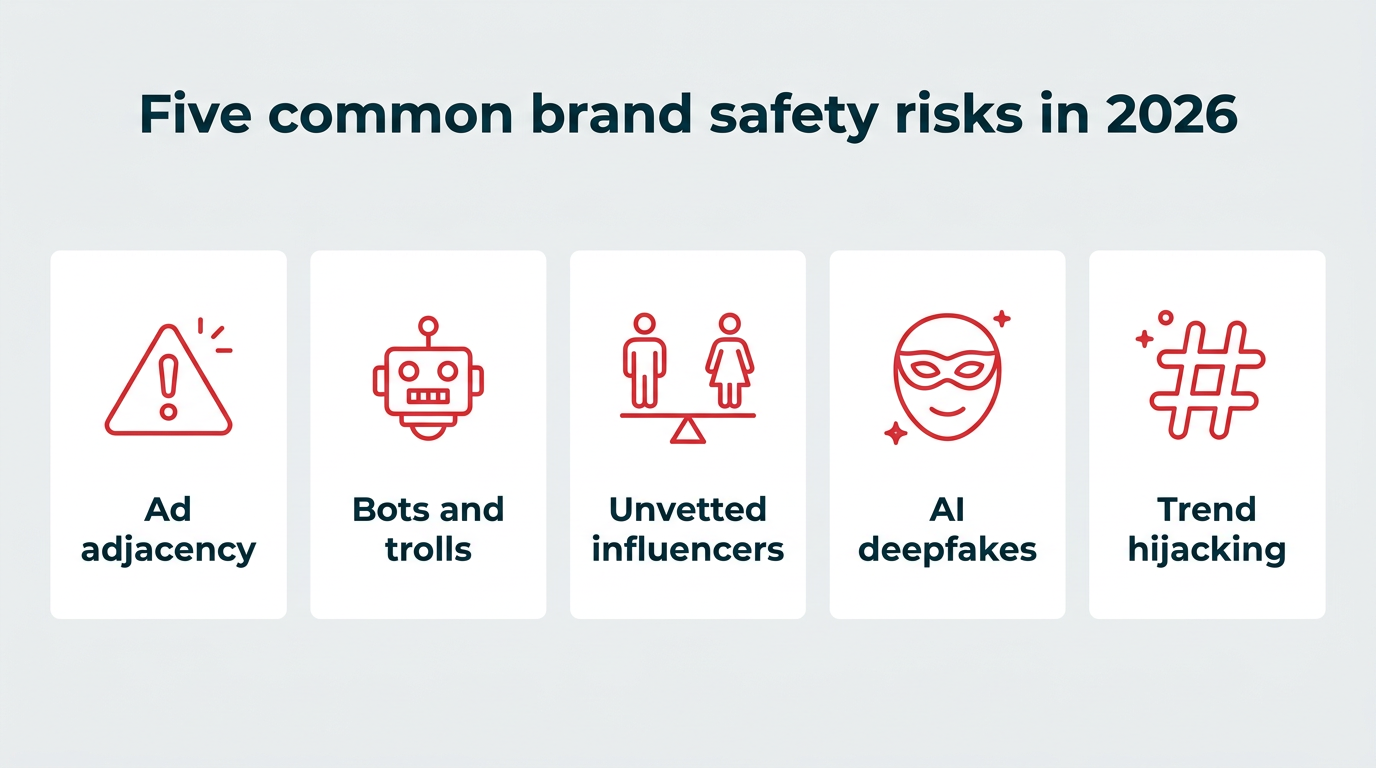
The digital risk landscape has undergone a profound transformation, driven by the simultaneous scaling of AI-generated content, automated content amplification, and the rise of creator-led media. Enterprise teams today confront a new generation of threats, predominantly falling into five critical categories:
-
Ad Placement Next to Harmful or Inappropriate Content: The pervasive nature of programmatic buying, which now accounts for over 90% of US digital display ad spending, means that advertising adjacency decisions occur at speeds impossible for human review. A single misconfigured campaign can inadvertently place a brand’s logo next to content that fundamentally contradicts its values. To mitigate this, many enterprises are shifting from reactive exclusion lists to proactive inclusion lists, approving only specific placements. These strategies are often paired with keyword and category blocking, and require monthly audits of placement reports rather than waiting until campaign completion.
-
Bots, Trolls, and Coordinated Inauthentic Behavior (CIB): Automated accounts and organized troll farms can rapidly flood comment sections, artificially distort sentiment data, and inflate minor complaints into what appears to be widespread backlash. Coordinated groups frequently target brands during product launches or significant public announcements. The primary danger lies not just in the sheer volume of noise, but in the risk that marketing teams might overreact to manufactured outrage or, conversely, overlook a genuine issue buried beneath the artificial din. Reliable social listening data and a clear threshold for what constitutes a legitimate incident are crucial for distinguishing between authentic and fabricated public sentiment.
-
Unvetted Influencer Partnerships: The growing reliance on influencer marketing means that a creator’s past controversial content or ongoing problematic behavior can surface mid-campaign, irrevocably linking their actions to the partnering brand. Influencer vetting must extend beyond mere follower counts to encompass a thorough review of past posts, audience authenticity, potential brand conflicts, and how the creator typically handles criticism. Furthermore, contracts should explicitly define content approval rights, disclosure requirements, and clear exit clauses, enabling swift termination of a partnership without protracted legal disputes.
-
Misinformation and AI-Generated Deepfakes: The advent of affordable synthetic media tools has made fake endorsements, fabricated executive statements, and cloned brand accounts a routine challenge. Gartner reported that 62% of organizations experienced a deepfake incident in the preceding 12 months, highlighting the pervasive nature of this threat. These AI-generated assets spread virally, often outpacing corrections and proving difficult to verify at scale. Practical defenses include advanced monitoring for brand and executive name mentions across video and audio content, proactive registration of trademarks to facilitate takedown requests, and pre-drafting rapid response templates for legal and communications teams to ensure a swift, coordinated reaction during an incident. Gartner projects enterprise spending on battling misinformation and disinformation to surpass $30 billion by 2028, underscoring the escalating financial and reputational stakes.
-
Hashtag and Trend Hijacking: Engaging with trending topics without thoroughly investigating their origin or evolving context is a common pitfall. Brands can inadvertently associate themselves with movements, memes, or campaigns entirely contrary to their values. Trends can also shift meaning rapidly, sometimes within hours, transforming an innocuous hashtag into a contentious one. A brief pre-publication check—identifying the trend’s origin, current usage, and assessing comfort with a screenshot of the brand’s post appearing in a news story—can prevent nearly all such incidents.
Building the Foundation: Internal Brand Safety Policies
These pervasive risks underscore the critical role of internal brand safety policies. These are the formalized rules, established workflows, and defined guardrails that dictate how teams represent the brand on social media and other digital platforms. They equip employees with clear guidance on what constitutes safe content, how to review and approve materials, and the specific steps to follow when brand safety measures are challenged or breached.
For large organizations, internal policies are indispensable. As enterprises expand, with numerous teams, regional offices, and external partners contributing to digital content, maintaining a unified brand voice and consistent adherence to safety standards becomes exponentially more challenging. Without clear guidelines, the risk of harmful content, the spread of misinformation, or accidental missteps dramatically increases, particularly as algorithms and bots amplify content at unprecedented speeds.
Internal brand safety policies differ significantly from general social media guidelines or external brand safety practices. While social media guidelines focus on tone of voice, visual style, and posting etiquette to maintain brand identity, and external brand safety practices primarily concern ad placement and fraud prevention handled by media buyers, internal policies operationalize these principles within the organization. They cover workflows, approvals, permissions, escalation rules, and how to manage unsafe content, ensuring consistency and compliance across the entire enterprise.
| Type | What it Covers | Who it’s For | Why it Matters |
|---|---|---|---|
| Internal Brand Safety Policies | Workflows, approvals, permissions, escalation rules, content allowances/prohibitions, incident handling | Internal teams, agencies, franchisees, partners | Keeps publishing safe, consistent, and compliant across the organization |
| Social Media Guidelines | Tone of voice, visual style, posting etiquette, community rules | Anyone creating content for the brand | Helps teams stay on-brand and maintain a consistent identity |
| External Brand Safety Practices | Ad placement, adjacency rules, avoiding unsafe environments, ad fraud prevention, accreditation | Media buyers, advertising teams, programmatic partners | Ensures ads don’t appear next to harmful or inappropriate content |
Most sophisticated enterprises require all three elements working in concert, with internal policies serving as the operational backbone that integrates and implements the others on a day-to-day basis.
Core Pillars of an Effective Brand Safety Policy
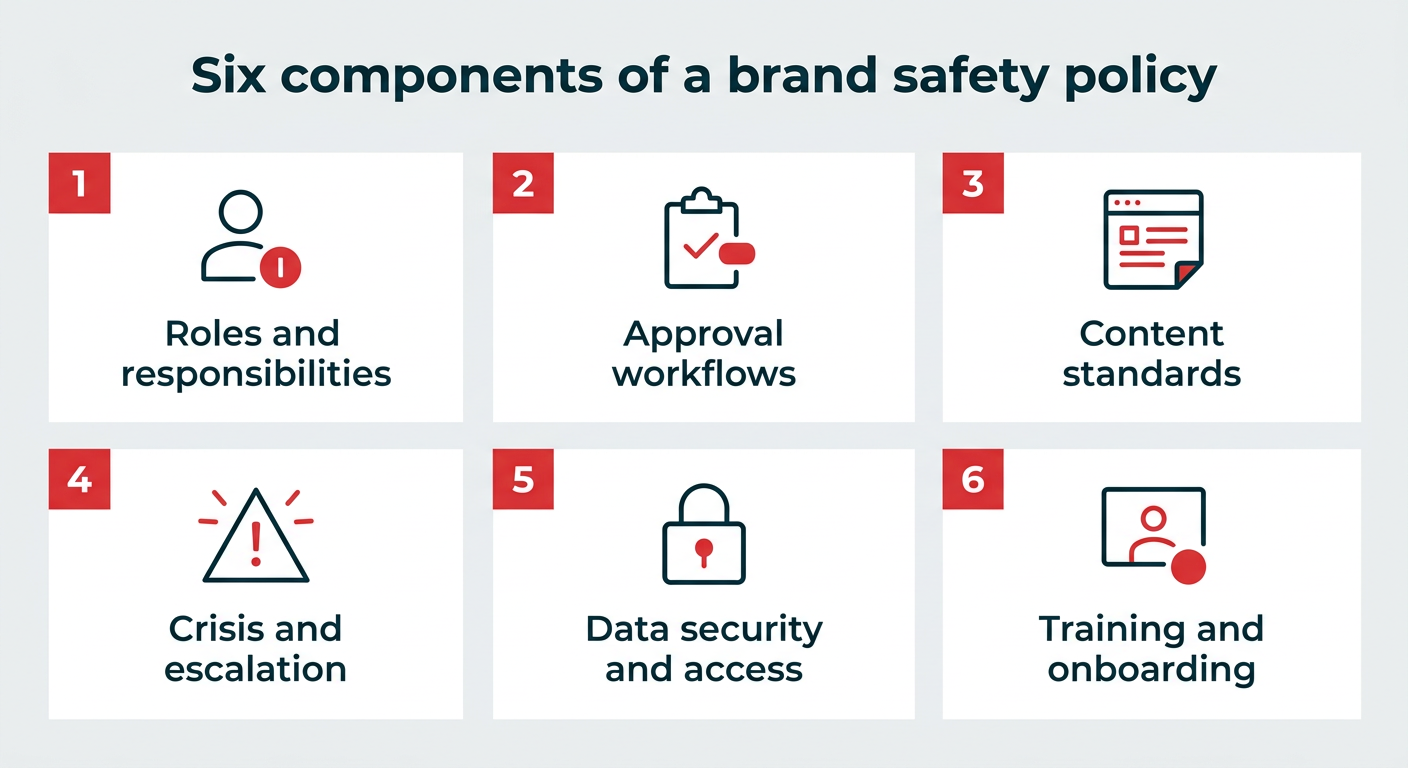
A robust internal brand safety policy provides a clear roadmap for all stakeholders. It meticulously details how content should be created, reviewed, approved, monitored, and how incidents should be managed. Key components include:
-
Roles and Responsibilities: Defining Ownership: Clarity of ownership is foundational to brand safety. Every individual and team involved in content creation and dissemination must understand their precise role and the specific aspects of the social strategy they are accountable for. This prevents oversights and ensures content aligns with approved categories. Typical enterprise roles include:
- Social Media Leads: Oversee daily content operations, approvals, and community management.
- Legal/Compliance Teams: Establish regulatory guardrails, review sensitive content, and advise on data privacy and intellectual property.
- Marketing/Brand Teams: Define brand voice, suitability guidelines, and campaign messaging.
- Public Relations/Communications: Manage crisis communications and external messaging.
- Human Resources: Address employee conduct on social media and internal policy enforcement.
- Regional/Market Teams: Adapt global policies to local cultural nuances and legal requirements.
- Influencer Managers: Vet creators and manage contractual obligations.
-
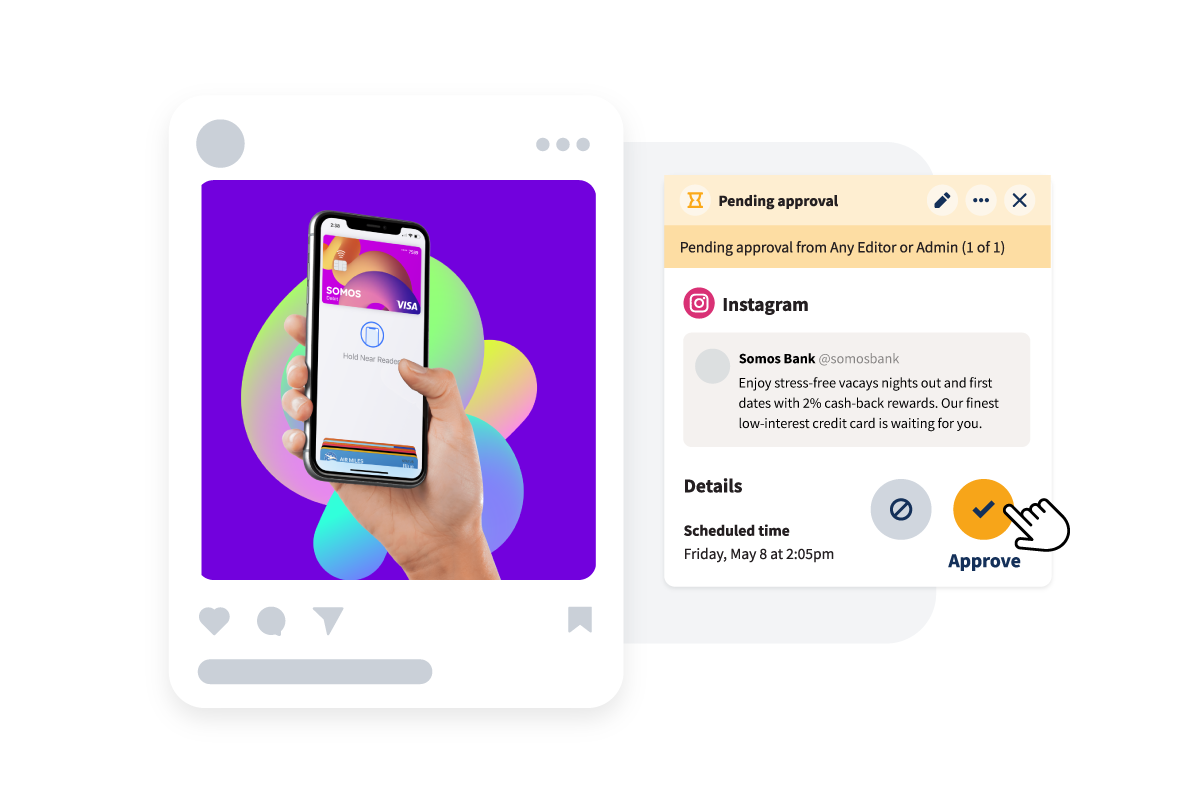
Approval Workflows, Permissions, and Publishing Guardrails: These mechanisms ensure that every piece of content undergoes appropriate review before publication. Permissions and guardrails control who can draft, edit, or publish, ensuring only trained and authorized personnel make final decisions. A strong setup should include:
- Multi-stage approval processes (e.g., draft > marketing review > legal review > publish).
- Clear content calendars with assigned reviewers.
- Automated alerts for content flagged for potential risks.
- Integration with content management systems to track revisions.
-
Content Standards: What Is and Isn’t Permissible: These standards educate teams on what constitutes brand-safe content, establishing explicit rules for tone, visual elements, factual claims, and sensitive topics. This eliminates guesswork and fosters consistency. Strong content standards should cover:
- Tone of Voice: Guidance on brand personality, language, and emotional resonance.
- Visual Guidelines: Rules for imagery, video, and graphic elements, including licensing and copyright.
- Claims and Substantiation: Requirements for factual accuracy, data sourcing, and avoiding misleading statements.
- Sensitive Topics: Prohibited content categories (e.g., hate speech, violence, discrimination) and guidelines for discussing controversial subjects.
- Legal Compliance: Adherence to advertising laws, data privacy regulations (e.g., GDPR, CCPA), and intellectual property rights.
- Crisis Communication Directives: Pre-approved messaging and procedures for responding to negative events.
-
Crisis Detection and Escalation Plans: Even with the most stringent policies, incidents can occur. A clear plan for early issue detection and swift escalation is paramount. A robust escalation plan should outline:
- Monitoring Protocols: Tools and methods for real-time tracking of brand mentions, sentiment, and emerging trends.
- Alert Triggers: Defined thresholds for negative sentiment, viral spread, or specific keywords that activate an alert.
- Response Tiers: Differentiated response protocols based on the severity and nature of the crisis.
- Escalation Matrix: A clear chain of command for who to notify, in what order, and within what timeframe.
- Pre-approved Messaging: Templates and guidelines for initial public responses.
- Post-Incident Review: Procedures for analyzing the incident, identifying root causes, and updating policies.
-
Data Security, Access Controls, and Account Protection: Brand safety also extends to protecting digital assets from unauthorized access, cyber threats, and human error. A strong policy should include:
- Password Management: Requirements for strong, unique passwords and multi-factor authentication (MFA).
- Role-Based Access: Limiting access to social media accounts and publishing tools based on individual roles and responsibilities.
- Regular Audits: Periodic review of access permissions and account activity.
- Third-Party Tool Vetting: Strict evaluation of any external tools integrated with social media accounts.
- Offboarding Procedures: Immediate revocation of access for departing employees.
-
Training and Onboarding for Every Role: Policies are only effective if understood and consistently applied. Comprehensive training ensures both new hires and existing teams are proficient in workflows, tool usage, and risk avoidance. Training should cover:
- Policy Overview: A detailed explanation of the brand safety policy’s purpose and key components.
- Tool Proficiency: Hands-on training for social media management platforms and monitoring tools.
- Scenario-Based Learning: Practical exercises simulating common brand safety risks and appropriate responses.
- Legal and Ethical Considerations: Education on copyright, privacy, and responsible content creation.
- Reporting Procedures: How to report potential violations or emerging threats.
Implementing Policies for Lasting Impact

A brand safety policy’s true value lies in its effective implementation. This involves transforming written rules into daily habits, supported by clear workflows, consistent training, and appropriate technological tools.
-
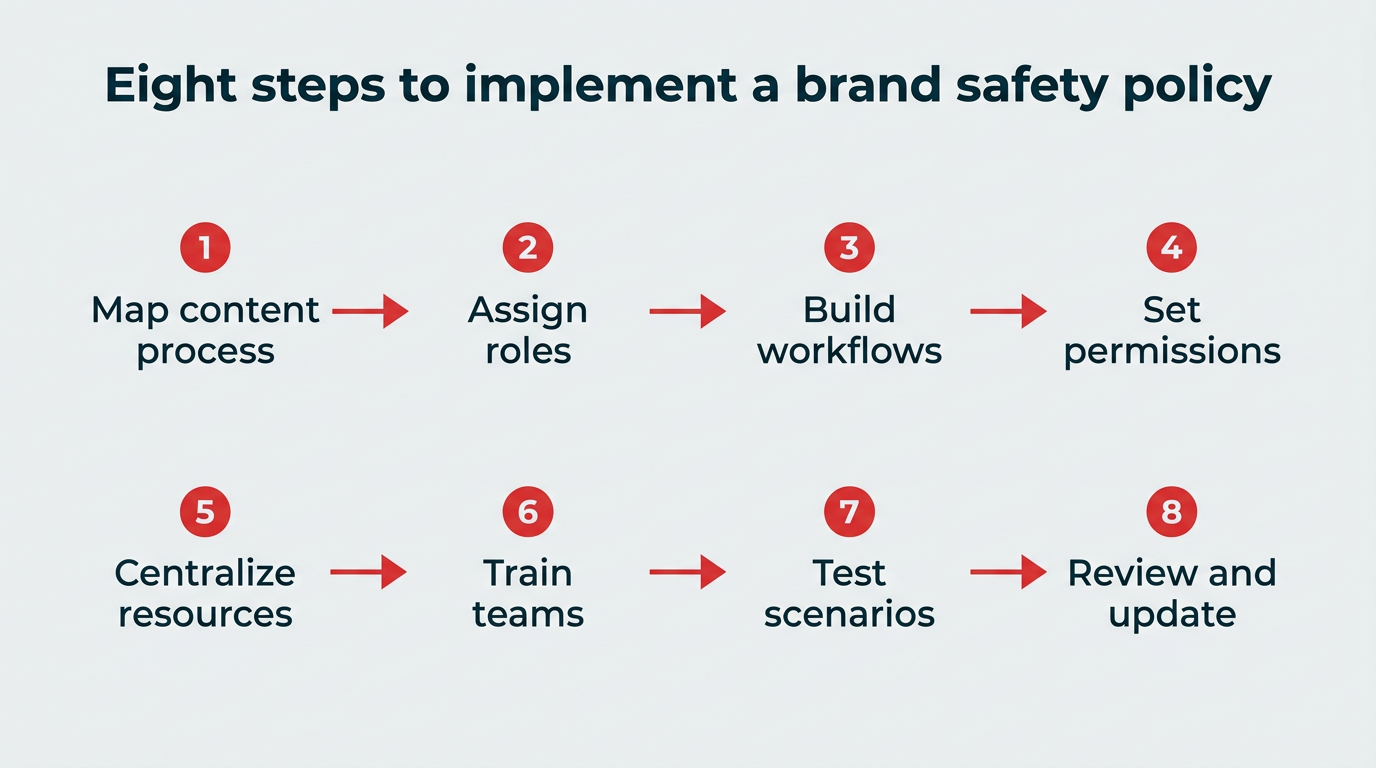
Map Current Content Processes: Before any changes, conduct a thorough audit of existing content creation and publishing workflows. Identify all steps from ideation to publication, including stakeholders, tools used, and any "unofficial shortcuts" that may introduce risk. This diagnostic phase reveals bottlenecks and vulnerabilities.
-
Assign Clear Roles and Responsibilities: Explicitly define who owns each stage of content creation, review, and publication. This eliminates ambiguity and prevents critical steps from being overlooked due to assumptions.
-
Build Approval Workflows and Publishing Guardrails: Translate defined roles into a structured workflow that the entire team must follow. This includes setting up multi-stage approvals, content calendars, and predefined review paths within social media management platforms.
-
Set Granular Permissions: Leverage role-based permissions within social media management systems to control who can draft, edit, schedule, or publish content. This is a powerful tool for safeguarding accounts and ensuring only authorized individuals can push content live.
-
Centralize All Brand Safety Resources: Consolidate all policy documents, guidelines, FAQs, training materials, and contact information into a single, easily accessible hub. This prevents fragmentation of information and ensures everyone can quickly find the necessary resources.
-
Train Everyone Who Touches Social Media: Implement ongoing training programs, not just one-off sessions. These should cover policy specifics, tool usage, and scenario-based learning. Integrating brand safety training into new employee onboarding ensures consistent foundational knowledge.
-
Test the Policy with Real Scenarios: Conduct periodic drills and simulations to test the policy’s effectiveness in practice. This could involve simulating a negative trend, a bot attack, or a deepfake incident to evaluate team response times, escalation paths, and decision-making processes.
-
Review and Update Regularly: Social media platforms, trends, and legal landscapes are in constant flux. Therefore, brand safety policies must be reviewed and updated at least annually, and ideally quarterly, to remain relevant and effective. Key triggers for review include platform policy changes, new legislation, significant brand incidents, or team restructuring.
Expert Perspectives on Sustaining Brand Safety
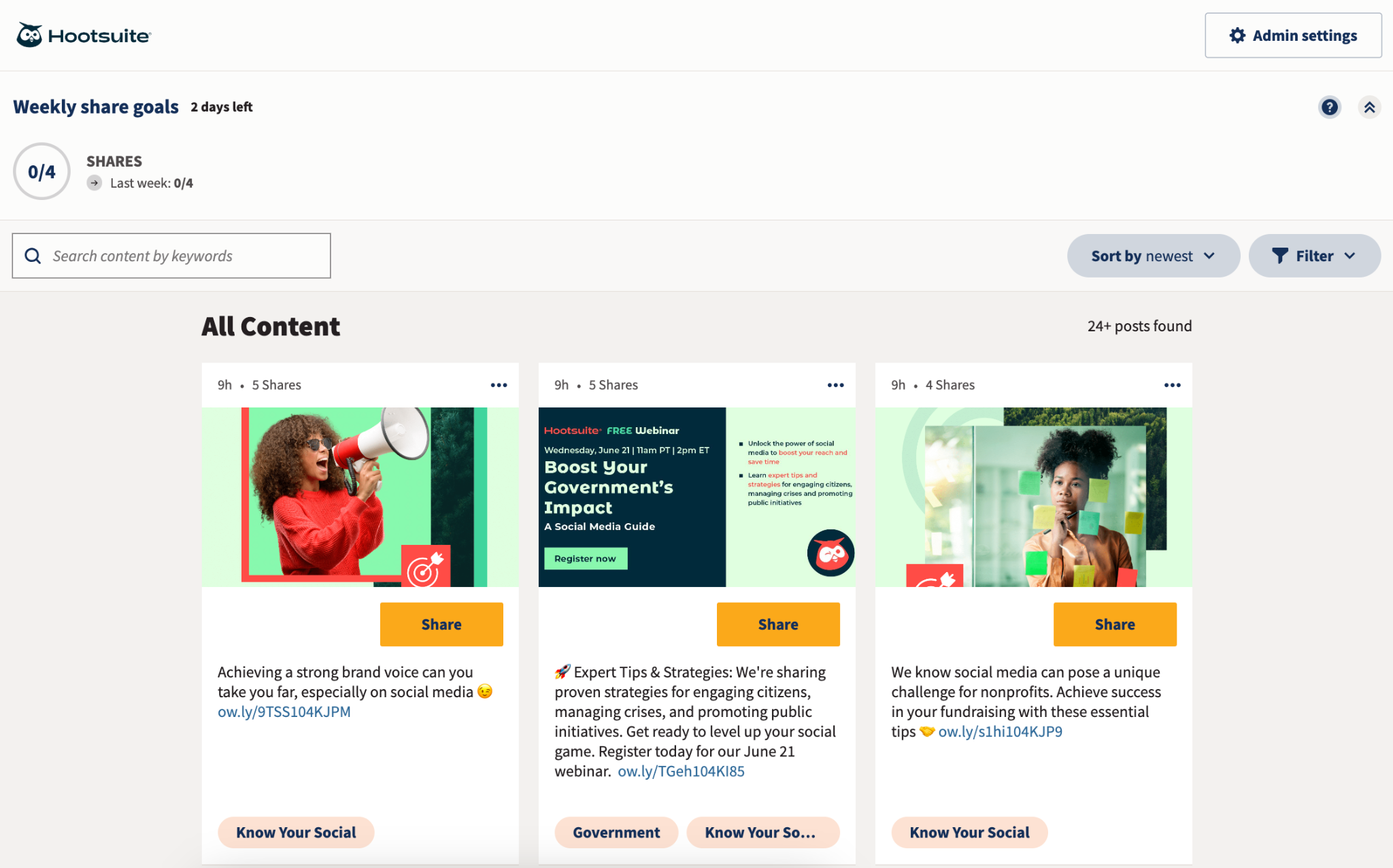
According to Nick Martin, Social Media Lead at Tilpati, effective brand safety strategies hinge on removing uncertainty and fostering a culture of positive guidance rather than fear. Martin emphasizes that when employees are unsure of what is permissible, they either become hesitant to engage or take unwarranted risks. He advocates for providing clear, approved pathways for employee sharing, such as centralized employee advocacy tools that offer pre-approved posts. This approach makes posting feel safe and intuitive, bypassing the risks associated with drafting content from scratch.
Martin also stresses that brand safety should be treated as continuous training, not a static document. He recommends creating initial presentations for new hires and following up with regular refresher sessions throughout the year. This ongoing education helps teams understand why certain rules exist and how to apply good judgment in unexpected situations—the very scenarios where most brand safety issues arise.
Crucially, Martin advises against fear-based language in policy documents. Instead of punitive statements like, "Do NOT speak against the organization, or you will be at risk of termination," he suggests clear, direct expectations such as, "Be aware not to share customer or private data in a social post." This approach protects the brand without discouraging employee participation. He also champions positive reinforcement, recommending that leaders highlight and celebrate well-crafted, compliant posts by employees, explaining why they are effective. This proactive recognition provides tangible models for others to follow, reinforcing desired behaviors.
The AI Imperative: A Double-Edged Sword for Brand Safety
Artificial intelligence is profoundly reshaping the brand safety landscape, acting as both an accelerator of risk and a powerful enabler of solutions. On the risk side, AI tools have drastically lowered the barrier to entry for creating sophisticated harmful content, including:
- Deepfakes: Realistic synthetic media, from fabricated videos of executives to cloned brand accounts, are easier and cheaper to produce.
- Automated Misinformation: AI can generate vast quantities of persuasive, contextually relevant misinformation at scale, making detection and containment more challenging.
- Targeted Manipulation: AI algorithms can identify vulnerable audiences and tailor harmful content for maximum impact.
However, AI also offers robust solutions for proactive brand protection:
- Real-time Content Moderation: AI-powered tools can analyze vast volumes of text, images, and video in real-time to detect and flag harmful content or policy violations before publication.
- Enhanced Sentiment Analysis: Advanced AI can discern nuanced sentiment and identify emerging negative trends or coordinated attacks more accurately than human analysts.
- Anomaly Detection: AI algorithms can spot unusual patterns in online activity, such as sudden spikes in bot-like engagement or coordinated CIB campaigns.
- Governed AI Workflows: Integrating AI into content creation and review processes can ensure that AI-generated drafts adhere to brand safety guidelines from the outset.
The strategic implication for marketing leaders is clear: AI does not supersede the need for a comprehensive brand safety policy. Rather, it elevates the urgency for policies that explicitly address machine-generated content and integrate AI-powered defense mechanisms.
Real-World Case Studies and Their Lessons
Examining real-world examples illuminates the consequences of brand safety in practice:
-
Adjacency Failure: A classic instance involves a major advertiser’s pre-roll advertisement appearing before extremist or violent video content on a platform. Screenshots of such unfortunate pairings can go viral, forcing the brand to issue public apologies and explain a placement it never knowingly approved. The lesson here is that a single blocklist is insufficient; tighter inclusion lists, independent third-party verification, and continuous, real-time review of placement reports are essential.
-
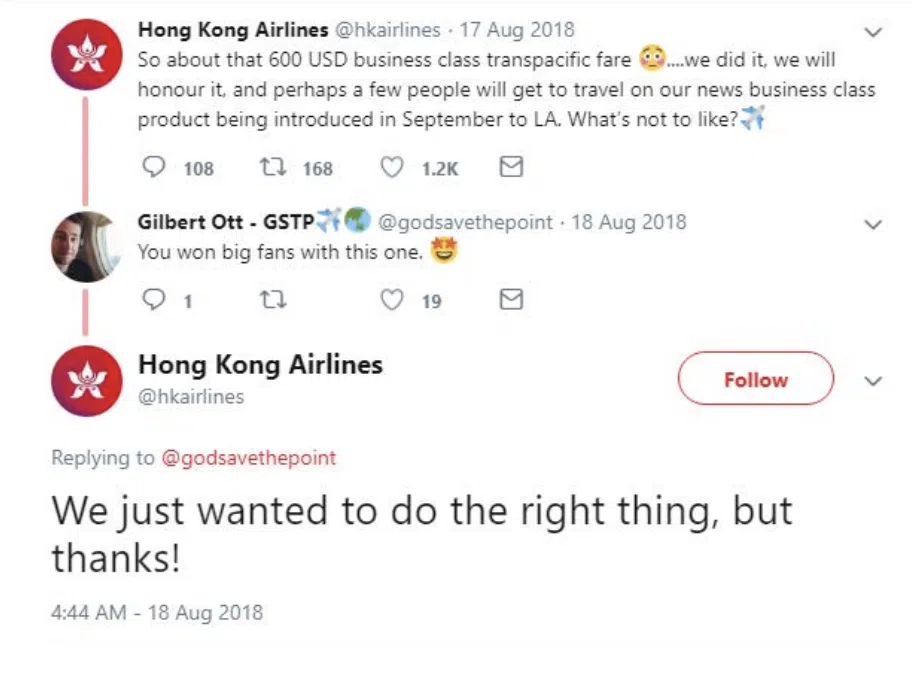
Crisis Turned into Opportunity (Hong Kong Airlines): In a notable success story, Hong Kong Airlines utilized advanced social listening tools to detect a mispriced fare rapidly going viral. By spotting the issue early, the team made a swift decision to honor the mistake fare rather than dispute it. This proactive and customer-centric response transformed a potential pricing error crisis into a significant goodwill narrative, resulting in a remarkable 4,900% increase in social media engagement for the airline. This case underscores the value of robust monitoring and a pre-defined crisis response framework that empowers quick, strategic decisions.
-
Trend Participation Gone Wrong: Brands frequently jump onto trending hashtags without adequately researching their origins or current context. This can lead to inadvertently aligning with a tragedy, a contentious political protest, or even a competitor’s campaign. The usual outcome is a hastily deleted post and a public apology. A simple, two-minute origin check before publishing, embedded as a mandatory step in the internal policy, can prevent nearly all such missteps.
Leveraging Technology for Enterprise Brand Safety
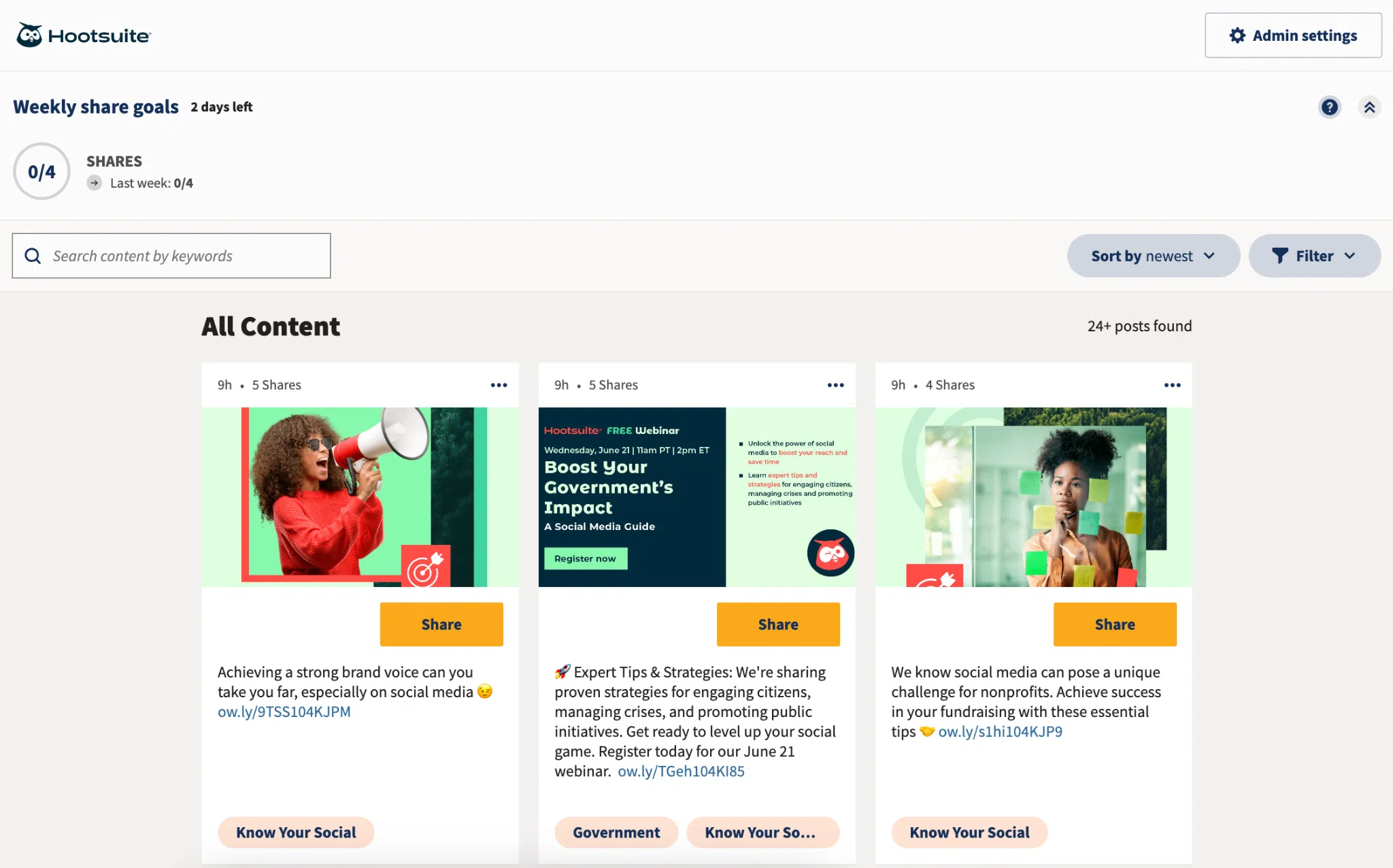
Modern social media management platforms play a pivotal role in operationalizing and enforcing internal brand safety policies at scale. Integrated systems offer large teams a connected environment to plan, review, approve, publish, and monitor content securely. For instance, Hootsuite Social OS provides a suite of applications designed to support enterprise brand safety efforts:
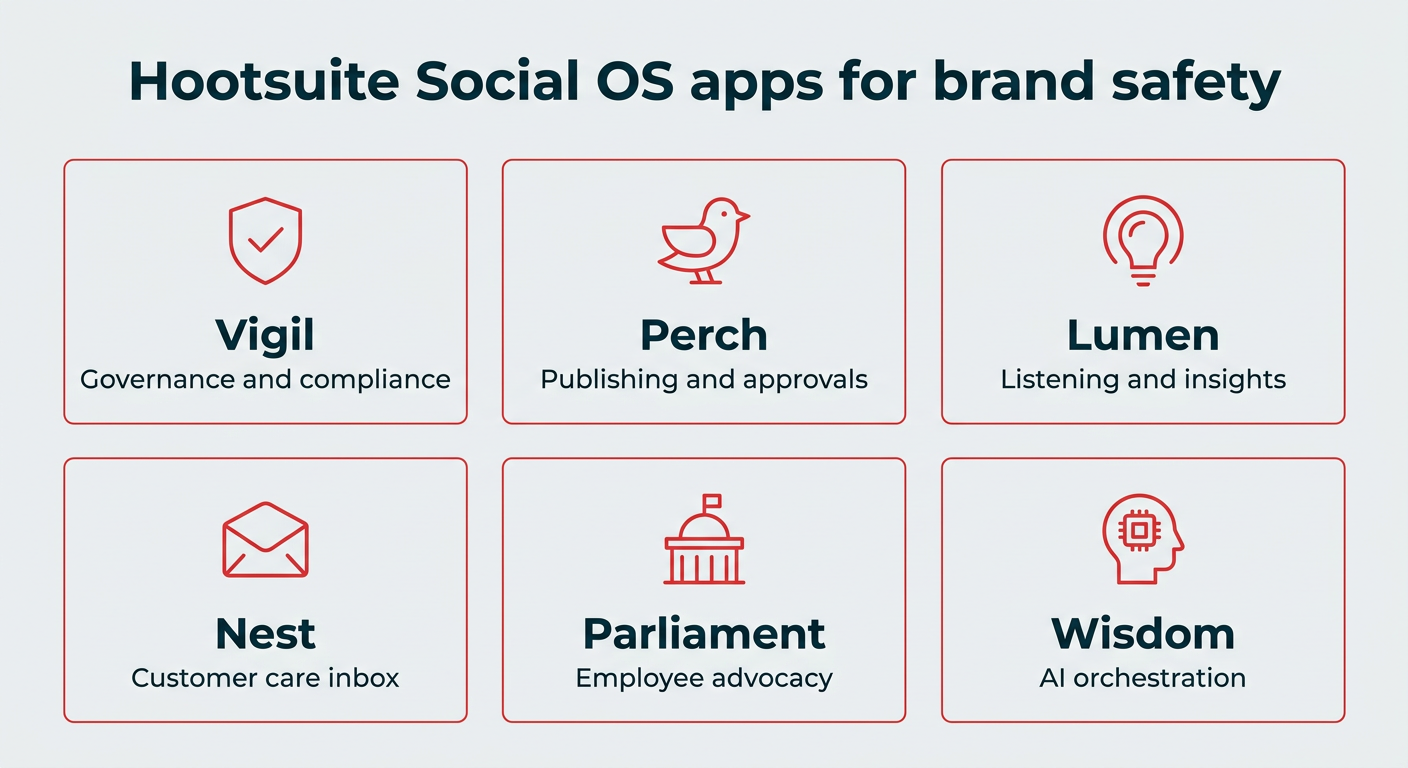
- Vigil (Governance and Compliance): Enforces policy adherence with automated checks and compliance features.
- Perch (Publishing and Approvals): Manages content workflows, multi-stage approvals, and publishing guardrails.
- Lumen (Listening and Insights): Offers real-time monitoring, sentiment analysis, and crisis alerts for early detection.
- Nest (Customer Care Inbox): Centralizes customer interactions, helping manage public sentiment during incidents.
- Parliament (Employee Advocacy): Provides pre-approved content for employees to share, ensuring brand-safe advocacy.
- Wisdom (AI Orchestration): Integrates AI for content generation and moderation, aligning AI-assisted workflows with policy.
By combining these controls, such platforms enable teams to follow stringent brand safety rules without sacrificing agility or efficiency.
In conclusion, the imperative for robust internal brand safety policies has never been more critical. In an era defined by rapid digital transformation, the pervasive influence of social media, and the dual promise and peril of artificial intelligence, brands must proactively shield their reputations. By establishing clear roles, implementing rigorous approval workflows, defining comprehensive content standards, preparing for crises, securing digital assets, and fostering a culture of continuous training, enterprises can navigate the complex digital landscape with confidence, ensuring their brand remains safe, consistent, and trusted by audiences worldwide.