rifanmuazin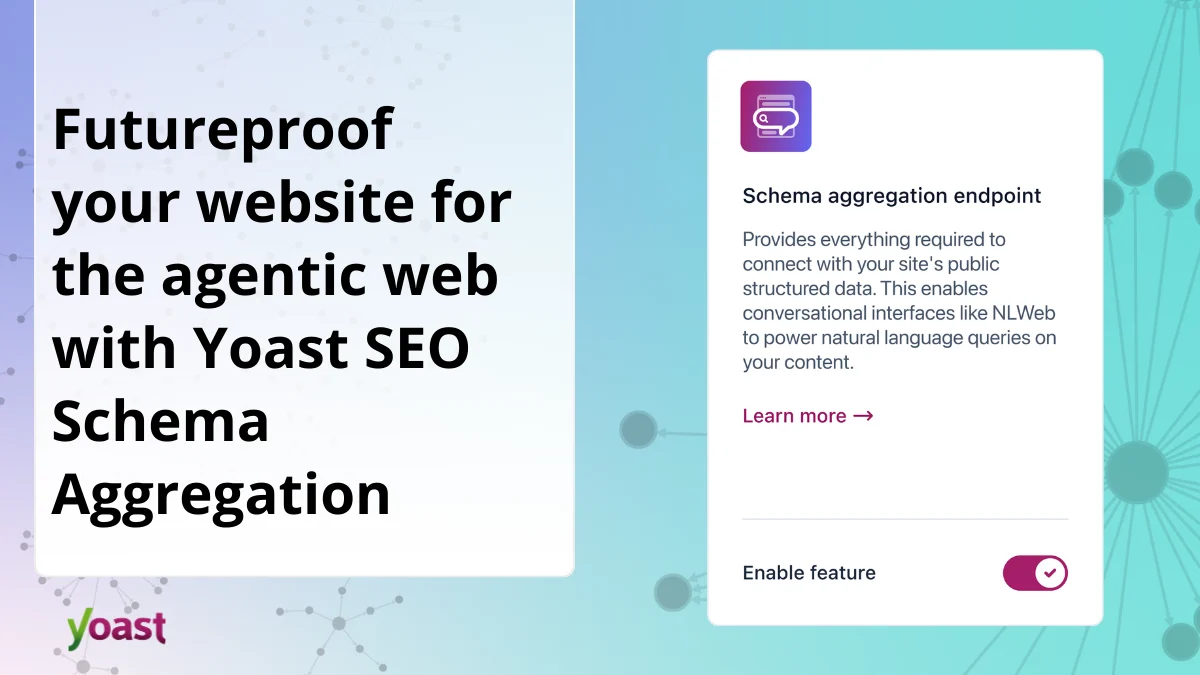
In a significant stride towards enhancing web content’s interaction with the burgeoning landscape of artificial intelligence, Yoast, a prominent developer of SEO software for WordPress, has unveiled its latest innovation: Yoast SEO Schema Aggregation. This new, opt-in feature represents the first major deliverable stemming from a previously announced collaboration with NLWeb, an open web protocol developed by Microsoft. The partnership, first disclosed in November 2025, aimed to streamline the process of building conversational interfaces for the web, and today’s announcement marks a pivotal moment in realizing that vision.
A New Era for Structured Data and AI Integration
The core function of Yoast SEO Schema Aggregation is to consolidate a website’s structured data into a clearer, more consistent, and centrally organized format. Structured data, fundamentally, is metadata embedded within web pages that provides explicit clues to search engines and AI systems about the content’s nature, authorship, and interconnections. By enabling this feature, website owners can significantly enhance the ability of search engines, large language models (LLMs), AI agents, and conversational assistants—such as Microsoft’s Copilot—to accurately understand and leverage their content. This proactive approach ensures that digital information is not only discovered but also correctly interpreted and engaged with in an increasingly AI-driven online environment.
Yoast has long been at the forefront of helping WordPress websites achieve fair and responsible representation across the open web. This commitment dates back years, with key milestones demonstrating a consistent focus on improving how search engines interact with web content. In 2019, for instance, Yoast pioneered the introduction of its innovative schema graph and API. This development was crucial in an era where search engines were evolving beyond simple keyword matching to become sophisticated discovery engines, requiring a deeper semantic understanding of content. The 2019 schema graph provided search engines with a more holistic view of a website’s entities and their relationships, laying foundational groundwork for the current advancements.
Today’s launch of Schema Aggregation marks the next logical step in this evolution. As the internet transitions into what is increasingly being termed the "agentic web"—a domain where AI agents autonomously browse, interpret, and act upon information—the ability for a website to be not just discovered but profoundly understood through conversation becomes paramount. The new feature establishes a standardized, robust connection between a website’s inherent structured data and the advanced systems powering AI-driven discovery and interaction. This ensures that published content is not merely accessible but comprehensible and actionable for the next generation of intelligent digital assistants.
The NLWeb Partnership: Extending Open Web Standards
The development of the NLWeb + Yoast integration has been a collaborative effort, notably involving the NLWeb team and R.V. Guha, a co-founder of Schema.org. Guha’s involvement underscores the feature’s adherence to and extension of established open web standards, reinforcing its credibility and long-term viability. Schema.org, a collaborative initiative by Google, Microsoft, Yahoo, and Yandex, has been instrumental in creating a common vocabulary for structured data markup, enabling webmasters to semantically annotate their content. By building upon these existing standards, Yoast and NLWeb are empowering WordPress websites to confidently and responsibly participate in the emerging agentic web, ensuring they remain future-ready in a rapidly changing digital landscape.
Key Benefits of Schema Aggregation
The Yoast SEO Schema Aggregation feature is designed with several critical benefits in mind, addressing both technical performance and strategic positioning in the AI era:
- Enhanced AI Understanding: By presenting structured data in a clearer, consolidated format, websites become more intelligible to LLMs and AI agents, leading to more accurate content representation in AI-generated summaries, answers, and interactions.
- Improved Consistency and Accuracy: The aggregation process brings together disparate pieces of structured data from across a website, resolving potential inconsistencies and ensuring a unified, authoritative representation of the site’s information.
- Reduced Server Load for AI Systems: Instead of AI crawlers needing to access hundreds or thousands of individual pages to gather structured data, the new endpoint allows for a single, optimized request to retrieve the site’s entire schema graph. This significantly reduces server load for both the website owner and the AI system, promoting efficiency.
- Privacy-First Approach: Acknowledging common concerns about data access in the age of AI, Yoast has engineered this feature with a privacy-first philosophy. It focuses on making existing structured data more accessible and understandable, rather than exposing new or private data points without explicit consent.
- Standardization at Scale: For developers and technical users seeking granular control, comprehensive documentation on schema markup is available. This allows for deep inspection and extension of the schema graph, offering maximum personalization while maintaining standardization and consistency across large-scale implementations.
- Future-Proofing: By aligning with NLWeb and adapting to the requirements of the agentic web, websites equipped with Schema Aggregation are better positioned to navigate future shifts in how information is discovered and consumed online.
Unveiling the New Experience: Yoast SEO 27.1
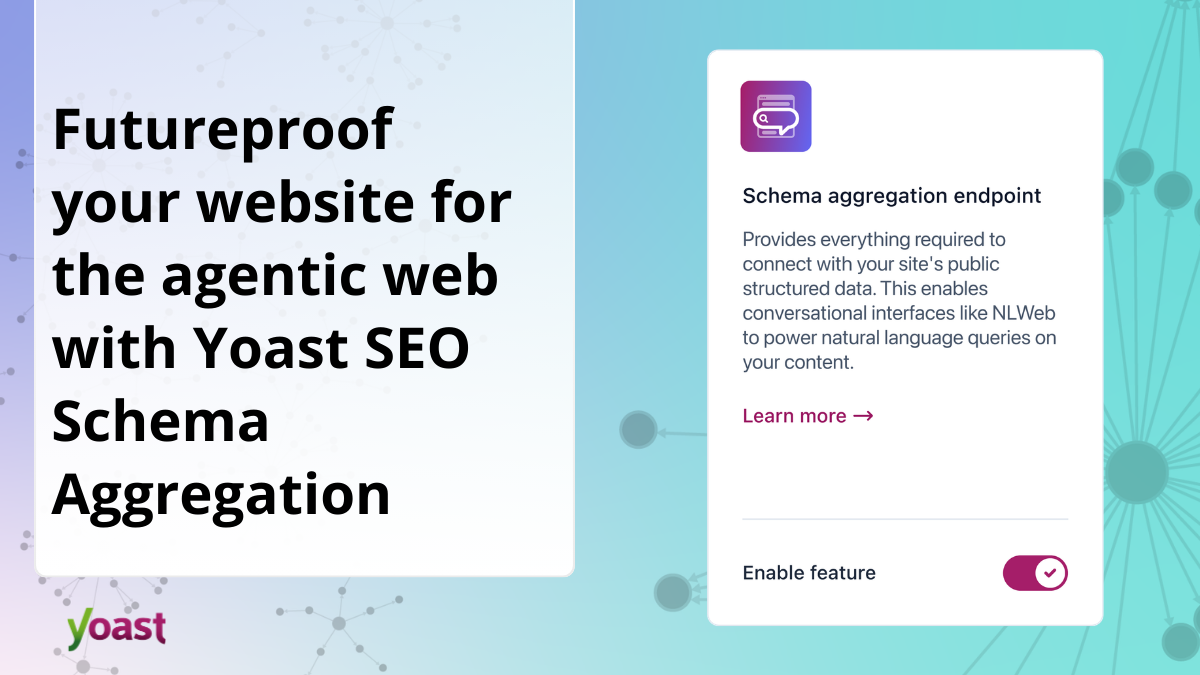
Upon updating to Yoast SEO version 27.1, users will be greeted with a guided walkthrough introducing the new Schema Aggregation feature. A simple toggle switch allows for easy activation. This feature, available in the free version of Yoast SEO, integrates a new endpoint that exposes a site’s complete structured data graph in a proposed new standard known as a ‘schemamap’.
Traditionally, search engines and AI systems would crawl individual pages to extract their respective structured data. For a website with hundreds or thousands of pages, this meant numerous requests, potentially leading to inefficiencies and fragmented understanding. With Schema Aggregation enabled, an AI system can now retrieve a site’s entire schema—encompassing articles, authors, products, organizational data, and more—in a single, optimized request. This paradigm shift moves from a page-centric view of structured data to a holistic, site-level understanding.
Consider the existing scenario: an individual page on yoast.com might output structured data detailing its content type, author, publication date, and related entities. This page-level schema is vital for understanding that specific piece of content. However, in isolation, it doesn’t immediately convey how that page fits into the broader ecosystem of the website.
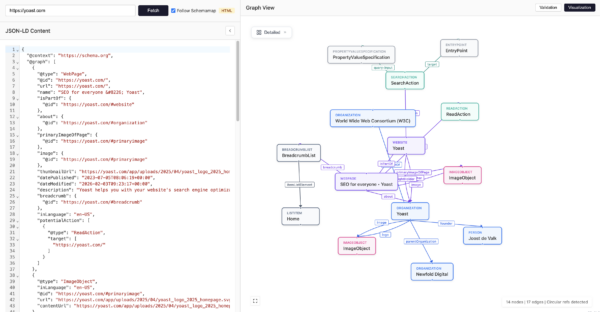
With Schema Aggregation, this changes dramatically. The feature consolidates all existing structured data into a ‘schemamap’—a comprehensive, connected output that visualizes the entire website’s structured data as a unified graph. While this schemamap can appear complex upon first inspection, its purpose is to provide AI systems with an overarching, interconnected view of the website’s content. This allows AI to discern relationships between articles, identify all authors associated with the site, catalog products, and understand the organization behind the content, all within a single, coherent structure. It’s not about changing the underlying schema, but rather reorganizing and presenting it in a way that maximizes its utility for intelligent agents. An illustrative example of a schemamap can be observed using the Yoast SEO Schema Visualizer, demonstrating the interconnectedness across an entire domain.
Technical Mechanics: Standardized, Connected, and Deduplicated
The operational mechanics of Schema Aggregation are engineered for optimal AI consumption:
- Standardization: The feature ensures that all structured data output adheres to widely recognized schema.org standards, making it universally parsable by AI systems and search engines. This consistency is crucial for accurate interpretation.
- Connection: It establishes explicit relationships between various entities on the website—linking authors to their articles, products to categories, and all content back to the overarching organization. This creates a rich, interconnected knowledge graph of the website.
- Deduplication: The aggregation process intelligently identifies and removes redundant data points, streamlining the schemamap and preventing conflicting information from being presented to AI systems. This efficiency further aids in accurate understanding and processing.
For developers keen on extending or integrating with Yoast’s schema capabilities, the Schema Integrations page provides resources on how partners connect to and leverage the Yoast SEO Schema Framework.
Collaborative Innovation and Rigorous Testing
The development of Yoast SEO Schema Aggregation was not an isolated effort. Operating at the scale of tens of millions of WordPress websites necessitates meticulous testing and validation to ensure a safe, reliable, and performant launch. This feature was developed with a keen eye on the needs of agencies and advanced users, undergoing rigorous testing in controlled environments.
A key partner in this process was Syde, Yoast’s Innovation Partner. Syde played an instrumental role in testing the new feature across a diverse spectrum of real-world client scenarios. This collaborative approach allowed Yoast to refine the schema aggregation logic based on practical feedback and confirm its scalability and consistent output quality prior to its widespread deployment. The ongoing partnership with Syde is expected to continue shaping future developments, ensuring clients remain visible and accurately represented as AI-driven systems continue their rapid evolution.
The Broader Implications for the Agentic Web
The introduction of Yoast SEO Schema Aggregation arrives at a critical juncture in the evolution of the internet. As AI models become increasingly sophisticated and pervasive, the traditional methods of web discovery are undergoing a profound transformation. Users are less frequently navigating directly to websites through search results and more often encountering content mediated by AI assistants that synthesize information from multiple sources.
In this "agentic web," the ability for a website to provide its content in a machine-readable, semantically rich format is no longer a niche SEO tactic but a fundamental requirement for relevance. Websites that fail to adapt risk becoming invisible or misrepresented in AI-generated responses. Yoast’s new feature directly addresses this challenge, offering WordPress users a powerful tool to ensure their content is not only seen but genuinely understood by the AI systems that will increasingly shape online information consumption.
This initiative also aligns with a broader industry push for better data governance and responsible AI. By allowing website owners to manage how their content is presented to AI, Yoast and NLWeb are empowering publishers to exert more control over their digital narrative, ensuring accuracy and mitigating potential misinterpretations. As Alain Schlesser, Principal Architect at Yoast, aptly puts it: "You can’t stop the AI wave, but you can direct it. Our integration with NLWeb puts you back in charge. It allows you to manage server load efficiently and ensures that when AIs do access your content, they get the rich, semantic understanding necessary to represent you correctly."
For webmasters, SEO professionals, and content creators, this means a renewed focus on the quality and structure of their data. The emphasis shifts from merely having content indexed to ensuring that content is intelligible and contextually rich for advanced AI. It promises a future where websites are active participants in conversations, rather than passive repositories of information.
Conclusion: Be Visible, Understood, and Represented
The rules of digital discovery are undeniably shifting, but website owners do not have to be left behind. Through the strategic collaboration with NLWeb and the innovative Yoast SEO Schema Aggregation feature, WordPress websites are empowered to remain at the heart of the conversation. This development is a testament to Yoast’s ongoing commitment to equipping its users with the tools necessary to thrive in an ever-evolving digital ecosystem.
To leverage these advancements, users are encouraged to update to the latest version of Yoast SEO (27.1) and enable the NLWeb integration within their settings. Comprehensive guidance on how to activate Schema Aggregation is available through Yoast’s dedicated help articles, ensuring a smooth transition into this new era of AI-driven web interaction.