The insurance sector, fundamentally built upon robust client relationships and trust, is undergoing a profound digital transformation, with Customer Relationship Management (CRM) systems emerging as indispensable tools for agencies seeking to optimize operations, enhance customer satisfaction, and drive sustained growth. In an increasingly competitive and tech-driven landscape, the ability to manage contacts, automate communications, and personalize client interactions across the entire policy lifecycle – from initial inquiry to renewal – is no longer merely an advantage but a critical necessity. This comprehensive guide delves into the intricate workings of CRMs specifically designed for insurance companies, distinguishes them from other vital industry software, and offers an informed perspective on the leading platforms shaping agency efficiency in 2026.
The Evolving Landscape of Insurance Technology: From Legacy Systems to Digital Agility
For decades, the insurance industry grappled with an operational paradox: while its core business hinged on personal relationships and meticulous record-keeping, its technological infrastructure often lagged, characterized by fragmented legacy systems, manual data entry, and siloed information. Many agencies relied on disparate spreadsheets, physical filing cabinets, or rudimentary software that struggled to communicate effectively. This archaic approach led to inefficiencies, elevated operational costs, and, critically, hampered the ability to deliver the agile, personalized service that modern consumers now expect.
The advent of specialized CRM platforms marks a significant turning point in this narrative. Driven by consumer demand for instant gratification, digital accessibility, and tailored offerings, alongside the industry’s push for greater efficiency and data-driven insights, insurance CRMs have evolved from basic contact managers into sophisticated ecosystems. These platforms are designed to address the unique complexities of insurance sales and service, offering a holistic view of the customer and automating processes that were once labor-intensive and prone to human error. The imperative for speed is paramount; studies indicate that leads contacted within one hour are 60 times more likely to qualify than those reached after a full day, underscoring the critical role of timely outreach facilitated by CRM automation.
Understanding the Insurance CRM: Beyond Generic Contact Management
At its core, a CRM for insurance companies is a specialized system engineered to track, manage, and optimize all customer interactions and data throughout the insurance policy lifecycle. Unlike generic CRMs that focus broadly on sales and marketing for any industry, insurance CRMs are pre-configured to understand and manage insurance-specific concepts such as policyholders, beneficiaries, carriers, coverage types, deductibles, and claim histories. They integrate seamlessly with email and phone systems, and increasingly, with carrier tools and other critical industry software, enabling agents to operate from a unified interface rather than toggling between multiple disparate applications. This integration not only streamlines workflows but also significantly reduces manual data entry, mitigating errors and freeing up agents to focus on high-value client engagement.
CRM vs. AMS vs. Agent Portal: Differentiating Core Insurance Software
The insurance technology ecosystem comprises several specialized software types, each serving distinct yet complementary functions. Understanding their differences is crucial for agencies to build a robust and efficient digital infrastructure.
- Customer Relationship Management (CRM): Primarily utilized by sales and marketing teams, the CRM’s main purpose is to manage customer relationships and the sales pipeline. Key functions include lead tracking, automated email campaigns, sales forecasting, and comprehensive customer communication history. It focuses on the front office interactions and the journey from prospect to policyholder.
- Agency Management System (AMS): This system is the backbone for service staff and operations teams, primarily responsible for policy administration. Its key functions encompass managing policy records, processing commissions, handling accounting, facilitating data downloads from carriers, and managing compliance documentation. The AMS is a back office system, handling the administrative and financial aspects of policies post-sale.
- Agent Portal: Often provided by carriers or developed by agencies themselves, agent portals are direct interfaces for producers and agents. Their main purpose is to facilitate quoting, binding, and submitting policy applications directly with carriers. Key functions include real-time rate comparison, application submission, and policy issuance, often acting as a bridge between the agent and the underwriting carrier.
While some platforms may offer overlapping functionalities, particularly in the growing trend of "AMS + CRM" solutions, a clear understanding of each system’s primary role helps agencies select the right tools for their specific needs.

The Indispensable Advantages: Why CRMs are Crucial for Insurance Agencies
Insurance agencies, distinct in their operational models from generic B2C or B2B businesses, derive unique and substantial benefits from insurance-specific CRM capabilities:
- Elevated Retention Rates: Customer retention is the bedrock of agency profitability. Insurance CRMs significantly bolster retention by implementing automated renewal workflows. These systems proactively alert agents 60-90 days before policy expiration, triggering personalized outreach sequences. This proactive approach allows agents to re-engage clients, address potential concerns, and secure renewals, dramatically reducing policy churn. For instance, global insurtech company YuLife leveraged HubSpot’s CRM to achieve a remarkable 98% customer retention rate, substantially exceeding the industry average.
- Increased Cross-selling and Upselling Opportunities: A sophisticated insurance CRM serves as a powerful engine for identifying and executing cross-sell and upsell strategies. By analyzing a customer’s existing policy data and profile, the CRM can automatically flag opportunities. For example, a client with only an auto policy can be automatically identified for a home or umbrella insurance quote, leveraging existing data without requiring manual review of every account. This data-driven approach ensures that agents maximize the lifetime value of each client.
- Enhanced Mobile Accessibility for Agents: The dynamic nature of an insurance agent’s role often involves client meetings, trade shows, and networking events outside the traditional office setting. Mobile CRM access empowers agents to update notes, tasks, and follow-ups in real-time as conversations unfold. The ability to access policy documents, message customers via text, or pull up critical information on the go ensures agents remain productive and responsive, regardless of their physical location. This agility is vital in a fast-paced market where immediate follow-up can differentiate an agency.
- Unified Client View Across the Agency: One of the most significant frustrations for both customers and agency staff stems from fragmented information. A robust insurance CRM provides a unified contact and policy view, ensuring that every team member – from the producer who sold the policy to a service representative answering a call – has immediate access to a comprehensive history of interactions, policy details, and claims. This shared context eliminates the need for policyholders to repeat information, fostering a seamless and efficient customer experience. As CJ Hutsenpillar of Hutsenpillar Insurance noted, "We used to have frustrated employees and frustrated customers because they were having to chase information, which was extremely inefficient… HubSpot users are spoiled with an activity timeline where you can see everything."
- Improved Compliance and Risk Management: Insurance is a heavily regulated industry. CRMs can help agencies maintain compliance by centralizing communication records, documenting client consent, and tracking mandatory disclosures. This centralized data repository is invaluable during audits and helps mitigate potential legal and financial risks associated with non-compliance.
- Scalability and Business Valuation: For agencies with ambitions for growth or eventual sale, a well-implemented CRM is a critical asset. It provides a structured, repeatable framework for sales and service, making the business less reliant on individual agents’ institutional knowledge. Organized, accessible data on client relationships, sales pipelines, and performance metrics significantly enhances an agency’s operational efficiency and market valuation.
Must-Have CRM Features for Modern Insurance Companies
The efficacy of an insurance CRM hinges on its specialized capabilities that extend beyond generic contact management. Agencies must prioritize platforms offering the following critical features:
- Insurance-Native Data Fields: A truly effective insurance CRM comes pre-configured with fields specifically designed for insurance data, such as policy numbers, coverage limits, deductibles, premium amounts, carrier information, effective and expiration dates, and links to claim histories. This "insurance-native" structure minimizes the need for extensive customization and ensures accurate data capture.
- Seamless AMS, PAS, and Carrier Integrations: The ability to integrate with existing Agency Management Systems (AMS), Policy Administration Systems (PAS), carrier rating tools, and document management solutions is paramount. The CRM should act as a central hub, connecting to rating platforms, e-signature tools, and accounting software to facilitate a smooth flow of information across the entire agency ecosystem. Prospective buyers should thoroughly vet a vendor’s integration ecosystem.
- Centralized Contact Management with 360-Degree View: A master database of customer contact information, coupled with a comprehensive history of all interactions (emails, calls, SMS, social media messages, policy changes, claims), provides agents with a 360-degree view of each client. The best platforms offer a unified inbox that allows multi-channel communication to be sent and tracked automatically within the contact record.
- Robust Lead Capturing, Enrichment, and Routing: Leads originate from diverse channels – website forms, phone calls, referrals, social media. A superior CRM captures every lead efficiently, provides an instant and personalized response, automatically enriches lead data with additional personal or company details, and intelligently routes them to the most appropriate agent based on predefined criteria (e.g., location, line of business, expertise).
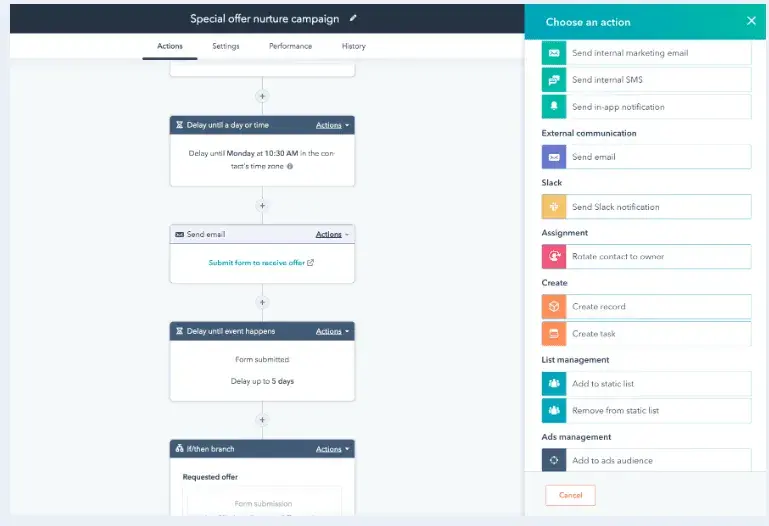
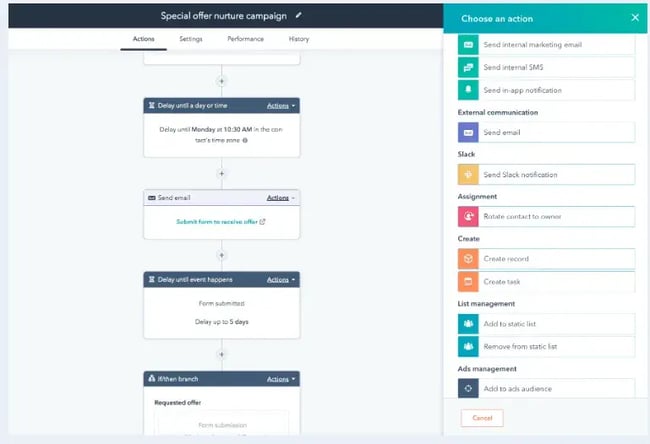
- Automated Follow-up Sequences: Insurance sales often require multiple touchpoints over extended periods. CRM automation enables agencies to set up scheduled communication sequences and task reminders, ensuring prospects remain engaged without constant manual effort. For example, a system can automatically send a quote follow-up email three days after delivery, schedule a check-in call reminder two weeks later, and deploy a final email after 30 days, optimizing conversion rates.
- Proactive Renewal Workflow Management: Given that the average insurance retention rate hovers around 84%, with top agencies achieving over 90%, robust renewal management is vital. CRMs track policy expiration dates and automatically trigger multi-stage renewal campaigns, starting with a retention call 90 days out, followed by re-engagement checks, and finally, paperwork reminders closer to the expiration date.
- Comprehensive Reporting and Pipeline Visibility: Agency owners and managers require insightful data to make informed strategic decisions. CRM reporting dashboards offer real-time visibility into agent performance, conversion rates at various pipeline stages, lead sources, and carrier-specific success metrics. This data enables managers to identify trends, support struggling agents, and reward top performers, driving continuous improvement. AI-powered analyses, such as predictive scoring, further assist agents in prioritizing outreach and forecasting revenue accurately.
- AI-powered Outreach and Automation: Artificial intelligence is rapidly transforming CRM capabilities. AI in an insurance CRM can summarize conversations, draft personalized outreach messages, and automatically trigger sequences based on detected cross-sell opportunities or upcoming renewals. This reduces manual workload, enhances personalization, and ensures timely communication.
Leading CRMs for Insurance Companies: A 2026 Perspective
The market for insurance-specific CRMs is dynamic, with several platforms offering robust solutions tailored to diverse agency needs. Based on G2 ratings, user reviews, pricing structures, and specialized features, the following five CRMs are poised to lead the market in 2026:
-
HubSpot CRM:
- G2 Rating: 4.4/5 with 35,739 reviews.
- Key Features: Unified customer records and inbox, comprehensive lead management (tracking, routing, enrichment), intuitive pipeline management, robust reporting dashboards, extensive AI-powered automation across marketing, sales, and service.
- Starting Price: Free tier available; paid tiers start at $20/month.
- Best For: Growing agencies and small to mid-sized brokerages seeking an all-in-one platform for marketing, sales, and service, with scalability.
- Analysis: HubSpot’s strength lies in its integrated platform approach, allowing agencies to start with free CRM tools and expand with Marketing, Sales, or Service Hubs as they grow. Its user-friendly interface and vast marketplace for integrations make it highly adaptable. BISA Seguros, a Bolivian insurer, significantly improved response times and customer service by digitizing operations with HubSpot, leveraging its Email Marketing and Workflows for automated communication and gaining better pipeline visibility.
-
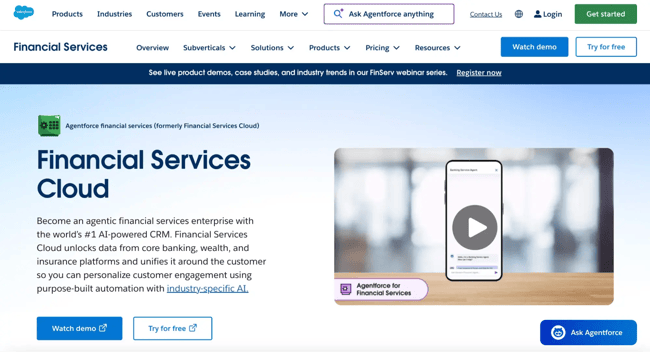
Agentforce Financial Services (formerly Salesforce Financial Services Cloud):
- G2 Rating: 4.3/5 with 226 reviews.
- Key Features: Deeply integrated insurance-specific data models, advanced AI-powered automation, 360-degree client view encompassing policies, claims, and interactions, extensive integration with carrier systems via prebuilt APIs, robust compliance features.
- Starting Price: Starting at $325/user/month.
- Best For: Large enterprises and complex agencies with dedicated IT resources and substantial implementation budgets.
- Analysis: Agentforce Financial Services is built for the intricate needs of large financial institutions. Its prebuilt data model for households, policies, and relationship hierarchies, coupled with sophisticated customization capabilities, makes it ideal for managing complex commission structures, multi-carrier relationships, and stringent regulatory requirements. Implementation can be resource-intensive, often requiring certified consultants.
-
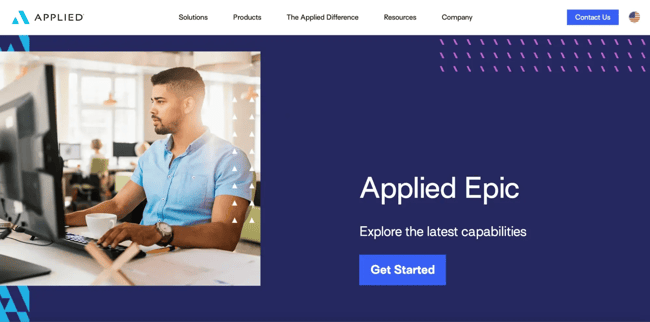
Applied Epic:
- G2 Rating: 4.4/5 with 1,571 reviews.
- Key Features: Combined AMS and CRM functionalities, comprehensive workflow automation, extensive carrier connectivity, mobile access, integrated accounting and commission management, document management.
- Starting Price: Custom quote.
- Best For: Mid-size to large Property & Casualty (P&C) and Benefits agencies, particularly those with complex commercial lines books and multiple locations, needing an integrated AMS and CRM solution.
- Analysis: Applied Epic is a market leader for agencies seeking a robust, all-in-one solution. While users praise its efficiency, data management, and organizational capabilities, it typically involves a steeper learning curve and a longer implementation period (averaging five months). Its strength lies in its comprehensive integration of core agency operations.
-
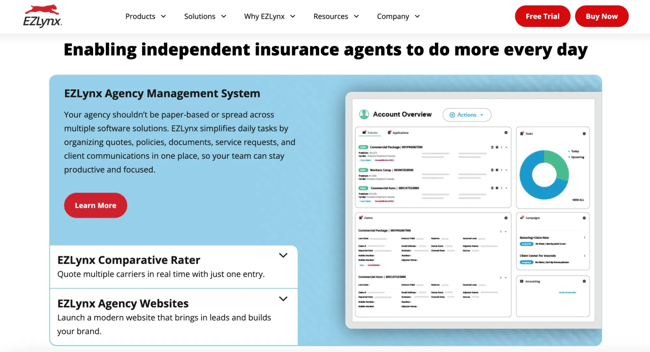
EZLynx:
- G2 Rating: 4.4/5 with 716 reviews.
- Key Features: Integrated comparative rater, policy management with daily carrier downloads, automation tools for renewals and remarketing, robust document management, multi-channel communication center (email and SMS), AI-assisted note-taking, strong integrations with various insurance technologies.
- Starting Price: Custom quote.
- Best For: Independent P&C agencies primarily focused on personal lines, seeking a unified platform for rating, CRM, and agency management.
- Analysis: EZLynx excels in its seamless integration of a comparative rater with CRM and AMS features, making it highly efficient for personal lines agents. Users appreciate its intuitive interface and quick implementation. While powerful for P&C, agencies dealing with life, health, or Medicare may need supplementary quoting tools.
-
Vertafore AMS360:
- G2 Rating: 4.3/5 with 949 reviews.
- Key Features: Built-in AMS with CRM functionalities, QQCatalyst for quoting, PL Rating for real-time personal lines quotes, comprehensive compliance tools and carrier connectivity, advanced document management, AI-powered workflows for back-office automation (e.g., email agent, reconciliation agent).
- Starting Price: Custom quote.
- Best For: Established agencies already within the broader Vertafore product ecosystem, needing a comprehensive AMS with integrated CRM capabilities.
- Analysis: AMS360 is a powerful system, particularly for agencies requiring deep integration within the Vertafore suite of products. Its innovative AI-powered features, such as an email agent that summarizes incoming emails and triggers workflows, and a reconciliation agent that automates commission processing, stand out. It offers a robust solution for complex agency operations.
Strategic Selection: Choosing the Right CRM for Your Insurance Agency
The decision to adopt a new CRM is a significant investment, and selecting the wrong platform can be costly in terms of time, resources, and missed opportunities. Agencies should follow a structured framework for comparison and selection:
- Identify Core Business Needs and Goals: Begin by clearly defining the specific problems the CRM is intended to solve. Is it improving lead conversion, boosting retention, streamlining administrative tasks, or enhancing reporting? Set measurable goals, such as increasing renewal rates by X% or reducing quote-to-cash time by Y days. Simultaneously, establish a realistic budget, considering not just licensing fees but also implementation, training, and potential integration costs.
- Gather Feedback from All Potential Users: A successful CRM adoption hinges on user acceptance. Engage all stakeholders – sales agents, brokers, customer service representatives, marketing teams, and back-office staff – to understand their daily pain points and desired functionalities. Sales agents might prioritize easy quote tracking, while managers need pipeline visibility and performance dashboards.
- Compile a Detailed Feature List: Based on internal feedback, create a comprehensive list of "must-have" and "nice-to-have" features. This should include insurance-specific data fields, integration requirements, automation capabilities, mobile access, reporting granularity, and AI functionalities.
- Thoroughly Compare Different CRM Companies: Research shortlisted solutions in depth, analyzing their capabilities, pricing models, and vendor support. It’s crucial to calculate the Total Cost of Ownership (TCO), as onboarding fees, per-module pricing, and required add-ons can significantly inflate the advertised monthly cost. Engage with peer agencies for their experiences and request customer references from vendors.
- Request Demos with Real Agency Scenarios: Narrow down the options to two or three top contenders and request personalized demonstrations. Crucially, ask vendors to showcase workflows using your agency’s specific data and scenarios. This hands-on approach reveals how the system performs in real-world conditions, from the quote-to-bind process to renewal campaigns and cross-sell workflows.
- Plan for Implementation and User Adoption: Once a CRM is selected, a structured implementation plan is vital. This involves creating user profiles, conducting comprehensive onboarding training, and walking users through their initial workflows. Appoint an internal "CRM Champion" to provide ongoing support, answer questions, and encourage consistent system usage. Remember, a CRM’s effectiveness is directly proportional to the quality of its user input and consistent adoption.
The Dual Approach: CRM and AMS Synergy for Optimal Performance
For most insurance agencies, particularly those experiencing growth, the ideal technological setup involves both a CRM and an AMS. While a CRM excels at managing the front-office sales process, lead nurturing, and customer communication, an AMS remains critical for back-office policy administration, commission tracking, accounting, and official record-keeping. These systems are complementary: the CRM drives new business and enhances customer relationships, while the AMS ensures the efficient and compliant servicing of those policies. Agencies that effectively integrate their CRM and AMS achieve a holistic view of their business, from initial prospect engagement to long-term policy management.
Navigating Implementation and Data Migration
CRM implementation timelines can vary significantly, from a few weeks for basic setups to several months for complex integrations and customizations. A phased approach is often recommended. Data migration, in particular, requires meticulous planning. Agencies should begin by cleaning up duplicate or outdated contact records in existing systems. Thoroughly mapping old data fields to new CRM fields is essential to ensure data integrity. Testing the migration with a small dataset before a full rollout can preempt many potential issues, ensuring a smoother transition and minimizing disruption.
Empowering Solo Agents and Small Agencies
The benefits of CRM extend powerfully to solo agents and small agencies, often disproportionately. Automation features handle routine tasks like follow-up emails, lead routing, and renewal reminders, freeing up lean teams to focus on client interaction and closing deals. Many CRMs, including HubSpot, offer free tiers or affordable plans that provide essential functionalities, allowing smaller entities to experience the benefits of digital organization and automation before committing to advanced features.
The Future of Insurance: Relationship-Driven and Digitally Powered
As the insurance industry continues its rapid digital evolution, the role of specialized CRM systems will only grow in prominence. Agencies that cling to legacy systems and manual processes risk being outpaced by more agile, tech-forward competitors. Beyond operational efficiency, a robust CRM ensures that an agency’s most valuable asset – its customer relationships and data – is meticulously managed, accessible, and leveraged for growth. As CJ Hutsenpillar aptly warned, disorganized data can even diminish an agency’s valuation should the business ever be considered for sale. Investing in a tailored insurance CRM is not merely an upgrade; it is a strategic imperative for future-proofing an agency, driving profitability, and fostering enduring customer loyalty in a perpetually evolving market.


 Nana
Nana
 Laily UPN